
FINANCE
Trump Bank Order Pushes Migrant Cash Toward Stablecoins

Trump immigration bank order signed May 19 could send more migrant money toward stablecoins and Bitcoin ATMs by making bank access feel conditional. The directive stops short of a blanket citizenship check, but it tells Treasury and federal bank regulators to tighten customer due-diligence rules and let banks seek immigration or work-authorization details when risk indicators warrant it.
Banks now have to price the compliance risk. Crypto firms can read a different signal: anxious cash, wages and remittances that still need somewhere to go if account holders begin treating the branch as another immigration checkpoint. That second-order shift carries a fraud and consumer-protection bill the order barely confronts.
The Order Puts Status Into a Risk File
The core text of the May 19 executive order is narrower than the fear around it. It does not tell banks to purge customers. It tells the Treasury Department, the federal finance agency that oversees illicit-finance policy, to work with bank regulators on changes to the Bank Secrecy Act (BSA, the anti-money-laundering law that sets identity and reporting duties for financial firms).
The timetable matters. Treasury has 90 days from the order to propose changes to customer due-diligence rules, which points to August 17, 2026. Regulators have 180 days to consider changes to bank customer identification program rules, which points to November 15, 2026. The Consumer Financial Protection Bureau, the federal consumer finance watchdog, was given 60 days to consider credit guidance tied to potential deportation and wage loss.
The politically explosive line allows banks, when other risk signals exist, to obtain information relevant to lawful immigration status and employment authorization. That wording makes immigration status part of a risk file, not a universal account-opening field. Still, compliance systems rarely wait for final rules when the White House has named a risk so plainly.
That is where stablecoins enter. If a customer thinks a bank may ask for papers later, the customer may move money before the bank asks. The order can change behavior before any regulator writes a final rule.
The ID Rule Leaves More Room Than Politics Suggests
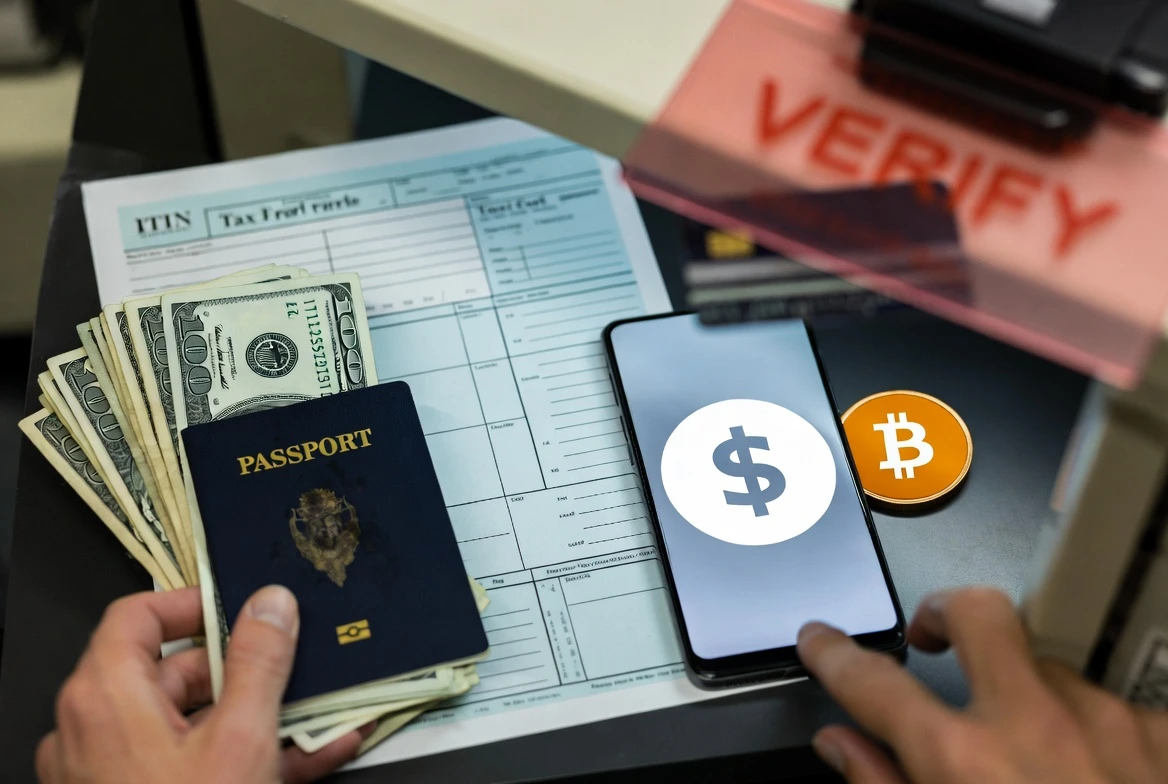
Current bank identity rules already give institutions room to verify people who are not U.S. citizens. Under 31 CFR 1020.220 customer identification rules, banks must collect identifying information and verify identity with risk-based procedures. For a non-U.S. person, the rule allows a taxpayer identification number, passport details, an alien identification card number or another government-issued document showing nationality or residence with a photograph or similar safeguard.
That existing flexibility is why the order’s reference to foreign consular identification cards is so important. It points regulators toward documents many immigrants use when they do not have a U.S. driver’s license or Social Security number. A tighter rule could hit ordinary account access in three practical places:
- New accounts – banks may require more documents before opening checking, savings or prepaid accounts.
- Account reviews – existing customers may face follow-up requests if activity triggers risk alerts.
- Credit products – lenders may treat lack of work authorization as part of ability-to-repay analysis.
- Branch discretion – frontline staff may apply conservative standards before compliance teams settle the policy.
The legal change may arrive through technical manuals and suspicious-activity guidance. The social effect is simpler: people who cannot predict the next document request may stop using the account.
The Remittance Corridor Gives Crypto Its Opening
Pew Research Center, a nonpartisan research organization, estimated that a record 14 million unauthorized immigrants lived in the United States in 2023, the most recent year for its detailed estimate. Pew also estimated 9.7 million unauthorized immigrants were in the U.S. workforce that year, so the affected population is tied directly to wages, bill payments and money sent abroad through Pew’s unauthorized-immigrant analysis.
- 14 million – Pew’s estimate of unauthorized immigrants living in the United States in 2023.
- 9.7 million – Pew’s estimate of unauthorized immigrants in the U.S. labor force that year.
- 16.1% – the share of foreign-born noncitizen households using nonbank international remittances in the 2023 FDIC survey.
- 6.36% – the global average cost of sending remittances in World Bank data updated in 2025.
The FDIC, the federal deposit insurance agency, found in its 2023 unbanked and underbanked survey that foreign-born noncitizen households were more than ten times as likely as U.S.-born households to send or receive nonbank international remittances. That does not mean all of those households lack lawful status. It does show that cross-border money movement is much more central for the population likely to feel the order first.
Cost creates the opening. The World Bank remittance price database says sending money globally still costs 6.36% on average. Stablecoin companies do not need to win a philosophical argument about decentralization. They only need to make the next transfer feel cheaper, faster or less exposed than the bank counter.
Four Money Routes Face Different Breakpoints
The order’s impact depends on which money route a household uses. A bank account is useful because it connects payroll, debit cards, rent and mainstream remittance services. A stablecoin wallet may move value quickly, but the user still needs an on-ramp to buy tokens and an off-ramp for the recipient to get local currency.
| Route | Typical Access Point | Consumer Protection | Order Pressure |
|---|---|---|---|
| Bank account plus remittance provider | Branch, app or payroll deposit | High, including regulated disclosures and account records | Higher ID review and possible account friction |
| Licensed money transmitter | Retail counter or transfer app | Moderate to high, depending on product and corridor | More monitoring if funding source becomes cash-heavy |
| Stablecoin wallet | Exchange, wallet app or peer transfer | Uneven, with custody and fraud risk varying by provider | Demand could rise if bank trust falls |
| Bitcoin ATM | Convenience store, gas station or kiosk | Low for mistaken transfers and scam payments | Fraud scrutiny and state restrictions are rising |
| Informal cash broker | Personal network or unlicensed courier | Lowest, with little paper trail or dispute path | May gain users if formal access narrows |
Regulated remittance transfers have a protection crypto users often do not think about until it is gone. Under the CFPB remittance cancellation rule, providers generally must honor a cancellation request received within 30 minutes after payment, unless the funds have already been picked up or deposited. A self-custodied crypto transfer sent to the wrong wallet has no branch manager and no built-in undo button.
Bitcoin ATMs Are a Weak On-Ramp for This Moment
Bitcoin ATMs look like the obvious winner because they turn cash into crypto without a bank lobby. The problem is that this part of the market is already under regulatory and fraud pressure. The Federal Trade Commission, the U.S. consumer protection agency, said consumer fraud losses involving Bitcoin ATM machines topped $65 million in just the first six months of 2024, with a median reported loss of $10,000 across all ages in its Bitcoin ATM scam data.
FinCEN, Treasury’s financial-crimes bureau, followed with a 2025 notice urging financial institutions to watch for suspicious activity involving convertible virtual currency kiosks, a regulatory term for cash-to-crypto machines. The agency said kiosks can be convenient for consumers but are also used by scammers, cybercriminals and drug-trafficking groups in its CVC kiosk notice.
Then came a corporate warning from the sector itself. Bitcoin Depot, a U.S.-based Bitcoin ATM operator, announced May 18 that it had initiated voluntary Chapter 11 proceedings to wind down operations and sell assets. The company said its network had been taken offline and cited state restrictions, transaction limits, litigation and regulatory enforcement in its Chapter 11 announcement.
The company’s numbers had already cracked. Bitcoin Depot said revenue fell by 49.2% year over year in the first quarter, driven by regulatory impacts and enhanced compliance controls, in its May 12 SEC filing. That makes the kiosk route a strange beneficiary: demand may rise just as the largest operators lose scale.
Stablecoins Have the Better Business Case
Stablecoins are better placed than kiosks because the business case does not require a machine in a store. A worker can receive cash wages, buy digital dollars through a friend, exchange, app or broker, and send value abroad within minutes. The weak link shifts from physical access to compliance, custody and the final conversion into local currency.
The Federal Reserve, the U.S. central bank, has already described the attraction. A 2026 Fed note on payment stablecoins said cross-border payments are often slower, more expensive and less transparent than domestic payments because they pass through chains of correspondent banks. It also noted that Congress passed the Guiding and Establishing National Innovation for U.S. Stablecoins Act (GENIUS Act, the federal payment-stablecoin law) in 2025, creating a framework for dollar payment stablecoins backed by safer assets on a one-to-one basis in the Fed’s stablecoin payments note.
That framework helps the pitch. A regulated dollar token sounds less like a speculative coin and more like programmable cash. But the IMF, the global financial institution, warned that stablecoins can also aid money laundering, weaken capital controls and accelerate currency substitution in countries where residents prefer dollars to local money. The same feature that helps a migrant family move funds cheaply can make oversight harder across borders.
The Debanking Fight Now Cuts Both Ways
The order lands at an awkward time for banking regulators. On April 7, the FDIC and the Office of the Comptroller of the Currency, the national bank supervisor, issued a final rule removing reputation risk from their supervisory programs. The FDIC reputation-risk rule bars the agencies from pressuring banks to close accounts based on political, social, cultural or religious views, protected speech or lawful but politically disfavored business activity.
Crypto companies had spent years arguing that vague reputational concerns let regulators push banks away from lawful customers. Now the immigration order invites banks to consider a different kind of risk, tied to status, wage continuity, account ownership and repayment. The legal theory is not the same. The lived experience may feel similar to the person whose account suddenly needs more documents.
That tension helps explain why the stablecoin market could benefit even without a mass account-closure wave. People do not need to be formally debanked to diversify away from a bank. They only need to believe the bank may become unpredictable.
For the administration, the challenge is enforcement leakage. If a policy meant to bring more identity checks into regulated banking pushes cash into less supervised channels, the result may be more suspicious activity reports inside banks and less visibility outside them.
Banks Will Decide Before Regulators Finish Writing
The next moves belong less to crypto founders than to bank compliance departments. Large banks can add prompts, documentation requests and account-review rules with little public drama. Community banks may move more slowly, but they also have less room to absorb examiner criticism if immigration-linked risk becomes part of BSA supervision.
Stablecoin providers will respond with the language of access: cheaper transfers, faster settlement, digital dollars for people left out of banks. They will be careful not to market directly as a way around immigration scrutiny, because that would invite the same regulators now studying the banks. The pitch will be softer. More inclusion, less paperwork, more control.
The hardest cases will sit in the middle: workers with temporary protections, people with pending asylum claims, households with mixed immigration statuses, and customers who have valid foreign documents but limited U.S. paperwork. The order groups risk around unlawful activity, but branch staff and automated systems can turn messy categories into blunt yes-or-no outcomes.
If banks treat the order as a narrow fraud-control instruction, stablecoins get a talking point. If branches respond by making status feel like a condition of ordinary money movement, crypto gets something more valuable: customers who did not plan to leave the bank until the bank started asking new questions.
Disclaimer: This article is for informational purposes only and does not provide financial, legal or immigration advice. Crypto transfers, stablecoins and Bitcoin ATMs carry fraud, loss, compliance and custody risks. Readers should consult qualified financial, legal or immigration professionals before acting, and figures are accurate as of publication.

-
 TECH1 year ago
Where Garmin Watches are Made and How They are Assembled
-

 AUTO2 months ago
Tesla’s Roadster Is ‘a Few Weeks Away,’ Says Its Chief Designer
-
 NEWS10 years ago
Samsung Releases Galaxy Note7 TV Ad as Reddit AMA Leaks Specs
-
 NEWS10 years ago
Android 7.0 Nougat Rolls Out To Nexus Devices With New Emoji, Features
-
 FINANCE9 years ago
Cardano Price Surges as ADA Enters the Crypto Top Ten List
-
 NEWS10 years ago
Pre-Order the First Camera Made for Facebook Live Streaming Video
-
 FINANCE1 year ago
Binance Suspends Trading and Withdrawals for a System Upgrade
-
 FINANCE9 years ago
RChain Price Jumps Nearly 150% to a New All-Time High of $2.03