
NEWS
Shenzhou-23 Visit Plan Puts Hong Kong’s Space Bet in View

The Shenzhou-23 Hong Kong visit plan now points to the first half of 2027, but the bigger story is a policy shift: Hong Kong is trying to turn Lai Ka-ying, its first payload specialist in space, from a civic milestone into a working pipeline for payloads, labs and space manufacturing.
Sun Dong, Hong Kong’s secretary for innovation, technology and industry, said on a Sunday television programme that the city had asked mainland authorities to arrange a crew visit after the astronauts return. The same remarks also put a new research centre for space manufacturing on the table, which is why the homecoming matters beyond the ceremony.
A Visit Request Became a Policy Signal
A post-mission visit would give Hong Kong the public moment it has been waiting for since the Shenzhou-23 launch. Schools would get the astronaut encounter. Officials would get the stage. Families would get a local proof point that a Hong Kong researcher can pass through the national training system and reach orbit.
That stage has been built fast. The Hong Kong government said the Long March 2F Y23 rocket carrying the crewed spacecraft launched at 11:08 p.m. on May 24 from Jiuquan Satellite Launch Center, then separated from the rocket and entered its planned orbit, according to the Hong Kong launch statement.
All citizens of Hong Kong are thrilled and proud.
John Lee, Hong Kong’s chief executive, used that line in the government’s launch statement. Pride is the easy part. The harder test is whether the city can convert **first half of 2027** attention into repeatable scientific work, because a one-off astronaut parade would fade faster than the laboratory projects now being attached to it.
Lai Ka-ying Turns the Symbol Into Flight Work
The China Manned Space Agency (CMSA, the agency that runs China’s crewed space programme) named Zhu Yangzhu, Zhang Zhiyuan and Lai to the mission. Its pre-launch briefing described the flight as the seventh crewed mission in the application and development phase of the China space station and the 40th flight of the national crewed programme, according to the Shenzhou-23 mission briefing.
| Crew Member | Mission Role | Signal Sent |
|---|---|---|
| Zhu Yangzhu | Commander and flight engineer | A third-batch astronaut leads the crew after flying on Shenzhou-16. |
| Zhang Zhiyuan | Spacecraft pilot | A first-time flier fills the piloting role after an air force background. |
| Lai Ka-ying | Payload specialist | Hong Kong’s researcher route now reaches the station itself. |
That crew mix matters because payload specialists are judged by the work they can perform once the launch camera moves on. Lai, a Hong Kong Police Force superintendent with a doctorate in computer forensics, was selected from the fourth batch of astronauts and trained for science operations, station management, spacecraft systems and robotic arm work.
The agency said one member of the crew will carry out a one-year in-orbit stay, with the astronaut to be decided later based on mission conditions. That adds weight to Shenzhou-23 as a science platform, not just a rotation flight with a historic passenger.
The Payload Puts Hong Kong on the Station Bench
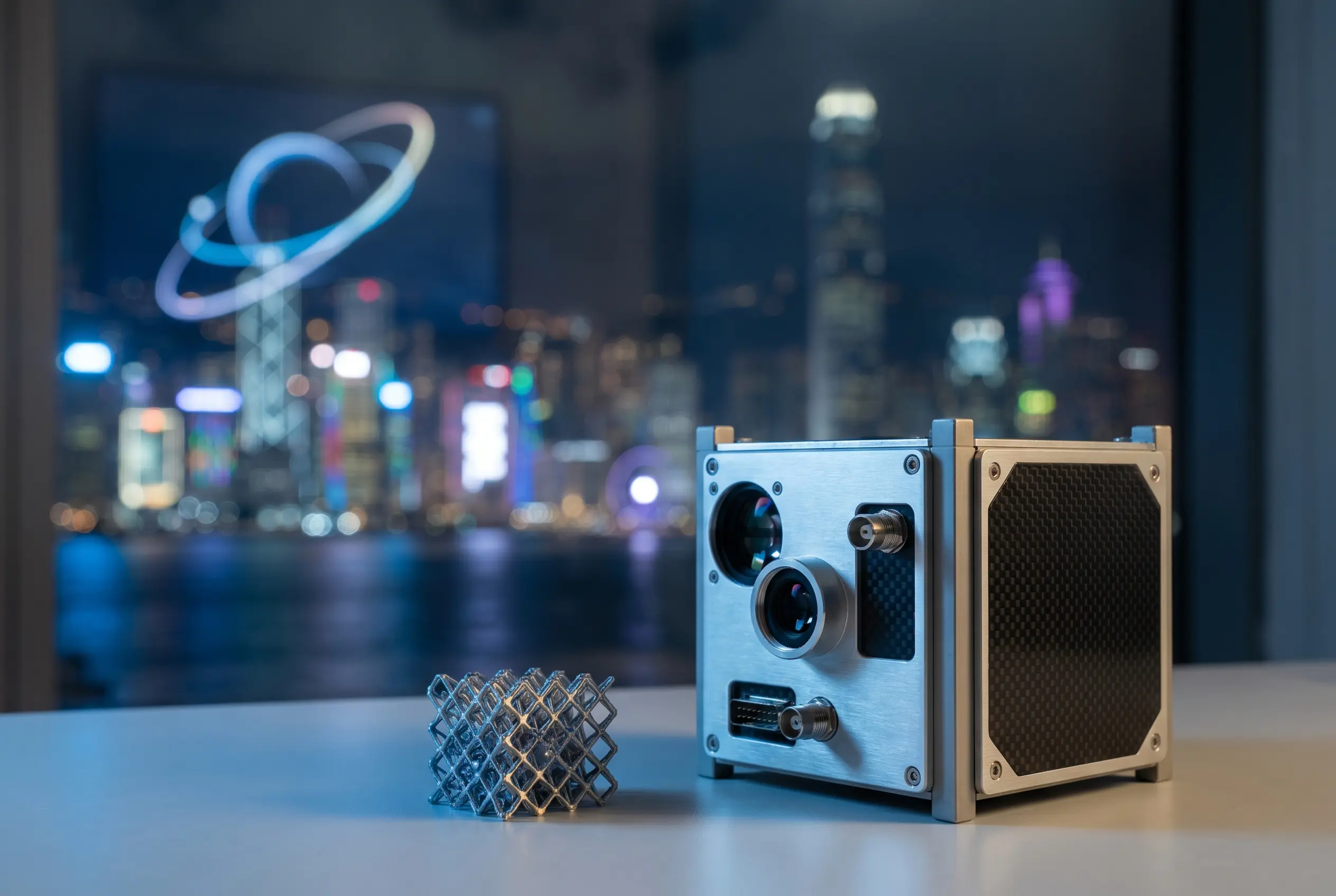
Payload work is where Hong Kong can measure its role with something firmer than applause. The Hong Kong University of Science and Technology (HKUST) says its Multi-Spectral Imaging Carbon Observatory (MUSICO, a compact greenhouse-gas detector for orbit) reached Tiangong on the Tianzhou-10 cargo spacecraft. The university calls it Hong Kong’s first scientific payload on the national space station.
The device targets carbon dioxide (CO2) and methane (CH4), two major greenhouse gases. HKUST says the instrument weighs less than 80 kg, carries four optical sensors and can monitor point sources such as power plants and landfills from low to mid-latitude regions, according to the MUSICO payload description.
That is the cleanest answer to a common question about Lai’s role. A payload specialist is not along for the ride. The job exists because the station has experiments that need trained operators who understand instruments, data and failure modes.
Hong Kong’s space pitch now has two halves. One is human: a Cantonese-speaking scientist from the city in orbit. The other is technical: an instrument that can feed climate data to research teams and public agencies. The second half will be harder to celebrate, but it is the part that can survive long after the visit photos are archived.
Space Manufacturing Raises the Stakes
Sun’s reference to a space manufacturing research centre fits a wider Hong Kong shift toward advanced manufacturing, materials and energy research. In March, the Innovation and Technology Commission said eight proposals had been approved for SEAM@InnoHK, the third research cluster under InnoHK, with government funding support of around HK$2.5 billion, about US$320 million using the Hong Kong dollar’s linked exchange band, according to the SEAM@InnoHK funding announcement.
For readers who do not follow orbital engineering, space manufacturing means making, assembling, inspecting or repairing equipment in orbit rather than launching every finished part from Earth. The idea is still difficult. Yet it is no longer science fiction. The European Space Agency said its metal printer produced the first metal part on the International Space Station in September 2024, calling it a step for crew autonomy on long-duration missions in the ESA metal printing announcement.
- HK$2.5 billion – the funding envelope announced for SEAM@InnoHK’s approved proposals.
- More than 100 – the new science and application projects CMSA said the crew will carry out during the mission.
- One year – the planned long-duration stay by one astronaut on this flight.
- Less than 80 kg – HKUST’s stated mass for the MUSICO payload model.
The risk for Hong Kong is over-claiming. A research centre can study 3D printing, artificial intelligence (AI, software that can model and optimize processes) and assembly methods. It cannot instantly create a space industry. The value comes if universities, government labs and mainland mission planners keep handing Hong Kong tasks with deadlines, flight rules and hardware consequences.
The Talent Pipeline Predates the Launch
Lai’s selection did not appear from nowhere. In October 2022, the Hong Kong government opened local preliminary screening for payload specialists as part of China’s fourth astronaut batch, giving permanent residents a route into the national crewed programme. The recruitment channels included 11 local universities, five government research and development centres, the Hong Kong Productivity Council, Science Park and Cyberport research institutions, government departments and the Hospital Authority, according to the Hong Kong payload specialist recruitment notice.
That list tells you what Beijing and Hong Kong were hunting for: researchers who could operate experiments, not celebrity envoys. It also explains why the coming visit, if it happens, should be treated as recruitment infrastructure.
- Candidate sourcing – universities, public research centres, Science Park, Cyberport and government departments widened the pool beyond one institution.
- Selection rounds – candidates moved through preliminary screening, a second round and a final round before astronaut training.
- Mission fit – payload specialists are defined by scientific and applied research in space stations.
For Hong Kong students, that is a useful message. The route to space did not begin with a rocket. It began with labs, screening, exams, physical standards, language, discipline and years of technical training.
The city now has a name to attach to that route. The next question is whether it can build enough projects for the second and third names to follow.
The Hard Part Comes After the Homecoming
The proposed visit has obvious political value. It would let Hong Kong place Lai beside students, teachers and researchers, then present the mission as a local contribution to China’s space programme. That is exactly why the event should be judged by what it leaves behind.
A strong version would connect the crew visit to school laboratories, university fellowships, payload design contests and open briefings on the MUSICO data stream. A weak version would produce speeches, banners and a few carefully managed appearances. The same astronauts could be used either way.
Space manufacturing raises a similar test. If the new centre wins flight-linked projects, publishes useful results and feeds talent into national missions, Sun’s announcement will look timely. If it becomes another branded lab with vague targets, the Shenzhou-23 glow will only make the gap more visible.
Hong Kong has advantages that are easy to list: strong universities, international research partners, advanced instrumentation skills and a public suddenly paying attention. It also has constraints: limited industrial depth in aerospace hardware, reliance on national mission access and a need to prove that local research can meet flight-grade requirements.
If the astronauts walk into a Hong Kong hall in the first half of 2027, the applause will be earned. What matters next is whether students see a path from that hall to a clean room, a payload bench and eventually a flight manifest.

-
 TECH1 year ago
Where Garmin Watches are Made and How They are Assembled
-
 AUTO2 months ago
Tesla’s Roadster Is ‘a Few Weeks Away,’ Says Its Chief Designer
-
 NEWS10 years ago
Samsung Releases Galaxy Note7 TV Ad as Reddit AMA Leaks Specs
-
 NEWS10 years ago
Android 7.0 Nougat Rolls Out To Nexus Devices With New Emoji, Features
-
 FINANCE9 years ago
Cardano Price Surges as ADA Enters the Crypto Top Ten List
-
 NEWS10 years ago
Pre-Order the First Camera Made for Facebook Live Streaming Video
-
 FINANCE1 year ago
Binance Suspends Trading and Withdrawals for a System Upgrade
-
 FINANCE9 years ago
RChain Price Jumps Nearly 150% to a New All-Time High of $2.03