
NEWS
Operation Condor: 1st Cavalry’s 400-Drone Sensor Fusion Test

The U.S. Army’s 1st Cavalry Division spent late April 2026 pushing more than 400 unmanned aerial systems into the skies above a Bavarian forest range, all of them feeding a single live picture of the battlefield to commanders sitting half a world apart. The drill, codenamed Operation Condor, ran inside exercise Combined Resolve 26-07 at the Joint Multinational Readiness Center in Hohenfels, Germany. It was the first Combat Training Center rotation to combine forward unmanned sensing zones, tactical-edge fusion, and reach-back to both III Armored Corps and V Corps simultaneously.
Operation Condor Lights Up the Bavarian Forest
The drill ran during the 1st Cavalry Division’s nine-month rotation under Operation Atlantic Resolve, which placed Greywolf troopers across Poland, Lithuania, and Estonia from August 2025 onward. Inside Combined Resolve 26-07, the 3rd Armored Brigade Combat Team served as main effort. On April 24, 2026, soldiers from the 3rd Brigade Engineer Battalion ran patrols and counter-UAS sweeps at the Amberg training site as part of 7th Army Training Command imagery from the Combined Resolve 26-07 counter-UAS lane.
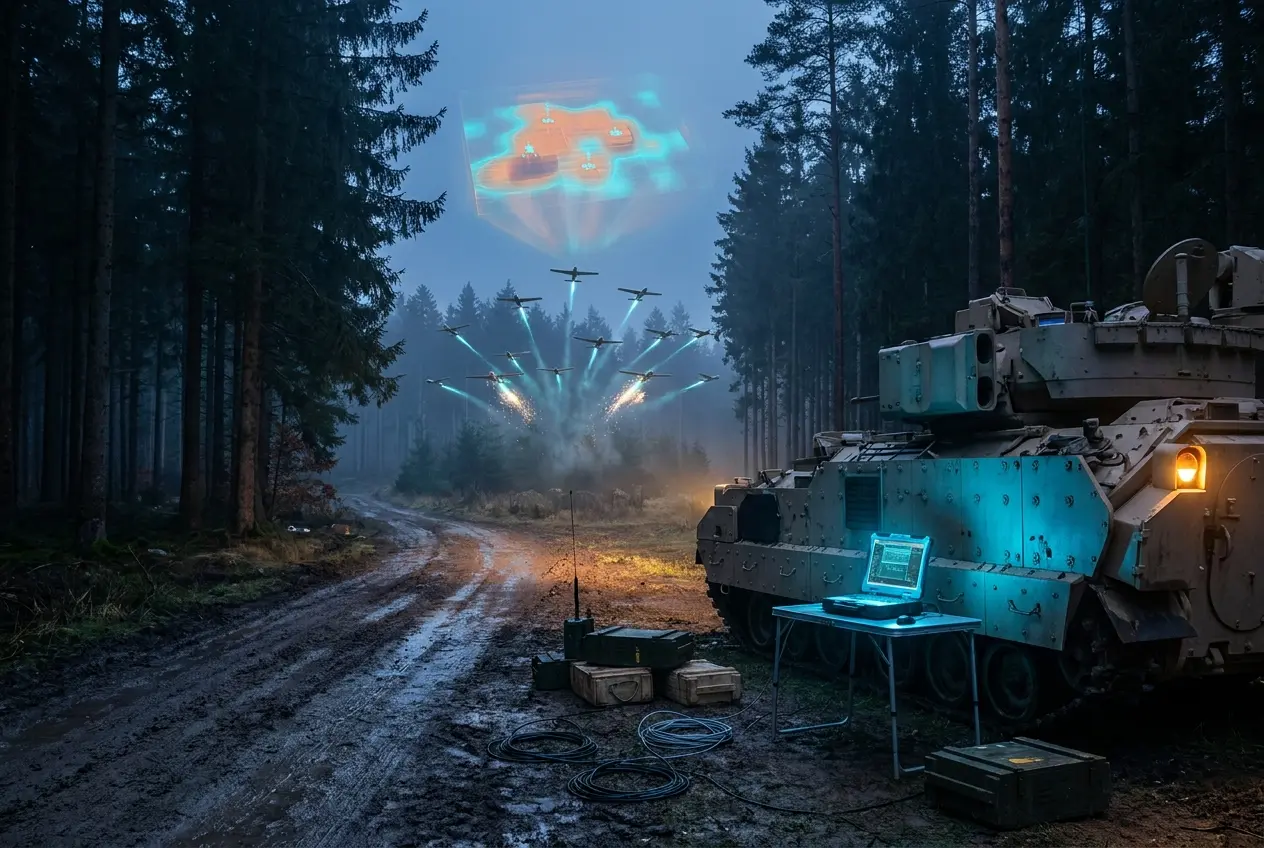
What set Operation Condor apart from a standard rotation was its sensing wave concept. The 1st Cavalry Division ran the drill as a wave-based warfare experiment, where the initial sensing wave drives every follow-on action. Acoustic, radio frequency, radar, and infrared feeds were fused at the tactical edge before traveling up to a brigade or corps S2.
That sequence is what the Army has been chasing across Project Convergence Capstone 5 and the broader Next Generation Command and Control program described in the Army’s NGC2 at the tactical edge feature on predictive logistics for decision dominance. Operation Condor moved the concept off a slide deck and into a Combat Training Center rotation.
A Brigade That Wasn’t Supposed to Lead the Wave
The 3rd Brigade is not one of the Army’s designated Transformation in Contact formations. Those brigades, which the service has been re-equipping with cheap drones and edge software since 2024, were the obvious candidates to run a sensor-fusion drill of this scale. Instead, the experiment landed on Greywolf, a heavy armored brigade built around Abrams tanks and Bradley fighting vehicles.
The unit answered with volume. More than 400 unmanned aerial systems flew across six commands during the rotation, the largest drone footprint a single armored brigade has ever put up at JMRC. By comparison, the active-duty mobile brigade combat teams the Army is standing up under its broader Transformation Initiative are sized at roughly 1,900 soldiers each, around 2,600 fewer than the legacy infantry brigades they replace.
Col. Michael E. Ziegelhofer, who commands the 3rd ABCT, framed the drill as a data problem more than a hardware problem. “New technology presents new data problem, understanding how the data is transferred, where it goes, and how we collect it in one place and make sense of it,” he said. “At the end state, the data is only good if we can deliver the right information to the commander to make better and faster decisions than the enemy.”
Greywolf brought roughly 3,000 troopers and 1,000 pieces of equipment across the Atlantic last summer for the rotation, which is part of why a non-TiC brigade ended up carrying the experiment.
| Posture | Mobile BCT (TiC) | 3rd ABCT (Non-TiC) |
|---|---|---|
| Doctrine | Light, mobile, drone-native | Heavy armor, Abrams plus Bradley |
| End-strength | About 1,900 soldiers | About 4,500 soldiers |
| Drone integration | Built into the org chart | Bolted on for Operation Condor |
| Combined Resolve role | Supporting | Main effort |
Fusing Sensors Before Humans Touch the Data
Tactical edge fusion is the technical heart of Operation Condor. Acoustic, RF, radar, and infrared feeds are pulled together at the collection point, processed by automated analytics, and only then pushed to an intelligence soldier or a commander. The point is to keep bandwidth-hungry raw video and signal data off the network entirely, an idea explored in the Warrant Officer Journal essay on operationalizing AI at the tactical edge published in March 2026.
The numbers from the rotation tell the story.
- 400-plus unmanned aerial systems airborne across six separate commands during the drill.
- Four sensor types fused at the edge: acoustic, radio frequency, radar, and infrared.
- 5 to 15 km, the reach of forward-based loitering effects beyond the friendly line of troops.
- Near real time push of fused product to III Armored Corps and V Corps.
From Acoustic Detection to a Strike in Minutes
The vignette the brigade ran most often started with an acoustic sensor. The sensor flags an enemy formation, an unmanned aerial system flies over to confirm the target, and then an unmanned ground vehicle pushes a forward-based effect downrange. Artillery never moves. Friendly positions stay dark on the enemy’s RF picture. The enemy formation is gone before it knows it has been seen.
Another vignette took the same shape but added an electronic warfare cue at the front end. Ziegelhofer described the sequence in detail to reporters at Hohenfels.
“We did some collective training events where we had electronic warfare capabilities out there detecting ground control stations with the drones, relaying the message where those are to someone else on the team who flies the drone over to validate the ground station is there with visual confirmation, and then call that back into the fire architecture to deliver effects and destroy that station,” he said.
The flow is what the Army calls a sensor-to-shooter timeline. Operation Condor’s claim is that fusing data at the collection point shaves minutes off that timeline because the brigade’s intelligence cell never has to integrate raw feeds by hand. Automated analytics do that work first.
Hiding On a Transparent Battlefield
The harder problem is what 1st Battalion, 4th Infantry Regiment is wrestling with: how a maneuver force survives when the same sensor saturation that helps it also exposes it. Lt. Col. Michael Andrew Cryer, the battalion commander, put the dilemma plainly to reporters at Hohenfels.
We need to preserve the option for offensive maneuver; how do we do that when there is a transparent battlefield that’s the problem set right now. You can be seen at anytime, anywhere, and it’s nearly impossible to hide.
The brigade’s answer is passive-first detection. The sensors lean on listening, not radiating. Acoustic and RF sensing leave a much smaller electromagnetic footprint than active radar, which lets the brigade build a picture of enemy formations without painting itself in return.
Network resilience folds in here too. The brigade’s evaluation framework explicitly tests whether the fusion architecture survives jammed bandwidth, denied GPS, and partial network outages, the exact set of conditions Russian electronic warfare units are running in Ukraine.
The Reach-Back to INDOPACOM and CENTCOM
Sensor feeds from Hohenfels do not stop at the brigade S2. They also push back to III Armored Corps, which uses them to build predictive heat maps that commanders inside V Corps in Europe and other combatant commands can pull on demand, building on the V Corps work captured in the Army’s Eastern Flank Deterrence Initiative announcement on V Corps’ 21st century defense.
That is where the multi-corps part of the experiment lives. The pipe runs to three combatant commands at once.
- EUCOM: V Corps planners in Wiesbaden see the same fused picture Greywolf’s sensors are producing in Bavaria.
- INDOPACOM: Pacific theater staffs pull predictive heat maps to study how a transparent battlefield translates to maritime and littoral terrain.
- CENTCOM: Middle East planners use the same architecture to model adversary RF and acoustic signatures in arid environments.
The PhantomX Pipeline Powering the Drill
Operation Condor did not appear out of nowhere. It is the field expression of an innovation effort III Armored Corps formalized at Fort Hood in early 2026, the Phantom Experimentation Laboratory, or PhantomX. The corps positions PhantomX as an umbrella for everything from advanced manufacturing to drone integration to AI tooling for command posts, as detailed in the Fort Hood announcement on the 2026 PhantomX innovation effort.
Inside that umbrella sits the 1st Cavalry Division’s own program, Pegasus Charge. In September 2025, the division ran the Army’s first armored-formation live fire of the Switchblade 600 loitering munition at Fort Hood, recorded in the Department of War announcement on the 1st Cavalry Division’s first Switchblade 600 live-fire exercise. That milestone fed directly into the kinds of forward-based effects Greywolf practiced in Bavaria.
The munition itself helps explain why the sensor-to-shooter chain matters. The Switchblade 600 has a flight endurance of 40 to 45 minutes, a 27-mile range, a 5-pound anti-armor warhead, and engagement reach of 5 to 15 kilometers in front of friendly lines. The Army’s fiscal 2026 budget puts about $68 million toward the LASSO loitering-munition program that includes Switchblade 600, with five brigade combat teams’ worth of munitions in the request.
V Corps’ parallel work in Europe completes the picture. Through the Eastern Flank Deterrence Initiative, V Corps is building a layered network of U.S. and allied sensors across NATO’s eastern frontier, including Soldier-borne RF detectors fielded by the 2nd Cavalry Regiment. Operation Condor is the first drill that wires III Armored Corps’ technology pipeline into that European sensing layer end-to-end.
Frequently Asked Questions
What Is Operation Condor and When Did It Run?
Operation Condor is the sensor-fusion drill the 1st Cavalry Division ran inside exercise Combined Resolve 26-07 at the Joint Multinational Readiness Center in Hohenfels, Germany. The exercise’s main training events ran in late April 2026, including counter-UAS lanes on April 24. It is the first Combat Training Center rotation to combine forward unmanned sensing zones, tactical-edge fusion, and live reach-back to III Armored Corps and V Corps in one drill.
Why Is the 3rd Armored Brigade Combat Team Called Greywolf?
Greywolf is the historical nickname of the 3rd Brigade Combat Team of the 1st Cavalry Division, drawn from the unit’s lineage. The brigade is currently on a nine-month rotation under Operation Atlantic Resolve, with troopers spread across Poland, Lithuania, and Estonia. Greywolf is heavy armor built around Abrams tanks and Bradley fighting vehicles, which is why its drone-heavy posture in Operation Condor was a notable break from how armored brigades usually fight.
Is the 3rd Brigade Part of Transformation in Contact?
No. Transformation in Contact, or TiC, is the Army’s program for re-equipping select formations with low-cost drones, edge software, and lighter org charts while they continue operational missions. The 3rd Brigade is explicitly outside TiC, which is what makes its 400-plus UAS deployment during Operation Condor unusual: the architecture is being tested on a heavy armored unit rather than a designated experimental one.
What Is the Switchblade 600 and How Does It Fit Into Pegasus Charge?
The Switchblade 600 is a tube-launched loitering munition built by AeroVironment with electro-optical and infrared sensors, 40 to 45 minutes of flight endurance, a 27-mile range, and a 5-pound anti-armor warhead. The 1st Cavalry Division ran the Army’s first armored-formation live fire of the system in September 2025 under its Pegasus Charge program, which sits inside III Armored Corps’ wider PhantomX umbrella.
How Does Tactical-Edge Sensor Fusion Change the Sensor-to-Shooter Timeline?
Traditional sensor-to-shooter chains push raw acoustic, RF, radar, and infrared data up to an intelligence cell, where soldiers fuse the streams by hand before passing targets to fires. Tactical-edge fusion runs that integration on the sensor itself, using automated analytics and AI. The intelligence cell receives prioritized targets instead of raw feeds, which trims minutes from the kill chain and reduces network bandwidth in contested environments.
The bigger test for Operation Condor is what happens when III Armored Corps tries to run the same data plumbing inside a real contested theater rather than a Bavarian forest range. That is the work waiting for Greywolf when the rotation ends and for the next non-TiC brigade that picks up the wave.

-
 TECH1 year ago
Where Garmin Watches are Made and How They are Assembled
-

 AUTO2 months ago
Tesla’s Roadster Is ‘a Few Weeks Away,’ Says Its Chief Designer
-
 NEWS10 years ago
Samsung Releases Galaxy Note7 TV Ad as Reddit AMA Leaks Specs
-
 NEWS10 years ago
Android 7.0 Nougat Rolls Out To Nexus Devices With New Emoji, Features
-
 FINANCE9 years ago
Cardano Price Surges as ADA Enters the Crypto Top Ten List
-
 NEWS10 years ago
Pre-Order the First Camera Made for Facebook Live Streaming Video
-
 FINANCE1 year ago
Binance Suspends Trading and Withdrawals for a System Upgrade
-
 FINANCE9 years ago
RChain Price Jumps Nearly 150% to a New All-Time High of $2.03