NEWS
Link Audio Hits Max, Pd, TouchDesigner, And VCV Rack On Live 12 4 Day

A French open-source developer has plugged Ableton’s alpha Link Audio API into six creative-coding hosts the same week Live 12.4 ships. Julien Bayle’s VOID bundle covers Max, Pure Data, TouchDesigner, VCV Rack, openFrameworks, and a VST/AU/CLAP plug-in family. Every binary is free, GPL-2.0, signed, and Apple-notarized.
The drop, tagged version 0.2.0, lands ahead of Ableton’s May 5, 2026 public release of Live 12.4. That update is the first time audio streams ride on the same Link sessions that have carried tempo and beat sync since 2016. Bayle, a Marseille-based Ableton Certified Trainer who runs the Structure Void label and code lab, calls the work an early R&D release.
For anyone routing sound between a visual patcher and a DAW today, the bundle is the closest thing to a one-click answer.
What Link Audio Actually Pipes Across The Network
Link Audio is not a replacement for JACK or Dante. It is a sample-accurate way for peers on the same local network to publish channels, subscribe to channels published by others, and stay in time without manual offset correction.
Each peer broadcasts one or more channels. Subscribers pick channels from any peer. The library compensates for output latency on every device so the same beat hits every speaker at the same instant, the design goal laid out in Ableton’s open-source Link SDK repository.
- 6 hosts supported in version 0.2.0.
- 0 Linux binaries for Pd or VCV Rack today, with openFrameworks the only Linux-friendly slice.
- GPL-2.0 licensing across the entire bundle.
- Apple Developer ID notarization on the macOS Universal builds.
That sample accuracy is the part Bayle says he validated against Live 12.4 in both directions across every host. Audio leaving Pure Data lands in Live with the right phase. Audio leaving Live lands in TouchDesigner and VCV Rack with the right phase too.
The architecture decisions, threading model, and DSP path are Bayle’s. The networking layer comes from Ableton’s own Link Audio reference implementation. He stresses that distinction because it separates hobbyist patchwork from a build that talks cleanly to a shipping DAW.
The Six Hosts Already Lit Up On Day One
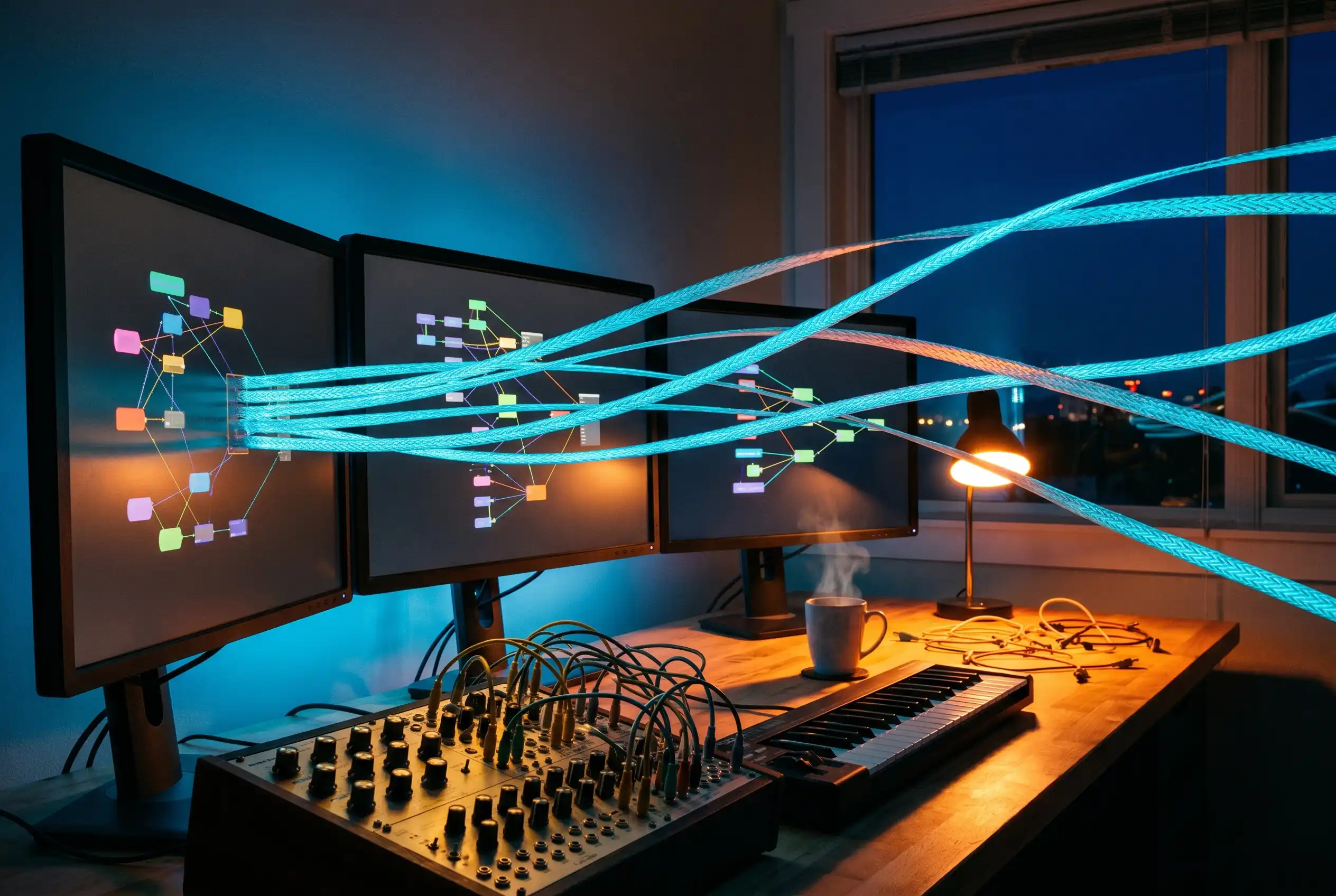
Bayle ships separate implementations per host, each adapted to that host’s threading and audio-graph conventions. Pd vanilla 0.56-2 and later get a Link Audio object on top of the existing tempo and transport bindings, building on the work tracked in the Pd 0.56-0test1 release announcement. Max and TouchDesigner get patcher externals. VCV Rack gets a native module. openFrameworks gets a dedicated addon. The plug-in family loads in any VST3, AU, or CLAP host.
- Pure Data: vanilla 0.56-2 and later, no Linux build yet.
- Max: external for current Cycling ’74 builds, macOS and Windows.
- TouchDesigner: patch-level operator, macOS and Windows.
- VCV Rack: native module, macOS and Windows.
- openFrameworks: ofxAbletonLinkAudio addon, including Linux.
- Plug-in: VST3, AU, CLAP, macOS Universal and Windows x64.
Pre-built binaries sit in two repos, the standalone ofxAbletonLinkAudio openFrameworks addon and the wider Void-LinkAudio host and plug-in repository. They are notarized for macOS, so Gatekeeper does not flag them. Linux Pd and Rack support are not in the bag yet, but Bayle has flagged that as the obvious next step.
How VOID’s Build Compares To JACK, Dante, And JackTrip
Bayle is careful to say his work does not displace what already exists. JACK still owns local low-overhead routing on Linux. Dante still owns multichannel professional networked audio in venues. JackTrip still owns wide-area performance over the public internet, anchored by Caceres and Chafe’s CCRMA technical paper on the JackTrip engine.
What Link Audio fits into is the gap between casual local routing and full studio infrastructure. A producer who wants to dump a Move groove into a TouchDesigner visual patch on the same Wi-Fi network does not want to install Dante drivers, configure a JACK server, or punch holes through a router for JackTrip.
| Tool | Network Reach | Topology | Strength | Weakness |
|---|---|---|---|---|
| Link Audio (VOID 0.2.0) | Local network | Peer to peer, sample accurate | Free, six hosts on day one | Alpha API, low channel count, no Linux Pd or Rack |
| JACK | Local machine and LAN | Hub via netjack | Free, mature, deep on Linux | Setup heavy, weak peer to peer outside specific drivers |
| Dante | LAN with managed switches | Centralized | Hundreds of channels, broadcast grade | Certified hardware, licensing cost, vendor stack lock |
| JackTrip | Wide-area internet | Edge or peer assisted | Sub-40 ms cross-country audio | Bandwidth hungry, firewall config required |
The JackTrip team’s own engineering paper reports that synchronized rhythmic performance demands one-way latency below roughly 25 to 30 milliseconds. Link Audio on a quiet local network sits comfortably below that floor. JackTrip’s edge approach exists precisely because forcing peer-to-peer audio across the open internet usually fails that math.
For a project where every musician shares a studio, Link Audio is now the lighter answer. For a project where one collaborator is in Brooklyn and one is in Berlin, JackTrip remains the right tool.
The Security Disclosure Bayle Wrote First
Bayle was asked outright whether large language models did the engineering work, and what that meant for the binaries’ safety. He gave a direct answer to CDM Create Digital Music.
The architecture, audio path, threading model, and DSP decisions are mine. Code is fully open source under GPL-2.0, so anyone can audit it. The networking layer is Ableton’s own Link Audio reference implementation, not anything I wrote from scratch. I’ve validated bidirectional audio sessions against Live 12.4 across all hosts.
Two things are useful in that statement. The license lets independent reviewers read every line, and ownership of the threading model is exactly where most network-audio implementations break. Apple’s notarization adds a static malware scan on top of the open-source audit path.
What’s Missing And Where Linux Users Should Look
Linux is the obvious gap. openFrameworks support shipped, but Pure Data and VCV Rack on Linux are still on the to-do list. Bayle has signaled those builds are not technically hard, just next in the queue.
Andrew Belt, who founded VCV Rack in 2016, has been clear about which platform he develops on. “I’m a Linux user. I write all this stuff on Linux. Mostly test it on Linux,” Belt told Synthtopia in a 2018 interview. A native Rack-on-Linux Link Audio module would close one of the largest holes in the current 0.2.0.
The other open question is channel count. Dante carries hundreds of bidirectional streams across a managed network. Link Audio’s current design favors a small number of high-quality streams between a small number of peers. For one Live set, one Push, and a TouchDesigner laptop, that is more than enough. For a 32-musician venue, it is not the answer yet.
Frequently Asked Questions
Does VOID Link Audio Replace JACK On Linux?
No. As of version 0.2.0, only the openFrameworks addon ships a Linux build. Pure Data and VCV Rack Linux binaries are not yet bundled. JACK and JackTrip remain the standard answers for full Linux audio routing today, with Bayle indicating Linux Pd and Rack support is the next priority on the roadmap.
Is The Bundle Compatible With Shipping Live 12 4?
Yes. Bayle says he validated bidirectional audio sessions between every supported host and Live 12.4 before publishing 0.2.0. Live 12.4 reaches general availability on May 5, 2026, with Link Audio also enabled in Note 2.0, Move 2.0, and Push 3 standalone alongside the desktop app.
Will Link Audio Work Over The Public Internet Between Cities?
Not by design. Link Audio targets local-network peers using the same discovery and clock-sync model as the original tempo Link. Wide-area-network performance still belongs to tools such as JackTrip, which uses edge servers to keep one-way latency under roughly 40 milliseconds across typical home connections.
Where Do I Download The Free VOID Binaries?
Two GitHub repositories run by Bayle host them. The openFrameworks addon lives at gluon/ofxAbletonLinkAudio. The plug-in plus host implementations live at gluon/Void-LinkAudio. Both ship pre-built notarized binaries for macOS Universal and Windows x64, with no installer required on Mac thanks to Apple-stapled notarization.
What Audio Quality And Channel Count Can I Expect?
VOID 0.2.0 supports publishing one or more channels per peer with sample-accurate sync against Live 12.4. Channel counts are deliberately modest compared with broadcast networks like Dante. The bundle targets the producer-plus-laptop case, not a 64-channel venue rig with hundreds of streams traveling between racks.
Is The Link Audio API Itself Final?
No. Ableton has shipped only an alpha version of the Link Audio SDK alongside the Live 12.4 public beta, available through the Ableton Live 12.4 announcement post. Bayle treats his bundle as an early R&D release and warns the API may shift before it stabilizes. Independent developers building on top of it should expect to update their code as Ableton iterates.
For now, the cleanest path from a Move groove to a TouchDesigner shader runs through Bayle’s plug-in. The next test is whether the rest of the open-source audio community treats this drop as a one-off curiosity or as the start of a wider creative-coding network.

-
 TECH1 year ago
Where Garmin Watches are Made and How They are Assembled
-

 AUTO2 months ago
Tesla’s Roadster Is ‘a Few Weeks Away,’ Says Its Chief Designer
-
 NEWS10 years ago
Samsung Releases Galaxy Note7 TV Ad as Reddit AMA Leaks Specs
-
 NEWS10 years ago
Android 7.0 Nougat Rolls Out To Nexus Devices With New Emoji, Features
-
 FINANCE9 years ago
Cardano Price Surges as ADA Enters the Crypto Top Ten List
-
 NEWS10 years ago
Pre-Order the First Camera Made for Facebook Live Streaming Video
-
 FINANCE1 year ago
Binance Suspends Trading and Withdrawals for a System Upgrade
-
 FINANCE9 years ago
RChain Price Jumps Nearly 150% to a New All-Time High of $2.03