
NEWS
ChatGPT Chats Become Murder Evidence as Privacy Privilege Crumbles

Police searching the apartment of a University of South Florida graduate student found something investigators are now calling a confession in plain text. Hisham Abugharbieh had typed into ChatGPT, on April 13, 2026, the question: What happens if a human has a put in a black garbage bag and thrown in a dumpster. Two weeks later he was charged with first-degree murder of his roommate and a second USF doctoral student. The chat log is in the affidavit. There is no privilege protecting it.
That single court filing has pulled a quiet legal question into the open: the billions of intimate questions people now ask AI chatbots every day sit in corporate databases with the same legal status as a Google search or a credit-card swipe. Prosecutors are noticing. So is Florida’s attorney general, who has opened the country’s first criminal probe into OpenAI itself.
The Florida Confession That Cracked The Case
Tampa prosecutors say Abugharbieh’s ChatGPT history reads like a planning document. According to the arrest affidavit reviewed by WUSF, he asked the bot how a body might be found, whether his neighbors would hear his gun, whether anyone had survived a sniper round to the head, and whether there was a water temperature “that burns immediately.”
He also asked, on April 15, whether he could keep a firearm at home without a license and whether a vehicle’s VIN could be altered. Investigators recovered a handgun and trash bags from the apartment. The two victims, both 27, were doctoral students.
The conversations were not subpoenaed from OpenAI. They were pulled directly from the suspect’s own device, the same way detectives have always read text messages and browser history. That is the part criminal-defense lawyers want users to understand before they type their next prompt.
Four Cases, One Pattern
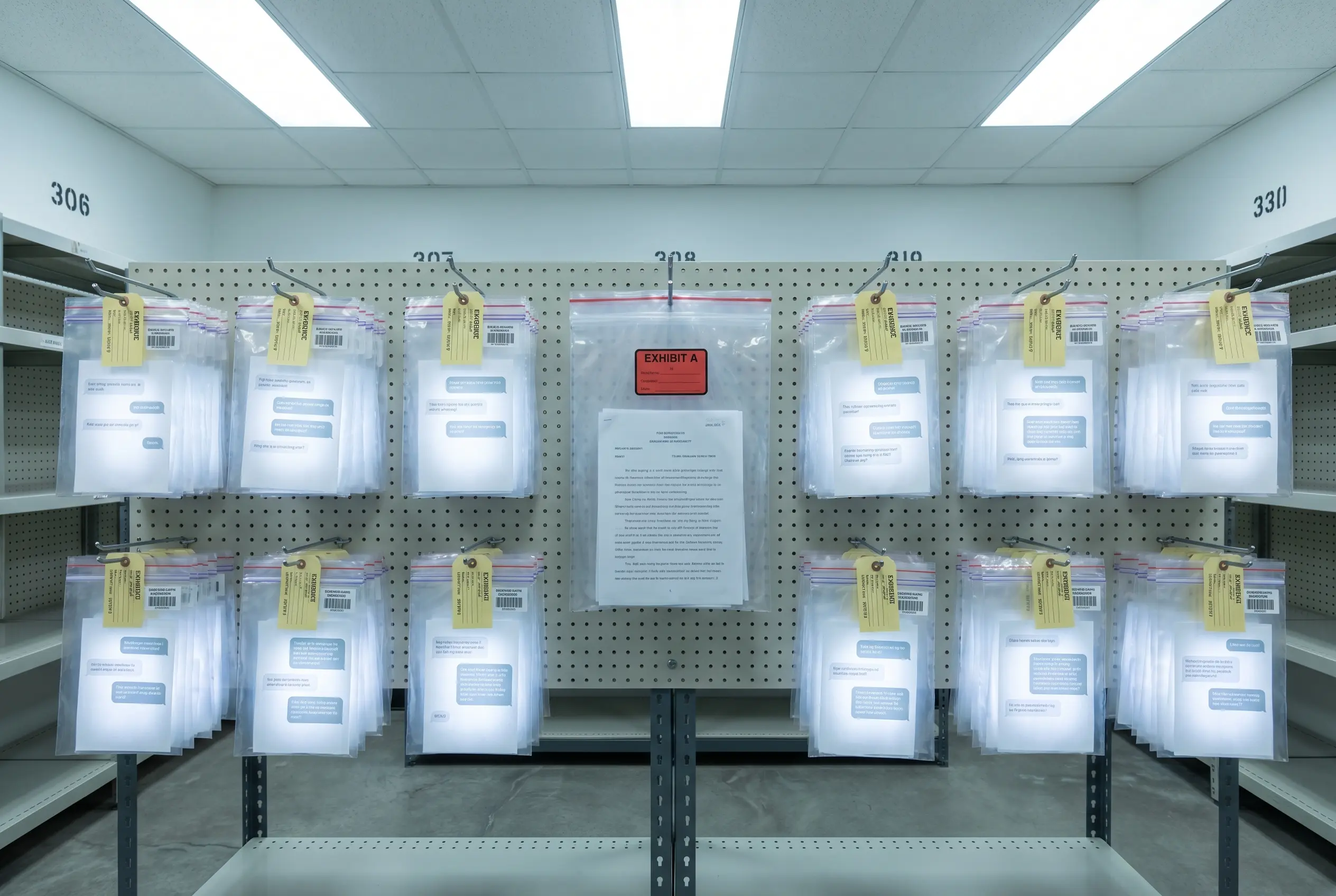
The USF filing is not an outlier. Generative AI has now appeared as core evidence in multiple homicides and an arson case inside roughly eighteen months, and the pace is accelerating in 2026.
- 2024, Virginia. A Snapchat AI conversation entered evidence in a state murder trial, the first widely cited use of a chatbot exchange to establish intent.
- January 2025, Los Angeles. Jonathan Rinderknecht, charged in the Palisades wildfire arson case, allegedly asked ChatGPT to generate images of people fleeing a fire before the blaze.
- April 2025, Tallahassee. Phoenix Ikner, the accused Florida State University shooter, entered more than 200 prompts into AI tools before the attack, asking about weapon choice, ammunition, and peak campus crowd times, per NPR’s reporting on the AG’s review.
- April 2026, Tampa. The USF double-homicide affidavit lifts ChatGPT prompts straight into the charging document.
Why ChatGPT Doesn’t Get Doctor-Patient Protection
American evidence law shields very specific relationships. Your lawyer cannot be subpoenaed about your case strategy. Your therapist cannot be forced to repeat what you said in session. Your priest, in most jurisdictions, cannot be made to disclose a confession. ChatGPT fits into none of those categories.
OpenAI CEO Sam Altman said so himself, on Theo Von’s podcast in July 2025, warning that users “talk about the most personal things in their lives” to the bot while no privilege exists. In the same interview captured by TechCrunch, he called the lack of a confidentiality framework a “huge issue” and said he was “very afraid” of how that data could be pulled into government investigations.
| Channel | Privileged? | Discoverable In Court? | Typical Subpoena Path |
|---|---|---|---|
| Conversation with attorney | Yes | No, with narrow exceptions | Blocked by privilege |
| Therapy session | Yes | No, in most states | Blocked by privilege |
| Phone call records | No | Yes | Carrier subpoena |
| Google search history | No | Yes | Device or platform subpoena |
| ChatGPT, Claude, Gemini chats | No | Yes | Device or platform subpoena |
Texas attorney Virginia Hammerle put it bluntly to CNN: “Anything that somebody’s typing into ChatGPT is something that could be discoverable.” Cybersecurity attorney Ilia Kolochenko, based in Washington, D.C., went further, calling the chat archives “a treasure trove for law enforcement agencies.”
A federal court has already extended the same logic to AI-drafted work product. In United States v. Heppner, decided in February 2026, the court ruled that documents a defendant generated using Anthropic’s Claude were not shielded by attorney-client privilege because the AI is not an attorney and cannot enter into that relationship.
The 60 Billion-Conversation Vault Prosecutors Now Eye
The discovery problem is bigger than any single affidavit. ChatGPT’s own user base has become the largest unprotected confessional in history.
- 4.5 billion monthly visits to ChatGPT, per traffic estimates cited in the NYT v. OpenAI docket.
- 2.5 billion prompts entered into ChatGPT each day.
- 60 billion conversations OpenAI told the court a preservation order would force it to retain.
- 377 messages from teenager Adam Raine that OpenAI’s own moderation flagged for self-harm content before his April 2025 death, according to the Raine v. OpenAI complaint.
- 200+ AI prompts entered by the FSU shooting suspect before the attack.
Some of that vault was forced into longer storage by an unrelated copyright fight. In May 2025, U.S. Magistrate Judge Ona Wang ordered OpenAI to preserve all output log data that would otherwise be deleted, after The New York Times argued the company’s chats were potential evidence of training-data infringement. OpenAI’s public response warned the order conflicted with its own privacy commitments. The preservation obligation lifted on September 26, 2025, but everything captured in the interim still exists.
That snapshot of the human inner monologue, intimate, searchable, dated, sits in servers a prosecutor can reach with a properly issued warrant. Defense bars in Texas, Florida, and California are now advising clients to treat any chatbot prompt the way they would treat an unencrypted email to a stranger.
Florida’s Other Move: Criminal Subpoenas Against OpenAI Itself
While prosecutors mine chat logs for evidence against suspects, Florida Attorney General James Uthmeier is trying to flip the dynamic and put the company in the dock. On April 9, 2026, his office announced criminal subpoenas to OpenAI tied to the FSU shooting, then expanded the probe on April 27 to fold in the USF case. It is the first attempt in the United States to hold AI executives criminally accountable for what their software told a user.
Uthmeier’s office is demanding internal training materials, threat-response policies, and records of how OpenAI cooperates with law enforcement, dating back to March 2024. An OpenAI spokesperson said the FSU shooting “was a tragedy, but ChatGPT is not responsible for this terrible crime,” arguing the bot “provided factual responses to questions with information that could be found broadly across public sources on the internet.”
What Defense Lawyers Are Telling Clients Right Now
The practical advice from criminal-defense and privacy lawyers in 2026 is uniform, and uncomfortable. Treat the chat box like a witness stand.
“ChatGPT is not your friend, is not your lawyer, is not your doctor, is not your spouse,” said Nils Gilman, a historian at the Berggruen Institute who tracks AI governance. The line, delivered to CNN, has begun showing up in continuing-legal-education slides for state bar associations this spring.
Lawyers in private practice are giving four concrete instructions to clients who use AI tools daily.
- Assume retention. Even chats you delete may be preserved under existing or future court orders. ChatGPT’s free and Plus tiers are the most exposed.
- Never type a hypothetical you wouldn’t say to a detective. The USF affidavit shows that a phrasing as mild as “What if” can be presented to a jury as planning.
- Use enterprise or zero-retention APIs for sensitive work. The May 2025 preservation order specifically excluded ChatGPT Enterprise.
- Real legal advice still requires a real lawyer. Asking the bot for case strategy strips your work of the privilege a licensed attorney would carry.
Joey Jackson, a CNN legal analyst and longtime defense attorney, expects courts to keep admitting these prompts under existing electronic-evidence rules. “It’s only going to get more relevant, more timely, and more contentious,” he said.
The pressure is now on Congress and state legislatures to decide whether some category of AI-confessional privilege should exist at all, and where its limits should sit. So far no bill has moved. Until one does, every prompt typed into a public chatbot is, in legal terms, a voluntary statement.
Frequently Asked Questions
Can police read my ChatGPT conversations without a warrant?
Generally no, but the bar is low. Law enforcement typically needs a warrant or subpoena to obtain chat logs from OpenAI under the Stored Communications Act. If officers seize your phone or laptop legally, they can read the chats stored locally without separately subpoenaing OpenAI. ChatGPT chats receive no special privilege, so courts grant access readily.
Does deleting a ChatGPT chat actually erase it?
Not always. OpenAI’s standard policy retains deleted chats for up to 30 days for abuse monitoring, but the May 2025 federal preservation order in NYT v. OpenAI required the company to keep all output log data, including deleted chats, until the order lifted on September 26, 2025. Anything created during that window may still exist.
Are conversations on ChatGPT Enterprise treated differently?
Yes. The court in the NYT preservation fight specifically excluded ChatGPT Enterprise, ChatGPT Edu, and zero-data-retention API customers from the order. These tiers carry stronger contractual privacy commitments and shorter retention windows, which is why corporate counsel increasingly require employees to use them for sensitive work.
Could AI chatbot privilege ever become law in the US?
Possibly, but no federal bill exists as of May 2026. Sam Altman has publicly called for a privacy framework similar to attorney-client or doctor-patient privilege. Legal scholars argue any privilege would require either an act of Congress or a state-by-state evidentiary rule, and would likely carve out exceptions for imminent harm.
What should I avoid typing into ChatGPT?
Anything you would not voluntarily say in front of a grand jury. That includes hypotheticals about harming yourself or others, questions tied to disputes you may litigate, medical confessions you want kept private, financial details that could surface in divorce or tax matters, and any communication where attorney-client or therapist privilege would otherwise protect you.
Is OpenAI itself facing criminal charges over these cases?
Florida AG James Uthmeier opened a criminal investigation in April 2026 into whether OpenAI bears responsibility for the FSU mass shooting and the USF student killings. It is the first such probe in the United States. OpenAI denies criminal liability, saying ChatGPT only repeated information already available online.
The cluster of cases moving through Florida courts this spring is doing for AI what the early smartphone-search rulings did for mobile data a decade ago. The legal system is figuring out, in real time and against the clock, whether the most intimate database ever assembled deserves a wall around it. Every prompt typed before that wall is built is, for now, fair game.

-
 TECH1 year ago
Where Garmin Watches are Made and How They are Assembled
-

 AUTO3 months ago
Tesla’s Roadster Is ‘a Few Weeks Away,’ Says Its Chief Designer
-
 NEWS10 years ago
Samsung Releases Galaxy Note7 TV Ad as Reddit AMA Leaks Specs
-
 NEWS10 years ago
Android 7.0 Nougat Rolls Out To Nexus Devices With New Emoji, Features
-
 FINANCE9 years ago
Cardano Price Surges as ADA Enters the Crypto Top Ten List
-
 NEWS10 years ago
Pre-Order the First Camera Made for Facebook Live Streaming Video
-
 FINANCE1 year ago
Binance Suspends Trading and Withdrawals for a System Upgrade
-
 FINANCE9 years ago
RChain Price Jumps Nearly 150% to a New All-Time High of $2.03