
BUSINESS
Bitcoin Pushes $80,000 as Senate Cracks Stablecoin Deal, Brazil Tightens

Bitcoin held above $78,000 on Sunday, May 3, 2026, pressing toward the $80,000 ceiling after a week shaped by U.S. regulatory progress, record exchange-traded fund inflows, and a fresh crackdown from Brazil’s central bank. The leading cryptocurrency traded near $78,411 in the early Asian session, having clawed back from a $75,500 low triggered by Middle Eastern geopolitical tension, while the S&P 500 closed at a fresh record of 7,230.12 on Friday.
The setup is unusual. Wall Street is at all-time highs, U.S. lawmakers just unstuck their long-stalled crypto market structure bill, and ETF buyers are back in size. Yet Bitcoin still cannot punch through a round number it last cleared in February.
Bitcoin Holds the $80,000 Door
The chart belongs to the bulls right now, even if the tape doesn’t show it yet. Bitcoin recovered every cent of last week’s geopolitical drawdown, when prices briefly dropped to $75,500 amid renewed Iran tension and a spike in Brent crude. The bounce arrived alongside a sixth straight weekly gain on the S&P 500, the longest such streak since October 2024.
Below the surface, the cluster of dramatic numbers tells the story:
- $78,411. BTC spot price as of 05:21 ET Sunday, per Investing.com data.
- $629.8 million. Net inflows into U.S. spot Bitcoin ETFs on May 1, per single-day issuer flow data.
- 7,230.12. The S&P 500’s record closing print on May 1, 2026, its sixth consecutive weekly gain.
- 818,334 BTC. Strategy Inc.’s corporate treasury holdings as of April 27, after a $255 million top-up, according to its official Bitcoin purchase log.
The macro backdrop is doing the work. Equity records typically pull risk capital into crypto on a lag. The question is how long the lag runs this time, and whether the next leg is a clean break or a third rejection at the same wall.
The Senate’s Stablecoin Compromise, Decoded
The political needle moved on Friday. Senators Thom Tillis (R-N.C.) and Angela Alsobrooks (D-Md.) released the long-awaited compromise text bridging the impasse over stablecoin yield in the CLARITY Act, the market structure bill that had been frozen inside the Senate Banking Committee since January.
The deal draws a line that crypto firms can live with and that bank lobbyists can defend. Issuers cannot pay interest or yield on stablecoin balances in a way that mimics a bank deposit. But platforms can still pay rewards tied to genuine activity, the same model credit card companies use for points and cashback.
The exact statutory language sets the boundary in plain terms.
“No covered party shall, directly or indirectly, pay any form of interest on yield (whether in cash, tokens, or other consideration) to a restricted recipient solely in connection with the holding of such restricted recipient’s payment stablecoins, or on a payment stablecoin balance in a manner that is economically or functionally equivalent to the payment of interest or yield on an interest-bearing bank deposit.”
The compromise closes the loophole banks feared most while preserving the activity-based reward economics Coinbase and Circle had built around USDC. Coinbase’s policy team backed the language within hours and pushed Senate Banking for a near-term markup, per the trade group’s joint statement on Saturday.
The drafters made the rationale explicit. The text states that depository institutions “provide financial services that are integral to the strength of the American economy” and that letting stablecoin issuers replicate them “may inhibit” those institutions, a sentence buried in the bill that wire coverage skipped over.
ETF Tape Tells the Quiet Story
Spot Bitcoin ETFs swung from three straight days of net outflows to a $629.7 million green print on Thursday, the largest single-session inflow of the year so far. The breakdown shows the heavyweight issuers carrying the tape.
- BlackRock IBIT: $284.4 million net inflow, the largest single-fund haul.
- Fidelity FBTC: $213.4 million.
- Ark 21Shares ARKB: $88.5 million.
- Bitwise BITB: $27.3 million.
- Grayscale Mini Trust, VanEck HODL, Morgan Stanley MSBT: a combined $16.3 million.
April closed with $2.44 billion in cumulative U.S. spot Bitcoin ETF inflows, the strongest month of the year, per Investing.com analysis of issuer disclosures. The pattern matters because spot ETF demand is now the marginal price-setter, not retail spot volume on Coinbase or Binance.
Brazil Slams the Back Door Shut
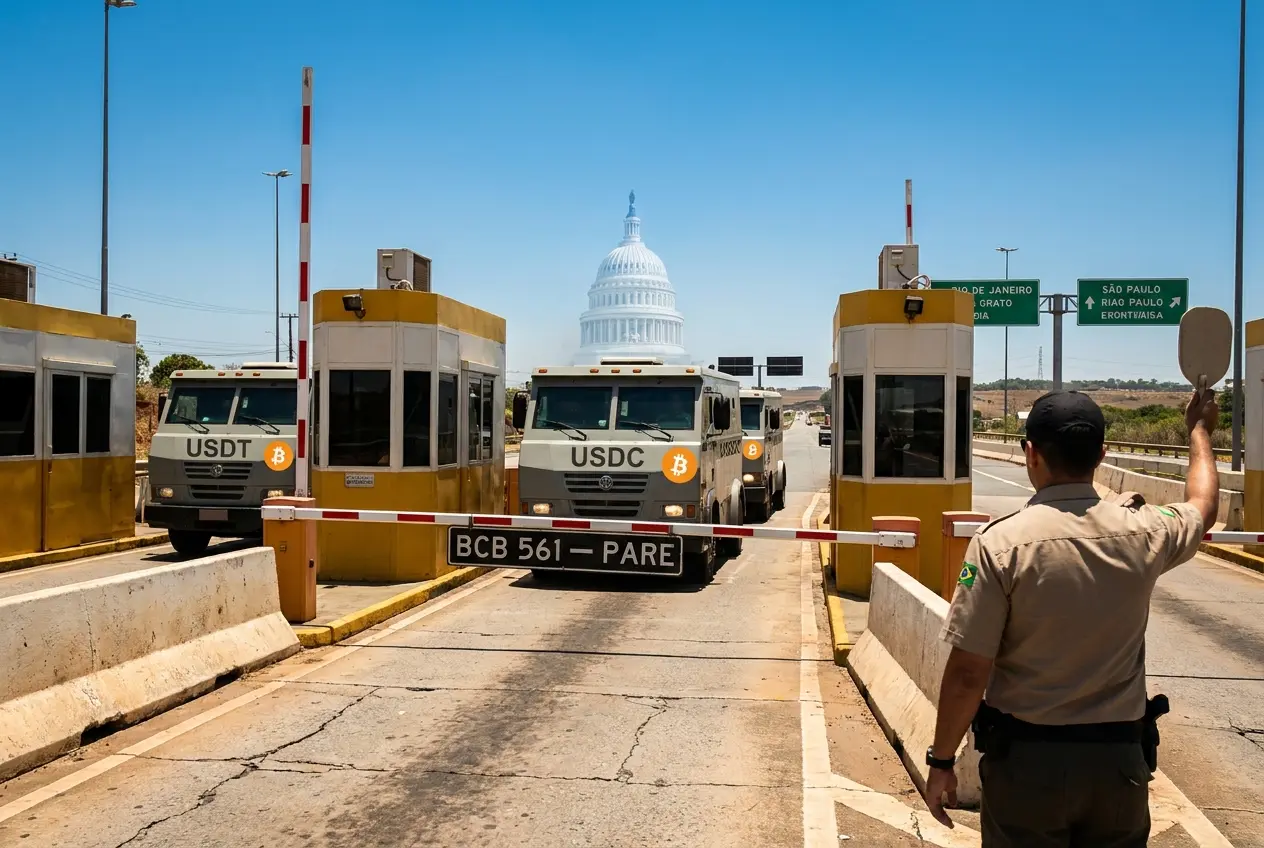
While Washington opens a door, Brasília is closing one. The Banco Central do Brasil published Resolution BCB No. 561 on April 30, banning electronic foreign exchange (eFX) providers from using Bitcoin, USDT, USDC or any other crypto asset to settle overseas remittances. The rule takes effect on October 1, 2026.
The mechanism it kills is specific. A Brazilian fintech can no longer take reais from a customer, swap into stablecoins, and settle the cross-border leg on a public blockchain. Payment between an eFX provider and its foreign counterparty must move through a regulated FX transaction or a non-resident real-denominated account in Brazil. The rule strikes at the core operating model of remittance firms like Wise, Nomad and Braza Bank, which had quietly built stablecoin rails into their back ends.
Brazil’s stablecoin market moves between $6 billion and $8 billion every month, with stablecoins accounting for roughly 90% of all crypto volume in the country. Officials at the BCB cited tax leakage and anti-money-laundering oversight as the primary motivation, according to the regulator’s filing reviewed by CoinDesk on Saturday.
Retail buyers are not affected. Individual Brazilians can still buy, sell, hold and transfer crypto through licensed virtual asset service providers under Resolution BCB No. 521, which took effect February 2. The new rule is surgical: it cuts the institutional remittance pipe, not the consumer wallet.
The $2.1 Billion Trap Above $80,000
Derivatives positioning explains why $80,000 keeps acting like flypaper. A cluster of roughly $2.1 billion in short positions sits stacked between $78,500 and $80,000, with a thinner band of around $100 million in spot sell orders layered on top. A decisive daily close above $80,000 would force liquidations across that band and could ignite a short squeeze toward $84,000.
Bitcoin has not closed a single weekly candle above $80,000 since the February peak, and the past three attempts have rejected at almost identical levels. Until that pattern breaks, the bias stays range-bound between the $75,000 floor that held last week and the $80,000 ceiling that has not.
Where the Altcoins Sat Out
Sunday’s altcoin tape was a study in apathy. The major caps barely moved while Bitcoin grabbed the narrative.
| Asset | Sunday Price | Sunday Move |
|---|---|---|
| Ethereum | $2,308.52 | +0.15% |
| XRP | $1.3876 | +0.08% |
| Solana | -0.10% | |
| Cardano | -0.20% | |
| Dogecoin | +0.29% |
The relative inertia matters. In past cycles, an ETF inflow of $629 million plus a friendly U.S. legislative print would have lit altcoins on fire by the Asian open. The muted response is consistent with a market where institutional demand is concentrated almost entirely in spot Bitcoin instruments and where altcoin retail flow has not yet returned in size.
The S&P 500’s record close, captured in real-time market commentary, gave the broader risk backdrop:
https://x.com/marketsday/status/2050449716585136284
Frequently Asked Questions
What is the Bitcoin price today, May 3, 2026?
Bitcoin traded at approximately $78,411 at 05:21 ET on Sunday, May 3, 2026, after recovering from a midweek low near $75,500. Prices have held within a $75,000 to $80,000 range for most of the week, with the upper boundary acting as the primary technical resistance.
What does the CLARITY Act compromise actually allow?
The Tillis-Alsobrooks compromise bars stablecoin issuers from paying interest or yield based purely on holding stablecoin reserves, but explicitly permits rewards tied to “bona fide activities or bona fide transactions.” Platforms can still offer points, cashback or governance rewards on user activity, similar to credit card incentive programs.
When does Brazil’s crypto remittance ban take effect?
Resolution BCB No. 561 takes effect on October 1, 2026, with adaptation deadlines for affected fintechs running into 2027. The rule blocks electronic FX providers from using Bitcoin or stablecoins to settle cross-border payments, but does not affect retail buying, holding or transferring of crypto.
Why is $80,000 such a hard level for Bitcoin to break?
Roughly $2.1 billion in short positions are clustered between $78,500 and $80,000, alongside about $100 million in resting spot sell orders. A decisive daily close above $80,000 would force liquidations across that band and could trigger a short squeeze toward $84,000, but Bitcoin has rejected at this level on three consecutive attempts since February.
How much Bitcoin do U.S. spot ETFs hold right now?
U.S. spot Bitcoin ETFs collectively pulled in $2.44 billion in April 2026, the strongest month of the year. May opened with a $629.7 million single-day net inflow on May 1, led by BlackRock’s IBIT at $284.4 million and Fidelity’s FBTC at $213.4 million.
Is Strategy still buying Bitcoin in 2026?
Yes. Strategy Inc. (formerly MicroStrategy) reported holdings of 818,334 BTC as of April 27, 2026, after a $255 million purchase that month. The company’s stake briefly exceeded BlackRock’s IBIT holdings of 802,823 BTC, the first time in the spot ETF era that a single corporate treasury outsized the largest spot Bitcoin fund.
The next setup hinges on three variables traders are watching into Monday’s open: whether spot ETF inflows extend a second consecutive session, whether the Senate Banking Committee schedules a near-term markup of the CLARITY Act, and whether Brent crude settles below $100 a barrel to take Middle East risk off the table. A clean alignment of all three is the cleanest path to the $80,000 break Bitcoin keeps refusing to close above. Anything less, and the range holds.

-
 TECH1 year ago
Where Garmin Watches are Made and How They are Assembled
-

 AUTO2 months ago
Tesla’s Roadster Is ‘a Few Weeks Away,’ Says Its Chief Designer
-
 NEWS10 years ago
Samsung Releases Galaxy Note7 TV Ad as Reddit AMA Leaks Specs
-
 NEWS10 years ago
Android 7.0 Nougat Rolls Out To Nexus Devices With New Emoji, Features
-
 FINANCE9 years ago
Cardano Price Surges as ADA Enters the Crypto Top Ten List
-
 NEWS10 years ago
Pre-Order the First Camera Made for Facebook Live Streaming Video
-
 FINANCE1 year ago
Binance Suspends Trading and Withdrawals for a System Upgrade
-
 FINANCE9 years ago
RChain Price Jumps Nearly 150% to a New All-Time High of $2.03