
NEWS
OnePlus Nord 6 Loses Just 35% After 3-Hour Gaming Test

The OnePlus Nord 6 ended a punishing three-hour gaming marathon with 61% battery left in the tank, after starting at 96% and cycling through Genshin Impact, Hitman: Absolution, Tomb Raider, and Call of Duty: Mobile back to back. The 9,000mAh silicon-carbon cell, the largest ever fitted to a Nord-series phone, lost just 35 percentage points across the entire session. That works out to roughly 11.7% per hour of heavy gameplay, with thermals briefly spiking to 44.5°C before settling back into the high 30s.
The test, run on the latest OxygenOS 16 build with brightness pegged at 70%, Bluetooth and Location off, and ambient room temperature held at 28°C, confirmed something the spec sheet only hinted at. A phone OnePlus officially positions in the upper mid-range can now out-endure most flagships at half the price.
How a 9,000mAh Cell Fits Inside a 8.5mm Phone
The Nord 6’s headline number isn’t possible with conventional lithium-ion chemistry. OnePlus stacked a silicon-carbon dual-cell pack with roughly 15% silicon in the anode, a composite that swaps part of the traditional graphite for silicon to push energy density well past what older smartphone packs could manage.
Industry analysis pegs silicon-carbon cells at energy densities approaching 600 Wh/kg, against roughly 387 Wh/kg for the lithium-ion packs that dominated phones until last year. That’s the only reason a 9,000mAh battery, the rough equivalent of a midsize power bank, can sit inside a 217-gram chassis just 8.5mm thick. OnePlus engineers told Tom’s Guide the chemistry also tolerates faster charge currents, which is why the same cell still accepts 80W SUPERVOOC input without cooking itself.
The chemistry matters for buyers planning to keep the phone three years or more. OnePlus has attached a four-year battery health guarantee covering 1,600 charge cycles to 80% health, a figure made possible only because silicon-carbon cells degrade more slowly under fast-charge stress than the graphite cells they replace.
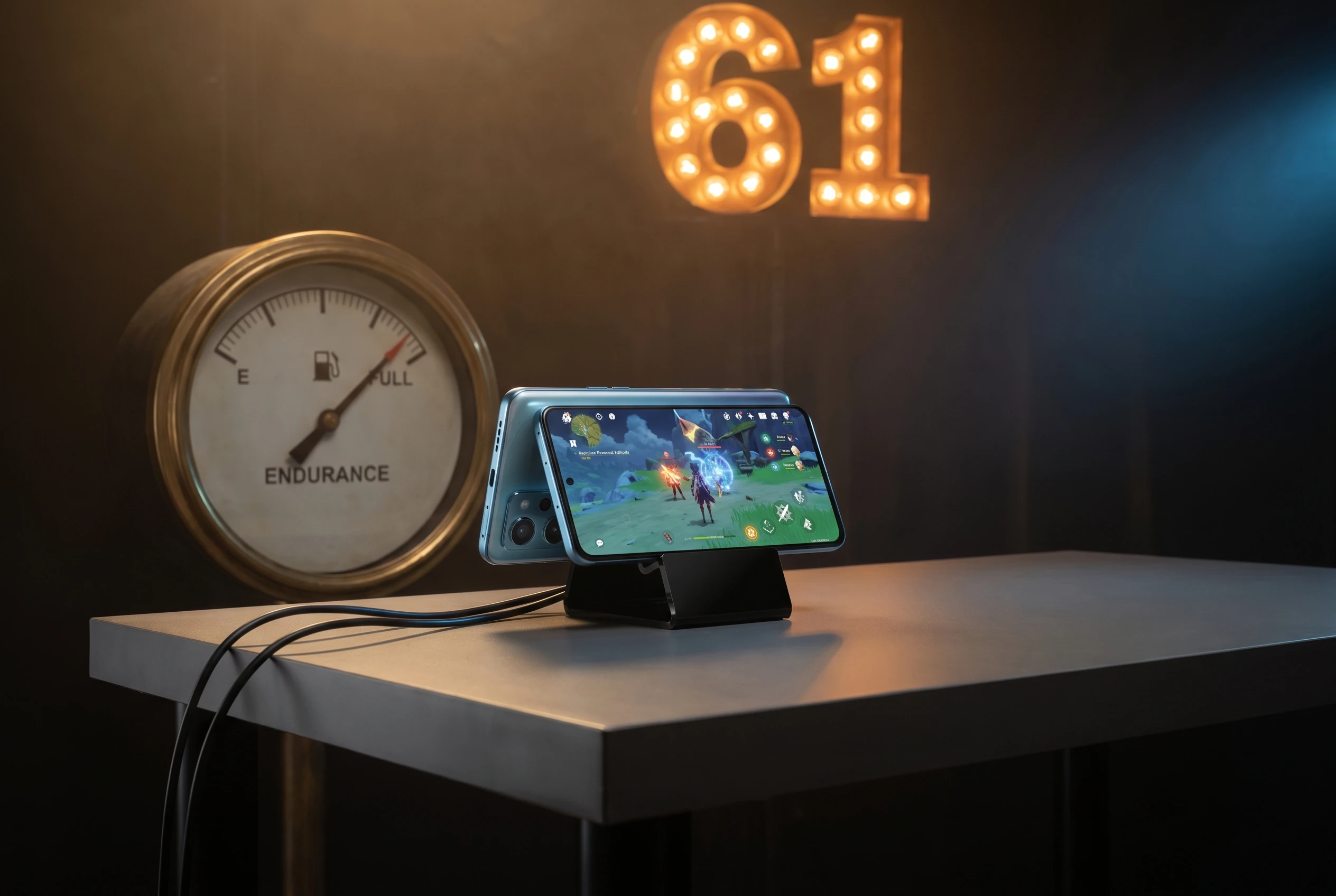
The Test Setup: Four Games, Three Hours, One Temperature Gun
The rules were strict, deliberately so. Loose conditions would have produced a glossy battery number that wouldn’t survive contact with a real owner’s daily use.
- Starting charge: 96%, captured the moment the first session began.
- Display: brightness locked at 70%, auto-brightness off.
- Radios: Bluetooth and Location Services off throughout; Wi-Fi on for online titles.
- Sampling cadence: battery percentage logged every 15 minutes; back-panel and display temperatures captured with an infrared gun every 45 minutes.
- Ambient: 28°C room temperature, no air conditioning, no fan.
- Software: OxygenOS 16 on the build that shipped at retail.
The four titles were picked for variety, not generosity. Genshin Impact taxes the GPU through its open world. Hitman: Absolution leans on cinematic rendering and physics. Tomb Raider is a PC-port that lights up the lighting engine. Call of Duty: Mobile pushes sustained frame rates in tight multiplayer maps.
Genshin Impact Took 10%. The Back Panel Hit 39.9°C.
Genshin Impact ran first, set to its highest preset with a 60fps cap. Combat sequences, region traversal, and a couple of overworld bosses cycled through the 45-minute window. There were no stutters, no resolution drops, no dynamic-throttle warnings.
The 9,000mAh pack lost 10 percentage points, ending the session at 86%. For context, the phone supports a stable 165fps in lighter titles like BGMI per OnePlus’s official Amazon India listing, so locking Genshin to 60 was the milder of two possible loads.
Heat told a different story. By the 45-minute mark the back panel measured 39.9°C and the display 39.6°C, warm enough that the phone needed two hands and a deliberate grip. Vapor-chamber cooling kept temperatures under the throttle ceiling, but only just.
Hitman: Absolution Pushed the Chassis to 44.5°C
Round two broke the calm. Hitman: Absolution, set to the Performance preset with a 60fps cap, drained 12% in 45 minutes and ran the back panel up to 44.5°C, the hottest reading of the entire test. The display crept to 42.8°C. The phone became uncomfortable to hold for long stretches.
That heat brought the only visible performance penalty of the day. Frame pacing wobbled during the fast-cut cinematics, and stealth sequences picked up faint stutters that hadn’t been present an hour earlier. The battery still drained gently relative to the heat, a sign the silicon-carbon cell was absorbing energy demand the cooling system was struggling to dissipate.
Hitman is also a PC port, and like many older titles in this genre it doesn’t always play nicely with adaptive frame-rate controllers. The brief throttle behavior matched what GSMArena’s stress-test data on the Snapdragon 8s Gen 4 flagged: erratic CPU clock cycling under uneven load.
By the end of the session the phone had drained from 86% to 74%. Still well within budget for a multi-game day.
Tomb Raider Cooled Off and Sipped Just 8%
Tomb Raider ran on the Performance preset with the frame rate capped at 40fps, the lowest cap of the test. That single setting choice rewrote the thermal story.
The back panel cooled from 44.5°C to 38.7°C, a 5.8°C swing that the phone needed after the Hitman session. Display temperature fell to 36°C. Gameplay through the puzzle-and-traversal sequences ran clean, with no frame drops in the lighting-heavy ruins. Battery dropped from 74% to 66%, an 8% loss across 45 minutes.
The pattern reinforced something most reviews of mid-range gaming phones miss. Frame-rate cap is a bigger lever for thermal and battery behavior on the Nord 6 than the graphics preset itself. Capping at 40fps recovered roughly four minutes of effective playtime per hour compared to the 60fps Hitman session, on top of the cooler chassis.
Call of Duty: Mobile Sipped Just 5%
The session closed with Call of Duty: Mobile across a stack of Team Deathmatch rounds. The 9,000mAh pack lost 5%, the smallest drop of the entire test, ending the three-hour run at 61%. Back panel and display both settled near 36.3°C, comfortable for sustained handheld play.
The Nord 6 absolutely demolishes its rivals when it comes to battery life, with the phone lasting two days comfortably even with heavy use.
That assessment, from Harish Jonnalagadda’s full Nord 6 review for Android Central, lined up almost exactly with the gaming-only test data. A 35% drain across three hours of heavy load implies roughly 8.5 hours of continuous gameplay before the battery hits empty, longer than most international flights short of long-haul.
The Numbers in One Glance
Here’s the full session laid out, game by game.
| Game | Start % | End % | Drop | Back panel peak |
|---|---|---|---|---|
| Genshin Impact (60fps, max preset) | 96% | 86% | 10% | 39.9°C |
| Hitman: Absolution (60fps, Performance) | 86% | 74% | 12% | 44.5°C |
| Tomb Raider (40fps, Performance) | 74% | 66% | 8% | 38.7°C |
| Call of Duty: Mobile | 66% | 61% | 5% | 36.3°C |
The shape of the curve matters as much as the totals. Drain accelerated through Hitman, then decelerated as the phone cooled and frame caps tightened. Anyone planning a long flight or commute should expect the early titles to bite harder than later ones.
What the Test Doesn’t Show: Bypass Charging and the Real-World Math
The 35% drop reads tidier than what most owners will hit in daily use, because daily use rarely strings four AAA-grade titles back to back. With mixed use, OnePlus claims and reviewers have largely confirmed two-day battery life on a single charge.
Two undertested features change the math further for serious gamers. Bypass charging, a setting buried in the battery menu, routes wall power directly to the SoC during gameplay so the cell doesn’t cycle while the phone plays. That feature alone can extend usable battery life across the warranty period by hundreds of cycles. The 80W SUPERVOOC brick refills the empty pack to 100% in roughly 75 minutes, and a five-minute top-up returns about an hour of gameplay.
Stats Worth Memorizing
- 9,000mAh. Largest battery ever shipped in a OnePlus Nord-series phone.
- 8.5mm. Chassis thickness, made possible only by silicon-carbon chemistry.
- 1,600 cycles. Battery health guarantee to 80%, a four-year promise from OnePlus.
- 2,366,913. AnTuTu Benchmark 11 score on the Snapdragon 8s Gen 4.
- 165fps. Stated peak frame rate, supported in 10 titles including BGMI and CoD: Mobile.
How the Nord 6 Stacks Up Against Its Closest Rivals
The launch price slots the Nord 6 at Rs 38,999 for 8GB+256GB and Rs 41,999 for 12GB+256GB, an aggressive pitch against the upper edge of the under-40K bracket. Its IP66, IP68, IP69 and IP69K ratings, plus MIL-STD-810H certification, are unusual at this price.
| Phone | Battery | Chip | Charging | Starting price |
|---|---|---|---|---|
| OnePlus Nord 6 | 9,000mAh Si-C | Snapdragon 8s Gen 4 | 80W wired | Rs 38,999 |
| iQOO Neo 11 | 7,000mAh Si-C | Snapdragon 8s Gen 4 | 120W wired | Rs 32,999 |
| Realme GT 8 Pro | 7,000mAh Si-C | Snapdragon 8 Elite Gen 5 | 120W wired | Rs 49,999 |
| Nothing Phone (4) | 5,200mAh Li-ion | Snapdragon 8s Gen 5 | 50W wired | Rs 39,999 |
None of the rivals get anywhere near 9,000mAh. That gap, combined with a four-year battery health pledge, is the quiet thesis behind the Nord 6. OnePlus isn’t selling raw performance leadership. It’s selling a battery you stop thinking about.
Frequently Asked Questions
How long does the OnePlus Nord 6 last during gaming?
In a controlled three-hour test across Genshin Impact, Hitman: Absolution, Tomb Raider, and Call of Duty: Mobile at 70% brightness, the Nord 6 dropped from 96% to 61%, a 35% loss. That implies roughly 8.5 hours of continuous heavy gameplay before the battery hits empty, with lighter titles stretching the figure further.
Is the OnePlus Nord 6 9,000mAh battery safe?
The pack uses silicon-carbon chemistry, the same class of cell now shipping in over a dozen 2026 Android phones. OnePlus rates it for 1,600 charge cycles to 80% health and backs the rating with a four-year health guarantee. Internal protections cap charging speed when temperatures cross safety thresholds.
How hot does the OnePlus Nord 6 get during gaming?
Back-panel temperatures peaked at 44.5°C during Hitman: Absolution but cooled to the high 30s during Tomb Raider and Call of Duty: Mobile. Display temperatures tracked roughly 1°C to 3°C lower than the back panel. The vapor-chamber cooling system keeps the phone usable in long sessions, though Hitman briefly tested that limit.
Does the Nord 6 support bypass charging for gaming?
Yes. Bypass charging is selectable in the battery settings menu and routes wall power directly to the SoC, skipping the cell so it doesn’t cycle while plugged in. That preserves long-term battery health for owners who game with a charger attached, a small feature with a large effect over a four-year ownership window.
How much does the OnePlus Nord 6 cost in India?
The 8GB+256GB variant is priced at Rs 38,999 and the 12GB+256GB variant at Rs 41,999. Sale began on April 9, 2026 through OnePlus.in, the OnePlus Store app, OnePlus Experience Stores, Amazon India, and select retail partners.
What charging speed does the Nord 6 support?
The phone ships with 80W SUPERVOOC wired charging, taking the 9,000mAh cell from 0 to 100% in about 75 minutes. A five-minute top-up returns roughly an hour of gameplay. The phone also supports 27W reverse wired charging for accessories, but no wireless charging.
The bigger lesson sitting under the test is what silicon-carbon chemistry has just made possible at this price. A phone that loses 35% across three hours of stacked AAA gaming, on a chassis under 9mm thick, costing under Rs 40,000, would have read as marketing fiction two years ago. It now reads as a Tuesday afternoon spec sheet, and the Nord 6 is just the most aggressive example yet.

-
 TECH1 year ago
Where Garmin Watches are Made and How They are Assembled
-
 AUTO2 months ago
Tesla’s Roadster Is ‘a Few Weeks Away,’ Says Its Chief Designer
-
 NEWS10 years ago
Samsung Releases Galaxy Note7 TV Ad as Reddit AMA Leaks Specs
-
 NEWS10 years ago
Android 7.0 Nougat Rolls Out To Nexus Devices With New Emoji, Features
-
 FINANCE9 years ago
Cardano Price Surges as ADA Enters the Crypto Top Ten List
-
 NEWS10 years ago
Pre-Order the First Camera Made for Facebook Live Streaming Video
-
 FINANCE1 year ago
Binance Suspends Trading and Withdrawals for a System Upgrade
-
 FINANCE9 years ago
RChain Price Jumps Nearly 150% to a New All-Time High of $2.03