
BUSINESS
Oracle’s $300B OpenAI Promise Is Breaking JPMorgan’s Loan Books

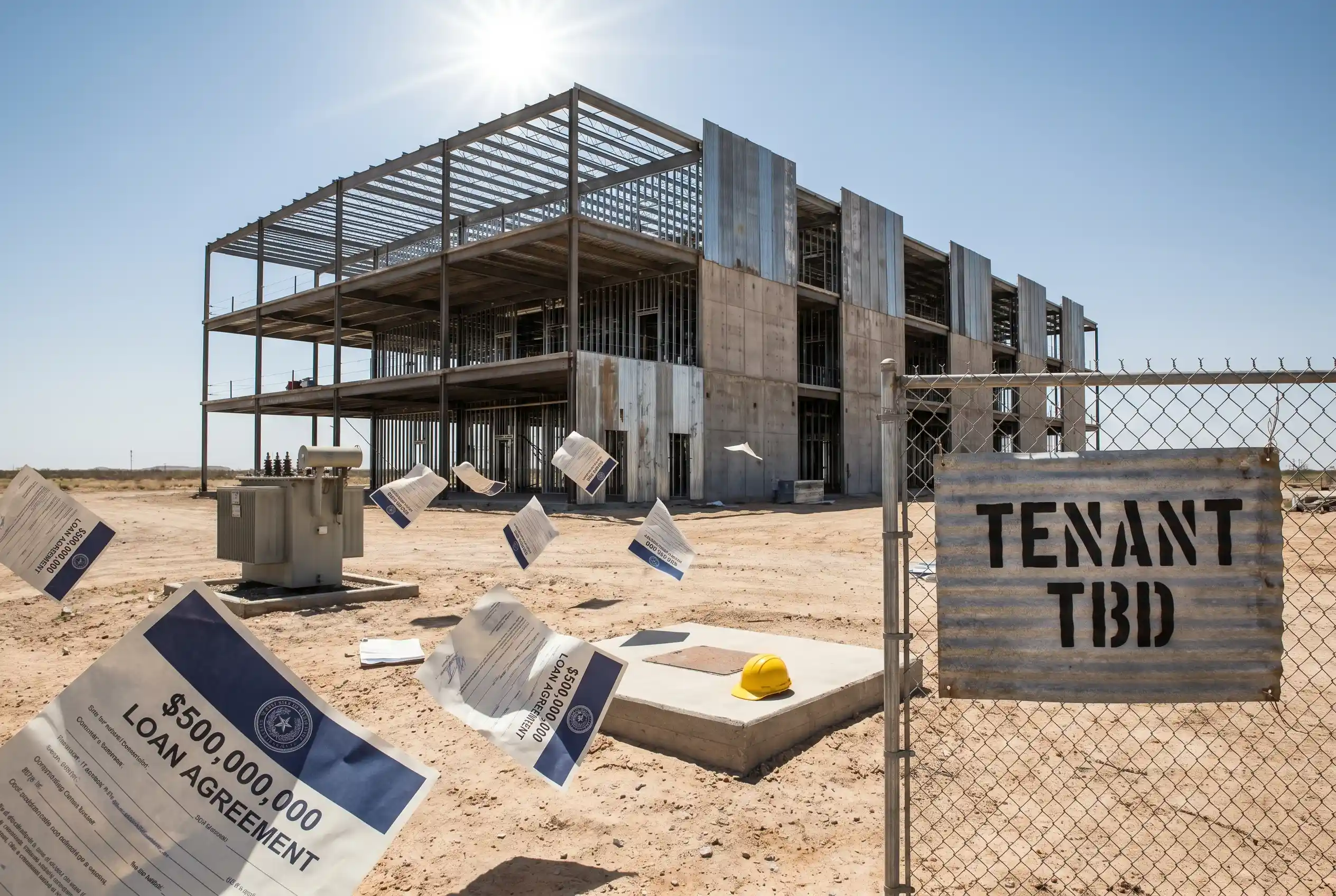
Oracle’s $300 billion compute promise to OpenAI has hit a wall the press release didn’t mention: the balance sheets of the banks that were supposed to fund it. JPMorgan Chase, MUFG and a syndicate of Wall Street and Japanese lenders have spent months trying to offload billions in loans tied to Oracle data centers in Texas and Wisconsin, with several internal credit teams flagging that they were pressed against single-borrower exposure limits, according to Bloomberg’s reporting on the Abilene reshuffle and a parallel Wall Street Journal account this week.
The strain has now produced two visible casualties. One is human: between 20,000 and 30,000 Oracle employees have lost their jobs since a March 31 round of 6 a.m. termination emails, with about 12,000 of those positions in India. The other is structural: a 700-megawatt Crusoe-built facility outside Abilene, originally earmarked for Oracle as the OpenAI tenant, was quietly handed to Microsoft after lenders balked at backing the expansion with Oracle’s name on the lease.
This isn’t a story about one bad quarter. It’s the first sustained test of whether a single investment-grade issuer can carry the financing weight of the AI build-out that everyone else is treating as inevitable.
The Single-Borrower Wall Banks Hit
US banks operate under hard internal caps on how much credit exposure they will hold to any one company. Those caps are not regulatory minimums. They are risk-committee policies designed to keep a single client’s blow-up from torching a quarter. Oracle, with roughly $96 billion in long-term debt heading into calendar 2026 and a Baa2 rating, is now bumping against those ceilings at multiple top-tier lenders at once.
The mechanism is straightforward. When Oracle signs a master lease with a developer like Crusoe, Vantage or Related Digital, the lender financing the building treats Oracle as the credit. The cash flow on the loan is Oracle’s rent. So a $14.75 billion construction loan on a Wisconsin data center sits on the books as Oracle exposure, even though Oracle isn’t the borrower of record.
That is why the company is performing what Moody’s, in its December 2025 outlook revision to negative, called “project finance functions” without the legal ring-fencing project finance normally carries. The infrastructure risk and the corporate credit risk have been collapsed onto one ticker.
Banks can hedge. They can syndicate. They can’t make the math disappear.
Why Oracle’s Credit Looks Different From Big Tech’s
Lenders are happy to wave Microsoft, Google and Meta through the door because each of those companies generates more free cash flow in a quarter than Oracle does in a year. Oracle’s debt-to-EBITDA ratio is forecast to push past 4x, and analyst sensitivity work from Barclays in November suggested Oracle could exhaust its cash position by November 2026 if capex stays on plan and revenue conversion lags.
| Company | Long-term debt (latest) | S&P / Moody’s rating | 2025 free cash flow | AI capex 2026 plan |
|---|---|---|---|---|
| Oracle | $96B+ | BBB / Baa2 (negative) | Negative through 2027 est. | $35B+ (TD Cowen est.) |
| Microsoft | $42B | AAA / Aaa | $74B | $80B |
| Alphabet | $10B | AA+ / Aa2 | $73B | $75B |
| Meta | $28B | AA- / A1 | $54B | $65B |
The gap is what bond desks call “two ratings notches and a continent of cash flow.” That is why the same loan officer who waves through a $20 billion Microsoft facility in an afternoon spends three months trying to syndicate a smaller Oracle-anchored deal.
How $38 Billion Got Past JPMorgan’s Limits
The flagship test came in October, when JPMorgan and MUFG launched a record $38 billion debt package to fund the Texas and Wisconsin sites that anchor Oracle’s slice of the Stargate program. The structure split into a $23.25 billion Texas tranche and a $14.75 billion Wisconsin tranche, both maturing in four years with two one-year extension options, priced at roughly 250 basis points over the benchmark.
To get it done, the lead arrangers had to widen the syndicate aggressively. Allocations went out to:
- JPMorgan and MUFG as joint lead arrangers absorbing the largest commitments.
- Wells Fargo, Goldman Sachs, BNP Paribas, Sumitomo Mitsui Banking Corp. and Societe Generale taking allocated portions to spread single-name exposure across at least seven balance sheets.
- Foreign and regional lenders brought in late to soak up the residual risk that domestic limits couldn’t accommodate.
Even with that distribution, the deal pushed several institutions to internal exposure caps. Bank risk officers, speaking to the Wall Street Journal this past week, described having to negotiate temporary headroom with their own credit committees to participate at the requested size.
The X account Wall St Engine, which tracks debt syndication news, summarized the deal mechanics for retail investors when the financing surfaced.
https://x.com/wallstengine/status/1981496416595038580
The Stargate tie matters because it locks lenders into a structural assumption: that OpenAI’s revenue will eventually back-stop Oracle’s lease payments. Right now, OpenAI is paying with cash from investors and Microsoft, not operating profit.
Abilene’s Quiet Verdict on Oracle Tenancy
Of all the recent data points, the Abilene shuffle is the most telling. Crusoe Energy built a 700-megawatt expansion at its west Texas campus on the assumption Oracle would lease it for OpenAI. Lenders for the expansion, however, refused to underwrite the facility with Oracle on the marquee. Crusoe quietly walked the lease over to Microsoft, which signed a 20-year contract for up to 900 megawatts of capacity at the same campus.
Oracle still occupies earlier phases of the Abilene complex on a 15-year lease, and OpenAI continues to rent Nvidia GPUs from Oracle Cloud at the location. That nuance got lost in most wire copy. Crusoe didn’t lose Oracle. The financing market lost confidence in Oracle as the credit on a brand-new building.
The data center industry rarely produces a cleaner read-through. When a developer can swap one hyperscaler tenant for another in 60 days and the bank syndicate immediately reprices the deal as easier, the market has voted on the underlying credits.
Inside the 6 A.M. Email That Cleared 30,000 Desks
The pressure on the financing side has translated directly into a pressure release on the operating side. Oracle started executing what TD Cowen now calls the largest workforce reduction in the company’s 47-year history beginning March 31, when employees in the United States, India, Canada, Mexico and several European offices opened identical termination emails sent at 6 a.m. local time. The sender field read “Oracle Leadership.” There was no manager call beforehand.
- 30,000. Upper bound of the cuts estimated by TD Cowen, against a global headcount of 162,000.
- 12,000. Positions cut in India alone, roughly 40% of Oracle’s India workforce in a single sweep.
- $8B to $10B. Annual cash freed up, per TD Cowen modeling.
- $2.1B. Restructuring charge Oracle disclosed in its March 2026 10-Q filing, with $982 million already booked in the first nine months of fiscal 2026.
Reaction inside the company spilled onto Reddit’s r/oracle and Blind almost instantly. One survivor’s post on r/cscareerquestions, widely shared, read: “Do not, I repeat do not give even an hour extra of what you would usually give to work. Draw healthy work-life boundaries, go completely offline post office hours.” The mood was less anger than resignation. The cuts had been telegraphed in financial filings for months. The 6 a.m. delivery just made it final.
The $156 Billion Hole the Layoffs Don’t Fill
Cutting 30,000 jobs releases $8 to $10 billion a year. Oracle’s AI infrastructure plan, per TD Cowen, requires roughly $156 billion in capital spending. The arithmetic is brutal.
To close the gap, Oracle has stacked financing channels in parallel. In its February 1 disclosure, the company committed to raising $45 billion to $50 billion in calendar 2026 through a one-time investment-grade bond issuance led by Goldman Sachs, plus an at-the-market equity program of up to $20 billion and a mandatory convertible preferred offering led by Citigroup.
That covers one year. Morgan Stanley analysts have estimated Oracle may need an additional $100 billion or more through 2027 and into early 2028.
“We’ve pondered how Oracle’s considerable funding needs over the next three years may test the depths of different fixed-income markets,” the Morgan Stanley credit team wrote in a note circulated to clients in April.
Then there’s the partner-debt layer banks aren’t on. Oracle has assembled roughly $72 billion in data-center partner financing across Michigan, Texas, Wisconsin and New Mexico for the Stargate program. The Saline Township, Michigan, deal alone reached $16.3 billion, the largest single-facility tech debt package ever assembled. PIMCO had to anchor about $10 billion of the bond tranche after US banks pulled back, with the notes priced at 98.75 cents on the dollar carrying a 7.5% coupon and maturing in 2045. Related Digital and Blackstone provided the equity.
That a private credit giant had to step in where US banks would not is the loudest signal yet that the AI build-out is migrating off bank balance sheets and into pension money, insurance reserves and sovereign wealth pools.
The risk is concentration on the other side, too. If OpenAI’s growth disappoints, Oracle’s lease income slips, the partner-debt structures wobble, and PIMCO’s pension and insurance clients absorb the loss instead of JPMorgan’s loan-loss reserves.
What OpenAI’s Miss Did to the Backlog
Oracle’s December 10 earnings disclosed a remaining performance obligations balance of $523 billion, up $68 billion in a single quarter, of which a substantial portion is the OpenAI contract. That backlog is the central bull case for the stock and the central bear case for the bonds.
The case wobbled this past week. The Wall Street Journal reported on April 28 that OpenAI missed internal user and revenue targets, sending Oracle shares lower and re-opening the question of how much of the $523 billion backlog converts to actual cash on the contracted timeline. OpenAI also expanded a separate cloud agreement with Amazon Web Services, reportedly worth about $138 billion, signaling a multi-cloud posture that dilutes Oracle’s share of OpenAI infrastructure spend.
The backlog is real. The conversion timeline is the disputed variable, and the entire bank financing thesis runs on it.
Frequently Asked Questions
Why are banks like JPMorgan struggling with Oracle’s data center loans?
Each bank has internal single-borrower exposure caps set by its risk committee. Oracle’s $300 billion OpenAI contract is producing so many connected loans, even when borrowed through partner developers like Crusoe, Vantage and Related Digital, that lenders treat the cumulative figure as Oracle credit. Several US banks have hit those internal caps and now have to syndicate, hedge, or hand pieces to private credit firms to participate in further deals.
How many people did Oracle lay off in 2026?
TD Cowen estimates between 20,000 and 30,000 employees have been or will be cut, against a global headcount of about 162,000. Roughly 12,000 of those positions were eliminated in India, equivalent to a 40% reduction of Oracle’s India staff. The terminations began on March 31, 2026, delivered through identical 6 a.m. “Oracle Leadership” emails with no advance notice from managers.
Did Oracle lose the Abilene, Texas data center to Microsoft?
Partly. Crusoe built a 700-megawatt expansion on the assumption Oracle would be the tenant for OpenAI workloads. Lenders refused to back the facility with Oracle on the lease, so Crusoe handed the new capacity to Microsoft on a 20-year contract for up to 900 megawatts. Oracle still occupies earlier phases of the Abilene campus on a 15-year lease, and OpenAI still rents GPUs from Oracle Cloud at the same location.
What is Oracle’s $50 billion 2026 financing plan?
Oracle plans to raise $45 to $50 billion of gross proceeds during calendar 2026 through a balanced mix. Half comes from a single one-time investment-grade senior unsecured bond offering led by Goldman Sachs. The other half comes from a mandatory convertible preferred equity offering and an at-the-market common equity program of up to $20 billion, both led by Citigroup. The proceeds fund data center expansion for OpenAI, AMD, xAI, Meta, TikTok and Nvidia.
Why did Moody’s downgrade Oracle’s credit outlook?
Moody’s revised Oracle’s outlook to negative from stable in December 2025, citing high counterparty concentration after the OpenAI deal and rising leverage. Moody’s affirmed the Baa2 rating but warned that Oracle’s debt is expected to grow faster than EBITDA, with leverage projected above 4x and free cash flow staying negative for an extended period before reaching breakeven. Barclays separately downgraded the debt to Underweight in November.
Will the AI data center boom run out of bank financing?
Mainstream estimates suggest hyperscalers can self-fund only about half of the projected $3 trillion in AI infrastructure spending through 2028 from operating cash flow. The rest needs to come from bank debt, public bonds and private credit. Microsoft, Alphabet and Meta still attract strong bank support. Oracle’s experience shows that lenders are now actively rationing capacity for issuers with weaker free cash flow profiles, pushing more risk onto private credit firms like PIMCO and Blackstone.
For now, Oracle is making the bridge. Cash from layoffs, new bonds, partner-debt structures and convertible preferreds together should cover calendar 2026, and possibly 2027 if OpenAI’s revenue ramp accelerates. The harder year is 2028, when the bond tranche on the Texas and Wisconsin loans matures and the next $100 billion of capex falls due. By then, the question is no longer whether banks can absorb Oracle. It is whether the pension funds and insurance pools that are quietly stepping in for the banks decide they like what they own.

-
 TECH1 year ago
Where Garmin Watches are Made and How They are Assembled
-

 AUTO2 months ago
Tesla’s Roadster Is ‘a Few Weeks Away,’ Says Its Chief Designer
-
 NEWS10 years ago
Samsung Releases Galaxy Note7 TV Ad as Reddit AMA Leaks Specs
-
 NEWS10 years ago
Android 7.0 Nougat Rolls Out To Nexus Devices With New Emoji, Features
-
 FINANCE9 years ago
Cardano Price Surges as ADA Enters the Crypto Top Ten List
-
 NEWS10 years ago
Pre-Order the First Camera Made for Facebook Live Streaming Video
-
 FINANCE1 year ago
Binance Suspends Trading and Withdrawals for a System Upgrade
-
 FINANCE9 years ago
RChain Price Jumps Nearly 150% to a New All-Time High of $2.03