
NEWS
Columbia AI Tool Finds ‘Hidden’ Sperm in 30% of Infertile Men

Doctors at Columbia University are using an artificial intelligence system to find sperm cells in men whose semen tests have come back empty for years, and the technology has now helped produce the first confirmed pregnancy from a patient who had been told he had no chance of biological fatherhood. The method, called STAR, scans millions of images in under two hours and pulls out individual sperm so rare that human technicians routinely miss them.
The Columbia University Fertility Center reports that STAR has located viable sperm in just under 30% of patients tested, all of whom had previously been diagnosed with azoospermia. The first baby conceived with the system was confirmed in 2025, and a research letter describing the case was published in The Lancet on October 31, 2025.
For roughly 1% of all men and 10% of men dealing with infertility, that 30% number is the difference between using their own DNA and turning to a sperm donor.
Inside Columbia’s STAR System
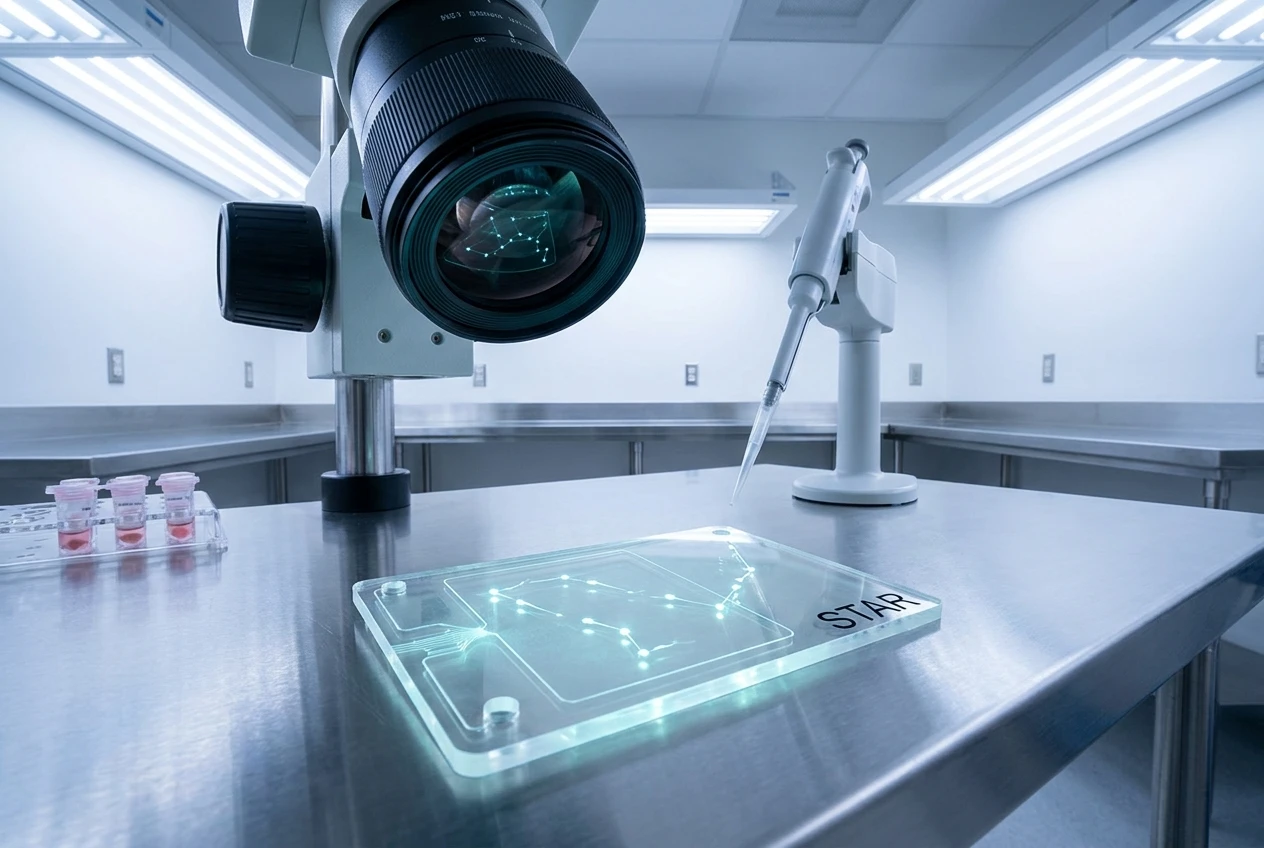
STAR stands for Sperm Tracking and Recovery, and it borrows its core idea from astrophysics. The team that built it took the same image-processing logic astronomers use to flag a single faint pixel in a deep-space photograph and pointed it at a slide of human semen. The Columbia Fertility Center’s account of the project describes the comparison directly: find the rare sperm cell the way you’d find a new planet.
The pipeline runs in three tightly linked steps:
- Image. A high-speed microscope captures roughly 300 frames per second, more than 8 million images per hour, of fluid moving through a microfluidic chip etched with channels as thin as a human hair.
- Identify. A machine learning model trained on cell-shape patterns flags any object that matches the signature of a sperm cell, ignoring debris, white blood cells, and tissue fragments.
- Isolate. A robot acts on the flag within milliseconds, diverting that slice of fluid into a holding chamber. There is no centrifuge spin, which avoids the mechanical stress that often kills fragile sperm.
The cell can then be used immediately for in vitro fertilization or frozen for later. The whole flow, from sample to stored sperm, can run in two hours on a single semen specimen.
What the AI Sees That Humans Miss
The case study published in The Lancet’s October 2025 research letter on STAR shows the gap between AI and a trained human at this task. From a 3.5 mL sample, the system scanned 2.5 million images in about two hours and pulled out two viable sperm. A skilled embryologist combing the same fluid by eye would not reliably find either one.
Zev Williams, director of the Columbia University Fertility Center, has said the system identified 40 times more sperm than manual searches by trained technicians and posted a 100% sensitivity rate in early testing. That is the part of the story doctors keep coming back to. The sperm were always there. The detection method was the bottleneck.
The numbers behind the procedure tell their own story:
- 8 million images per hour. The throughput of the imaging stage on a single chip.
- 2 sperm cells. The total recovered in the first published case, enough to create two embryos.
- 30%. Share of azoospermia patients in whom STAR has found usable sperm, per Williams.
- 1%. Share of all men affected by azoospermia, the condition STAR targets.
One healthy sperm is all an embryologist needs to fertilize an egg through intracytoplasmic sperm injection. STAR is built around that fact. The system isn’t trying to recover a sample. It’s trying to recover a single cell.
The First Baby and the 19-Year Wait
The pregnancy that proved the system worked involved a couple identified only as Samuel and Penelope. Samuel has Klinefelter syndrome, a chromosomal condition in which males are born with an extra X chromosome, and is the most common genetic cause of non-obstructive azoospermia, accounting for roughly 17% of cases. Samuel and Penelope had been trying to conceive for nearly two decades. Multiple IVF cycles, manual sperm searches, and two surgical extractions had all failed. STAR found two cells.
“You only need one healthy sperm to create an embryo. There are so few things where the reward for all the effort that was put into it is something as wonderful and special as this. Now there’s a baby girl and hopefully, God willing, many, many more.” Zev Williams, director of the Columbia University Fertility Center.
Where Top Fertility Doctors Split
Outside Columbia, the response has been mixed. The reservation that gets the most weight comes from Gianpiero Palermo, the embryologist who developed intracytoplasmic sperm injection in the early 1990s and reshaped male infertility care. Palermo has questioned whether STAR is doing more than putting a finer mesh over the same biological reality, and has warned that some patients with non-obstructive azoospermia genuinely produce no sperm at any point in the cycle.
His concern is practical: a 30% hit rate, framed without context, can read to a desperate patient as a 30% chance of a baby. It is not. It is a 30% chance of finding a usable cell, which is the first step in a chain that still includes egg retrieval, fertilization, embryo development, transfer, and a successful pregnancy. Each step has its own attrition.
San Francisco reproductive endocrinologist Aimee Eyvazzadeh has pushed back on the cautious read. “AI isn’t creating sperm. It’s helping us find the rare, viable ones that are already there but nearly invisible,” she has told reporters covering the technology.
Both views can be true at the same time. STAR is a detection upgrade, not a biology upgrade.
Project lead Hemant Suryawanshi, an assistant professor of reproductive sciences at Columbia, has said the team is now running larger trials to test STAR across broader patient populations. Until those results land, the 30% figure rests on the center’s own caseload.
The Money Math Patients Won’t See in the Press Release
STAR sits inside a treatment chain that is already expensive. Microsurgical testicular sperm extraction, the surgery many azoospermia patients undergo before considering AI tools, runs roughly $8,000 to $12,000 per attempt at University of Utah Health’s fertility program. A full IVF cycle in the United States typically adds another $15,000 to $25,000 before medications.
Columbia has not published a price for STAR access, and most U.S. health insurance does not cover infertility services. For couples weighing whether to pursue it, the comparison looks roughly like this:
| Approach | Sperm Found | Per-Attempt Cost | Trauma to Patient |
|---|---|---|---|
| Manual search of ejaculate | Baseline (often zero in azoospermia) | Included in IVF workup | None |
| microTESE surgery | ~43% retrieval rate (Klinefelter cohorts) | $8,000 to $12,000 | Surgical, recovery time |
| STAR (Columbia) | ~30% in tested azoospermia cases | Not publicly priced | None beyond standard sample |
| Donor sperm | 100% availability | $1,000 to $1,500 per vial | None biological |
The trade-off is not just clinical. It’s also a question of how many cycles a couple can afford before they shift to donor sperm. STAR’s appeal is that it sits earlier in the chain than surgery and may save some patients a microTESE altogether. For couples already deep into the multi-cycle reality of IVF spending, that timing matters as much as the headline percentage.
How AI Is Quietly Rewriting Every Step of IVF
STAR is the most dramatic example of AI moving into fertility care, but it isn’t the only one. The global male infertility market sat at $4.85 billion in 2025 and is projected to hit $8.05 billion by 2035, per industry data tracked by Nova One Advisor’s male infertility report. AI tools are a major reason that growth curve looks the way it does.
Embryo selection algorithms now predict implantation viability with around 85% accuracy, against roughly 60% for traditional embryologist scoring. CooperSurgical pushed an AI-integrated computer-assisted sperm analysis system into clinics in January 2025. Mayo Clinic researchers have published an AI model that flags pancreatic cancer years before symptoms appear, part of the same broad shift toward AI-driven medical diagnostics reshaping clinical practice.
Frequently Asked Questions
What does the STAR method actually do?
STAR, short for Sperm Tracking and Recovery, uses high-speed microscopy, AI image recognition, and a microfluidic chip to scan a semen sample for individual sperm cells. It can process more than 8 million images per hour and isolate any sperm it finds within milliseconds, so the cells can be used in IVF without surgical extraction.
Who can use the STAR method?
It is currently aimed at men diagnosed with azoospermia, especially non-obstructive azoospermia caused by conditions like Klinefelter syndrome. Columbia University Fertility Center is the first clinic offering it. Larger trials are underway to test it in broader patient populations, so availability outside Columbia remains limited as of May 2026.
How successful is the STAR method?
Columbia reports finding usable sperm in just under 30% of azoospermia patients tested, with 40 times more sperm identified than manual searches by trained embryologists. The first confirmed pregnancy was reported in 2025. A 30% sperm-recovery rate is not the same as a 30% birth rate, since IVF still has to succeed afterward.
How much does the STAR method cost?
Columbia has not published a public price for STAR. Patients should expect it to add to standard IVF costs of $15,000 to $25,000 per cycle in the United States, plus any surgical sperm extraction, which runs $8,000 to $12,000. Most U.S. insurance plans do not cover infertility treatment, so out-of-pocket spending is the norm.
Is the STAR method safer than microTESE surgery?
STAR works on a standard semen sample, so it carries none of the surgical risks of microTESE, which involves opening the testis under a microscope to search for sperm. For some men, STAR may avoid the need for surgery entirely. Patients who produce no sperm anywhere in the reproductive tract will still need surgical options or a donor.
When will the STAR method be widely available?
Columbia has not announced a public rollout timeline. The team is running larger clinical trials and has published a single case in The Lancet. Independent replication at other fertility centers will likely take one to three years before STAR is offered routinely outside Columbia.
For now, the STAR method is a single-clinic tool with one published birth, a 30% detection rate, and a long line of patients hoping to be in that fraction. The science is real, the trade-offs are real, and the next round of trial data will decide how far it travels beyond New York.

-
 TECH1 year ago
Where Garmin Watches are Made and How They are Assembled
-

 AUTO2 months ago
Tesla’s Roadster Is ‘a Few Weeks Away,’ Says Its Chief Designer
-
 NEWS10 years ago
Samsung Releases Galaxy Note7 TV Ad as Reddit AMA Leaks Specs
-
 NEWS10 years ago
Android 7.0 Nougat Rolls Out To Nexus Devices With New Emoji, Features
-
 FINANCE9 years ago
Cardano Price Surges as ADA Enters the Crypto Top Ten List
-
 NEWS10 years ago
Pre-Order the First Camera Made for Facebook Live Streaming Video
-
 FINANCE1 year ago
Binance Suspends Trading and Withdrawals for a System Upgrade
-
 FINANCE9 years ago
RChain Price Jumps Nearly 150% to a New All-Time High of $2.03