
NEWS
Trump, Xi and Putin Recycle a 1985 Nuclear Vow
Trump, Xi and Putin issued a Shenzhen peace text that repeats a 1985 nuclear vow, warns the ICC, and sets no warhead cuts.

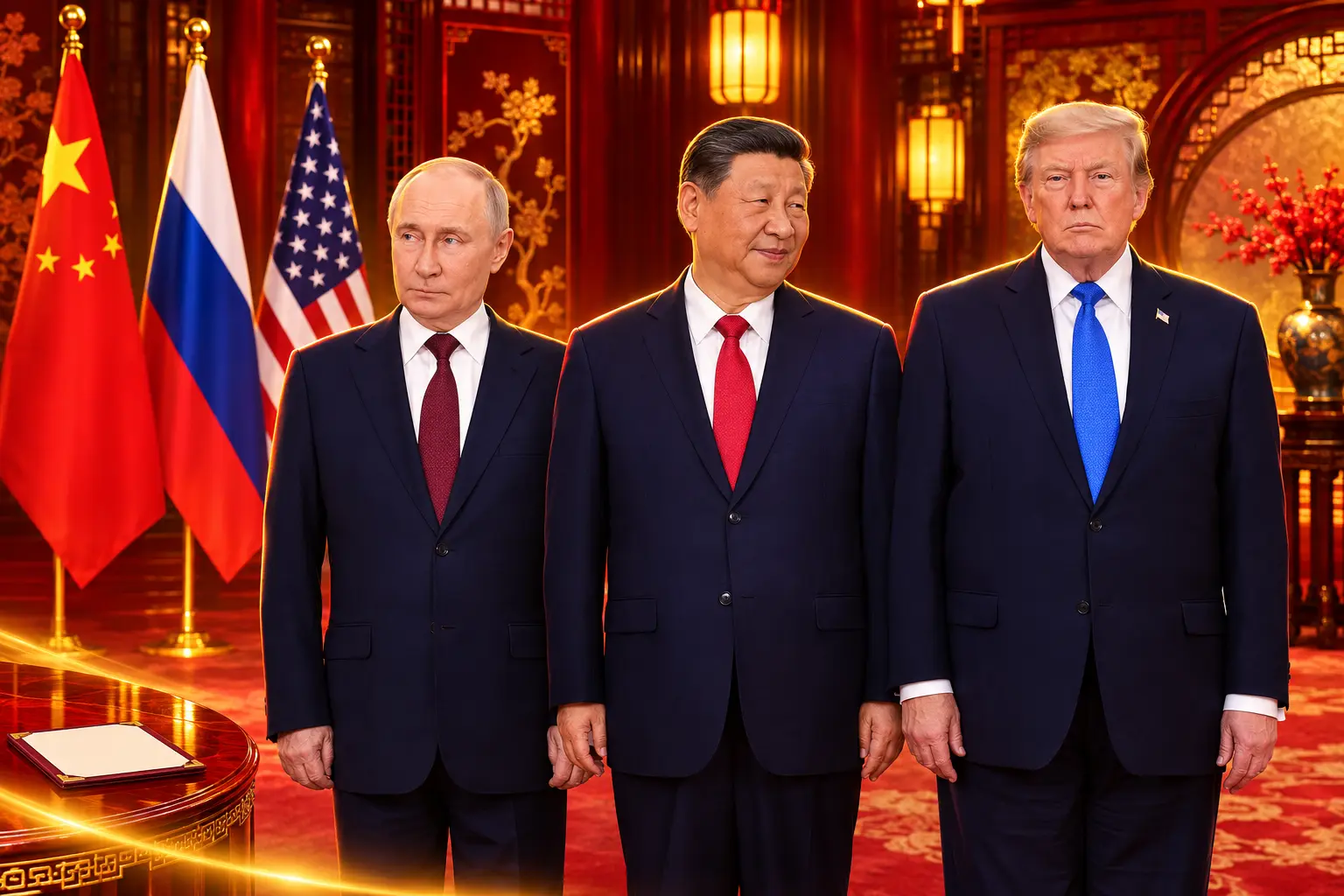
Donald Trump, Xi Jinping and Vladimir Putin issued a four-point peace text in Shenzhen on November 19 that set no warhead limits.
The first Trump-Xi-Putin trilateral summit lasted about 90 minutes at Kylin Villa, on the sidelines of the APEC meetings. Trump had come to talk about cutting nuclear weapons. The paper they signed talked about nuclear risk, oil, the United Nations and the International Criminal Court.
Four Points and No Warhead Caps
China hosted, and the Russian and U.S. presidents thanked Beijing for the first sitting of the three. Xi called the format a landmark. Trump said they were making history. Putin said the three were founding members of the United Nations with a shared duty for peace. None of that produced a number, a date or an inspector.
The Chinese government posted the four-point Declaration toward Peace after the session. It is short enough to read in a minute, and every clause is written to be signed without anyone giving anything up.
WHAT THE FOUR POINTS PROMISE
| Point | The commitment | What is missing |
|---|---|---|
| 1. United Nations | The three, as permanent members of the Security Council, commit to reform the UN so it can meet global challenges. | No reform plan, no other members named, no timetable. |
| 2. Energy | They plan to raise production and supply of refined petroleum products and stress stable energy flows. | No volume, no sanctions language, no price. |
| 3. Courts | State consent and official immunities are of paramount importance; the ICC and similar bodies must not abuse their jurisdiction. | No case named, no court reform, no exception for war crimes warrants. |
| 4. Nuclear weapons | A nuclear war cannot be won and must never be fought. The three will hold a dialogue on reducing nuclear risks and preventing spread. | No arsenal cuts, no start date, no verification, no mention of the Nuclear Non-Proliferation Treaty. |
Trump told the table the three were uniquely placed to discuss how to reduce the number of nuclear weapons on Earth. The signed line is narrower. It commits them to a dialogue on reducing nuclear risks, which a state can join while still adding warheads.
The Same Sentence Reagan Signed in Geneva
The nuclear sentence is not new. Ronald Reagan and Mikhail Gorbachev put it in the 1985 Geneva joint statement after three days of talks that began, as this meeting did, on November 19. The wording matches. The bargain around it does not.
The sides, having discussed key security issues, and conscious of the special responsibility of the USSR and the U.S. for maintaining peace, have agreed that a nuclear war cannot be won and must never be fought.
Joint Soviet-United States Statement, Geneva, November 21, 1985
Geneva also told negotiators to hurry toward 50 percent cuts in offensive nuclear arms, plus an interim deal on intermediate-range missiles. Those talks were already running. Shenzhen created no equivalent track. Forty-one years later the three presidents borrowed the slogan and left the arithmetic behind.
Tong Zhao, a senior fellow at the Carnegie Endowment for International Peace, called the fresh recitation better than nothing. The 1985 line was a door into years of staff work. The 2026 line is the whole harvest of a 90-minute sitting.
China Took a Seat at 620 Warheads
Trump has wanted China in a nuclear deal since his first term. Beijing has said no on a simple ground: its force is much smaller, so equal ceilings would freeze a gap that still favors Washington and Moscow. In April, Sun Xiaobo, China’s director-general for disarmament, told the Nuclear Non-Proliferation Treaty review that Washington’s multilateral pitch was an attempt to shift its own duties onto others, and that China has no interest in them.
On November 19 China sat anyway, because the paper asked for a dialogue rather than a freeze. The Stockholm International Peace Research Institute’s yearbook, with figures for the start of 2026, shows why that distinction matters to Beijing.
SIPRI NUCLEAR INVENTORIES, JANUARY 2026
| Country | Total inventory | Military stockpile | Deployed |
|---|---|---|---|
| Russia | about 5,420 | 4,400 | 1,796 |
| United States | 5,042 | 3,700 | 1,770 |
| China | about 620 | 620 | not separately listed as a peer force |
SIPRI’s global count is 12,187 warheads counted in January, of which 9,745 sit in military stockpiles and 4,012 are deployed. Russia and the United States hold almost 86 percent of the inventory and about 83 percent of the usable stockpiles. China’s pile rose from 600 a year earlier and from roughly 260 a decade ago, the fastest climb of the nine nuclear-armed states. The Pentagon has projected more than 1,000 Chinese warheads by 2030. Even then the force would remain far below either of the other two.
Trump still called them the three largest nuclear powers by far. That billing is the concession. China did not have to freeze a single silo to collect it.
FROM NEW START TO SHENZHEN
- February 5, 2026: The New START treaty expires, ending the last legal caps on U.S. and Russian strategic forces, set at 1,550 deployed strategic warheads and 700 deployed missiles and bombers.
- February 5, 2026: Trump posts that nuclear experts should work on a new, improved treaty. He had already passed on Putin’s offer to keep the old ceilings for one more year without the old inspections.
- April-May 22, 2026: The NPT review conference in New York closes without consensus, the third straight failure and 16 years after the last agreed final document. China repeats that it will not join talks built as equal cuts.
- November 19, 2026: The three presidents meet in Shenzhen and promise a nuclear-risk dialogue with no ceilings attached.
Those New START figures and the SIPRI deployed counts are not the same ledger. The treaty counted only deployed strategic warheads. SIPRI’s deployed column includes other operational weapons. After February 5, neither column is bound by a treaty.
Why the ICC Line Was Written In
Point 3 is the clause with a defendant. The International Criminal Court’s Pre-Trial Chamber II issued arrest warrants issued in March 2023 for Putin and Maria Lvova-Belova, Russia’s commissioner for children’s rights, over the alleged unlawful deportation and transfer of Ukrainian children from occupied territory. Russia is not a party to the Rome Statute and rejects the court.
Trump arrived already on that side of the argument. In his opening remarks he said he would suggest ways to protect national sovereignty from rogue globalist organisations such as the International Criminal Court, which he said had gotten out of control and strayed far beyond its jurisdiction. The joint text adopted his complaint in diplomatic clothes: state consent and official immunities are of paramount importance, and the court must not abuse its jurisdiction.
No warrant is withdrawn by a communiqué. What the sentence does is put the United States and China on paper with Russia against the court that named Putin. For a leader the West tried to isolate after the 2022 invasion, that is a seat at the table with a legal alibi attached.
Ukraine Never Made the Joint Text
The war was in the room. Putin said the three had common interests in settling regional conflicts, including the conflict in Ukraine, and that he and Trump had already spent a long bilateral session on it. Trump said that was pretty much what their discussion had been about, and that he hoped both sides wanted the war to end. Xi, chairing, did not mention Ukraine in his opening remarks. He talked about more than 10,000 wars in human history, more than 60 smouldering local conflicts, and the duty of major powers in a global village.
None of that survived into the four points. Iran did not either, though Trump said the three had to stop nuclear spread and that Washington would not let Iran obtain a weapon, a live U.S. war he had already put on his own agenda.
SAID IN THE ROOM, ABSENT FROM THE TEXT
- Ukraine: Putin and Trump both said they had spent time on the war; the declaration never names it.
- Iran: Trump tied non-proliferation to the U.S. fight with Iran; the paper is silent.
- Warhead totals: Trump asked for a discussion of reducing numbers; the paper asks for a discussion of reducing risks.
- North Korea: The proliferation clause names no program and no peninsula.
Volodymyr Zelensky said questions concerning Ukraine must be decided with Ukraine involved, a line Kyiv has used whenever Washington talks over its head. The Shenzhen text did not decide a settlement. It also did not record that a settlement was even on the table.
Berlin Called Shenzhen a Photo Opportunity
European leaders met in Berlin on the same day, backing Ukraine while the three presidents sat in Guangdong. German Chancellor Friedrich Merz rejected the comparison that had already begun to travel with the pictures.
A Yalta format will not bring peace.
Friedrich Merz, German chancellor, Berlin, November 19, 2026
Merz called the sitting a photo opportunity and said the United States understands there can be no peace without Europe. Trump’s son-in-law and envoy Jared Kushner, standing with him, said Trump had dialled into Berlin and come away from Putin and Xi believing peace is achievable. Those two sentences can both be true and still describe different meetings.
James Crabtree, a visiting fellow at the European Council on Foreign Relations, said the three-way format underlines how unreliable Washington now looks to Japan, South Korea, Australia and the Europeans who used to treat the United States as the floor of the system. Slovak Prime Minister Robert Fico took the other side, calling the session historic and saying Europe was no longer invited to the table. The argument in allied capitals is not about warhead physics. It is about who is in the photograph.
Point 2, the refined-fuel pledge, lands in the same fight. Ukraine has been hitting Russian energy sites. A U.S.-China-Russia plan to raise output of refined products, written as a gift to all nations, is also a signal that fuel flows matter as much in this format as a ceasefire.
The Dialogue Has No Date and No Inspectors
Amy J. Nelson, writing in Arms Control Today in September, warned that a summit-driven nuclear track would replace inspectors and legislatures with whatever three men will still say to each other after the next election. Shenzhen is that model in miniature. The verification architecture that died with New START is not in the new text. Neither is a promise to hold deployed strategic forces at the old 1,550 cap while something else is written.
Xi can take the pictures home as proof that China now sits with the two legacy arsenals as a peer. Putin can take the ICC sentence and the open door. Trump can take a peace declaration that uses Reagan’s words. The wars they each brought into the villa are still running, and the nuclear dialogue they announced has no start date, no agenda and no one assigned to count a warhead.
Geneva’s sentence opened a staff process that later cut a class of missiles. Shenzhen’s sentence ended a morning.

India’s First-Timers and Pant Build a Record 720

Kutch Crash Kills Seven From Army Families After October Toll

Ukrainian Drones Leave Finland Fighting a Russian Ship Fire

ICJ Genocide Order Runs Through Arakan Army Land

CII Asks Patel Panel to Shift Who Funds Indian Credit

Clancy Juror Says the Holdout Never Cited Evidence

The iPhone 18 Pro Max Splits Apple’s Fall in Two

OpenAI Calls GPT-6 Astra AGI Then Locks Its Exploits

Trump Claims Hormuz Control as Oil Holds Near $96

Russia Closes the Goethe-Institut Berlin Tried to Save

 NEWS2 months ago
Clancy Juror Says the Holdout Never Cited Evidence
- NEWS3 months ago
The iPhone 18 Pro Max Splits Apple’s Fall in Two
- NEWS3 months ago
OpenAI Calls GPT-6 Astra AGI Then Locks Its Exploits
- BUSINESS3 months ago
Trump Claims Hormuz Control as Oil Holds Near $96
- LIFESTYLE3 months ago
Russia Closes the Goethe-Institut Berlin Tried to Save
- AUTO3 months ago
Volkswagen’s Job Cuts Leave Four Plants Without Cars
- NEWS3 months ago
Dyson Puts Nurovi Robots on Sale Without the UV Flagship
- BUSINESS3 months ago
US Destroys Five Iranian Tankers as the Shock Hits Jordan










