
NEWS
Stanford’s AI Designed 16 Living Viruses. Now the Screening Clock Is Ticking

Stanford and Arc Institute researchers have crossed a line synthetic biology has been chasing for two decades: an artificial-intelligence model designed complete viral genomes from scratch, and 16 of those designs came alive in a Petri dish. The work, posted to bioRxiv on September 12, 2025 and now circulating in pre-publication form across regulator inboxes, used the Evo 1 and Evo 2 genome language models to generate 302 candidate phiX174 variants, of which 16 successfully infected and killed Escherichia coli. As of April 2026, it remains the first end-to-end generative design of functional, evolutionarily novel bacteriophages, and the first hard test of whether the world’s gene-synthesis screening regime can keep up.
The result has put two clocks on a collision course. One belongs to AI biology, which is now generating viable genomes carrying up to 392 novel mutations from anything in nature. The other belongs to the International Gene Synthesis Consortium, whose updated screening protocol does not require providers to flag synthetic DNA orders at the 50-base-pair threshold until October 2026.
What Stanford and Arc Actually Built
The team, led by Stanford assistant professor Brian Hie with student researcher Samuel King at the Arc Institute, fine-tuned the Evo models on a curated set of 14,466 Microviridae sequences clustered at 99 percent identity. Evo 1, described in the November 2024 Science paper on sequence modeling from molecular to genome scale, was trained on roughly 2.7 million prokaryotic and phage genomes. Evo 2, formally published in Nature in March 2026, scaled to 9.3 trillion nucleotides spanning every domain of life, with a one-million-token context window at single-nucleotide resolution.
The target was phiX174, a tiny lytic phage first isolated from Paris sewage in 1935. It carries 11 genes packed into 5,386 bases of overlapping reading frames, the kind of architecture that punishes sloppy edits. The model did not edit. It wrote.
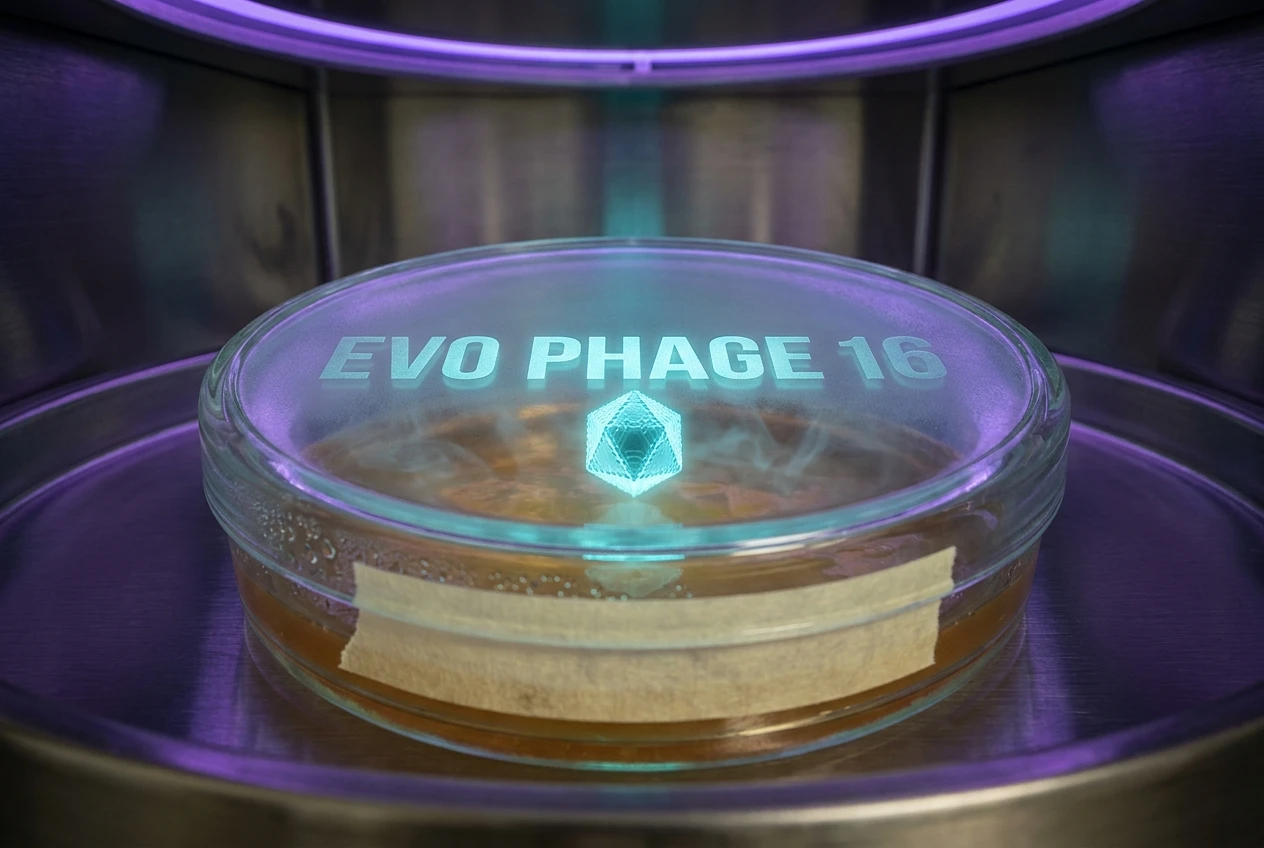
From 302 generated candidates, the lab synthesised, transfected, and screened every design. Sixteen replicated, lysed their hosts, and produced viable progeny. Cryo-electron microscopy of one winning design revealed a DNA-packing protein evolutionarily distant from any known structure.
“That was pretty striking, just actually seeing, like, this AI-generated sphere,” said Brian Hie, the Stanford and Arc researcher who led the work.
Why 16 of 302 Is the Number That Matters
A 5.3 percent hit rate sounds modest. It is not. PhiX174 has been the workhorse of synthetic virology for 90 years, and the previous gold standard, J. Craig Venter’s 2003 reconstruction, copied a known sequence. The Stanford-Arc designs do not copy. The 16 viable genomes carry between 67 and 392 novel mutations relative to the nearest natural genome, a divergence wide enough that several would qualify as their own species under International Committee on Taxonomy of Viruses rules.
Some of the AI-designed phages also outperformed the wild type. Lysis kinetics ran faster. Head-to-head fitness competitions tipped toward the synthetic versions. A cocktail of generated phages cleared phiX174-resistant E. coli in three separate strains, the kind of result phage-therapy clinicians have been trying to engineer manually since the 1920s.
“They saw viruses with new genes, with truncated genes, and even different gene orders and arrangements,” said Jef Boeke, director of the Institute for Systems Genetics at NYU Langone Health. The Microviridae fine-tuning matters: it taught the model genre, not memorisation.
The Image That Changed the Biosecurity Conversation
For two years, regulators have asked whether genome-scale models could produce coherent, working biology or only plausible-looking nonsense. The cryo-EM structure answered that. A capsid that does not exist in nature, designed by software, was now sitting in a buffer at Stanford.
The team’s safety choices were deliberate. Evo’s training corpus excluded sequences from human-infecting viruses, the lab worked only with non-pathogenic E. coli C, and synthesis was confined to dedicated biosafety cabinets. None of those choices apply to anyone else who downloads the open weights.
A Screening Regime Built for an Older Threat
The infrastructure meant to catch dangerous synthetic DNA orders was designed against a different adversary: a graduate student typing in a known smallpox sequence. AI-generated genomes break the assumption underneath that defence.
The October 2026 Deadline
Under version 3.0 of the IGSC Harmonized Screening Protocol, signed in September 2024, gene-synthesis providers must begin flagging orders at 50 base pairs by October 2026, down from the previous 200-base-pair threshold. The protocol still relies on best-match comparisons against a database of regulated pathogen sequences. An Evo-designed genome with 67 to 392 novel mutations is, by construction, a poor best-match to anything on that list.
What the Protocol Misses
The new U.S. Office of Science and Technology Policy framework on nucleic-acid synthesis screening, finalised in April 2024, formalised customer screening and order logging. Neither it nor the IGSC protocol explicitly covers AI-rewritten sequences whose function is preserved while their surface identity is scrambled. A working group within the International Biosecurity and Biosafety Initiative for Science has been drafting AI-aware screening guidance since late 2025; no public deadline has been announced.
Where Venter Drew the Line
J. Craig Venter, who led the first synthetic-cell project in 2010, called the bacteriophage work “just a faster version of trial-and-error experiments” but reserved his sharpest warning for the next step.
“One area where I urge extreme caution is any viral enhancement research, especially when it’s random so you don’t know what you are getting,” Venter told Newsweek on September 18, 2025. “If someone did this with smallpox or anthrax, I would have grave concerns.”
The Stanford team has not extended Evo to mammalian-tropic viruses, and the published model card explicitly excludes them. Open-weight derivatives are another matter. Evo 2’s weights, code, training data, and inference framework were released openly in February 2025 through Arc and NVIDIA’s BioNeMo platform.
The Therapy Pipeline Investors Are Already Pricing
The same capability that worries biosecurity officials is the basis of a near-term commercial bet. Phage therapy has been a fringe option in Western medicine since penicillin displaced it in the 1940s, but antibiotic-resistant infections kill an estimated 1.27 million people a year, according to the 2022 Lancet Global Burden of Antimicrobial Resistance study.
Designed phages bypass the slowest step in the field: hunting sewage for a wild virus that happens to kill the patient’s strain. “Most gene therapy uses viruses to shuttle genes into patients’ bodies, and AI might develop more effective ones,” said Samuel King, the Arc student researcher on the project.
“This is the first time AI systems are able to write coherent genome-scale sequences,” Hie told Nature.
Two early-stage companies, Phare Bio and Adaptive Phage Therapeutics, have publicly disclosed partnerships exploring AI-designed phage libraries. Neither has named Evo specifically. Series-A term sheets circulating in Boston and the Bay Area in the first quarter of 2026 increasingly include clauses on dual-use risk disclosure, according to two venture investors who reviewed them.
How AI-Designed Genomes Compare to Earlier Synthetic Biology
| Milestone | Year | Genome Size | Method | Novelty vs. Nature |
|---|---|---|---|---|
| Venter phiX174 reconstruction | 2003 | 5,386 bp | Manual chemical synthesis | None, exact copy |
| JCVI synthetic Mycoplasma cell | 2010 | 1.08 Mb | Stitched natural sequence | Watermarks only |
| Sc2.0 synthetic yeast chromosomes | 2014 to 2024 | ~12 Mb total | Human-redesigned | Engineered edits |
| Stanford-Arc Evo phages | 2025 | 5,386 bp each | AI generative design | 67 to 392 novel mutations |
Frequently Asked Questions
Did AI Actually Design a Living Virus?
Yes, in the narrow technical sense that bacteriophages are functional biological entities, though virologists debate whether viruses qualify as alive. Evo 1 and Evo 2 produced complete genome sequences that, once synthesised and packaged, infected E. coli, replicated, and killed their hosts.
Can Evo Design Viruses That Infect Humans?
Not as released. The Arc Institute team excluded human-infecting viral sequences from Evo’s training corpus, and the published model card prohibits that use. Open weights mean third parties could attempt to fine-tune around those restrictions, which is the core biosecurity concern.
How Many AI-Designed Phages Worked?
Sixteen out of 302 candidate genomes synthesised and tested produced viable, replicating phages, a 5.3 percent hit rate. Some outperformed the natural phiX174 in lysis speed and head-to-head fitness competitions.
What Stops Someone Ordering a Dangerous AI-Designed Sequence?
The International Gene Synthesis Consortium’s Harmonized Screening Protocol requires member providers to screen orders against regulated-pathogen databases. AI-designed sequences with high novelty can score poorly on best-match checks, a vulnerability that screening firms are now patching ahead of the October 2026 50-base-pair flagging deadline.
Is This Already Being Used for Phage Therapy?
Not yet in patients. The Stanford-Arc work was a proof of concept in laboratory E. coli. Companies including Phare Bio and Adaptive Phage Therapeutics have signalled interest in AI-designed phage libraries, but clinical-grade designs require regulatory review under the U.S. FDA’s investigational new drug pathway.
The cryo-EM image of an AI-designed capsid now sits in two places at once: in the supplementary materials of a preprint biosecurity offices have been reading since autumn, and on the slides of every venture pitch meeting selling phage therapy as the antibiotic-resistance answer. Which clock wins, the governance one or the generative one, will be decided in the months between now and the IGSC’s October deadline.

-
 TECH1 year ago
Where Garmin Watches are Made and How They are Assembled
-

 AUTO3 months ago
Tesla’s Roadster Is ‘a Few Weeks Away,’ Says Its Chief Designer
-
 NEWS10 years ago
Samsung Releases Galaxy Note7 TV Ad as Reddit AMA Leaks Specs
-
 NEWS10 years ago
Android 7.0 Nougat Rolls Out To Nexus Devices With New Emoji, Features
-
 FINANCE9 years ago
Cardano Price Surges as ADA Enters the Crypto Top Ten List
-
 NEWS10 years ago
Pre-Order the First Camera Made for Facebook Live Streaming Video
-
 FINANCE1 year ago
Binance Suspends Trading and Withdrawals for a System Upgrade
-
 FINANCE9 years ago
RChain Price Jumps Nearly 150% to a New All-Time High of $2.03