
HEALTH
Smartphone Smoking AI Finds the Five-Minute Relapse Window

Smartphone smoking AI, or artificial intelligence applied to phone sensor data, has crossed a small but striking line: in a new peer-reviewed study, motion sensors inside ordinary phones predicted smoking events within the next five minutes with 85% accuracy, beating a model based on familiar triggers such as time of day.
The study, published on May 21, 2026, in Scientific Reports, is small enough to demand caution and unusual enough to deserve attention. It points to quit-smoking apps that interrupt urges before they crest, while moving addiction support into a sensitive new place: passive behavior prediction from a device people carry all day.
The Five-Minute Window
Maryam Abo-Tabik, a computer science researcher at the University of Central Lancashire, Nicholas Costen, a computing and mathematics researcher at Manchester Metropolitan University, and Yael Benn, a psychology researcher at Manchester Metropolitan University, built the study around the phone people already carry. Their Scientific Reports smoking prediction study followed 17 smokers for about three and a half months.
For the first two weeks, participants logged every cigarette by pressing a button in a phone app. After that, they had a short window to quit, then reported lapses and cravings for three months. The phone continuously recorded accelerometer, gyroscope, magnetometer, light, time and location data, although the strongest model relied on movement sensors rather than location.
- 5-minute window – The model aimed to flag a near-future risk moment, not simply label a cigarette after the fact.
- 85% accuracy – Phone movement data predicted smoking behavior before participants quit.
- 78% accuracy – The same model predicted cravings and lapses during the quit period.
- 17 smokers – The cohort makes the finding early evidence, not a finished medical product.
The best performer was a one-dimensional convolutional neural network with bidirectional long short-term memory (1D-CNN-BiLSTM, a deep learning model built for time-series patterns). In plainer terms, it looked for tiny sequences in the way a phone moved, turned and oriented itself before a smoking-related event.
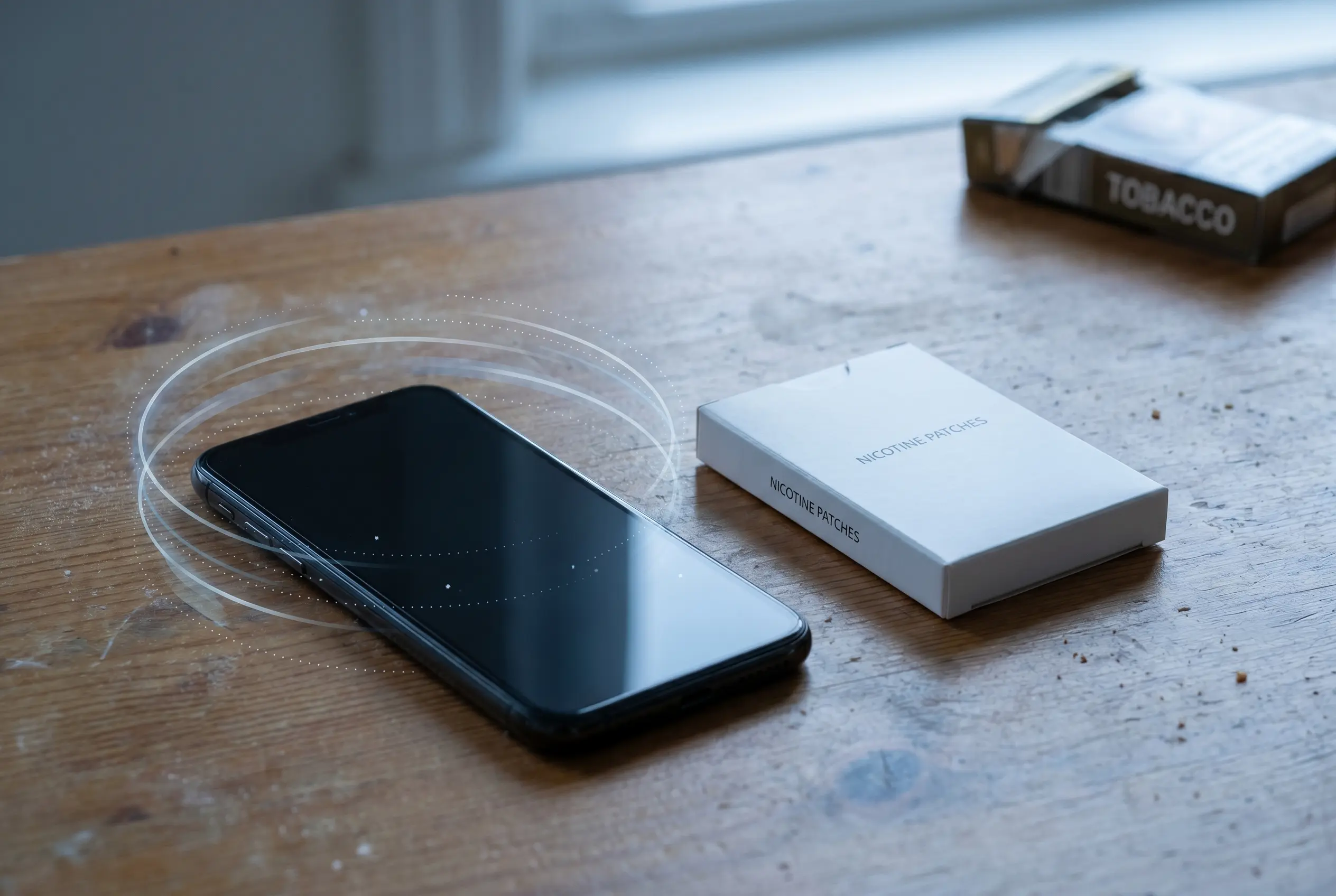
Movement Beat the Usual Triggers
Smoking research has long treated relapse risk as a mix of place, time, mood, social context and access to cigarettes. Those signals still matter. The surprise here is that movement alone carried more predictive power than the familiar trigger set, with the study reporting 63% accuracy for traditional factors and lower performance for time of day by itself.
| Approach | Data Stream | User Cost |
|---|---|---|
| Phone motion AI | Accelerometer, gyroscope, magnetometer | Passive sensing on an ordinary phone |
| Time and trigger models | Time of day, places, urges, social cues | Manual reports or sensitive context |
| PLOS Digital Health lapse prediction study | Ecological momentary assessment (EMA, a short survey asked in the moment), heart rate and steps | Wearable adherence and frequent prompts |
| JMIR just-in-time smoking intervention trial | App reports and weighted risk factors | Survey completion before tailored messages |
The table shows why this result is more than another accuracy claim. If a phone can infer risk before a person opens an app, the intervention can arrive earlier and with less work from the user. That also raises the standard for proof, because a false alert could remind someone of the very habit they are trying to escape.
Why the Phone Matters More Than the Wearable
Wearables have an obvious friction point: the user has to wear the device, charge it and accept another stream of personal monitoring. Phones avoid part of that burden. They sit in pockets, bags, hands and on tables, which makes the data noisy, but also makes the test closer to daily life than a lab task.
- No extra device needs to be issued, fitted or remembered.
- No fixed phone placement was required during the study.
- Fewer active prompts could reduce survey fatigue during a quit attempt.
- Support could be timed to the minutes before a craving peaks.
Current quit apps already show the practical demand. The NHS Quit Smoking app page describes tools for tracking progress, savings and daily support. The new study points to a different layer: not just showing progress after a smoke-free day, but choosing the moment when a nudge might stop that day from breaking.
The paper attacks a passive timing problem: the most useful support may be needed before a person has the words, or patience, to ask for it. That is where an app could show a family photo, a race finish line or another personal cue chosen when motivation was high.
The Sample Is Small, and the Labels Are Messy
The limitations are not footnotes. The study had 17 participants, all in the United Kingdom, and the authors say the result needs testing across cultures, lifestyles and physical-function profiles. A movement pattern seen in a British commuter with full mobility may not translate to a night-shift worker, an older quitter or someone using a mobility aid.
The labels also came from self-report. Participants pressed a button when smoking, then reported cravings and lapses during the quit period. That is better than asking people to remember events days later, but it still leaves noise. A phone movement linked to reporting a craving could partly resemble the motion of opening an app, reading a message or taking the device from a pocket.
One result helps, but does not close the case. In a cross-person test, the model trained on other smokers and then tested a held-out participant, using 14 people with post-quit data. It reached an average receiver operating characteristic area under the curve (AUC, a score for separating events from non-events) of 0.80, with better separation for cravings than lapses. That suggests some shared signal, not a universal rule.
The Privacy Bargain in a Quit-Smoking App
The researchers did not use Global Positioning System data (GPS, satellite location data) in the model. They cited both sensitivity and bias: modern phones often collect location only when the app is open, which in this study happened around reports of smoking or craving. That would make the signal too close to the label.
Motion data may sound less invasive than location, but it is still behavior. A phone’s tilt, pace and handling can hint at commutes, routines, sleep schedules, social settings and disability. The privacy bargain is harder than a standard app permission prompt suggests, especially when the app is tied to addiction and relapse.
A credible product would need plain consent, short data retention, local processing where possible, clear opt-outs and a clean wall between treatment access and research training. It would also need to tell users what happens after a warning: who sees it, whether it is stored, and whether a clinician, insurer or employer could ever touch it. The study itself says future deployment would require ethical compliance and transparency under AI rules.
Addiction AI Has a Wider Target
Smoking is a useful test because events are frequent enough to study and cravings can arrive fast. The broader claim is bigger. The authors suggest that subtle movement signals could one day help detect other health behaviors or conditions, including overeating, insomnia, mental health problems and eating disorders. That claim should stay conditional until larger trials prove it.
The need for better timing is plain. The WHO tobacco fact sheet says tobacco kills more than 7 million people each year, including an estimated 1.6 million non-smokers exposed to second-hand smoke. In the United States, a CDC smoking cessation analysis found that in 2022 most adults who smoked wanted to quit and about half tried in the past year, but fewer than 10% quit successfully.
That gap is where a five-minute warning could matter. Counseling, medication, quitlines and social support remain the proven base of cessation. A predictive app would be an addition, not a substitute, and its first job would be to get the right message into the right window without turning the phone into a source of pressure.
If larger trials across countries, ages and mobility profiles keep the signal, the five-minute warning becomes a clinical design problem. If they do not, the study still leaves a harder question for digital health: how much of a craving was already visible in the phone before the smoker noticed it?
Disclaimer: This article is for informational purposes only and is not medical advice. Smoking cessation, nicotine dependence and digital health tools can involve health risks, privacy considerations and treatment decisions; consult a qualified clinician or cessation professional. Study figures and public health data are accurate as of publication.

-
 TECH1 year ago
Where Garmin Watches are Made and How They are Assembled
-

 AUTO3 months ago
Tesla’s Roadster Is ‘a Few Weeks Away,’ Says Its Chief Designer
-
 NEWS10 years ago
Samsung Releases Galaxy Note7 TV Ad as Reddit AMA Leaks Specs
-
 NEWS10 years ago
Android 7.0 Nougat Rolls Out To Nexus Devices With New Emoji, Features
-
 FINANCE9 years ago
Cardano Price Surges as ADA Enters the Crypto Top Ten List
-
 NEWS10 years ago
Pre-Order the First Camera Made for Facebook Live Streaming Video
-
 FINANCE1 year ago
Binance Suspends Trading and Withdrawals for a System Upgrade
-
 FINANCE9 years ago
RChain Price Jumps Nearly 150% to a New All-Time High of $2.03