
NEWS
Samsung Galaxy Liquid Cooling Signals a Flagship Heat Wall

Samsung Galaxy liquid cooling remains a research project rather than a launch promise, with a Korean report saying Samsung Electronics, the company behind Galaxy phones, has formed a dedicated active-cooling group to study a sealed liquid loop connected directly to the phone’s main processor for steadier gaming, video and on-device artificial intelligence (AI, phone-side model processing).
The timing matters because Samsung’s current answer to heat is already better than it was a year ago. Moving from bigger vapor chambers to circulating coolant would signal a harder truth for premium phones: peak speed is easy to sell, while sustained speed is getting harder to hide.
The Report Puts Liquid Cooling on the Galaxy Road Map
South Korean business outlet Sisa Journal E reported on May 29, 2026, that the work sits inside Samsung’s Production Technology Research Institute, the company’s internal manufacturing and process-research arm. Park Min, a senior researcher and lab lead there, was reported as saying the team is focused on a liquid-cooling structure tied directly to the application processor (AP, the phone’s main chip package for apps, graphics and AI tasks).
That detail is the important one. Samsung already tells buyers on the Galaxy S26 and S26+ thermal page that its redesigned vapor chamber and thermal interface material (TIM, compound that helps heat move between parts) improve heat dissipation by 29% compared with Galaxy S25. A sealed loop would go beyond spreading heat across a plate. It would try to move heat away from the source while heavy tasks are still running.
The company has not announced a liquid-cooled Galaxy phone, a model name or a launch window. That keeps this in the lab category. Still, **the design problem is trust**: if Samsung adds moving coolant to a mass-market flagship, the hardware has to disappear into normal phone life, not feel like a gaming accessory grafted onto a premium slab.
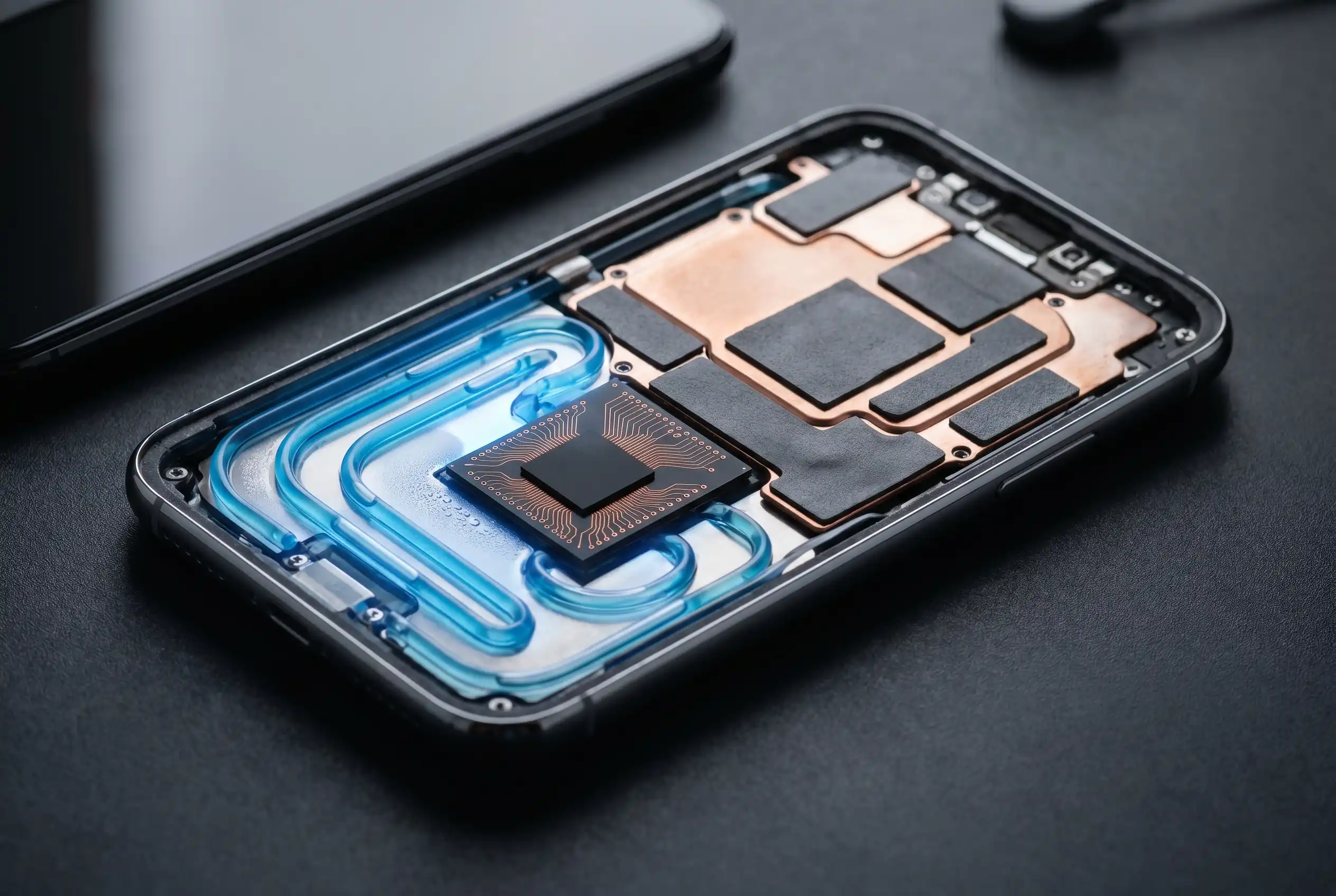
Passive Cooling Is Running Out of Easy Gains
Smartphone cooling used to be a quiet materials race. Graphite sheets got wider. Heat pipes became vapor chambers. Chip packages improved. Software became quicker to throttle a hot central processing unit (CPU, the general compute block) or graphics processing unit (GPU, the graphics block) before a user felt the phone turn uncomfortable.
- 29% better thermal performance is Samsung’s claim for the redesigned Galaxy S26 vapor chamber versus Galaxy S25.
- 16% lower thermal resistance is Samsung Semiconductor’s figure for the Exynos 2600 heat package versus Exynos 2500.
- 24,000 RPM is RedMagic’s claimed fan speed, measured in revolutions per minute, for its AquaCore cooling stack.
Samsung Semiconductor, the company’s chip division, says the Exynos 2600 Heat Path Block package lowers thermal resistance by up to 16% by improving the route heat takes out of the system on a chip (SoC, the package that combines CPU, GPU, AI and other blocks). That kind of packaging gain is valuable because it attacks heat close to the die.
It also shows the ceiling. A better chip package still has to hand heat to a phone body with a battery, cameras, antennas, glass, glue and a user’s hand wrapped around it. The more Samsung asks one device to shoot high-resolution video, run generative edits, keep games smooth and power an always-ready assistant, the less room there is for passive parts to do all the work.
Gaming Phones Show the Hardware Trade
RedMagic, ZTE’s gaming-phone brand, has already turned phone cooling into a visible selling point. OPPO, the Chinese smartphone maker, has tried built-in fans in its K-series gaming devices. Vivo’s iQOO brand still pushes large passive stacks for buyers who want gaming speed without a fan. Samsung is studying the same physics, but for a much broader audience.
| Device Or Line | Cooling Approach | Performance Promise | Design Cost |
|---|---|---|---|
| Galaxy S26 and S26+ | Redesigned vapor chamber with TIM | Better passive heat spread during games and video | Still limited by phone surface area |
| RedMagic 11 Pro | AquaCore flowing liquid cooling system, liquid metal, 3D vapor chamber and fan | Active heat movement under long gaming load | Gaming-phone bulk, vents and visual hardware drama |
| OPPO K13 Turbo Series | OPPO Storm Engine built-in cooling fan with a 7,000 mm² vapor chamber | Cooler surface temperatures during long play | Fan module, ducting, sealing and noise control |
| iQOO 15 | iQOO 15 8K vapor chamber cooling system with graphite and thermal gel | Large passive heat spread with no pump | No active coolant circulation |
Ingress Protection (IP, a lab rating for dust and water resistance) claims are the catch in that table. OPPO says the K13 Turbo fan module carries IPX6, IPX8 and IPX9 water-resistance ratings. RedMagic says its fan is waterproof. Those claims prove active systems can be sealed better than skeptics once assumed, yet they also show why Samsung would move slowly. A Galaxy flagship has to survive millions of pockets, repairs, trade-ins and warranty checks.
Mainstream Buyers Bring Different Constraints
Gaming-phone buyers will accept vents, lights, thicker bodies and visible thermal hardware if frame rates stay high. Galaxy S and Ultra buyers are less forgiving. They expect camera quality, thinness, wireless charging, long support cycles and a clean design before they ask how the cooling stack works. **A sealed phone is a harder place than a gaming shell**.
Water Sealing
A loop that carries coolant has to stay sealed after drops, pressure changes, charging heat and years of battery swelling. A fan system has to move air without inviting dust. Samsung’s premium phones are sold through carriers, retailers and corporate channels where reliability matters as much as launch-day speed. One leak story would travel faster than any benchmark win.
Fan Noise
The report says Samsung is also evaluating air cooling, but fan noise and added weight are obvious problems for a mainstream flagship. A phone can hide a neural processing unit (NPU, the AI math block) or a vapor chamber. It cannot hide a whine during a quiet train ride, a meeting or a late-night video call.
Repair Risk
Service is the boring constraint that often decides whether a lab idea ships. A liquid loop adds parts, bonding steps, inspection points and possible failure modes. It may also complicate battery swaps and back-glass repairs. Samsung can afford exotic engineering in a prototype. It needs repeatable manufacturing for a Galaxy line sold at global scale.
On-Device AI Changes the Cooling Math
The heat question is moving beyond games. Qualcomm, the U.S. chipmaker whose Snapdragon platforms power many premium Android phones, says the Snapdragon 8 Elite Gen 5 mobile platform brings faster CPU, GPU and Hexagon NPU performance while also improving power efficiency. Faster chips reduce wait times, then invite heavier software.
That is where sustained cooling becomes a user feature rather than a lab chart. The phone has to keep its speed after the first burst, when the body is warm and the chip is no longer living off a cold-start advantage.
- Long gaming sessions expose thermal throttling when frame rates fall after early minutes of play.
- High-resolution video capture keeps image processing, storage and display blocks busy at the same time.
- Generative photo edits and local assistants can run repeated NPU loads instead of a single quick task.
- Charging during heavy use adds battery heat to the same crowded body.
Samsung’s choice is not simply liquid versus vapor chamber. **Cooler silicon is only useful if software lets it stay fast**. If the operating system clamps performance early to protect battery life or surface temperature, the extra hardware becomes insurance rather than a visible upgrade.
The Shipping Test Is Reliability, Not Benchmarks
The safest reading is that Samsung is preparing options. The company already improved passive cooling in Galaxy S26 and S26+, and its chip division has made the package itself a larger part of the thermal story. Research into active liquid cooling does not mean the next Galaxy flagship will have a pump.
The commercial logic is clear, though. Samsung competes with Apple in premium phones, with Chinese brands in fast hardware and with its own past devices in upgrade cycles. A cooler Galaxy could give buyers a reason to care about performance after years of annual processor claims that blur together. Sustained speed is easier to feel than a benchmark score.
The risk is just as plain. A liquid-cooled phone would have to pass drop tests, water tests, aging tests and service tests before marketing ever gets to say the word cooling. It would also have to fit beside larger cameras, batteries and antenna layouts without making the device thicker than buyers want.
If Samsung can hide the loop, keep the seals and make the phone feel normal, the Galaxy line gets a performance story buyers can feel after the first minute. If it cannot, vapor chambers will keep doing the quiet work while gaming phones own the showpiece hardware.

-
 TECH1 year ago
Where Garmin Watches are Made and How They are Assembled
-

 AUTO3 months ago
Tesla’s Roadster Is ‘a Few Weeks Away,’ Says Its Chief Designer
-
 NEWS10 years ago
Samsung Releases Galaxy Note7 TV Ad as Reddit AMA Leaks Specs
-
 NEWS10 years ago
Android 7.0 Nougat Rolls Out To Nexus Devices With New Emoji, Features
-
 FINANCE9 years ago
Cardano Price Surges as ADA Enters the Crypto Top Ten List
-
 NEWS10 years ago
Pre-Order the First Camera Made for Facebook Live Streaming Video
-
 FINANCE1 year ago
Binance Suspends Trading and Withdrawals for a System Upgrade
-
 FINANCE9 years ago
RChain Price Jumps Nearly 150% to a New All-Time High of $2.03