
NEWS
Samsung Takes Automotive Memory Lead as China Rewrites the Market

Samsung automotive memory is no longer a side story in the chip cycle. Figures attributed to S&P Global Mobility, the automotive data firm, put Samsung Electronics, South Korea’s largest memory chipmaker, at 40% of the global automotive memory market for 2025, ahead of Micron Technology, the Idaho-based incumbent, at 35%.
The useful read sits in the customer mix. Chinese electric vehicle makers are adding cockpit screens, driver-assistance compute and local supply pressure at the same time data centers used for Artificial Intelligence (AI, model training and inference) are pulling memory capacity away from long-cycle car programs.
The Share Shift Behind the Supplier Ranking
The S&P count, released through industry accounts on May 31, flips the 2025 leaderboard. On that reading, the Korean group gained five percentage points from 2024 while the U.S. rival lost the same amount. A ten-point gap swing in one cycle is unusually sharp for a market built around multi-year vehicle qualifications.
The caveat matters: supplier rankings can differ by revenue, unit shipments and memory category. The 2024 automotive memory vendor summary from TechInsights, the semiconductor research firm, said the Idaho company led that year by revenue, with the Korean group second and Kioxia third. S&P’s new table appears to capture a later, broader demand shift rather than a quiet tweak in one contract.
- 40% – the reported 2025 share for the new leader in S&P-cited automotive memory data.
- 35% – the reported 2025 share for the U.S. rival after leading the prior year.
- $139 billion – S&P Global Mobility’s public forecast for automotive semiconductor revenue by 2031, up from around $90 billion in 2025.
That mix of data points is why the ranking deserves more than a scoreboard read. Automotive memory is small beside phones, PCs and cloud servers, but it is sticky. Once a part is qualified for a car platform, changing it can mean fresh testing, fresh paperwork and fresh risk.
China Became the Fastest Route to the Dashboard
China matters because the car is becoming the place where consumer electronics habits meet safety-grade procurement. The International Energy Agency (IEA, an intergovernmental energy agency) said in its electric vehicle sales review that electric car sales reached 21 million units in 2025 and that battery and plug-in models captured more than half of annual car sales in China for the first time.
For BYD, the Shenzhen-based electric vehicle leader, Xiaomi Auto, the car arm of the Chinese electronics company, and Geely, the Hangzhou-based automaker, the dashboard is no longer a radio slot. It is a rolling phone, a mapping terminal, a voice assistant and a driver-monitoring display. More local model launches mean more chances for a memory supplier to become default-approved across related platforms.
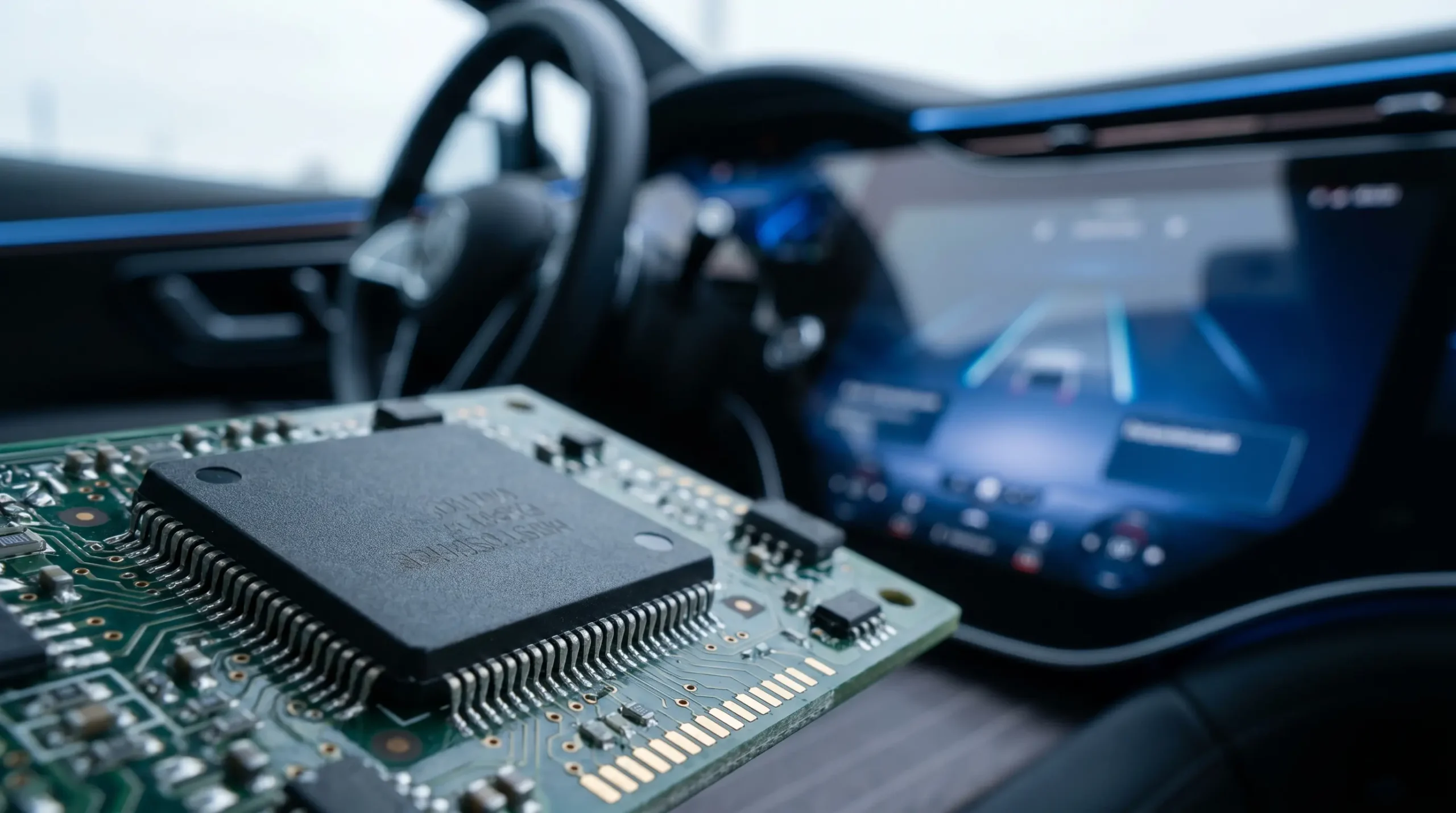
The automotive memory application map from Samsung shows why that matters. It lists In-Vehicle Infotainment (IVI, cockpit media and information systems), Advanced Driver Assistance Systems (ADAS, sensor-based safety and driving support) and gateway systems as memory users, with Low Power Double Data Rate memory (LPDDR, power-efficient dynamic memory) and Universal Flash Storage (UFS, embedded flash storage) spread across major vehicle domains.
Memory Content Is Climbing Faster Than Vehicle Volume
The reason this supplier shift matters is arithmetic. S&P Global Mobility says in its automotive semiconductor demand outlook that revenue tied to auto chips is projected to rise from around $90 billion in 2025 to about $139 billion by 2031, an average annual growth rate of 7.5%. Vehicle production is not growing anywhere near that fast.
Memory grows with features, not with wheels. A low-cost combustion car needs chips too, but a software-heavy electric model adds bigger displays, more cameras, more logged data and more domain controllers. That raises demand for Dynamic Random Access Memory (DRAM, working memory used by processors) and NAND flash memory (nonvolatile storage that keeps data after power-off).
- Cockpit compute: larger screens, local voice processing and faster boot times pull in LPDDR and UFS.
- Driver assistance: cameras, radar and sensor fusion need fast temporary memory for data moving through processors.
- Centralized architecture: fewer, larger controllers can raise memory density even when vehicle unit growth is modest.
- Over-the-air software: updateable features increase the value of reliable storage across the life of a car.
That is the reason an automotive share gain is more than a bragging point. A supplier approved for one high-volume platform can ride several trim levels, regions and mid-cycle refreshes without winning every socket from scratch.
Micron Still Has the Qualification Moat
The U.S. incumbent still has a strong case with safety and platform wins. The Qualcomm automotive platform qualification notice said its LPDDR5X, UFS 3.1, Xccela flash and serial NOR flash were pre-integrated for platforms from Qualcomm, the San Diego chip designer, including cockpit and ride systems.
Challengers are moving too. SK hynix, the Korean memory maker, says its LPDDR5X has Automotive Safety Integrity Level D (ASIL-D, the highest ISO 26262 vehicle safety grade). Kioxia, the Japanese flash-storage supplier, sells automotive UFS 4.0 and 4.1. ChangXin Memory Technologies (CXMT, a Chinese DRAM producer) has mass-produced LPDDR5X for client markets, though automotive qualification remains a longer climb.
| Supplier | Visible Automotive Proof Point | Strategic Read |
|---|---|---|
| Samsung Electronics | Automotive LPDDR5X listed up to 9.6 Gbps and -40 C to 125 C, plus DRAM, solid-state drive and embedded storage lines. | Share gain tied to China sockets and a broad one-stop portfolio. |
| Micron Technology | Qualified memory and storage across Qualcomm automotive platforms, including LPDDR5X and UFS. | Deep qualification base that is hard to displace quickly. |
| SK hynix | ASIL-D certification for LPDDR5X automotive DRAM. | Safety certification bid for future mobility programs. |
| Kioxia | Automotive UFS 4.0 and 4.1, with storage capacity options from 128GB to 1TB. | Strong in embedded storage rather than full DRAM coverage. |
| CXMT | LPDDR5X mass production for client devices, with faster samples offered to customers. | Potential China pressure valve, but automotive grade work remains the hurdle. |
The AI Capacity Fight Hits the Car Line
The pressure point is fab allocation. S&P’s automotive DRAM shortage analysis says the shift to software-defined vehicles, electrification and AI-heavy architectures has turned memory into a strategic bottleneck, while the three leading producers together hold more than 90% of global DRAM production.
High Bandwidth Memory (HBM, stacked DRAM used beside AI accelerators) is the reason car buyers are back in a queue. Wafers, packaging tools and engineering time move toward the customers paying the best margins. The car business buys for long life and low defect rates, but data-center customers buy urgency.
The Korean group has to serve both. The fourth-quarter memory earnings deck said its memory business would keep expanding AI-related products such as High Bandwidth Memory 4 (HBM4, a new generation of stacked AI memory), high-density Double Data Rate 5 (DDR5, current-generation system memory) and enterprise solid-state drives, while also reporting record quarterly memory revenue and profit.
For automakers, that means a No. 1 supplier can still be a constrained supplier. The buyer cares less about a trophy share than about whether the same part will be available through a seven-year vehicle program, with change notices and requalification kept under control.
Allocation Is the New Scoreboard
The hidden stakeholder in this change is the purchasing team at the automakers moving fastest toward centralized compute. If the Korean leader uses China demand to harden early approvals, it can turn one cycle of share gain into a platform habit. If it cannot, buyers will split sockets across qualified suppliers and keep second sources warm.
That second-source habit helps explain why the Idaho company is not being pushed off the road. Its safety work, Qualcomm connection and UFS push give it places to defend even if the headline share moved. The same goes for SK hynix in safety-grade DRAM and Kioxia in embedded storage.
For now, allocation is becoming the scoreboard. If the Korean supplier keeps high-end car programs fed while AI customers keep paying more for memory, its 40% share can harden into a procurement map. If allocation tightens again, automakers will treat the ranking as a warning label.

-
 TECH1 year ago
Where Garmin Watches are Made and How They are Assembled
-
 AUTO3 months ago
Tesla’s Roadster Is ‘a Few Weeks Away,’ Says Its Chief Designer
-
 NEWS10 years ago
Samsung Releases Galaxy Note7 TV Ad as Reddit AMA Leaks Specs
-
 NEWS10 years ago
Android 7.0 Nougat Rolls Out To Nexus Devices With New Emoji, Features
-
 FINANCE9 years ago
Cardano Price Surges as ADA Enters the Crypto Top Ten List
-
 NEWS10 years ago
Pre-Order the First Camera Made for Facebook Live Streaming Video
-
 FINANCE1 year ago
Binance Suspends Trading and Withdrawals for a System Upgrade
-
 FINANCE9 years ago
RChain Price Jumps Nearly 150% to a New All-Time High of $2.03