NEWS
Europe’s Ukraine Talks Seat Arrives as a Moscow Invitation
European leaders say they are ready for Ukraine peace talks, after Putin invited them to Moscow first and Russian drones hit Kyiv the same day.

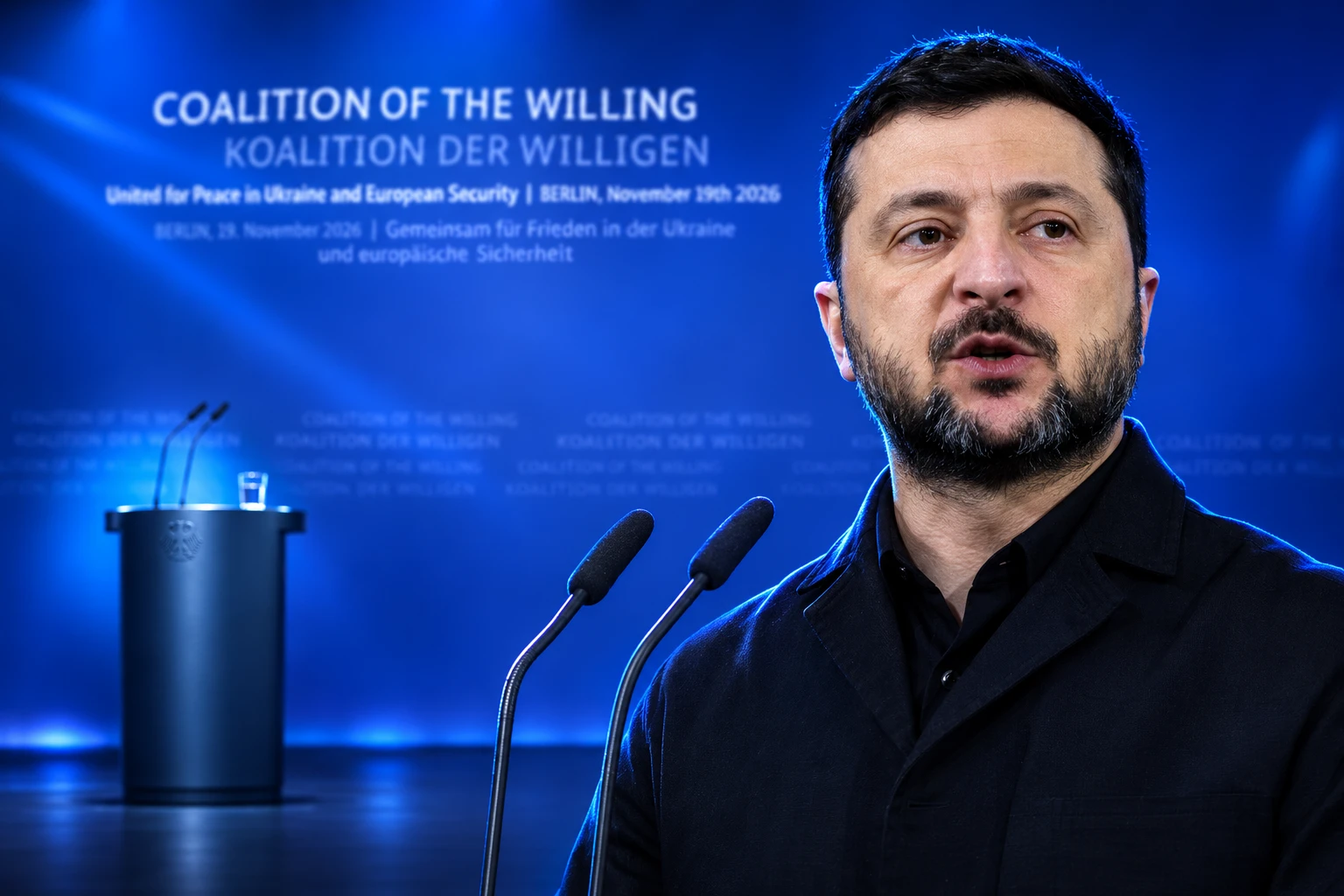
European leaders said on November 19 they are ready to negotiate with Russia on ending the war in Ukraine, hours after Vladimir Putin invited them to Moscow first.
They spoke in Berlin as Russian drones hit Kyiv, and as U.S. envoy Jared Kushner claimed Moscow would accept a NATO-style guarantee that Volodymyr Zelenskyy says still does not mean troops on Ukrainian soil.
A Piece of the Wall for Every Delegation
German Chancellor Friedrich Merz hosted the Coalition of the Willing at the Chancellery on Thursday, November 19, while Donald Trump, Putin and Xi Jinping held their first three-way meeting in Shenzhen on the sidelines of APEC. The Chinese joint text, titled a declaration toward peace, did not mention Ukraine.
Berlin answered with turnout. The German government counted 44 delegations, including 26 heads of state or government, plus the leaders of the European Union and NATO, in the coalition’s largest summit to date. The group itself still numbers almost 40 partner countries, co-chaired by Germany, France and the United Kingdom, and has met since spring 2025.
Merz handed guests a fragment of the Berlin Wall and told them a Yalta-style deal would not bring peace. “At Yalta, Europe was divided up. It was parcelled up. And we won’t allow anything like that to happen again,” he said. He called the Shenzhen gathering a photo opportunity, and said the United States knows there can be no peace without Europe.
British Prime Minister Andy Burnham called it the coalition’s strongest show of numbers, and said Europe had a clear, consistent and united negotiating position. French President Emmanuel Macron said Europe was not an item on anyone’s menu. Polish Prime Minister Donald Tusk, answering Trump’s description of Putin as a friend, said Putin “is not our friend and will never be.”
Zelenskyy, who sat with Merz, Macron and Burnham, was dryer. He has said Putin has always said no. After the larger meeting he posted that diplomacy was the priority in Berlin, and that Russian strikes had not eased.
We continued our talks with Friedrich Merz @bundeskanzler in a bilateral format. The Chancellor and I discussed how the Coalition of the Willing meeting went and what we will focus on first and foremost. Of course, diplomacy is our priority, and most of today’s conversations have… pic.twitter.com/NopmweH1N0
— Volodymyr Zelenskyy / Володимир Зеленський (@ZelenskyyUa) November 19, 2026
Putin Wants the Europeans in Moscow First
The seat Europe has spent months demanding was offered from Shenzhen on terms set in Moscow. Putin told reporters the Americans had been asking, insistently, for Europeans to join talks that have mostly run among Russia, the United States and Ukraine. He said he was not against that, and that talking about security in Europe without Europeans is pointless.
We need to understand what Europe will bring to these talks. That is why, through diplomatic channels, we have invited the Europeans to come to Moscow in order to determine their positions. And after that, we will decide in what format we will continue the dialogue with Ukraine.
Vladimir Putin, President of Russia, press conference in Shenzhen
That sequence is the offer. Europe comes to Russia, sets out a position, and the Kremlin then chooses the format. It is not a four-party table already agreed, and it is not a meeting on neutral ground. Officials from France, Germany and the United Kingdom have already discussed a possible encounter with Moscow; one national security adviser spoke with Yury Ushakov, Putin’s foreign policy aide, who suggested holding it in the Russian capital.
Ushakov had said earlier in the week that a great deal of work remained before any four-sided talks. In Shenzhen, Putin also said he heard European leaders talk about war in 2030, called that abnormal, and said Russia was not planning to attack anyone. He described European fear of a Russian war as political diarrhea, and said everyone understands Russia is not going to war with Europe.
WHAT WE KNOW
- The invite: Putin said it went out through diplomatic channels, without naming a date, a list of guests, or a European reply.
- The U.S. ask: He said Washington had pressed Russia to let Europeans into the talks.
- The catch: Russia, on his account, decides the format only after Europe has explained itself in Moscow.
WHAT IS UNCONFIRMED
- The addressees: The European Commission and Council had not, in the first hours, said whether an invitation had reached them, or only national capitals.
- The Article 5 claim: Kushner said Russia is now comfortable with a NATO-style guarantee; Moscow has not said so in public.
- The next room: Zelenskyy wants the following session to be four-way. No date or venue has been set.
Kushner, briefing in Berlin with fellow envoy Steve Witkoff after the China meetings, struck a brighter note. He said Trump had come away believing peace is achievable, wanted a deal with Europe at his side, and thought the Russians were willing to trust the American argument that Europeans belong in the room. Merz and Burnham both tied any wider talk on European security to a peace deal with Ukraine first. Putin’s invitation does not accept that order.
What Article 5 Means When Ukraine Is Not in NATO
The sharpest gap in Berlin was not whether Europe should talk. It was what a security pledge for Ukraine would actually require a Western capital to do if Russia attacked again. Kushner said any guarantee would be based on NATO’s Article 5, that Trump is open to an Article 5-like promise if it serves U.S. interests and sits inside a wider package, and that the idea would need serious monitoring, deterrence and consequences, not trust.
Zelenskyy was not sure they were describing the same clause. “I’m not sure we have the same understanding of Article 5, do we?” he asked. For him, Article 5 means partner forces are present on Ukrainian territory. Putin, speaking the same day, again called foreign troops in Ukraine unacceptable. Macron urged allies to reopen the question of Ukraine’s NATO membership, which Russia rejects outright.
The 1949 treaty is more precise, and more elastic, than the slogan. Allies agree that an attack against them all is how an armed attack on one in Europe or North America is to be treated, and that each party will then take “such action as it deems necessary, including the use of armed force.” It is a political promise with a military option, not an automatic order to send troops. That flexibility is exactly why Kyiv, Washington and Moscow can all say “Article 5” and mean different deployments.
THREE READINGS OF THE SAME CLAUSE
| Who is speaking | What they say it requires |
|---|---|
| North Atlantic Treaty, Article 5 | An armed attack on one ally is treated as an attack on all; each party then takes the action it judges necessary, which may include force |
| Jared Kushner, U.S. envoy | A guarantee for Ukraine “based on Article 5”; Trump open to it if it serves U.S. interests, as part of a broader package, with monitoring and penalties |
| Volodymyr Zelenskyy | Partner forces present on Ukrainian territory; NATO membership still the strongest long-term shield |
| Vladimir Putin | No foreign troops in Ukraine; such a force would be treated as a legitimate military target |
The Coalition’s own joint statement, issued by Germany, France, the United Kingdom and Ukraine, stays closer to a European-led multinational force, U.S.-backed, that would offer “reassurance measures” in the air, at sea and on land after a ceasefire, plus a legally binding promise, subject to national procedures, to restore peace if Russia attacked again. That force is still a plan. The coalition’s first joint drill, Koalicja-2026, runs from November 9 to November 22 on members’ territory, mainly in Poland, as a defensive deployment exercise, not a mission inside Ukraine.
Witkoff and Kushner had already signed onto a five-point guarantee outline in Paris in January. Alaska talks in August 2025 had put an Article 5-like U.S. pledge on the table. The argument has not moved onto a signed text that Kyiv, Moscow and Congress would all accept. Selling the label first is how Washington keeps Europe in the process without first answering Zelenskyy’s troop question.
The Same Afternoon, Drones Hit Kyiv
While the Chancellery filled, Russian drones worked over the Ukrainian capital. Kyiv Mayor Vitali Klitschko said a 26-year-old man was killed in the Podilskyi district and five people were injured, four of them in hospital. Debris fell in Podilskyi, Obolonskyi and Shevchenkivskyi. A strike behind the Dutch embassy caused minor damage to the building; Dutch Foreign Minister Tom Berendsen said no staff were hurt, then summoned the Russian ambassador. Austria’s embassy was damaged. Windows at St. Volodymyr’s Cathedral were blown out. Fragments also landed on the grounds of Ukraine’s foreign ministry.
KYIV, NOVEMBER 19
- The death: One man, 26, killed in Podilskyi, according to Klitschko.
- The wounded: Five people injured, four taken to hospital.
- The missions: Dutch and Austrian embassies damaged; no diplomats reported hurt.
- The cathedral: Windows shattered at St. Volodymyr’s in the same daylight wave.
Ukrainian Foreign Minister Andrii Sybiha put the raid against the pictures from China. In Shenzhen, he said, Putin had portrayed himself as a world leader; in Kyiv he was a global criminal and a terrorist, and should be treated as one.
Putin had, by then, already closed one narrow off-ramp. He said he had asked Russia’s Security Council to think about a limited halt to strikes at sea and on energy sites, then dropped it after Ukrainian attacks on the Crimean Bridge, the road and rail link from Russia to occupied Crimea. Ukraine hit the bridge for a third time in a week. “After the strikes on the Crimean Bridge, we will not negotiate,” he said. Russia’s reply, he promised, would be far more painful than what Kyiv had done to the crossing. He still claimed Russia had no desire to keep the war going, and blamed Ukraine and Europe for refusing compromise.
That pairing, an invitation to talk in Moscow and a refusal to pause the bombing, is the file Europe is being asked to walk into. An invitation issued while drones hit European embassies in Kyiv is a way to peel capitals into a separate channel, each hoping it can extract a better hearing alone, rather than a yes to a four-party table with Ukraine in the room.
€45 Billion More for Ukraine’s Next Year
Berlin did not only talk process. The joint statement condemned Russia’s missile and drone campaign against civilians and infrastructure, said Russia had made only minimal territorial gains this year and had not taken a single strategically important city, and repeated that Russia cannot outlast the coalition’s support. Burnham put a finer point on the map, saying Russia had taken no more than 0.2 percent more Ukrainian land for a human cost he compared with Soviet losses in Afghanistan, compressed into two or three months at a time.
The money is easier to count than the force that would police a ceasefire.
WHAT BERLIN PUT ON PAPER
- The 2027 gap: Ukraine needs help to close an estimated 70 billion euro hole next year.
- The new proposal: The European Commission, on November 18, put forward up to 45 billion euros more for 2027, on top of a 90 billion euro EU support loan running through the end of 2027.
- The NATO pledge: Allies restated a 70 billion euro commitment in military kit, aid and training for 2026, and at least the same level in 2027.
- The British add: Burnham pointed to a 10 billion pound package in the recent budget, and announced 1,000 long-range drones, British-built, plus fast attack boats with Norway.
- The winter priority: Extra missile defense, especially against ballistic missiles, before the cold months bite harder.
Macron told allies to do the maximum on air defense. Zelenskyy listed interceptors that can kill attack drones, better ballistic cover, including through the FREYJA programme, and independent satellite links among his immediate asks. The coalition pledged to go after Russian oil and gas revenue, crypto and illicit flows, the military-industrial base, and the shadow fleet. None of that substitutes for an agreed guarantee, and none of it is a ceasefire.
Team Europe Speaks for the Continent Now
Who actually sits in the European chair is now a named roster, not a mood. At an informal EU gathering in Dublin on November 13, leaders agreed that the European negotiating team would be the E5, France, Germany, Italy, Poland and the United Kingdom, plus the EU institutions, acting in lockstep with other member states. Zelenskyy described the same idea as five countries plus the EU and NATO, and said the next meeting should already be four-party: Ukraine, Europe, the United States and Russia, with the agenda written jointly by Kyiv, Europe and Washington.
HOW THE WEEK LINED UP
- November 9, 2026: Koalicja-2026, the coalition’s first joint military drill, begins on members’ territory, mainly in Poland, and runs through November 22.
- November 13, 2026: EU leaders in Dublin name the E5 plus EU institutions as Europe’s team for talks on Ukraine.
- November 18, 2026: The Commission proposes up to 45 billion euros more for 2027 against a 70 billion euro financing gap.
- November 19, 2026: Trump, Putin and Xi meet in Shenzhen; Putin invites Europeans to Moscow; the Coalition meets in Berlin; Russian drones kill one person in Kyiv and damage two EU embassies.
Buried in the German readout is the land concession Europe has already put in writing. Peace talks, Merz’s government said, should include Ukraine, Russia, the United States and Team Europe, and “the starting point for an agreement on territorial issues must be the so-called line of contact.” Reconstruction aid for Ukraine, and a path into Europe, sit on one side of that sentence. Gradual, conditional relief from sanctions on Russia sits on the other. That is not a final map. It is a starting line drawn on the current front, before any European envoy has set foot in Moscow.
Kushner can call the Russians comfortable. Putin can call the Europeans to his capital. Burnham can call the coalition united. The war Russia launched in February 2022 is still being fought with drones over Kyiv, and the guarantee with NATO’s name on it still has no shared meaning, no troops agreed, and no date for the four-party meeting Zelenskyy says he is counting on.

India’s First-Timers and Pant Build a Record 720

Kutch Crash Kills Seven From Army Families After October Toll

Ukrainian Drones Leave Finland Fighting a Russian Ship Fire

ICJ Genocide Order Runs Through Arakan Army Land

CII Asks Patel Panel to Shift Who Funds Indian Credit

Clancy Juror Says the Holdout Never Cited Evidence

The iPhone 18 Pro Max Splits Apple’s Fall in Two

OpenAI Calls GPT-6 Astra AGI Then Locks Its Exploits

Trump Claims Hormuz Control as Oil Holds Near $96

Russia Closes the Goethe-Institut Berlin Tried to Save

 NEWS2 months ago
Clancy Juror Says the Holdout Never Cited Evidence
- NEWS3 months ago
The iPhone 18 Pro Max Splits Apple’s Fall in Two
- NEWS3 months ago
OpenAI Calls GPT-6 Astra AGI Then Locks Its Exploits
- BUSINESS3 months ago
Trump Claims Hormuz Control as Oil Holds Near $96
- LIFESTYLE3 months ago
Russia Closes the Goethe-Institut Berlin Tried to Save
- AUTO3 months ago
Volkswagen’s Job Cuts Leave Four Plants Without Cars
- NEWS3 months ago
Dyson Puts Nurovi Robots on Sale Without the UV Flagship
- BUSINESS3 months ago
US Destroys Five Iranian Tankers as the Shock Hits Jordan