
NEWS
MSI MEG Vision X2 AI+ Turns the AI PC Into a Mascot

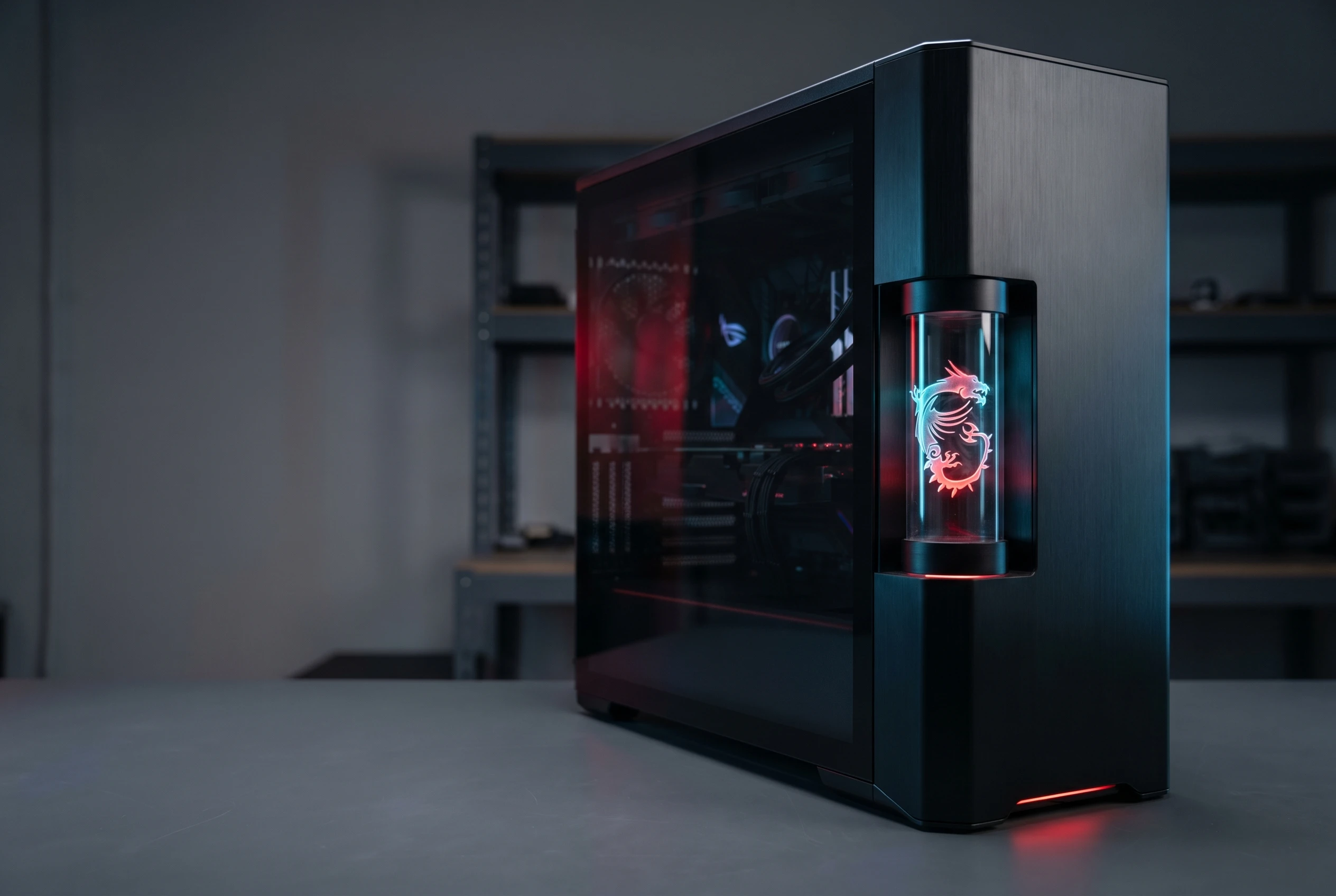
MSI MEG Vision X2 AI+ is MSI’s new flagship gaming desktop, announced May 31 ahead of Computex in Taipei, with a cylindrical AI Holostage display built into the case and LuckyClaw, a local agentic AI companion, preloaded for voice control of performance modes, MSI monitor settings and RGB lighting. The capsule grabs attention; the missing price, exact configurations and ship window make the reveal harder to judge.
The pitch follows Razer’s AVA and MSI’s own 13-inch AI human machine interface (HMI, a control surface for people and machines) tower, but it moves the assistant from a side screen into a display chamber on the PC itself. That is why this odd-looking tower matters: PC makers are trying to turn invisible local AI chips into something a buyer can see, talk to and remember.
A Gaming Tower Grows a Character
MSI, the Taiwan-based PC maker formally known as Micro-Star International, described the tower in MSI’s MEG Vision X2 AI+ announcement as a flagship MEG gaming desktop with two new pieces: LuckyClaw and AI Holostage. LuckyClaw is the character and command layer. AI Holostage is the cylindrical display interface built into the chassis.
The company says the display can present digital companions, desktop pets and third-party AI avatars, with LuckyClaw preloaded from the factory. That matters because the product is being sold less as a faster tower than as a more social PC, one that asks players to accept an always-available character as part of system control.
- May 31: MSI published the announcement before the show opened.
- June 2 to June 5: the desktop is scheduled for Computex floor time in Taipei.
- L0118: MSI lists its booth at Taipei Nangang Exhibition Center Hall 1, fourth floor.
LuckyClaw Starts With System Control
Agentic artificial intelligence (agentic AI, software designed to pursue goals and take actions rather than only answer prompts) is a grand label for a modest first job here. MSI says LuckyClaw can respond to natural voice commands that switch performance modes, change MSI monitor settings and adjust RGB lighting. Those are the same chores PC owners often handle through utilities, hotkeys or on-screen menus.
The companion also connects to MSI’s broader software plan. In a separate AI Jinni software brief, MSI describes AI Jinni as a hybrid local and cloud hub for its PCs, with LuckyClaw able to switch between foundation models, manage agents and connect to Discord, Slack, Telegram and WhatsApp. MSI also says Document AI and Local Chat run on the device without an internet connection or token fees.
The practical read is simple: MSI wants the avatar to become a front end for PC settings, local files and communications. That is a harder job than animating a mascot. If LuckyClaw cannot reliably change a fan profile, adjust a monitor or recover from a misunderstood command, the character becomes decoration on a machine that still needs old control panels.
The Missing Spec Sheet Creates the Friction
MSI has not published a retail price, full configuration list or ship date for the new tower. That omission lands harder because the MEG line is expensive already. One official US Store configuration of the earlier Vision X AI 2nd, with an Intel Core Ultra 9 285K, NVIDIA GeForce RTX 5080, 64GB of DDR5 memory and a 2TB solid-state drive (SSD, the flash storage used for system and game files), sits at the $5,499 Vision X AI listing.
That does not price the new model. It sets the buyer’s mental starting point. A holographic-style capsule, third-party avatar support and whatever hardware MSI chooses for the X2 could push the number up, or MSI could use the new interface to defend a price near today’s premium tower range. For now, the reveal is a price-free flagship tease.
| Product | AI Interface | Disclosed User Control | Clarity for Buyers |
|---|---|---|---|
| MSI MEG Vision X2 AI+ | AI Holostage cylindrical display with LuckyClaw | Voice control for performance modes, MSI monitor settings, RGB lighting and future skills | Low: no public price, ship window or full specifications |
| MSI MEG Vision X AI 2nd | 13-inch AI HMI touchscreen with mic and speaker | System monitoring, MSI app control and monitor settings | High: active product and store listings exist |
| Razer AVA product page | Standalone 5.5-inch 3D hologram companion | Agentic workflows, avatar choices, vision and audio sensing | Medium: beta and reservation details are public, final retail test remains ahead |
Computex Gives the Capsule a Serious Stage
Computex is the right place for a product that would look silly in a normal desktop refresh. The official Computex show profile lists the event from June 2 to June 5 across Taipei venues, with the theme AI Together and focus areas including AI and Computing, Robotics and Mobility, and Next-Gen Tech.
The show profile also lists 1,500 exhibitors from 33 countries or regions and names MSI among key participants. In that setting, a capsule mascot is less random than it sounds. Every PC company has a neural processing unit (NPU, a chip block built for AI math) story, a graphics card story and a local model story. Very few have a physical reason for a passerby to stop.
The AI Holostage gives MSI a two-second sales prop. Visitors can see the assistant before they hear the feature list. That makes it useful even if LuckyClaw is still unfinished, because trade shows reward products that photograph well and explain themselves from a distance.
The Friendly Face Raises a Trust Question
Personality makes the control problem more approachable, but it also moves trust into the center of the product. A desktop agent that hears commands, touches system settings and connects to chat apps needs clear permission limits. It also needs logs a user can understand, because a cute avatar does not make an autonomous action harmless.
Enterprise buyers are already wary of the same problem. In a Gartner agent survey, Gartner, the technology research firm, said only 15% of IT application leaders were considering, piloting or deploying fully autonomous AI agents, even as 75% had piloted, deployed or already deployed some form of AI agent. The worry was not whether agents can act. It was whether organizations can govern them.
The same survey said 74% of respondents viewed AI agents as a new attack vector and only 13% strongly agreed they had the right governance structures. Those are corporate numbers, but they map neatly onto a gaming desktop. If LuckyClaw can change hardware behavior and eventually add skills, MSI has to show where the boundaries sit.
MSI’s local-computing pitch helps. On-device chat, local document retrieval and model assessment inside AI Jinni give the company a privacy story that cloud-only assistants cannot match. The missing piece is user proof: a plain view of what runs on the PC, what leaves it and what the companion is allowed to change without asking. That is the trust boundary MSI now has to draw.
The Useful Version Is Boring on Purpose
Strip away the mascot and the best version of LuckyClaw looks practical. Gamers do not need another animated window when a game is running. They do need settings that stay out of the way, especially when a headset is on, a stream is live or a full-screen title is refusing to behave.
The hands-free control case breaks into four jobs that sound dull, which is a good sign for a PC utility:
- Switching from quiet cooling to performance mode without opening MSI Center.
- Changing monitor features while a game or editing app stays in focus.
- Moving RGB lighting from showpiece mode to a calmer desktop setup.
- Answering local file or manual questions when the user does not want to search support pages.
Each of those tasks can save a few clicks. None requires the user to bond with a mascot. That is the irony in MSI’s design: the more useful LuckyClaw becomes, the less the owner should notice the character working.
The Shipping Test for a Mascot PC
The X2’s biggest risk is the gap between demo language and retail behavior. MSI says third-party custom AI virtual characters can appear through AI Holostage, which opens a door to branded avatars, desktop pets and creator-made companions. It also opens a support burden: animation formats, moderation rules, content stores, model access and update policies.
Razer has taken the cleaner product route with AVA, a separate 5.5-inch 3D hologram companion that its page says connects to a Windows PC over USB Type-C and includes dual far-field microphones, an HD camera and a speaker. MSI’s route is messier and more ambitious because the companion is part of the computer case. If the idea works, the PC becomes the accessory.
For buyers, another glamor shot will matter less than a configuration page with CPU, graphics, memory, storage, price, warranty, privacy controls and a ship date. If MSI publishes that and LuckyClaw responds quickly on the show floor, AI Holostage may graduate from spectacle to control surface. If those basics stay missing, the capsule remains a bright Computex trick in a very expensive box.

-
 TECH1 year ago
Where Garmin Watches are Made and How They are Assembled
-

 AUTO3 months ago
Tesla’s Roadster Is ‘a Few Weeks Away,’ Says Its Chief Designer
-
 NEWS10 years ago
Samsung Releases Galaxy Note7 TV Ad as Reddit AMA Leaks Specs
-
 NEWS10 years ago
Android 7.0 Nougat Rolls Out To Nexus Devices With New Emoji, Features
-
 FINANCE9 years ago
Cardano Price Surges as ADA Enters the Crypto Top Ten List
-
 NEWS10 years ago
Pre-Order the First Camera Made for Facebook Live Streaming Video
-
 FINANCE1 year ago
Binance Suspends Trading and Withdrawals for a System Upgrade
-
 FINANCE9 years ago
RChain Price Jumps Nearly 150% to a New All-Time High of $2.03