
NEWS
iPhone MLS Broadcast Tests Apple’s Sports Flywheel

The iPhone MLS broadcast of LA Galaxy vs Houston Dynamo FC was Apple’s clearest live test of a bigger idea: if it owns the phone, the camera software, the production accessories and the MLS rights window, a smartphone can become part of a full sports workflow instead of a novelty sideline shot.
The catch matters. The phones sat inside a professional broadcast machine, with operators, lenses, sync hardware, monitors and a production truck doing the work viewers never see. The camera body shrank. The rest of the show stayed very grown up.
A Smartphone Test Built on a Rights Deal
Major League Soccer (MLS, the top North American soccer league) described the May 23 match at Dignity Health Sports Park in Carson, California, as the first major professional live sporting event captured entirely on iPhone. The official setup covered LA Galaxy, the Carson-based MLS club, against Houston Dynamo FC, the Texas club, with warmups, player introductions, in-net goal angles and crowd atmosphere all folded into the live feed through the MLS announcement of the full-match iPhone broadcast.
That test made sense only because of the media structure around it. In 2022, the company and the league signed a 10-season arrangement that made the Apple TV app the home for every live MLS match from early 2023 through 2032, with no local broadcast blackouts, according to the Apple and MLS global rights announcement. A rights holder with that much control can take a production risk that a one-off network partner might avoid.
The soccer itself ended neatly enough: a 1-1 draw, with Joseph Paintsil scoring for the home side and Guilherme answering for Houston, according to the LA Galaxy match report from Carson. For the broadcast business, the score was almost the least interesting number on the night.
The Phone Was the Camera Body, Not the Whole Camera
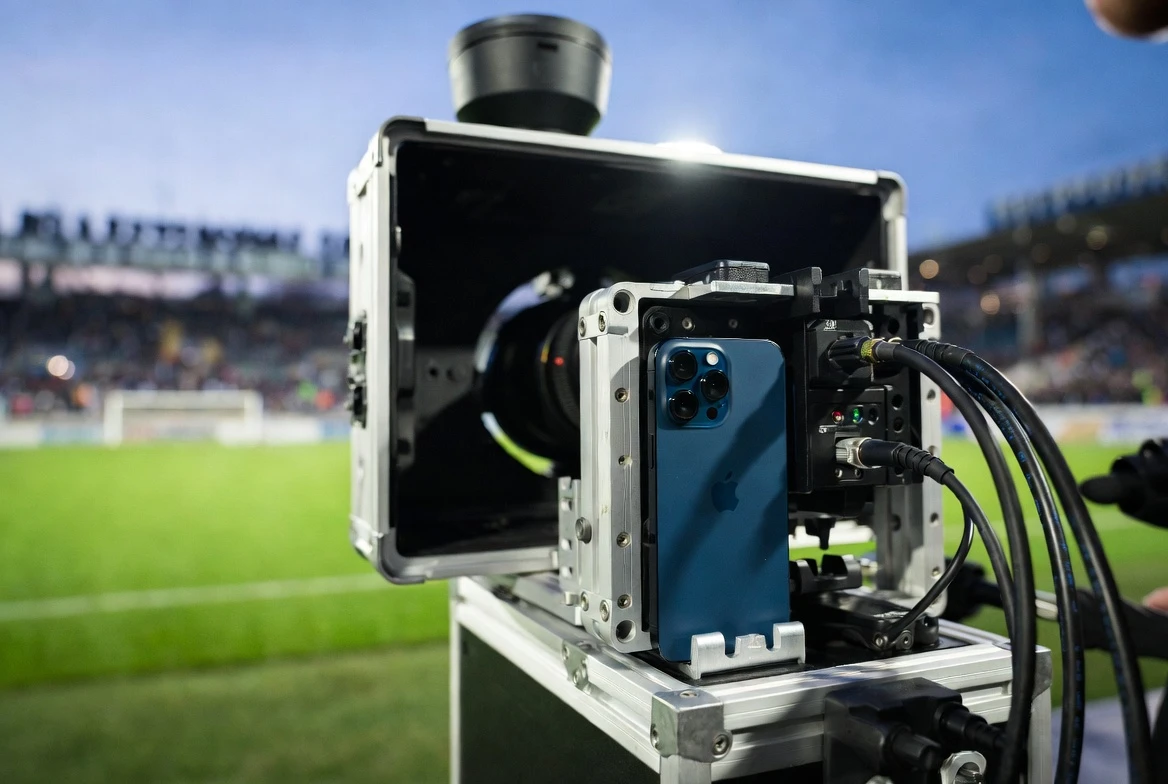
The shorthand version says 15 iPhone 17 Pro Max units shot a professional soccer match. The more useful version says a familiar handset became one part of several very different camera positions. Some rigs used the built-in lenses. Others were connected to pro accessories. A few looked much closer to standard television cameras than to a phone on a selfie stick.
| Setup | Main Job | What It Proved | What It Still Needed |
|---|---|---|---|
| Native phone lens | Close sideline, crowd and tight-space views | Small bodies can reach angles large cameras struggle to occupy | Operator skill, stabilization and lighting discipline |
| Phone plus Blackmagic dock | Wired production camera position | The handset can feed a managed live workflow | Power, sync, cabling and truck integration |
| Phone plus Fujinon zoom | Long field coverage from broadcast-style positions | The sensor can sit behind serious glass | Heavy lens support, adapter hardware and a trained camera crew |
| Production truck | Switching, replay, color and transmission | The phone feed can join a professional show | The same back-end system live sports already uses |
That is why the test was persuasive and limited at the same time. The device did not replace the whole camera chain. It moved the capture point into places where a smaller body has an edge, then relied on the existing chain to make those signals behave like television.
Why the Picture Could Hold Together
The Pro models arrived with hardware aimed at more than casual video. Apple’s technical specifications list Apple Log 2, ProRes RAW and genlock support on iPhone 17 Pro; genlock is a synchronization method that keeps multiple video sources aligned frame by frame. The same specs list a 48MP Pro Fusion camera system, including Main, Ultra Wide and Telephoto cameras.
Blackmagic Design, the Australian camera hardware and software company, supplied the piece that makes a pocket device less awkward in a truck-centered workflow. Blackmagic Camera ProDock technical specs show High-Definition Multimedia Interface (HDMI, the cable standard used to carry video and audio), microphone, headphone, genlock, timecode, USB storage and power connections. That list reads like a translation layer between phone and broadcast bay.
The long-lens positions told a different story. Fujifilm, the Japanese imaging company, lists the Fujinon HZK25-1000mm lens catalogue with a 25-1000mm focal length, 40x zoom ratio and 28.8kg approximate mass. Pairing a phone with that kind of glass changes the claim. The small sensor mattered, but the familiar broadcast look still came from expensive optics and the people trained to use them.
The Broadcast Math Favors the Platform Owner
This was the part that made the night bigger than a camera demo. A single event let Cupertino advertise its device, stress-test its production stack, feed its subscription service and generate sports rights value in one loop.
- 15 Pro Max units were reported across the venue, turning one match into a multi-camera proof of concept.
- three 48MP rear cameras on the Pro line gave the production built-in wide, ultra-wide and telephoto options before any outside lens was added.
- 10-year MLS deal control gave the rights holder room to test the format without asking a separate broadcaster to carry the reputational risk.
- more than 100 countries and regions had access to MLS Season Pass at launch, according to Apple’s MLS Season Pass rollout.
The value sits in that overlap. Phone buyers see professional proof. Sports subscribers see new camera positions. Production teams see a smaller capture tool that can be managed through familiar software. No single piece makes the model work by itself.
The Limits Are Part of the Lesson
The strongest warning from the match is hiding in its success. A phone can carry a full broadcast only when enough professional support surrounds it. Strip away the dock, cabling, lens mounts, monitoring, color work and replay system, and the same device becomes a very good mobile camera rather than a match-day production package.
- Long-field coverage still asks for serious optics, especially in soccer, where the action can move from one penalty area to the other in seconds.
- Power and heat become production variables when a small device is asked to run as a live camera for a full match.
- Color consistency needs discipline when many small sensors face changing light, grass glare, shadow and stadium LEDs.
- Cost perception can mislead viewers, because the phone may be cheaper than a broadcast camera while the surrounding rig is not cheap at all.
Those limits do not make the experiment hollow. They make it honest. The expensive parts of live sports are not only the cameras. They are the control systems, the labor, the reliability plan and the ability to make every shot arrive on time.
Where This Leaves the Broadcast Truck
The first uses that travel are likely to be specific angles, not whole-league camera swaps. Goalmouth cameras, bench-adjacent views, tunnel shots, warmups, handheld field moves and tight architectural spaces all suit a small body. Those positions have clear value even if the main game camera remains a traditional broadcast unit.
The official MLS release also shows a careful progression: phones appeared first in selected moments during Friday Night Baseball, then in more sports productions, then in the Carson full-match test. That path says the company is treating the device like a production component that earns trust job by job.
If the next full-match test keeps the wide shots as clean as the goalmouth cuts, the phone stops asking for permission to be on the truck.

-
 TECH1 year ago
Where Garmin Watches are Made and How They are Assembled
-
 AUTO3 months ago
Tesla’s Roadster Is ‘a Few Weeks Away,’ Says Its Chief Designer
-
 NEWS10 years ago
Samsung Releases Galaxy Note7 TV Ad as Reddit AMA Leaks Specs
-
 NEWS10 years ago
Android 7.0 Nougat Rolls Out To Nexus Devices With New Emoji, Features
-
 FINANCE9 years ago
Cardano Price Surges as ADA Enters the Crypto Top Ten List
-
 NEWS10 years ago
Pre-Order the First Camera Made for Facebook Live Streaming Video
-
 FINANCE1 year ago
Binance Suspends Trading and Withdrawals for a System Upgrade
-
 FINANCE9 years ago
RChain Price Jumps Nearly 150% to a New All-Time High of $2.03