NEWS
GSLV-F17 Lifts EOS-05 While India’s Workhorse Stays Grounded
ISRO’s GSLV-F17 put EOS-05 on a geosynchronous path, replacing the imager this rocket lost in 2021, with PSLV still grounded.

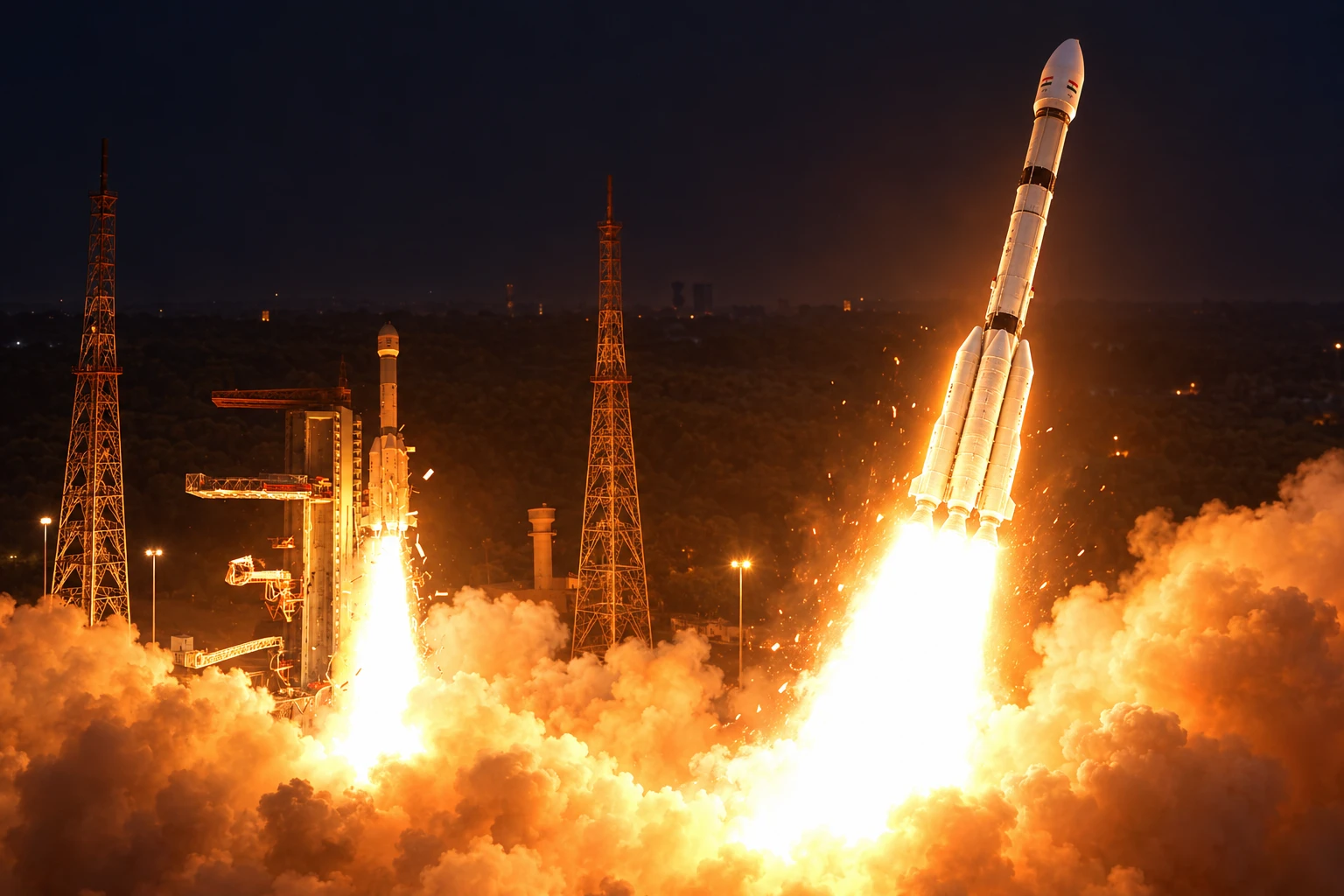
At 2:55 a.m. on September 4, a GSLV-F17 rocket lifted the 2,367 kg EOS-05 satellite off Sriharikota and toward geosynchronous orbit. It was the Indian Space Research Organisation’s first launch since a Polar Satellite Launch Vehicle failed in flight on January 12.
PSLV, the rocket India has used for decades to put working satellites into polar paths, is still grounded after two third-stage failures in a row. GSLV-F17, the 19th flight of a vehicle with four failures and two partial failures behind it, had to carry the load, and it did so with a replacement for the geo-imager this family lost in 2021.
PSLV Has Not Flown Since January
On May 18, 2025, PSLV-C61 lost EOS-09, a radar imaging satellite, when chamber pressure in the solid third stage dropped and the vehicle could not finish the job. ISRO formed a Failure Analysis Committee. The detailed report went to the Prime Minister’s Office and was not released in public.
On January 12, 2026, at 10:17 a.m. IST, PSLV-C62 lifted off with EOS-N1, also called Anvesha, and 15 co-passenger spacecraft. Chairman V. Narayanan said the first two stages ran as planned, then crews saw a disturbance in roll rates near the end of the third-stage burn and a deviation from the flight path. The rocket fell short of orbital speed. None of the 16 payloads reached a usable orbit.
That January flight was a consecutive mission failure for the first time in PSLV’s history, even after the C61 committee’s fixes and seven mission-readiness reviews. ISRO grounded the fleet. From January 12 to September 4, 235 days passed with no Indian orbital launch from Sriharikota. The 107th large-rocket flight from the island was not a PSLV. It was GSLV-F17, after a 27.5-hour countdown, in rain, with about 16,500 scientists, engineers and support staff on the net.
THE GROUNDED WORKHORSE
- May 18, 2025: PSLV-C61 loses EOS-09 after a third-stage chamber-pressure drop.
- January 12, 2026: PSLV-C62 loses EOS-N1 and 15 co-passengers after a late third-stage roll disturbance.
- August 28, 2026: GSLV-F17 rolls from the Vehicle Assembly Building to the umbilical tower at Satish Dhawan Space Centre.
- September 4, 2026: GSLV-F17 lifts off at 2:55 a.m. IST and puts EOS-05 into its planned transfer orbit.
Crews still call GSLV the naughty boy because its early years were rough. The nickname sat poorly beside a workhorse that could not fly. The pad was busy again. The rocket India trusts for routine polar work was not on it.
2,367 Kilograms Into a Lower Orbit
ISRO confirmed the vehicle succeeded in placing EOS-05 into the intended orbit, a sub-geosynchronous transfer orbit rather than a full geosynchronous throw. The satellite is healthy and, the agency said after the flight, it received a better-than-expected path. It still has to fire its own engines over coming days to reach a geosynchronous slot about 35,786 km up, where it can hover over the same broad stretch of Earth.
https://x.com/isro/status/2095649303251607909
GSLV-F17 stood 51.7 metres tall and weighed 420.5 tonnes on the Second Launch Pad, flying with a 4-metre ogive composite fairing. The stack is three stages: a solid S139 core with four liquid L40H strap-ons, a liquid second stage, and a CUS15 cryogenic third stage burning liquid hydrogen and liquid oxygen. Narayanan told the control room this was the 19th GSLV mission, and that the same vehicle family had grown from a 1,536 kg first payload to the 2,367 kg spacecraft on this flight.
GSLV-F17 INJECTION TARGETS
| Item | Figure |
|---|---|
| Liftoff | 2:55 a.m. IST, September 4, 2026 |
| Vehicle | GSLV-F17, 51.7 m, 420.5 t |
| Payload | EOS-05, 2,367 kg |
| Target injection | 170 km by 28,934 km transfer orbit, 19.28° inclination |
| Launch azimuth | 104° |
| Final working orbit | Geosynchronous, about 35,786 km |
Separation came about 19 minutes after liftoff, near 3:14 a.m. From that ellipse the spacecraft, not the rocket, has to close the gap to geosynchronous altitude. A GEO imager that heavy does not get a free ride to station. It spends its own propellant to finish a job the upper stage started.
GISAT-1 Died When the Cryogenic Stage Did Not Light
EOS-05 is GISAT-1A, the rebuilt answer to GISAT-1, which flew as EOS-03. That 2,268 kg satellite lifted on GSLV-F10 on August 12, 2021, from the same Second Launch Pad, aimed at the same class of orbit. The first two stages ran. The indigenous cryogenic upper stage did not.
A Failure Analysis Committee traced the loss to a damaged soft seal in a vent and relief valve on the liquid-hydrogen tank. Pressure in the tank was too low when the engine was supposed to light, the fuel booster turbo pump inside the tank did not run as designed, and the flight computer cut the mission. GISAT-1 never reached orbit. India spent five years without the continuous geo-imaging watch that flight was built to start.
The same cryogenic technology is why GSLV exists in this form. In the early 1990s India tried to buy the know-how from Russia and ran into a United States-led denial regime. A few engines arrived. The full design did not. ISRO spent roughly 20 years building the CE-7.5 engine at the Liquid Propulsion Systems Centre. The first clean success with that Indian-built upper stage came on January 5, 2014, with GSAT-14 on GSLV-D5. F10 was the reminder that a cryogenic stage can still kill a mission after a decade of clean-looking flights. F17 was the second try at the satellite that died on that stage.
What a 42-Metre Pixel Buys From Geosynchronous Orbit
Most of ISRO’s Earth cameras live a few hundred kilometres up. They take sharp strips and come back days later. EOS-05 is built to sit near 36,000 km and keep looking at the Indian landmass, nearby seas and border belts. Science minister Jitendra Singh called it India’s first imaging satellite from geosynchronous orbit, with visible, infrared, multispectral and hyperspectral bands. Weather satellites already sit in that orbit. A land imager with hyperspectral sensors is a different machine.
DK Singh, the new director of the U R Rao Satellite Centre in Bengaluru, where the spacecraft was built, called it another eye in the sky. The eye is not a Cartosat. From that height a 700 mm Ritchey-Chrétien telescope, based on the Cartosat-2A design, yields a 42-metre pixel in its main visible and near-infrared mode. The bargain is speed: a chosen sector every five minutes, the whole Indian landmass every 30 minutes, if the view is cloud-free.
EOS-05 IMAGING MODES
- MX-VNIR: six visible and near-infrared channels at 42-metre ground resolution, covering 0.45 to 0.875 micrometres.
- HyS-VNIR: 158 spectral bands at 318-metre resolution, from 0.375 to 1.0 micrometres.
- HyS-SWIR: 256 short-wave infrared bands at 191-metre resolution, from 0.9 to 2.5 micrometres.
- Cadence: selected field every 5 minutes; full Indian landmass every 30 minutes, under cloud-free conditions.
That is how you watch a cyclone fill out over the Bay of Bengal, a flood spread down a river, or a fire line move, without waiting for the next polar pass. It is also how you accept a 42-metre pixel when a low-orbit mapper can do much finer. The satellite will not replace those mappers. It adds a movie where they offer stills. Agriculture, forestry, water, disaster warning and, as Narayanan put it after the flight, strategic data all sit on that same stare.
Thirteen Full Successes in 19 GSLV Flights
Across Mk I and Mk II, the GSLV family has now flown 19 times from Sriharikota: 13 full successes, four failures and two partial failures. The Mk II vehicle with the Indian cryogenic stage has 13 of those flights. Two of them failed, D3 in 2010 on the first try with the home-built upper stage, and F10 in 2021. The other 11, including F17, worked. Recent form is better than the nickname. F12, F14, F15 and F16 all succeeded before this one, and F16 lofted NISAR, the NASA-ISRO radar satellite, at 2,393 kg into a sun-synchronous orbit on July 30, 2025.
FLIGHTS THAT SHAPE THIS PAD
| Flight | Date | Payload | Result |
|---|---|---|---|
| GSLV-F10 | August 12, 2021 | GISAT-1 / EOS-03, 2,268 kg | Failure, cryogenic stage |
| PSLV-C61 | May 18, 2025 | EOS-09 radar satellite | Failure, third stage |
| GSLV-F16 | July 30, 2025 | NISAR, 2,393 kg | Success, sun-synchronous orbit |
| PSLV-C62 | January 12, 2026 | EOS-N1 plus 15 co-passengers | Failure, third stage |
| GSLV-F17 | September 4, 2026 | EOS-05, 2,367 kg | Success, sub-geosynchronous transfer orbit |
The ledger is why Friday morning felt larger than a routine GTO run. PSLV’s long record is still far cleaner than GSLV’s. It is also the record that stopped in January. Until that third stage is cleared, the medium-lift cryogenic rocket is the one ISRO can actually light. F18 is already on the books for a second-generation NavIC satellite, NVS-03, in the last quarter of 2026. The naughty-boy joke will travel with those flights whether the hardware deserves it or not.
Sailors and Airmen Stood at Sriharikota
Senior officers from the Indian Navy and the Indian Air Force were at the spaceport for the launch. A camera that can hold the subcontinent, the Arabian Sea and the Bay of Bengal in view, and refresh a chosen box every five minutes, is a civilian disaster tool and a maritime picture at the same time. Hyperspectral bands that pick out crop stress also pick out materials. ISRO still describes EOS-05 as an Earth observation spacecraft. The guest list was not only civilian.
Once the Earth Observation Satellite 05 is operationalized in the orbit, it will become India’s first dedicated imaging satellite from the geo orbit, providing important strategic data for our country.
V. Narayanan, Chairman, ISRO, after GSLV-F17
Singh, who holds the science and space portfolio, called the flight another giant leap and pointed to the mix of bands. His post went up minutes after orbital injection.
https://x.com/DrJitendraSingh/status/2095629223339966473
Narayanan’s other line from the control room was drier. He said the reward for hard work is more work, and he credited an open work culture at the agency. EOS-05 still has to circularise. PSLV still has to be explained. The next cryogenic flight is already in the queue. Applause at 3:14 a.m. does not clear that board.
Gaganyaan Is Still Due This Year
In late August, speaking on National Space Day in Ahmedabad, Narayanan said ISRO planned eight launch-vehicle missions and 12 satellite missions in the current financial year, and that the Gaganyaan programme had run about 8,000 tests and was in its final leg. He said the first uncrewed Gaganyaan flight should come within about four months, with three uncrewed missions before a crewed one. That test uses a human-rated LVM3, not GSLV-F17. It still sits on the same calendar as a PSLV fleet that cannot currently fly and a GSLV that just took a 2,367 kg imager to a transfer orbit.
WHAT WE KNOW
- The launch: GSLV-F17 injected EOS-05 into the planned sub-geosynchronous transfer orbit at 2:55 a.m. on September 4 and the spacecraft is healthy.
- The replacement: EOS-05 / GISAT-1A is the rebuilt geo-imager after GISAT-1 was lost on GSLV-F10 on August 12, 2021.
- The gap on the pad: PSLV has not flown since the C62 third-stage failure on January 12, 2026.
WHAT IS UNCONFIRMED
- Station: The final geosynchronous longitude for EOS-05 has not been published with the post-launch notices.
- PSLV return: No public date has been set for the next polar flight, and the C61 committee report remains unreleased.
- Gaganyaan day: The first uncrewed test is targeted in the coming months, without a firm liftoff date.
EOS-05 will spend the next stretch raising its orbit on its own fuel, on a seven-year design life on the I-2K bus, while PSLV stays in the hangar and the human-spaceflight stack keeps testing. The geo-imager India lost in 2021 is finally on its way up. The rocket that was supposed to be the easy one is not.
Frequently Asked Questions
What Is EOS-05 and How Does It Differ From GISAT-1?
EOS-05, also catalogued as GISAT-1A, uses ISRO’s I-2K bus with about 2,280 watts of power, a 1,000 kg dry mass and a planned seven-year life. GISAT-1 weighed 2,268 kg and was aimed at 85.5 degrees East; it never arrived. The new spacecraft is 2,367 kg and must still raise itself from the transfer ellipse to a geosynchronous slot with its liquid apogee motor.
Why Did ISRO Use a Sub-Geosynchronous Transfer Orbit?
The CUS15 upper stage carries about 15 tonnes of liquid hydrogen and liquid oxygen and was tasked to a 170 km by 28,934 km ellipse, thousands of kilometres short of a circular geosynchronous orbit at 35,786 km. The satellite finishes the climb. That split is how a heavy imager gets off a medium-lift cryogenic rocket without demanding a full GTO throw from the upper stage.
What Caused the GSLV-F10 Failure in August 2021?
The committee found liquid-hydrogen tank pressure about 50 millibars low at ignition because of leakage through a damaged vent and relief valve. The fuel booster turbo pump then failed to feed the engine. Telemetry showed a deviation at 297.3 seconds and the onboard computer aborted at 307 seconds. The fixes included active tank pressurisation and a stronger valve circuit, which later Mk II flights flew with.
How Is a Geosynchronous Imager Different From a Polar-Orbit Camera?
A polar mapper takes sharp, narrow strips and may wait days to see the same valley again. Prakash Chauhan, then director of the Indian Institute of Remote Sensing, put a 4,000 by 4,000 km MX-VNIR scene at about 78 minutes of imaging and 107.2 gigabits of data for the GISAT design. EOS-05 trades that wide, repeatable stare for a 42-metre pixel, which is coarse next to a low-orbit camera and fast enough to watch a flood or cyclone change in a single morning.

Police Tighten the Ring Around Gyanesh Kumar’s House

Ravi Shankar Calls Hanuman Ansh a Slap to Big Spenders

Microsoft Puts Nvidia in the Surface Laptop Ultra Flagship

Adult Fires on an Armed Juvenile at Longmont Dollar Tree

Jordan Absorbs Iranian Missiles Aimed at Parked US Jets

The iPhone 18 Pro Max Splits Apple’s Fall in Two

OpenAI Calls GPT-6 Astra AGI Then Locks Its Exploits

Russia Closes the Goethe-Institut Berlin Tried to Save

Clancy Juror Says the Holdout Never Cited Evidence

Trump Claims Hormuz Control as Oil Holds Near $96

 NEWS2 months ago
The iPhone 18 Pro Max Splits Apple’s Fall in Two
- NEWS2 months ago
OpenAI Calls GPT-6 Astra AGI Then Locks Its Exploits
- LIFESTYLE2 months ago
Russia Closes the Goethe-Institut Berlin Tried to Save
- NEWS1 month ago
Clancy Juror Says the Holdout Never Cited Evidence
- BUSINESS2 months ago
Trump Claims Hormuz Control as Oil Holds Near $96
- AUTO2 months ago
Volkswagen’s Job Cuts Leave Four Plants Without Cars
- NEWS2 months ago
The Lincoln’s 286-Day War Cruise Ends at a Thai Pier
- NEWS2 months ago
Dyson Puts Nurovi Robots on Sale Without the UV Flagship