
AUTO
Skoda Bets on Sedans Again with 2026 Slavia Facelift
Skoda unveils the 2026 Slavia facelift with 8-speed auto, rear massage seats and 360 camera while doubling down on sedans against India’s SUV tide.

Skoda Auto India unveiled the 2026 Slavia facelift on 18 August in Mumbai, opening pre-bookings at Rs 15,000 while keeping prices for later announcement and targeting festive-season deliveries. The update pairs an 8-speed automatic with the 1.0-litre TSI, rear-seat massagers and a 360-degree camera as the brand simultaneously previews more Octavia RS units and the return of the Superb.
The move lands in a market where SUVs already account for more than 60 percent of passenger-vehicle sales. Skoda is betting the midsize sedan still has room if it answers the complaints owners actually voice after living with the car.
That bet rests on a simple reading of the segment. Buyers who still want a boot and a lower centre of gravity have grown fewer in number, yet they remain vocal about the gaps they meet every day. The facelift treats those gaps as a checklist rather than a styling exercise.
Subtle lines keep the mature look
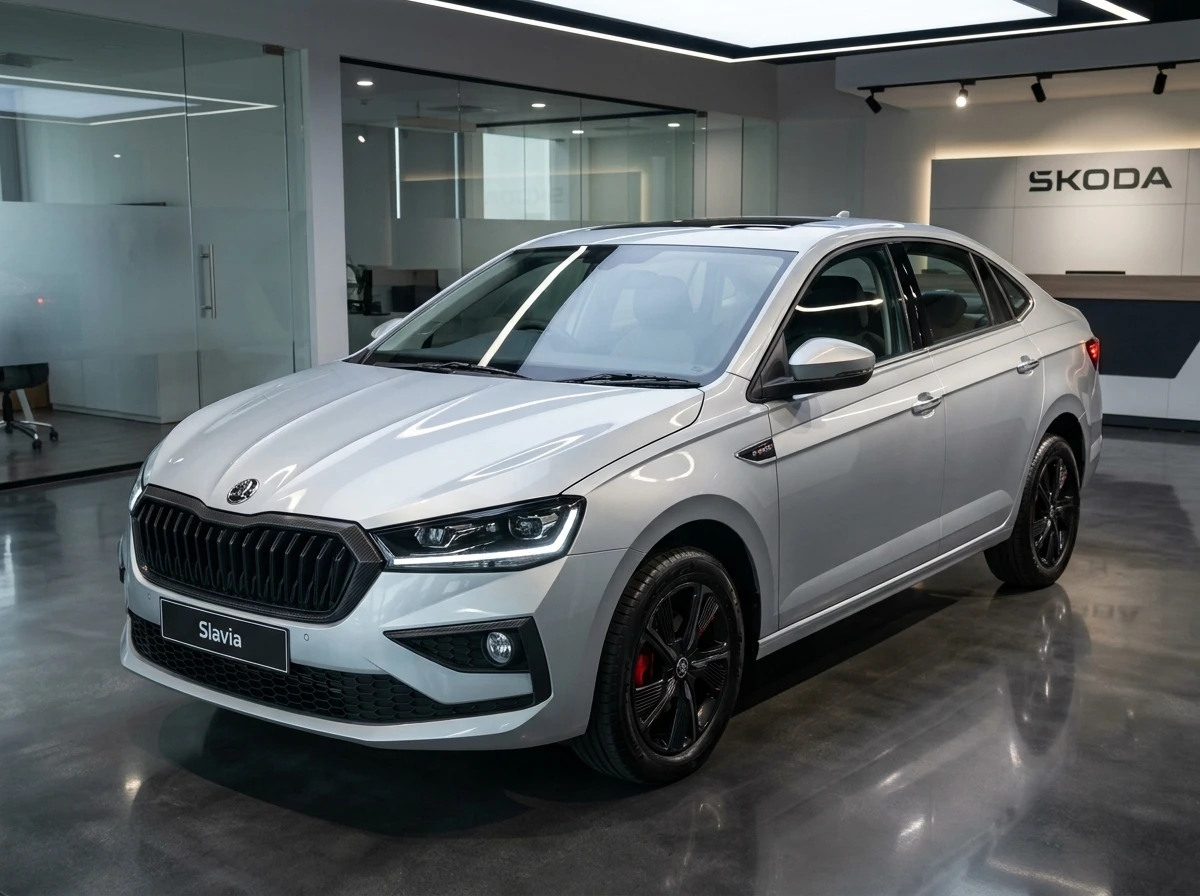
Exterior changes stay restrained. The LED daytime running lamps now use multiple sections, faux carbon-fibre trim runs along the lower grille edge, and the front bumper gains a textured air dam plus LED fog lamps. New 16-inch diamond-cut alloy designs freshen the side view while the classic sedan proportions, pronounced belt line and chrome door-handle garnishes remain.
At the rear the LED taillamps receive updated detailing, more faux carbon trim and sequential indicators. The Monte Carlo trim adds blacked-out wheels and exterior pieces, red brake calipers and a red grille accent. Two new colours join the range: Arctic Silver and Cappuccino Beige, bringing the total to ten options that also include Shimla Green, Lava Blue and Deep Black.
- Arctic Silver and Cappuccino Beige arrive as the two fresh exterior choices
- Shimla Green, Lava Blue and Deep Black carry over among the wider ten-colour palette
- Monte Carlo alone adds blacked-out wheels, red brake calipers and a red grille accent
Inside the dashboard architecture carries over with its beige-and-black theme. The floating touchscreen stays, now with a revised interface, while the digital instrument cluster grows larger. The cabin therefore reads as a familiar space with sharper screens rather than a full redesign, which suits owners who already like the layout and simply want it to work harder.
Restrained exterior updates also protect residual values for cars already on the road. A buyer stepping from the pre-facelift model into the new one will recognise the proportions at a glance, yet the sequential indicators, revised alloys and multi-section daytime running lamps give the 2026 car a clearer identity in traffic and on the dealership floor.
The 8-speed automatic is the mechanical headline
Powertrains are otherwise unchanged. The 1.0-litre turbo-petrol TSI still makes 115 PS and 178 Nm; the 1.5-litre TSI continues at 150 PS and 250 Nm. What changes is the gearbox on the smaller engine.
| Engine | Power / Torque | Transmission |
|---|---|---|
| 1.0-litre TSI | 115 PS / 178 Nm | 6-speed MT or new 8-speed torque-converter AT |
| 1.5-litre TSI | 150 PS / 250 Nm | 7-speed DSG |
The outgoing 6-speed automatic on the 1.0 TSI is replaced by the 8-speed unit. Skoda and owners expect smoother shifts and better efficiency in city traffic. The 1.5 keeps its dual-clutch DSG. Variants run Classic, Classic Plus, Signature, Sportline, Prestige and Monte Carlo.
The 8-speed torque-converter matters most for the volume engine. City stop-go traffic rewards extra ratios and a conventional automatic’s low-speed manners, which is why the brand and early commentary both flag smoother shifts and improved efficiency as the practical gains. Buyers who want the sharper dual-clutch response still step up to the 1.5-litre TSI and its 7-speed DSG.
Leaving both engines’ power and torque figures untouched keeps the mechanical story simple. The facelift does not ask shoppers to relearn performance claims. It asks them to notice how the smaller turbo pairs with a more modern gearbox, then choose trim height for kit rather than for a different power band.
Comfort kit that answers living with the car
Feature gains target everyday friction points. Higher trims now offer a 10.1-inch touchscreen with an AI assistant backed by Google Cloud, a 10.25-inch digital cockpit, rear massaging seats (a first in the segment), electrically adjustable and ventilated front seats, a single-pane sunroof, wireless phone charging, wireless Android Auto and Apple CarPlay, connected-car tech, keyless entry and cruise control.
- 360-degree camera and front parking sensors added for the first time
- Rear-seat massager exclusive to the segment at this price
- Larger 10.25-inch virtual cockpit with turn-by-turn navigation
- Updated LED lighting package including sequential indicators
- New alloy designs and Monte Carlo red accents
On X, auto commentator Nitin Sinha summarised the update as “basically a customer feedback list turned into a car,” listing the 360 camera, front sensors, better climate setup, rear massage and 8-speed automatic. He also noted that ADAS and an electronic parking brake remain absent.
India remains one of our most important global growth markets and a great example of what Škoda Auto can achieve when we listen closely to our customers. The new Slavia builds on this approach.
Klaus Zellmer, CEO of Škoda Auto, said those words at the Mumbai event. Brand director Ashish Gupta added that the car introduces contemporary styling, advanced technology and enhanced comfort while carrying forward the brand’s sedan legacy of design, dynamics, safety and engineering.
The pattern across the kit list is consistent. Parking aids, rear comfort and screen size address ownership friction that owners raise after months with the car, not showroom checkboxes that look good on a slide. The absent ADAS suite and electronic parking brake show where the brand still drew a line for this cycle.
Wireless phone charging, wireless Android Auto and Apple CarPlay, and the Google Cloud-backed AI assistant together push the cabin toward fewer cables and fewer taps. For a midsize sedan sold against feature-heavy rivals, that software layer is as visible day to day as the new alloys.
Safety foundation holds at five stars
The facelift keeps six airbags, electronic stability control, tyre-pressure monitoring, all-wheel disc brakes, hill-hold assist, rear parking sensors and an electronic differential lock. Front parking sensors and the 360-degree camera are the new additions.
The platform already earned a five-star Global NCAP result for both adult and child occupant protection under the 2023 protocols, with a stable structure and strong scores. That rating still underpins the safety story.
Ownership support expands through the Škoda Super Care ownership package: four-year standard warranty (or 100,000 km), four free scheduled services and four years of roadside assistance.
Passive hardware therefore stays familiar while active parking support widens. Six airbags, all-wheel discs and stability control already formed the core case; the 360-degree camera and front sensors simply close gaps that matter in tight Indian parking. The five-star Global NCAP result under 2023 protocols remains the external benchmark shoppers can cite without waiting for a fresh crash test of the facelift skin.
Super Care folds warranty, scheduled service and roadside help into one four-year frame. For a sedan fighting residual-value anxiety in an SUV-heavy market, that package is part of the retention argument alongside the new comfort kit.
Sedan numbers stay modest while SUVs dominate
Martin Jahn, Škoda Auto board member for sales and marketing, noted that nearly 80,000 Slavia units have been sold to date, giving the model a strong position in its segment. Recent monthly tallies, however, sit near or below 1,000 units. July 2026 figures put the Slavia at 993 units.
The wider midsize sedan group (Slavia, Virtus, Verna, City) moves far fewer cars than the SUV leaders. Compact and midsize SUVs continue to absorb the bulk of new-car demand. Skoda’s own Kylaq and Kushaq deliver the volume growth. Against that backdrop the facelift is less a volume play than a retention tool for buyers who still prefer a boot, lower centre of gravity and the driving manners of a proper sedan.
| Measure | Figure |
|---|---|
| Slavia cumulative sales | Nearly 80,000 units |
| Recent monthly pace | Near or below 1,000 units |
| July tally | 993 units |
| SUV share of passenger-vehicle sales | More than 60 percent |
Those figures explain the product brief. Cumulative volume near 80,000 units proves a durable base, yet a monthly run rate around 993 units shows how narrow the live demand lane has become. Kylaq and Kushaq carry brand growth; the Slavia must keep sedan loyalists from drifting away when their next purchase cycle opens.
In that light every added convenience, from the rear massager to the 8-speed automatic, works as insurance on a smaller but still valuable customer set rather than as a bid to reverse the SUV tide.
How the refreshed Slavia meets its rivals
The Volkswagen Virtus shares the same MQB-A0-IN platform, engines and much of the hardware. Design taste and a few feature timing differences separate the twins; the Virtus facelift is widely expected to follow with similar 8-speed, camera and screen upgrades. Hyundai’s Verna offers a stronger 160 PS 1.5 turbo with 7-speed DCT plus Level 2 ADAS on higher trims. Honda’s City counters with a refined naturally aspirated 1.5 and a strong-hybrid option that leads the segment on efficiency claims.
| Model | Powertrain highlight | Notable kit stance |
|---|---|---|
| Skoda Slavia facelift | 115 PS 1.0 TSI with new 8-speed AT; 150 PS 1.5 TSI with 7-speed DSG | Rear massager, 360-degree camera; no ADAS on this update |
| Volkswagen Virtus | Same MQB-A0-IN engines and hardware family | Facelift expected to echo 8-speed, camera and screen gains |
| Hyundai Verna | 160 PS 1.5 turbo with 7-speed DCT | Level 2 ADAS on higher trims |
| Honda City | Refined naturally aspirated 1.5 plus strong-hybrid | Segment-leading efficiency claims on the hybrid |
Expected pricing for the Slavia facelift sits between Rs 11 lakh and Rs 18 lakh ex-showroom, a modest rise of roughly Rs 25,000-50,000 over the outgoing range depending on variant. Exact figures are due early next month according to multiple reports. The official Škoda Slavia model page still lists the pre-facelift configuration and starting price near Rs 9.99 lakh, so shoppers should treat current online numbers as placeholders until the fresh list appears.
Price discipline will decide how sharp the comparison feels. A rise held near Rs 25,000-50,000 keeps the facelift inside the familiar midsize window and limits the gift to the Verna’s stronger turbo or the City hybrid’s efficiency story. If the final list stretches much further, the new camera, massager and 8-speed unit will have to work harder to justify the gap.
Until Skoda publishes the fresh sticker, the near Rs 9.99 lakh figure on the current model page remains a pre-facelift placeholder only. Serious shoppers will wait for the early-next-month confirmation before locking a comparison against Virtus, Verna or City invoices.
Customer feedback drives the update brief
Zellmer’s Mumbai remarks and Sinha’s owner-eyed summary point to the same method. The brand framed India as a market where listening closely shapes the product, and the commentator read the finished car as a feedback list made metal. Rear massage, the 360-degree camera, front parking sensors, the larger 10.25-inch cockpit and the 8-speed automatic each map to a lived complaint rather than a clean-sheet dream feature.
Gupta’s stress on contemporary styling, advanced technology and enhanced comfort sits on top of that same brief. Design and dynamics stay inside the brand’s sedan legacy; the new work concentrates on technology and comfort that owners said they missed. The absences Sinha flagged, ADAS and an electronic parking brake, mark the edge of what this cycle was willing to absorb.
That approach fits a low-volume, high-loyalty niche. When monthly sales hover near 993 units, each retained buyer matters more than a broad conquest wave. Turning feedback into standard or high-trim kit is a direct way to protect the nearly 80,000-strong ownership base already built.
What the booking window means for buyers
Pre-bookings opened on 18 August at Rs 15,000 with prices still held back and festive-season deliveries as the target. Exact prices are due early next month on multiple reports, which leaves a short gap between a refundable commitment and a full invoice decision.
- 18 August – Mumbai unveil, Slavia pre-bookings open at Rs 15,000; additional Octavia RS units and Superb expressions of interest also flagged the same day
- Early next month – Exact Slavia facelift prices expected
- Festive season – Targeted start of Slavia deliveries once prices are confirmed
- Second quarter of next year – Superb return with TDI diesel power slated for delivery
The Rs 15,000 booking fee lets interested buyers hold a place while the final ex-showroom band, expected between Rs 11 lakh and Rs 18 lakh, becomes public. Shoppers who already favour the Slavia’s dynamics can use the window to compare trim content, especially where the rear massager, 360-degree camera and 8-speed automatic sit in the ladder from Classic through Monte Carlo.
Bookings run at dealerships and through the brand’s online channel, so the path from interest to allocation is open even before the price list lands. Delivery timing still hinges on that confirmation landing cleanly ahead of the festive rush.
A wider sedan bet accompanies the facelift
On the same day Skoda opened pre-bookings for additional Octavia RS units and invited expressions of interest for the all-new Superb, which returns with TDI diesel power and is slated for delivery in the second quarter of next year. The combination signals that the brand still sees value in a three-tier sedan ladder: accessible Slavia, performance Octavia RS, and flagship Superb.
PatanCAR’s Sid Patankar noted the timing on X: the Slavia facelift, the diesel Superb and another batch of 50 Octavia RS cars put “sedans in focus” at Skoda India. Whether that focus converts into sustained sales depends on pricing discipline and how quickly the Virtus and others match the new kit.
Bookings are live at dealerships and via the Škoda Auto India homepage bookings channel. Deliveries are expected to begin with the festive season once prices are confirmed. For buyers who already prefer the Slavia’s dynamics and build, the facelift removes several daily irritations without rewriting the car’s character.

-
 TECH1 year ago
Where Garmin Watches are Made and How They are Assembled
-
 AUTO2 months ago
Tesla’s Roadster Is ‘a Few Weeks Away,’ Says Its Chief Designer
-
 NEWS10 years ago
Samsung Releases Galaxy Note7 TV Ad as Reddit AMA Leaks Specs
-
 NEWS10 years ago
Android 7.0 Nougat Rolls Out To Nexus Devices With New Emoji, Features
-
 FINANCE9 years ago
Cardano Price Surges as ADA Enters the Crypto Top Ten List
-
 NEWS10 years ago
Pre-Order the First Camera Made for Facebook Live Streaming Video
-
 FINANCE1 year ago
Binance Suspends Trading and Withdrawals for a System Upgrade
-
 FINANCE9 years ago
RChain Price Jumps Nearly 150% to a New All-Time High of $2.03