
BUSINESS
PNG scheme flips CGD economics with cheap gas for each new home line
New scheme from September rewards billed domestic PNG lines with cheap domestic gas, cutting CGD payback from 10 years to 3 and targeting unbilled activations.

The government on 18 August approved an incentive scheme that will give City Gas Distribution companies an extra 200 standard cubic metres of cheaper domestic APM gas for every incremental billed household PNG connection they add above a set threshold, starting 1 September 2026. India currently has 1.74 crore domestic PNG connections. The six-month programme in two tranches is meant to turn unbilled lines into working ones and push networks into new areas by rewriting the maths that made household last-mile work slow.
The extra gas will replace costlier imported LNG that CGD firms now buy for their CNG transport business, cutting overall sourcing costs. Officials expect that swap to shrink the payback period on domestic PNG capital spending from around 10 years to about three.
In plain terms, each new billed kitchen unlocks a fixed volume of lower-priced domestic gas that the same company can put into its transport portfolio. The household side earns the reward; the CNG side captures the cost relief. That dual effect is why the ministry cast the scheme as a company incentive rather than a retail subsidy.
How the APM gas reward is structured
Eligible CGD entities receive the additional allocation of lower-priced, domestically produced gas only for billed domestic PNG connections that exceed the threshold fixed for each Geographical Area. The scheme runs in two tranches covering six months in total. The official PIB scheme details and payback estimate spell out the substitution mechanism and the expected return compression.
| Element | Detail |
|---|---|
| Start date | 1 September 2026 |
| Reward | 200 SCM APM gas per incremental billed domestic PNG connection above GA threshold |
| Duration | Two tranches spanning six months |
| Use of gas | Substitutes costlier LNG currently bought for CNG (transport) |
| Expected payback | From ~10 years down to ~3 years on D-PNG capex |
| Current base | 1.74 crore domestic PNG connections |
The Ministry of Petroleum and Natural Gas frames the programme as a direct incentive for companies to activate existing pipes and extend coverage rather than a consumer subsidy. APM gas comes from conventional fields of ONGC and Oil India and is priced lower than spot or long-term LNG cargoes that have stayed elevated amid West Asia supply tensions.
Thresholds are set per Geographical Area, so the bar reflects local network maturity rather than a single national number. Only billed connections count. A laid pipe that never generates a meter reading earns nothing under the formula. That design pushes firms to finish last-mile activation and start invoicing, not merely to report trench kilometres.
Why a three-year payback changes the rollout pace
CGD firms have long faced a structural mismatch. Authorisations cover the bulk of India’s population and geography after successive bidding rounds, yet actual household connections remain a fraction of the multi-crore targets set for the early 2030s. Laying pipe into dense housing societies and high-rises is capital intensive; recovery stretched over a decade made managers cautious even when demand existed.
By linking cheap gas volumes to each new billed kitchen, the scheme turns domestic PNG from a long-gestation social project into a margin contributor that also improves the CNG side of the business. Market observers on X quickly flagged listed CGD names such as Indraprastha Gas, Mahanagar Gas and Gujarat Gas entities as the clearest near-term beneficiaries because denser urban networks already contain large numbers of laid but unbilled connections that can be activated with lower incremental spend.
- Payback compression: 10 years to approximately 3 years on domestic PNG capital expenditure
- Gas swap: 200 SCM APM per new billed line displaces higher-priced LNG in transport
- Activation focus: Convert unbilled connections already in the ground before pure greenfield expansion
- Cost backdrop: LNG prices remain sensitive to episodic West Asia disruptions
That economics flip is the second-order lever. Households get safer, metered cooking gas; the companies get a reason to move faster because the reward lands on their overall gas bill.
A decade-long recovery forced capital committees to rank domestic PNG behind quicker CNG or industrial loads. A three-year clock changes the internal queue. Projects that once failed hurdle-rate tests can clear them when the APM volumes offset LNG bought for transport, which is why observers expect denser GAs to move first.
Households gain convenience and lower fuel risk
Piped natural gas reaches kitchens through underground lines at low pressure. It is lighter than air, so any leak disperses rather than pooling. There is no cylinder booking, storage or delivery wait. Billing tracks actual metered use, the same way electricity or water is charged. Officials note that PNG is generally cheaper than LPG on a per-unit energy basis and cuts indoor pollution compared with traditional fuels.
- Continuous low-pressure supply through underground lines
- Metered bills tied to actual use, without cylinder logistics
- Lighter-than-air fuel that disperses rather than pools if a leak occurs
- Lower indoor pollution than many traditional cooking fuels
- Generally cheaper than LPG on a per-unit energy basis
The scheme sits alongside other recent steps that lower friction for both companies and consumers. States are being pressed to cut VAT on natural gas to 5 percent; several have already moved. An Accelerated Approval Framework and standardised Right-of-Way charges under the Natural Gas & Petroleum Distribution Order, 2026 aim to speed infrastructure clearances. National PNG Drive 2.0 includes a portal for LPG cylinder surrender, awareness camps and conversion of housing societies still on cylinders. A unified digital registration platform is under development.
These moves matter more when LPG markets stay volatile. A recent commercial LPG price cut still left rates elevated in major cities, underscoring why a reliable pipeline alternative carries weight for both households and the import bill.
When VAT cuts, faster clearances and a working surrender portal line up with a live PNG connection, the household switch costs less time and money. The incentive does not change the sticker price at the burner tip on day one. It raises the odds that the pipe reaches the kitchen in the first place.
CGD firms stand to unlock already-laid pipes first
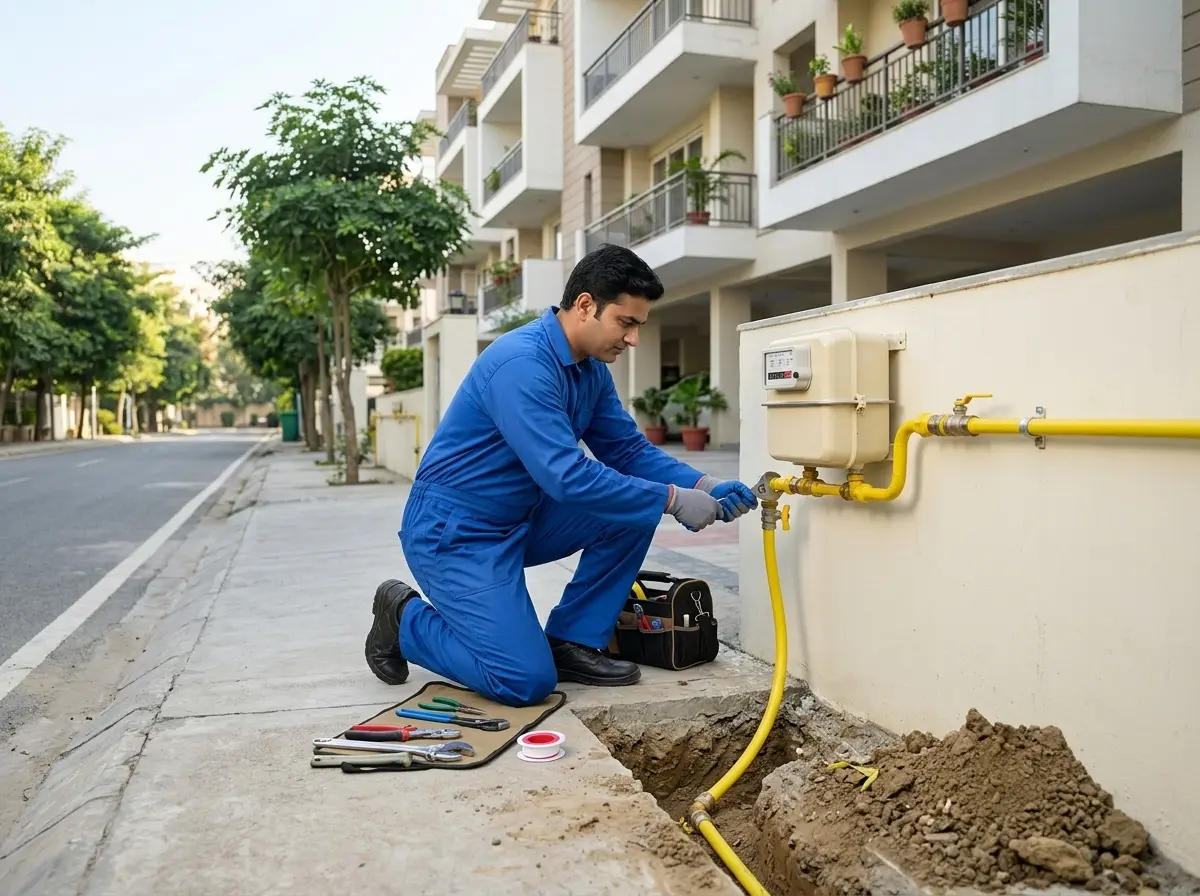
The immediate opportunity is conversion. Many urban GAs already have steel or polyethylene lines running past apartments that were never activated or billed. Turning those into revenue connections requires less new trenching than greenfield work and delivers the APM reward faster. Companies that already dominate dense markets can raise daily installation and activation rates without waiting for new authorisations.
Longer term the same incentive supports expansion into smaller towns and new housing as the six-month window proves the model. The Petroleum and Natural Gas Regulatory Board tracks progress through its PNGRB monthly CGD progress reports. Earlier targets spoken of by the board and ministry have ranged around 12 crore-plus connections by the early 2030s, a multiple of today’s 1.74 crore base. Closing that gap requires both capital and a workable return, which the gas allocation is designed to supply.
The resulting cost savings are expected to shorten the payback period for capital expenditure incurred on D-PNG connections from around 10 years to approximately 3 years, giving CGD entities a strong financial incentive to expand household PNG connectivity more rapidly.
The ministry statement itself makes the link explicit. Downstream, higher domestic gas demand also supports the broader push for more indigenous supply, including the cabinet push for deepwater gas capital approved earlier.
Activation-first logic also matches the tranche design. Six months is short for heavy greenfield buildout across new towns. It is long enough to clear backlogs of unbilled urban lines, book the incremental volumes, and show whether the three-year payback holds in live operations.
Earlier policy steps that set up this incentive
The new scheme did not appear in isolation. Over recent months the government has stacked regulatory and fiscal changes to make PNG easier to build and cheaper to buy.
- Natural Gas & Petroleum Distribution Order, 2026: standardised Right-of-Way charges and accelerated clearances with defined timelines.
- VAT rationalisation drive: states encouraged to move natural gas VAT toward 5 percent.
- National PNG Drive 2.0: LPG surrender portal, society-level conversion camps and household outreach.
- Unified registration portal: single-window digital application and tracking still under development.
- Domestic gas allocation rules: existing MoPNG natural gas allocation guidelines already prioritise CGD for PNG and CNG; the incentive layers an incremental volume on top of performance.
Together they address the three classic bottlenecks: permission delays, end-user price, and company returns. The August decision supplies the return piece that had been missing.
Prior rules already steered domestic gas toward CGD for PNG and CNG. What they did not do was tie extra APM volumes to each new billed household above a local threshold. The August scheme fills that gap without rewriting the base allocation stack.
What the six-month window will test
Performance will be measured against Geographical Area thresholds. Companies that clear the bar get the gas volumes; those that do not simply keep their existing allocation. Because the reward is incremental and time-bound, the pressure is on to convert and bill quickly rather than announce multi-year plans. Daily connection rates, unbilled-to-billed conversion ratios and the share of APM gas flowing into the CGD pool will be the practical scoreboard.
If the economics hold, the model can be extended or made permanent. If activation remains slower than hoped, the constraint may lie elsewhere, in last-mile labour, society permissions or consumer willingness to surrender LPG cylinders. Either way the six-month experiment will produce hard numbers on how responsive CGD capital is to a three-year payback.
| Signal | What it shows |
|---|---|
| Daily connection rates | Whether crews and contractors can scale installation pace |
| Unbilled-to-billed conversion | How fast idle pipes become revenue lines |
| APM share in the CGD pool | Whether earned volumes actually displace LNG in transport |
| Threshold clearance by GA | Which networks clear the bar and which stay on base allocation |
Two tranches keep the test honest. A single open-ended window would let firms defer effort; a split calendar forces early proof, then a second push. PNGRB monthly progress reports will make the trajectory visible well before the window closes.
The Gas Swap Ties Kitchens to Transport Costs
The reward is denominated in APM gas, not cash. That choice matters for how the saving appears on a CGD balance sheet. Domestic APM volumes from conventional ONGC and Oil India fields replace cargoes of imported LNG that firms have been buying to keep CNG retail running while household networks lagged.
West Asia supply tensions have kept those LNG prices elevated on both spot and long-term routes. Every 200 SCM earned against a new billed PNG home is 200 SCM the company need not buy at those higher landed costs for transport fuel. The kitchen connection and the CNG station therefore share one sourcing pool.
Because the swap lands on the overall gas bill, finance teams can underwrite domestic PNG capex with a clearer offset. The payback compression from around 10 years to about three rests on that mechanism holding through both tranches. If LNG stays expensive, the earned APM volumes remain valuable. If household billing stalls, the offset never arrives.
Listed urban operators flagged by market observers already run large CNG networks beside dense housing. For them the swap is immediate: activate an unbilled line, book the APM volume, and cut a slice of LNG spend in the same reporting period. That loop is tighter than waiting for greenfield buildout in thinner markets to mature.
Urban Networks Can Convert Idle Lines Fastest
Authorisations already blanket much of the country’s population and geography. The gap is not paper coverage; it is billed kitchens. Today’s 1.74 crore domestic PNG base sits far below the 12 crore-plus early-2030s ambition spoken of by the board and ministry. The shortest path across part of that gap runs through steel and polyethylene already in the ground.
Dense GAs hold the largest stocks of lines that pass apartments yet never went live. Activation needs meter fitting, safety checks, billing setup and customer onboarding rather than fresh trunk trenching. Incremental spend per connection is lower, and the 200 SCM reward arrives sooner, which is why the six-month clock favours conversion over pure expansion in the first cut.
- Lower incremental capex: meters and service links on existing laterals beat new trunk routes
- Faster reward timing: billed status triggers APM volumes inside the tranche window
- CNG overlap: urban operators can apply earned gas straight into transport demand
- Scalable crews: daily installation rates can rise without new authorisations
Smaller towns and fresh housing still matter once the model is proved. The same incentive that clears urban backlogs can later fund extension where pipes do not yet run. The near-term scoreboard, though, will be written in cities where unbilled connections already wait.
Cleaner kitchens and a tighter gas balance
For households the practical change is immediate once the pipe is live: continuous supply, metered bills, no cylinder logistics and lower emissions inside the home. For the energy system the same connections reduce reliance on imported LPG cylinders whose prices and availability have swung with global events. Every billed PNG kitchen that displaces a cylinder is one less point of pressure on the subsidy and import apparatus.
The scheme therefore does double duty. It solves a company-level return problem that had kept pipes idle, and it advances the cleaner-cooking and energy-security goals that successive governments have set for the gas economy. The next half-year will show how many of those 1.74 crore connections become active revenue lines and how many new ones follow once the payback clock starts ticking at three years instead of ten.
Hard numbers from the two tranches will decide whether the three-year payback is a temporary bridge or a lasting template. Either outcome gives policymakers a clearer map of where capital, labour and consumer switching still bind, and where cheaper domestic gas can keep pulling idle pipes into daily use.

-
 TECH1 year ago
Where Garmin Watches are Made and How They are Assembled
-

 AUTO3 months ago
Tesla’s Roadster Is ‘a Few Weeks Away,’ Says Its Chief Designer
-
 NEWS10 years ago
Samsung Releases Galaxy Note7 TV Ad as Reddit AMA Leaks Specs
-
 NEWS10 years ago
Android 7.0 Nougat Rolls Out To Nexus Devices With New Emoji, Features
-
 FINANCE9 years ago
Cardano Price Surges as ADA Enters the Crypto Top Ten List
-
 NEWS10 years ago
Pre-Order the First Camera Made for Facebook Live Streaming Video
-
 FINANCE1 year ago
Binance Suspends Trading and Withdrawals for a System Upgrade
-
 FINANCE9 years ago
RChain Price Jumps Nearly 150% to a New All-Time High of $2.03