
NEWS
Rahul Gandhi Condemns Force on Jharkhand Students After Ally Crackdown
Rahul Gandhi labels police force on Jharkhand job aspirants wrong as students march over JPSC JSSC irregularities.

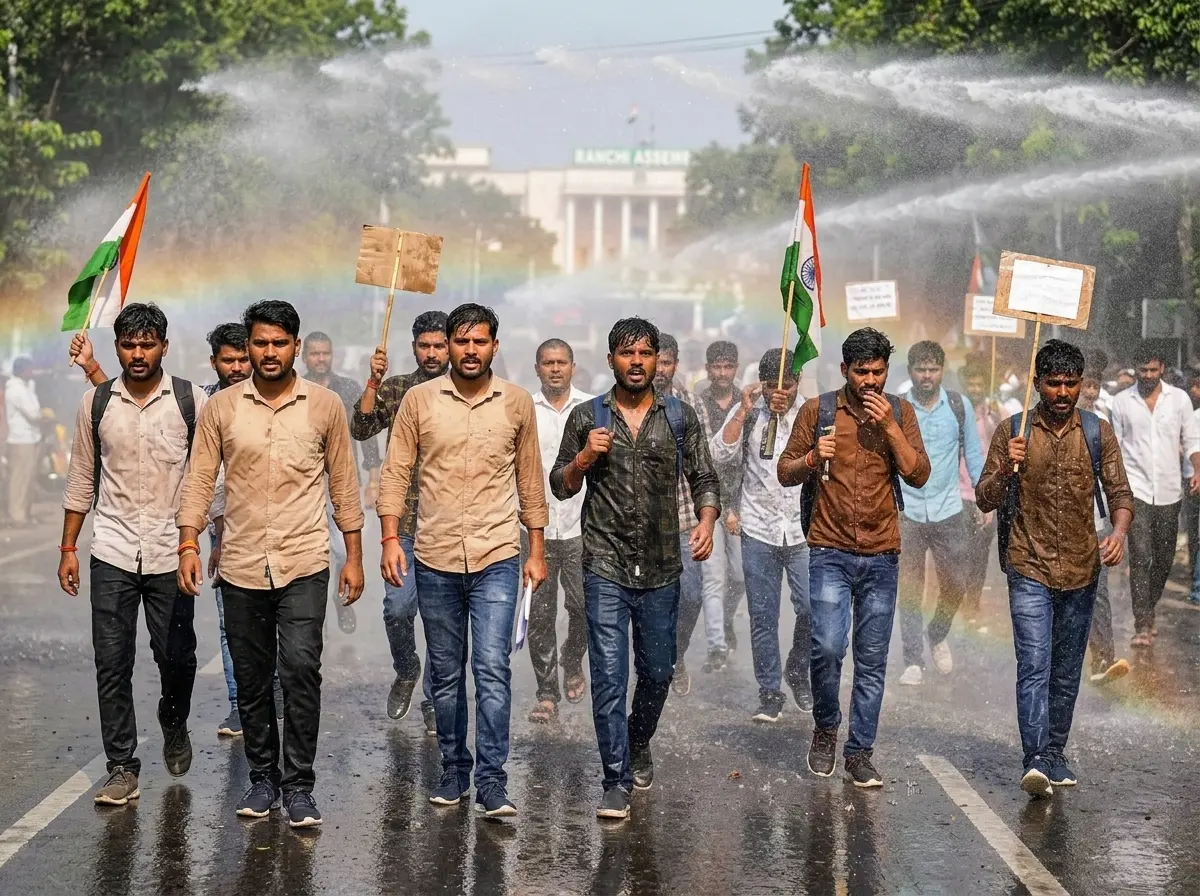
Rahul Gandhi on Monday condemned the police use of force against job aspirants marching in Ranchi, declaring that students have a right to peaceful protest and that only dialogue can solve their grievances. The Leader of the Opposition posted the statement as water cannons, tear gas and lathi charges met thousands of protesters outside the Jharkhand Assembly on the 17th day of their agitation over alleged recruitment exam irregularities.
The remarks came from a Congress leader whose INDIA bloc ally, the Jharkhand Mukti Morcha, heads the state government under Chief Minister Hemant Soren. BJP leaders had spent days hammering Gandhi for earlier silence on the same protests. The timing placed immediate pressure on the alliance while answering the charge of selective quiet.
Police Meet the Assembly March
Protesters set out around 10.30 am from outside the old assembly building, aiming for a gherao of the Vidhan Sabha. The day marked Soren’s 51st birthday. Police had erected barbed-wire barricades along the route. When aspirants breached them and closed in, officers responded with water cannons near Jagannathpur Temple, followed by tear gas shells and a lathi charge.
One injured protester, Sanjay Mahto, told PTI his head and legs hurt and his head was bleeding. JLKM leader Devendra Nath Mahto, fasting for nine days and having lost 10.5 kilograms, joined in an ambulance while carrying a portrait of former chief minister Shibu Soren. He objected to the barricades and said the government was hell-bent on suppressing their voice. “We will not hold any talks now,” he added.
- Water cannons deployed first to push back the crowd
- Tear gas shells lobbed as barricades fell
- Lathi charge on those who continued advancing
- Placards demanded cancellation of JSSC-CGL or a CBI probe
Students insisted the march stayed peaceful. Crowd voices on X noted the absence of stone-throwing or abuse even under the force, contrasting it with other recent student actions. The sequence of water, gas and sticks followed the breach rather than preceding it, a detail protesters repeated to underscore their claim of restraint.
What the Aspirants Still Demand
The core issues centre on the Jharkhand Public Service Commission and Jharkhand Staff Selection Commission. Aspirants want a CBI probe into paper leaks and irregularities, cancellation of multiple exams held after 2019, disclosure of cut-offs and OMR sheets, and structural reforms including a recruitment calendar on UPSC lines.
After six hours of talks on Sunday, the government agreed to cancel three examinations: the JPSC backlog 2023, backlog 2025, and the 14th JPSC preliminary. It also offered ED involvement on financial angles, CID on criminal ones, fast-track courts, a new feedback portal, and help from IIMs and XLRI for longer-term fixes. Minister Sudivya Kumar Sonu said 98 percent of demands were accepted. Three JPSC members resigned.
Protesters rejected the package as incomplete. They want the JSSC-CGL results cancelled too, plus every exam tied to the TDPL testing agency and figures like Abhay Tiwari. Student leader Ravindra Paswan said they would not compromise until a CBI probe is ordered. The government has refused, noting Supreme Court and High Court monitoring of the CGL process and that some candidates have already joined posts.
| Exam or Item | Government Position | Student Demand |
|---|---|---|
| JPSC backlog 2023 | Cancel | Cancel |
| JPSC backlog 2025 | Cancel | Cancel |
| 14th JPSC prelims | Cancel | Cancel |
| JSSC-CGL results | No cancel (court-monitored) | Cancel |
| Probe agency | CID + ED | CBI |
| TDPL-linked exams | Inquiry | Full cancellation |
Nineteen people had already been arrested in the JPSC-linked cases before Monday’s march. The three cancellations matched student demands exactly on those papers. The remaining gaps on the CGL results and the choice of probe agency kept the core dispute intact.
Gandhi’s Statement and the Parallel Column
In his X post, Gandhi wrote that the use of force against students is wrong. “Students have a right to peaceful protest, and only dialogue can yield solutions. The Jharkhand government must continue to hear these students out and resolve their issues immediately.” The bilingual post mirrored the Hindi original.
They were attacked with tear gas shells, beaten with nail-studded lathis and shot with pellet guns.
That line comes from Gandhi’s own Either Culpable or Incompetent column published the same day in The Hindu. There he focused on the July 20 Delhi march on Parliament over NEET and other leaks, where Delhi Police and RAF (both reporting to the Union home minister) used similar tactics plus pellets. He argued Amit Shah was either culpable for authorising it or incompetent for not knowing, and must resign. He described meeting a 19-year-old with hundreds of pellets in his body and young women injured on private parts.
The Jharkhand statement therefore sits inside a broader claim that force against students is unacceptable wherever it occurs. It also arrived after days of BJP attacks claiming selective silence when the state government was an ally. The same-day column and post together framed the Ranchi events as part of one continuous standard rather than an isolated remark.
Alliance Tightrope and Political Scoring
Jharkhand is ruled by JMM with Congress support inside the INDIA bloc. Soren had earlier promised justice through dialogue, not batons, and warned against politicisation. On Sunday he said vested interests were trying to disrupt democracy. Governor Santosh Kumar Gangwar also urged talks.
Gandhi’s public rebuke puts direct pressure on that ally while letting him claim consistency with his Delhi stance. BJP voices immediately flipped the script: if force is wrong in Jharkhand, why the earlier silence, and why no similar heat on the state education minister? One Union minister, Jitan Ram Manjhi, said Rahul needed to understand that criticising an NDA state is easy while their own government faces the same test. Right-leaning posts on X called the timing opportunistic and noted the absence of resignation demands for Soren comparable to those for Dharmendra Pradhan after the CJP protests.
The irony is sharp. Condemning the force shores up Gandhi’s youth credentials and undercuts BJP’s “silence” charge, yet it publicly embarrasses a key state partner and keeps the exam-scam story alive in a way that damages the entire alliance. Students themselves have kept politicians at arm’s length on one stage while JLKM occupies another, insisting the movement stay student-led.
The Rejected Package Leaves Core Gaps
Sunday’s six-hour session produced concrete movement on three JPSC papers and a cluster of process promises. Minister Sonu’s 98 percent claim rested on those cancellations plus the ED-CID split, fast-track courts, the feedback portal and the IIM-XLRI assistance offer. Three JPSC members stepped down the same day.
Students measured the offer against their full list and found the two largest remaining items untouched. The JSSC-CGL results stayed in place because of court monitoring and the fact that some candidates had already joined. The probe stayed with state agencies rather than the CBI. TDPL-linked exams received only an inquiry promise instead of outright cancellation.
- Three JPSC exams cancelled in full alignment with student demands
- JSSC-CGL results left standing under court oversight
- CBI demand refused in favour of CID plus ED
- Nineteen prior arrests left outside the fresh package
That arithmetic turned the 98 percent figure into a political liability. The rejected items were precisely the ones that had driven the 17-day street presence. Monday’s force then removed the immediate path back to the table that Devendra Nath Mahto had already closed with his ambulance statement.
A Longer Cycle of Leaks and Delays
Jharkhand’s recruitment system has drawn controversy for more than two decades. The first major JPSC leak allegation hit the History paper in 2003, forcing a cancellation and re-exam the next year. The 2012 examination produced five CBI cases years later; charges eventually named a former chairman, officials and candidates, many linked by family to power centres.
More recent history includes JSSC CGL papers cancelled or delayed after 2023 and 2024 leak claims, an Excise Constable raid that netted over 150 people (later disputed), and the current TDPL agency that had previously been blacklisted by JSSC yet won the JPSC contract. A viral OMR sheet from a successful 14th JPSC prelims candidate claiming only 48 of 100 correct answers ignited the present wave. CID arrests followed, including a deputy controller and TDPL directors. Former JPSC chairman L. Khiangte resigned after questioning and raids.
- 2003: History paper leak allegation, exam cancelled
- 2012: Major irregularities; CBI cases filed years later against 50 people
- 2023-24: JSSC CGL leaks and cancellations, results delayed over a year
- 2024-25: Further CGL and board exam controversies
- April-July 2026: 14th JPSC prelims, viral OMR, arrests, resignations, indefinite protest
Aspirants describe an endless loop: prepare, sit, face leak rumours or cancellation, wait months or years for results, repeat. One 34-year-old from Bokaro said he has cleared initial rounds seven times without a job. The process itself has become the punishment. Each new cycle begins before the previous one has fully resolved, leaving cohorts of candidates trapped in overlapping delays.
How Force Compares Across Two Cities
Gandhi’s same-day column and Ranchi post invited a direct side-by-side reading of the tactics used in Delhi and in Jharkhand. The instruments differed in degree yet shared the same sequence of escalation once barricades failed.
| Tactic | Ranchi March | Delhi July 20 March |
|---|---|---|
| Water cannons | Deployed near Jagannathpur Temple | Not cited |
| Tear gas | Shells after barricades fell | Shells used |
| Lathi charge | On advancing protesters | Nail-studded lathis reported |
| Pellet guns | Not reported | Used; one 19-year-old carried hundreds |
In Delhi the force fell under agencies reporting to the Union home minister. In Ranchi it fell under the state government headed by an INDIA ally. Gandhi applied the identical principle to both: force against students is wrong and dialogue remains the only route. The comparison supplied the consistency claim that answered BJP attacks on earlier silence.
Students in Ranchi pointed to the absence of stone-throwing as evidence that the higher end of the Delhi spectrum was unnecessary. The shared use of tear gas and sticks nevertheless gave both episodes a common visual language that social media amplified within hours.
Youth Trust and the Political Calculation
The Ranchi agitation draws confidence from the Delhi CJP protests that forced a Union minister’s exit. Students here want the same institutional reckoning. Yet the political layer is inescapable. Gandhi’s intervention fits his broader GenZ outreach efforts, positioning him as the listener who answers Instagram questions and stands with aspirants. At the same time it tests how far an opposition leader can go against a state ally without fracturing the bloc.
On the ground, the deadlock continues. Government talks have not produced the CBI probe or full cancellations students want. Force on Monday hardened positions further. Across X, observers noted the selective-outrage pattern runs both ways: parties defend force when their own governments use it and denounce it when rivals do. The students’ sustained peaceful pressure remains the constant that neither side fully controls.
Whether Monday’s statement accelerates a settlement in Ranchi or simply freezes the political temperatures higher, the underlying exam-integrity failures that sent thousands into the streets are not new and will not vanish with one post or one round of talks.

-
 TECH1 year ago
Where Garmin Watches are Made and How They are Assembled
-
 AUTO2 months ago
Tesla’s Roadster Is ‘a Few Weeks Away,’ Says Its Chief Designer
-
 NEWS10 years ago
Samsung Releases Galaxy Note7 TV Ad as Reddit AMA Leaks Specs
-
 NEWS10 years ago
Android 7.0 Nougat Rolls Out To Nexus Devices With New Emoji, Features
-
 FINANCE9 years ago
Cardano Price Surges as ADA Enters the Crypto Top Ten List
-
 NEWS10 years ago
Pre-Order the First Camera Made for Facebook Live Streaming Video
-
 FINANCE1 year ago
Binance Suspends Trading and Withdrawals for a System Upgrade
-
 FINANCE9 years ago
RChain Price Jumps Nearly 150% to a New All-Time High of $2.03