
NEWS
Trump’s New Orders Shift Birthright Fight to Visas and Rules
After the Supreme Court blocked a broad birthright ban, Trump’s August orders target commercial birth schemes and narrow citizenship categories through.

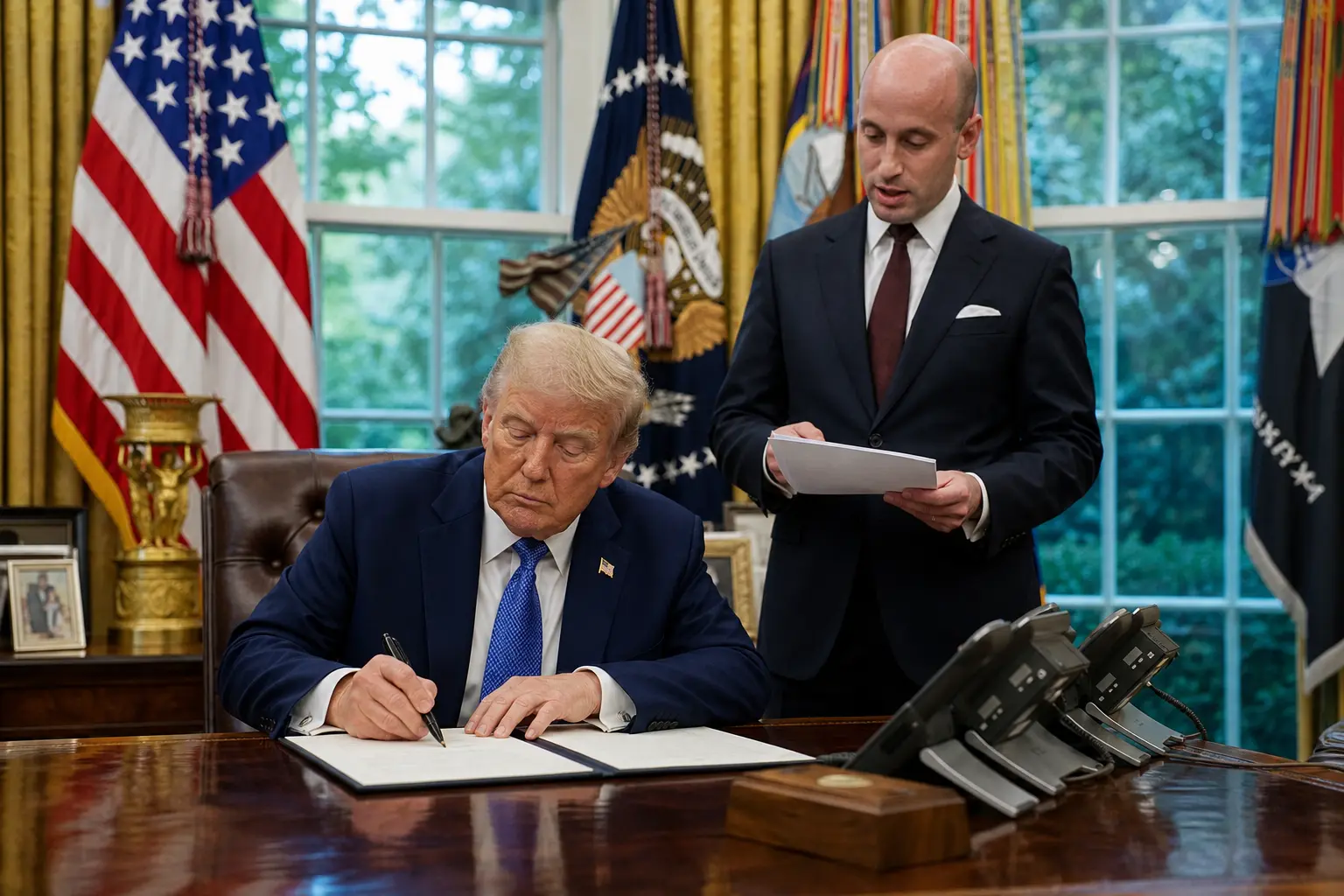
President Donald Trump signed two executive orders on August 6 that target commercial birth tourism and narrow the categories of children eligible for U.S. citizenship documents, five weeks after the Supreme Court rejected his broader attempt to end birthright citizenship.
Speaking in the Oval Office, Trump called the June ruling “very unfortunate” and said the new actions amounted to “making adjustments.” White House Deputy Chief of Staff Stephen Miller stood nearby as the president framed the moves as protection for the value of American citizenship.
What the Two Orders Direct
The first order, titled Continuing to Protect the Meaning and Value of American Citizenship, instructs agencies not to issue or accept citizenship documents for a person when neither parent is a U.S. citizen and any of several conditions apply. Those conditions reach alien enemies (including members of designated foreign terrorist organizations), certain foreign government employees, parents who engaged in a commercial transaction to place the mother or a surrogate in the United States for the birth, and births in territories where federal statute does not confer citizenship.
- Alien enemies, including members of designated foreign terrorist organizations
- Certain foreign government employees
- Parents who engaged in a commercial transaction to place the mother or a surrogate in the United States for the birth
- Births in territories where federal statute does not confer citizenship
Agencies have 30 days to issue public guidance. The order cites the Supreme Court’s language in Trump v. Barbara and claims consistency with historical exceptions the Court recognized.
The second order, Ending Birth Tourism, defines the practice as entry on a nonimmigrant visa for the purpose of giving birth, or facilitating such entry. It delegates presidential authority under the Immigration and Nationality Act to the secretaries of State and Homeland Security. They may deny visas or entry, revoke authorizations, permanently bar individuals, remove people who engaged in the practice, and act against facilitators. Humanitarian and national-interest exemptions remain available.
| Order | Core Tool | Main Targets |
|---|---|---|
| Continuing to Protect… | Citizenship document denial | Children of FTOs, foreign officials, commercial birth arrangers, certain territories |
| Ending Birth Tourism | Visa and entry controls | Nonimmigrant travelers whose purpose is childbirth; facilitators |
The White House fact sheet on the two orders links both actions to the Barbara decision and to a longer list of immigration enforcement steps the administration claims credit for.
Together the orders split the problem into two tracks. One tries to limit the paperwork that follows a birth already on U.S. soil. The other tries to stop the trip that produces the birth. That division shapes every later fight over legality and practical effect.
The Supreme Court Wall Still Stands
On June 30 the Court ruled 6-3 in Trump v. Barbara that children born in the United States to parents who are unlawfully or temporarily present are “subject to the jurisdiction” of the United States and therefore citizens under the Fourteenth Amendment. Chief Justice John Roberts wrote the majority opinion. The decision reaffirmed the longstanding reading that has governed since the late nineteenth century.
Trump’s first-day 2025 executive order had sought to withhold citizenship from children whose parents lacked citizenship or permanent residency. Lower courts blocked it; the Supreme Court finished the job. The new citizenship order tries to stay inside the “historical exceptions” the majority acknowledged rather than rewrite the clause outright.
Ratified in 1868, the Citizenship Clause was written to secure citizenship for formerly enslaved people after the Civil War and Dred Scott. Trump told reporters the original purpose was “for the babies of slaves” and that businesses now form around the guarantee. Miller argued that temporary visitors obtain welfare access, eventual voting rights, and other privileges through their U.S.-born children.
The June decision left those privileges intact for the great majority of children born on U.S. soil. The administration’s reply is to narrow the edges the Court itself left open and to choke off the commercial pipeline that delivers some of those births. Whether that reply survives depends on how tightly judges read the historical exceptions the majority mentioned.
How Large Is the Birth Tourism Practice
Numbers remain modest relative to total U.S. births. The Centers for Disease Control and Prevention recorded roughly 9,600 births in 2024 to mothers who listed a foreign address. The most expansive census-based estimate, advanced by the Center for Immigration Studies and cited by the Migration Policy Institute birth tourism estimates, places the annual figure between 22,000 and 26,000. That is a tiny share of the more than 3.5 million U.S. births each year.
- 9,600 CDC foreign-address births in 2024
- 22,000-26,000 high-end contested estimate of intentional birth tourism
- $20,000-$100,000 typical package prices reported for facilitation services
- 3.5-3.7 million total annual U.S. births for scale
Facilitators advertise housing, medical coordination, and visa coaching, especially to clients from China, Russia, Nigeria, and parts of Latin America. Southern California maternity hotels and South Florida operations serving Russian clients have drawn repeated law-enforcement attention. A 2020 regulation already made travelers primarily seeking birth inadmissible; ICE launched further network investigations earlier in 2026. The new order expands and hardens those tools.
Even at the high end of the contested range, the practice accounts for well under one percent of annual births. The political weight far exceeds the raw count because each birth creates a lifelong claim on citizenship, and because package prices show a profit motive that the administration wants to extinguish.
Who Feels the Visa Pressure First
The citizenship-document order will face immediate constitutional suits. The tourism order works through the far broader power to control temporary admission. Consular officers and border agents must now assess intent. Pregnant travelers on tourist, student, or other nonimmigrant visas can expect closer scrutiny even when their stay is otherwise lawful.
Immigration attorneys already warn that the commercial-transaction language is vague. A package deal is clear. Paying a hospital bill or renting an apartment near a preferred doctor sits in a grayer zone. Lawful H-1B workers, F-1 students, and their spouses who become pregnant while in status could face secondary screening or visa problems on future travel. The order’s exemptions for humanitarian cases and national interest give officers discretion that can cut both ways.
The practical squeeze lands on the facilitation industry first. Brokers who marketed “anchor” packages now operate under explicit presidential direction to deny the underlying visas and bar participants. That pressure exists regardless of how courts treat the citizenship carve-outs. Similar documentation fights over citizenship status appear in other systems; citizenship documentation disputes abroad show how administrative rules can lock people out of benefits for years even when core nationality questions remain contested.
Intent screening is inherently subjective. An officer who sees a late-term pregnancy and a short planned stay may deny entry even when the traveler holds a valid visa. Travelers who previously entered without incident may now carry extra documentation to prove a non-birth purpose. The exemptions offer a safety valve, yet they also create uneven outcomes from post to post.
Legal Challenges Are Already Forming
New York immigration attorney Cyrus Mehta called the commercial-transaction bar “blatantly unconstitutional” and too vague to survive Fourteenth Amendment review. In a detailed post he argued that even children of designated terrorists remain subject to U.S. jurisdiction and therefore citizens, that most foreign-government employees lack full diplomatic immunity, and that birth tourism itself falls inside the Barbara holding.
Every aspect of Trump’s new executive order restricting birthright citizenship after the Supreme Court upheld it in Trump v. Barbara is unconstitutional.
Mehta wrote that assessment on X, drawing thousands of views within hours. The American Civil Liberties Union’s Cody Wofsy said the Court already decided the core issue and that any executive rewrite of birthright citizenship “will meet the same fate as the last one.”
The tourism order rests on different footing. Presidents have long held substantial authority over visas and temporary entry. Courts have been more deferential there. The fight over the definition of birth tourism and visa powers may therefore turn on implementation details and whether officers apply the rules even-handedly rather than on the Citizenship Clause itself.
Challengers will almost certainly file first against the citizenship-document rules, where the constitutional stakes are highest and the Barbara precedent is freshest. The visa rules may draw slower, more fact-specific suits that attack particular denials or patterns of enforcement rather than the order’s text in the abstract.
Historical Exceptions and the Next Enforcement Wave
The new citizenship order lists specific categories of children denied citizenship documents that the administration says track longstanding exceptions: children of invading armies or diplomats with immunity, and certain territorial cases. American Samoa already does not confer birthright citizenship by statute; the order simply notes that reality. Expanding “alien enemy” and commercial-purpose language beyond those narrow historical boxes is where the constitutional collision is sharpest.
- July 9, 1868, Fourteenth Amendment ratified, Citizenship Clause takes effect.
- 1898, United States v. Wong Kim Ark affirms citizenship for child of Chinese non-citizen parents domiciled in the United States.
- January 20, 2025, Trump’s first-term-return order seeks to end birthright for children of non-citizens and non-permanent residents.
- June 30, 2026, Supreme Court strikes that order 6-3 in Trump v. Barbara.
- August 6, 2026, Two narrower executive orders signed.
Agencies must produce guidance within 30 days. Lawsuits will almost certainly follow within the same window. The tourism order can begin shaping consular decisions immediately. The citizenship order’s document-denial rules will be tested in federal court almost as fast. The administration’s second-order bet is that controlling the front door of temporary entry can shrink the practice even if the constitutional back door stays open.
Document Rules and Visa Rules Diverge
The two orders share a political goal yet rest on unequal legal ground. Citizenship documentation touches the Fourteenth Amendment directly. Visa and entry control rests on the Immigration and Nationality Act and on the long tradition of presidential authority over temporary admission.
That difference already appears in the early reactions. Mehta and Wofsy trained their fire on the citizenship order. The tourism order drew less immediate constitutional alarm precisely because courts have historically deferred to the executive on who may enter for a short stay.
| Feature | Citizenship Order | Tourism Order |
|---|---|---|
| Primary legal anchor | Historical exceptions to the Citizenship Clause | Immigration and Nationality Act authorities |
| Likely court posture | Strict scrutiny under Barbara | Greater deference to executive entry power |
| Speed of effect | Needs agency guidance, then faces suits | Can shape consular decisions at once |
| Core remedy sought | Deny citizenship documents | Deny or revoke visas, bar facilitators |
If judges strike the commercial-transaction and alien-enemy expansions, the visa track can still raise the cost and risk of arranging a birth trip. That fallback is built into the pair of orders from the start.
Facilitators Absorb the First Shock
Package prices of $20,000 to $100,000 show an industry that has treated U.S. birthright as a marketable product. The tourism order names facilitators as direct targets. Secretaries may permanently bar individuals and act against those who arrange the travel.
Southern California maternity hotels and South Florida operations that served Russian clients already faced law-enforcement attention. The 2020 regulation and the 2026 ICE network investigations supplied earlier pressure. The new presidential direction removes ambiguity about the administration’s intent.
Brokers who once advertised housing, medical coordination, and visa coaching now face the prospect that their clients will be refused at the consulate or turned away at the border. Even if some citizenship-document rules fall in court, a facilitator whose customers cannot reliably enter has little product left to sell.
That is the adjustment Trump described: less a frontal assault on the Citizenship Clause and more an attempt to make commercial birth schemes expensive, risky, and administratively difficult while daring the courts to strike every new category one by one.

-
 TECH1 year ago
Where Garmin Watches are Made and How They are Assembled
-

 AUTO2 months ago
Tesla’s Roadster Is ‘a Few Weeks Away,’ Says Its Chief Designer
-
 NEWS10 years ago
Samsung Releases Galaxy Note7 TV Ad as Reddit AMA Leaks Specs
-
 NEWS10 years ago
Android 7.0 Nougat Rolls Out To Nexus Devices With New Emoji, Features
-
 FINANCE9 years ago
Cardano Price Surges as ADA Enters the Crypto Top Ten List
-
 NEWS10 years ago
Pre-Order the First Camera Made for Facebook Live Streaming Video
-
 FINANCE1 year ago
Binance Suspends Trading and Withdrawals for a System Upgrade
-
 FINANCE9 years ago
RChain Price Jumps Nearly 150% to a New All-Time High of $2.03