
HEALTH
Lung Cancer Hits More Never-Smokers as India Faces Pollution Shift
Oncologists report more lung cancer in never-smokers and women driven by pollution and radon.

Lung cancer cases among never-smokers, women and younger adults are climbing in India, according to Bengaluru oncologist Dr. Radheshyam Naik, even as artificial intelligence and molecular testing open clearer paths to longer survival. Smoking remains the top risk, yet passive smoke, traffic pollution, biomass fuels and radon now shape a different patient profile ahead of World Lung Cancer Day.
Dr. Naik, senior consultant medical oncologist and head of the bone marrow transplant unit at Sammprada Hospital, said the old idea that only smokers get the disease still delays care for people who never lit a cigarette.
The Numbers Behind India’s Changing Cases
Global figures put the scale in view. The World Health Organization recorded 2.5 million new cases and 1.8 million deaths from lung cancer in 2022, making it the leading cause of cancer cases and deaths worldwide. In India the World Cancer Research Fund tallied 81,748 new lung cancer cases in India that year, with an age-standardised rate of 5.8 per 100,000, plus 75,031 deaths.
| Region | New Cases 2022 | Deaths 2022 | ASR Incidence |
|---|---|---|---|
| World | 2,480,675 | 1,817,469 | 23.6 |
| India | 81,748 | 75,031 | 5.8 |
| India men | 58,970 | 54,220 | 8.5 |
| India women | 22,778 | 20,811 | 3.2 |
Rates look lower than in China or the United States, yet the absolute burden is large and the demographics inside it are shifting. Doctors report more patients under 50 and more women who never smoked.
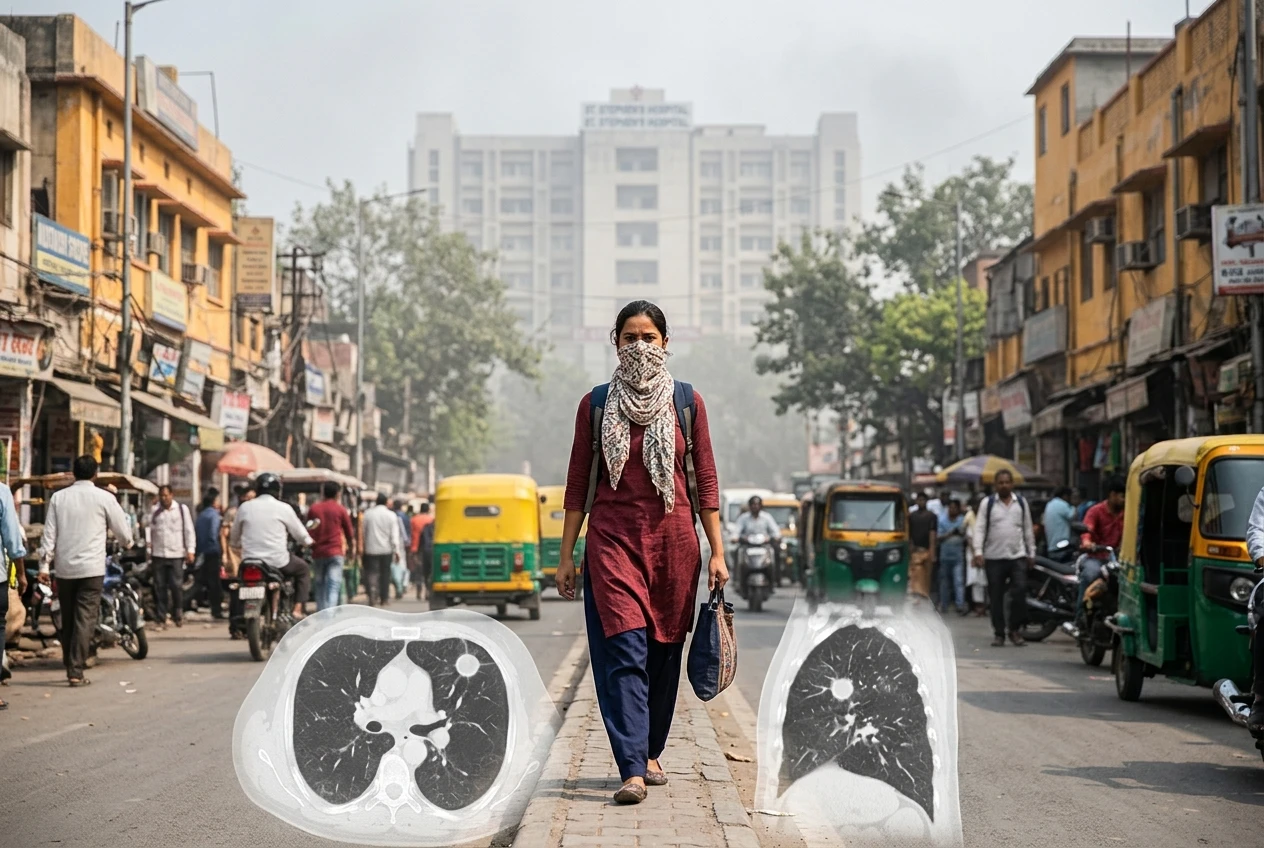
Pollution, Radon and the New Risk Mix
Dr. Naik put concrete shares on the non-tobacco drivers he sees in clinic. About 5-7% of cases link to passive smoking. Around 10% tie to traffic-related air pollution. Another 10-15% of non-smoking-related lung cancers trace to radon gas. Indoor air pollution from traditional cooking fuels adds further load.
- Passive smoking: 5-7% of cases
- Traffic air pollution: roughly 10%
- Radon exposure: 10-15% of non-smoking-related cases
- Biomass and indoor fuels: ongoing contributor, especially for women
These percentages sit alongside the global picture. The CDC notes that 10% to 20% of lung cancers in never-smokers occur in people who smoked fewer than 100 cigarettes in a lifetime in the United States. Secondhand smoke and radon each account for thousands of those cases yearly. In India the same exposures meet denser cities and more solid-fuel cooking, so the non-smoker share can run higher in some hospital series.
On X, patients and advocates keep pointing at the air. One woman living with stage 4 never-smoker lung cancer after years in Delhi described dirty air as a proven daily killer and asked how many more deaths it would take before policy catches up. That crowd reading matches what oncologists now say in quieter rooms: the risk list has lengthened while public messaging still circles tobacco alone.
Adenocarcinoma Takes Over
The tumour types themselves have flipped. Two decades ago India saw more squamous cell carcinoma and small-cell lung cancer tied to heavy smoking and beedi use. “Today, nearly 80% of lung cancers that we diagnose are adenocarcinomas, a pattern that now closely resembles Western countries,” Dr. Naik said. Filtered cigarettes, changed smoking patterns and broader lifestyle shifts help explain the histology change.
Adenocarcinoma often grows in the outer lung and can appear in never-smokers. It is also the subtype most likely to carry targetable mutations such as EGFR, ALK or ROS1. That biological fact turns the demographic shift into a treatment opportunity once the right tests are ordered.
Quick snapshot
- 80% of current diagnoses in Dr. Naik’s practice are adenocarcinomas
- Earlier era: higher squamous and small-cell shares linked to beedi smoking
- Never-smoker lung cancers worldwide: roughly half to 60% adenocarcinoma
AI Reads Scans and Pathology Slides
Artificial intelligence now sits inside the diagnostic workflow. In pathology it helps separate cancer from benign changes and pins down the exact subtype so treatment can start on the right path. In radiology it scores CT nodules for malignancy risk and flags which patients need biopsy or surgery sooner.
“AI is becoming an invaluable decision-support tool. It improves diagnostic accuracy, reduces uncertainty and helps us begin the right treatment much earlier,” Dr. Naik said. The gain matters most for the new patients who do not fit the old smoker checklist and might otherwise wait longer for a scan.
Women and Younger Patients Move to the Center
Women who never smoked face higher relative risk than men in the same category. Research summarised by the Lung Cancer Research Foundation shows non-smokers nearly twice as likely to be women. Asian never-smoking women in some data sets carry still higher rates. In India rising tobacco use among women and adolescents, plus indoor cooking smoke and outdoor pollution, add layers.
Smoking remains the leading cause of lung cancer, but it is no longer the whole story. We are increasingly seeing lung cancer in people who have never smoked, particularly women and younger adults.
Dr. Naik made that point directly. Younger age at diagnosis also stands out. Indian patients often present a decade earlier than Western counterparts. Lifestyle factors (diet, obesity, inactivity, alcohol) combine with the environmental load. The result is a clinic list that no longer matches the textbook image of a long-term male smoker.
Precision Tests Rewrite Survival Odds
Molecular profiling and biomarker testing now sit at the centre of care. Tumours are classified by genetic mutations and immune features so patients receive targeted drugs or immunotherapy instead of one-size chemotherapy.
“Molecular testing and biomarker testing have become the foundation of lung cancer treatment today. They tell us which patients are likely to benefit from targeted therapies and who will respond to immunotherapy. Without these tests, it is difficult to offer the most effective treatment,” Dr. Naik said.
- Targeted drugs for EGFR, ALK and other drivers
- Immunotherapy for tumours with high PD-L1 or other markers
- Earlier-stage use of these agents alongside surgery and radiation
- AI-assisted pathology that speeds subtype and biomarker calls
These tools already lift survival for advanced disease and are moving into earlier stages. Dr. Naik expects many patients to live substantially longer over the next five to ten years, with complete cure possible for some categories. Access remains uneven. Global surveys still find gaps in comprehensive biomarker testing, especially outside major centres. In India the cost and laboratory reach of next-generation sequencing decide who actually receives the personalised plan.
Awareness Still Lags the Biology
Prevention still starts with never starting to smoke and quitting early. Yet the second-order problem is clear: if the public and many primary doctors still picture only smokers, never-smokers ignore early cough, chest pain or breathlessness and arrive at later stages. Screening guidelines themselves often focus on heavy smoking history, leaving the new cohort outside routine low-dose CT programs.
Household steps help. Test for radon, improve kitchen ventilation, cut indoor solid-fuel use, and reduce outdoor exposure on high-pollution days. Everyday moves such as simple habits that support long-term health also lower background risk across ages. The larger policy work (cleaner air, tobacco control, equitable testing) will decide how many of the new patients actually meet the better therapies in time.
Dr. Naik closed on both notes: keep prevention first, and recognise that the outlook for those who do develop the disease has never looked more promising. Research in genomics, immunotherapy and targeted medicines is moving fast. The patients who will benefit most are the ones the old story still overlooks.
Frequently Asked Questions
What percentage of lung cancers occur in never-smokers?
Global estimates place 10-20% of lung cancers in people who never smoked or smoked fewer than 100 cigarettes; some Indian hospital series report higher never-smoker shares, especially among women, while smoking still drives the majority overall.
Which environmental factors raise lung cancer risk besides smoking?
Secondhand smoke, outdoor traffic pollution, indoor biomass and cooking fumes, radon gas, and occupational dusts or chemicals all contribute; Dr. Naik attributes roughly 5-7% of cases to passive smoking, 10% to traffic pollution and 10-15% of non-smoking cases to radon.
Why has adenocarcinoma become the dominant lung cancer type in India?
Nearly 80% of diagnoses in current practice are adenocarcinomas, up from higher earlier shares of squamous and small-cell disease; filtered cigarettes, lower beedi intensity and lifestyle shifts track the change that now mirrors Western patterns.
How do molecular tests change lung cancer treatment?
Biomarker testing identifies mutations and immune markers so doctors can prescribe targeted drugs or immunotherapy instead of uniform chemotherapy, improving response rates and survival for both advanced and earlier-stage disease when the matching therapy is available.
Can lung cancer be cured with current advances?
Early-stage disease treated with surgery plus modern adjuvant therapies already offers high cure rates for some patients; Dr. Naik expects complete cure for additional categories within five to ten years as genomics and immunotherapy continue to advance.
Disclaimer: This article is for general information only and is not medical advice. Consult a qualified physician for personal health decisions.

-
 TECH1 year ago
Where Garmin Watches are Made and How They are Assembled
-
 AUTO2 months ago
Tesla’s Roadster Is ‘a Few Weeks Away,’ Says Its Chief Designer
-
 NEWS10 years ago
Samsung Releases Galaxy Note7 TV Ad as Reddit AMA Leaks Specs
-
 NEWS10 years ago
Android 7.0 Nougat Rolls Out To Nexus Devices With New Emoji, Features
-
 FINANCE9 years ago
Cardano Price Surges as ADA Enters the Crypto Top Ten List
-
 NEWS10 years ago
Pre-Order the First Camera Made for Facebook Live Streaming Video
-
 FINANCE1 year ago
Binance Suspends Trading and Withdrawals for a System Upgrade
-
 FINANCE9 years ago
RChain Price Jumps Nearly 150% to a New All-Time High of $2.03