
NEWS
Don Pettit’s Milky Way Shot Rests on a Homemade Orbital Tracker
NASA astronaut Don Pettit released a favorite Milky Way photo after securing 1.2 million RAW ISS images, enabled by a mechanical sidereal drive built at RIT.

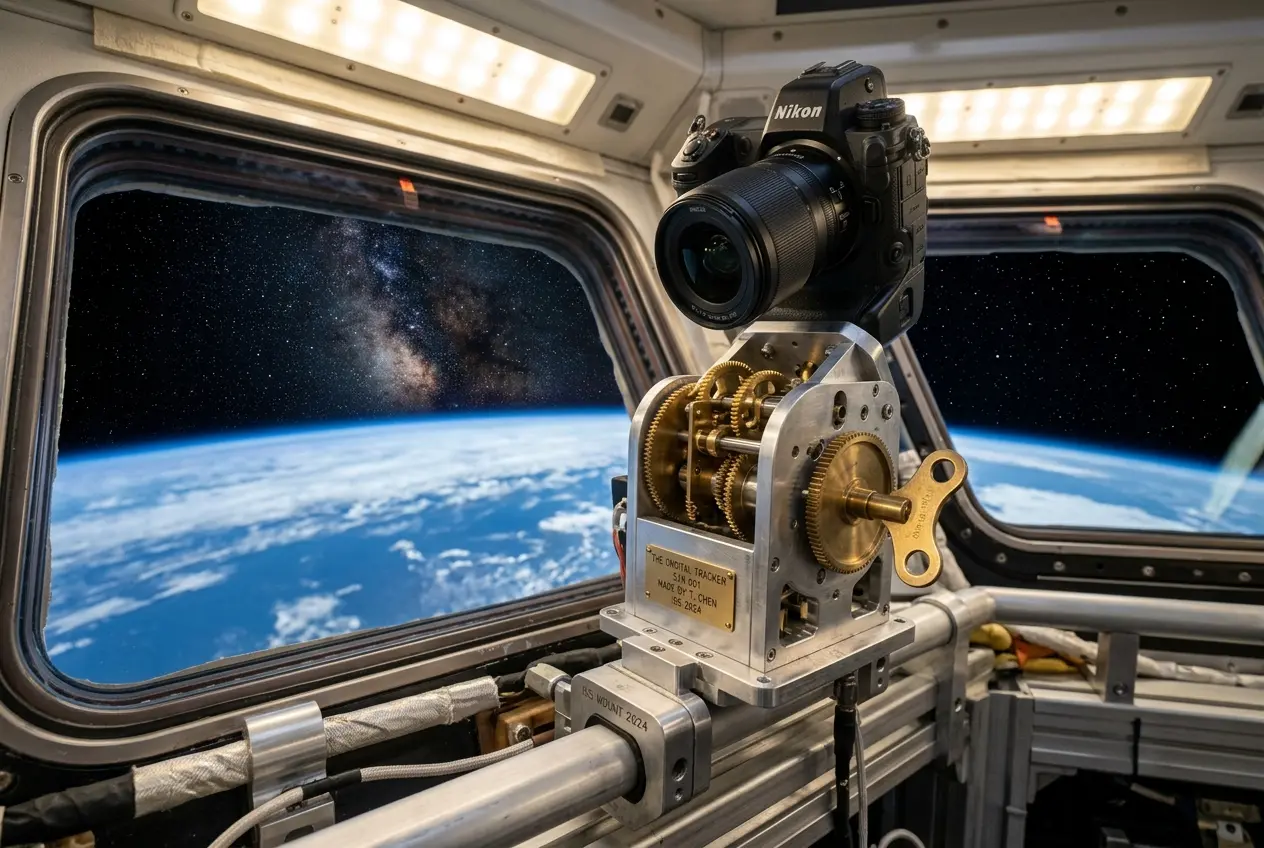
NASA astronaut Don Pettit posted a sharp Milky Way photograph on July 31 after finally receiving the full set of 1.2 million RAW image files from his most recent stay on the International Space Station. The shot came from the Cupola with a Nikon Z9, an Arri Zeiss 15 mm lens wide open at T1.8, and a custom sidereal drive that cancelled star motion against the station’s orbit.
The archive lag stretched more than a year past his April 2025 return. The picture is striking. The tool that made the stars stay as points instead of streaks is the quieter story.
That quieter story runs through every stage of the mission. The same orbital motion that smears untracked stars also sets the exact rate a mechanical drive must match. The same bandwidth limits that delayed the files also explain why the camera stayed busy for months on end. The result is both a public image and a working demonstration of how simple hardware can still solve a moving platform’s hardest photographic problem.
The 1.2 Million Files Finally Came Home
Pettit wrote simply that he at last held every file. He called the Milky Way frame one of his favorites. The post drew more than a million views in hours and tens of thousands of likes.
His latest flight covered Expeditions 71 and 72. He launched on Soyuz MS-26 on September 11, 2024, with Roscosmos cosmonauts Alexey Ovchinin and Ivan Vagner. The trio logged 220 days and 93.3 million miles before landing on the Kazakh steppe on April 19, 2025, the day before Pettit’s 70th birthday.
- Career total: 590 days in space across four flights
- Orbits this mission: 3,520
- Photo scale: earlier public counts topped 670,000 images; the RAW haul reached 1.2 million files
- Platform speed: roughly 28,000 km/h, one full Earth circuit every 90 minutes
| Count | Figure |
|---|---|
| Earlier public image tally | 670,000+ |
| Full RAW archive | 1.2 million files |
| Increase over prior count | nearly double |
| Mission duration | 220 days |
RAW files keep the full sensor data without JPEG compression. That volume lets later processing pull faint structure that would vanish in ordinary downloads. Getting the complete set to the ground took time. Downlink bandwidth and storage pipelines still move slower than a camera shutter in orbit.
The gap between shutter click and desktop arrival is structural. Each orbit yields fresh frames, yet the station’s data pipes must also carry crew video, science telemetry and vehicle health packets. Photography waits its turn. When the files finally landed, the archive held both the single striking Milky Way frame and the much larger body of work that made that frame possible.
Gear That Froze the Stars
Long exposures from the ISS normally smear stars into arcs. The station keeps its belly pointed at Earth, so the sky appears to wheel. Pettit’s solution sat on a mechanical mount that rotated once every 90 minutes, matching the orbital period and holding the camera locked on the celestial background.
| Component | Detail |
|---|---|
| Camera | Nikon Z9 |
| Lens | Arri Zeiss 15 mm at T1.8 |
| Drive | Custom sidereal tracker, fully mechanical |
| Location | ISS Cupola observation module |
| Effect | Stars as points, Earth features as streaks or static depending on exposure |
The wide aperture gathered faint light quickly. The drive kept the galaxy from blurring. Without it the same exposure would have produced classic star trails. Blackout fabric around the camera cut reflections from the thick Cupola windows.
The Cupola’s seven windows give a near-hemispheric view, yet those same panes scatter interior light. Fabric baffling turned the module into a dark enclosure long enough for the sensor to integrate. The 15 mm focal length framed the galactic plane without needing a mosaic. At T1.8 the lens collected photons fast enough that the spring-powered drive only had to hold steady for manageable stretches rather than multi-hour runs.
Earth features behave differently under the same settings. City lights and coastlines streak or freeze according to exposure length, while the stars remain fixed points. That split is the visual proof the mount worked: one axis tracked the sky, the other let the ground slide past.
An Oven Clock Went to Orbit
The tracker did not come from a NASA lab catalog. Rochester Institute of Technology associate professor Ted Kinsman designed it after a 2023 call from photography alumnus Peter Blacksberg and Pettit himself. Electronics would have needed two years of flight certification. The team needed a device on the station before Pettit arrived in September 2024.
Kinsman scavenged a 60-minute chart-recorder clock drive built for industrial ovens. The unit cost about forty dollars unused. He and his son Parker, then an industrial-design student, machined aluminum plates and added 60-tooth and 90-tooth gears so the output turned once every 90 minutes. A speed adjustment handled small orbit changes. The whole assembly stayed purely mechanical and spring-powered. One full wind lasted about 18 hours.
- Must survive launch vibration without special test facilities
- Zero electronics to avoid lengthy certification
- Adjustable rate for real ISS orbit variations
- Serviceable by the astronaut with ordinary tools if needed
- Standard ¼-20 camera threads and multiple mounting points
The finished orbital sidereal tracker camera mount was laser-etched with its pedigree and shipped on Cygnus NG-21 in August 2024. It reached the station a few weeks later. Pettit installed it in the Cupola and began collecting the frames that now fill the 1.2 million-file archive.
The gear ratio itself is straightforward arithmetic. A 60-minute base drive stepped up by the tooth counts yields a 90-minute output, the same period as one Earth circuit at station altitude. The speed trim let Pettit correct for the small day-to-day shifts in orbital period that real stations experience. Because the mechanism was spring-driven, a single winding covered an entire crew day plus margin.
Pettit Has Been Building Trackers for Decades
This was not his first homemade fix. On Expedition 6 in 2002-2003 he built a barn-door tracker from spare parts so city lights stayed sharp while the station moved. He later patented the Space Cup, a capillary-flow vessel that lets astronauts drink without straws in weightlessness, the first patent for an object invented in space.
- 2002-2003, Expedition 6: barn-door tracker for night-side Earth photography; two EVAs; Saturday Morning Science demos
- 2008, STS-126: particle-clumping experiments that illuminated early planet formation
- 2011-2012, Expedition 30/31: first commercial Dragon capture; Angry Birds microgravity videos; more star-trail composites
- 2024-2025, Expedition 71/72: metal 3D printing, water sanitization, plant growth and fire studies plus the new sidereal system and 1.2 million RAW files
At 71 he remains NASA’s oldest active astronaut. Chemical engineer by training, inventor by habit, he treats the station as both laboratory and workshop.
The through-line is practical. Each flight added another device or method born from materials already on hand or quickly fabricated. The barn-door tracker of Expedition 6 and the oven-clock mount of Expedition 71/72 solve related problems with the same philosophy: match the motion you cannot stop, keep the mechanism simple enough to certify and repair, and let the camera do the rest.
What the Archive Unlocks for Science
A million-plus RAW frames form more than a pretty gallery. They hold Earth observations, atmospheric glows, auroras, lightning, and deep-sky fields taken above most of the atmosphere. Researchers can stack, calibrate and mine them for faint signals that single JPEGs discard. Public-domain NASA imagery already fills databases; this batch adds density and quality from one consistent observer who understood both the science and the art.
The same sky appears in studies of the wind from the Milky Way’s central black hole and in explanations of why galaxies appear to recede from us. Ground telescopes fight light pollution and air glow. From 400 km up the view is cleaner, and a tracked camera can hold integration time long enough to reveal structure.
Processing the full set will take further months. Some frames will become research data. Others will simply remind viewers how the galaxy looks when city lights no longer wash it out.
Consistency matters as much as volume. One astronaut, one camera system, one mounting geometry, and thousands of orbits produce a uniform data set. Calibration frames and repeated pointings become easier to combine. Faint atmospheric phenomena that appear in only a handful of exposures can still be extracted when the rest of the archive supplies the noise model.
The Drive Turns Once Every Orbit
The station completes a full circuit roughly every 90 minutes at about 28,000 km/h. Because the vehicle keeps its belly toward Earth, the celestial sphere appears to rotate at that same rate when viewed from inside. A camera fixed to the module therefore paints stars into arcs during any long exposure.
The sidereal mount counters that apparent motion directly. Its output shaft completes one revolution in the same 90 minutes, so the camera body stays locked on the star field while the Earth slides underneath. The 60-tooth and 90-tooth gear pair converts the original 60-minute oven-clock period into the required orbital match. A manual speed trim absorbs the small differences that arise when atmospheric drag or reboosts nudge the actual period.
Spring power keeps the solution inside the certification envelope. No batteries, no processors, no software loads. One winding supplies about 18 hours of tracking, enough for a full crew day of Cupola sessions. If the rate drifts, the astronaut can adjust it with ordinary tools already on board.
- Orbital period sets the required drive rate
- Gear ratio converts a 60-minute base to 90 minutes
- Spring motor avoids electronics certification
- Trim control handles real-world orbit changes
Certification Rules Shaped The Hardware
Electronics would have needed two years of flight certification. The call that started the project came in 2023; Pettit was due on station in September 2024. The calendar left no room for a conventional avionics path.
A purely mechanical clock drive sidestepped that gate. The industrial oven unit already existed, cost about forty dollars, and contained no circuitry that required radiation, thermal-vacuum or electromagnetic testing. Aluminum plates and standard gears could be machined in a university shop. Launch vibration still had to be survived, yet the absence of circuit boards removed the longest schedule item.
The finished mount flew on Cygnus NG-21 in August 2024 and reached the Cupola weeks later, still inside the window the crew needed. Laser etching recorded its pedigree on the hardware itself. Once installed, the same simplicity that sped certification also made on-orbit service possible with ordinary tools.
The episode shows how schedule pressure and certification rules can favor scavenged, spring-powered solutions over purpose-built electronics when the performance target is modest and the deadline is firm.
Viewers Saw Both Awe and Doubt
Reaction on X mixed wonder with technical caution. NASA Administrator Jared Isaacman replied “Incredible .. great work Don.” One widely liked comment called the image historic because the light left its sources up to a million years ago and, for more distant objects, billions of years earlier.
This is likely one of the most historic photographs ever taken by a human. I mean that literally. We are looking at places and events in our galaxy that occurred up to 1 million years ago.
That reply captured the scale many felt. Others noted the city lights appear as streaks while the stars stay points, proof the tracker did its job. A few argued the bright Milky Way is a product of long exposure or stacking and would not match a naked-eye glance through the Cupola. Both observations can be true at once. The camera collected light the eye cannot store; the mount kept celestial objects fixed so the collection stayed sharp.
Many comments circled back to light pollution. Large parts of the human population have never seen the Milky Way with their own eyes. Pettit’s frame, enabled by a forty-dollar oven clock and a university makerspace, put that missing view back in front of them.
The dual reading of the image is useful. Technical viewers check the streak geometry and confirm the drive rate. Casual viewers simply meet the galaxy again. Both groups encounter the same underlying fact: above most of the atmosphere and free of ground glare, a tracked camera can store light that city skies erase.
Pettit’s own words remain the simplest summary. He finally had the 1.2 million raw image files from my latest mission, and he shared one favorite. The mechanical ingenuity that made the favorite possible remains just out of the frame, still turning once every ninety minutes in the imagination of anyone who now wants sharper stars from a moving platform.

-
 TECH1 year ago
Where Garmin Watches are Made and How They are Assembled
-
 AUTO2 months ago
Tesla’s Roadster Is ‘a Few Weeks Away,’ Says Its Chief Designer
-
 NEWS10 years ago
Samsung Releases Galaxy Note7 TV Ad as Reddit AMA Leaks Specs
-
 NEWS10 years ago
Android 7.0 Nougat Rolls Out To Nexus Devices With New Emoji, Features
-
 FINANCE9 years ago
Cardano Price Surges as ADA Enters the Crypto Top Ten List
-
 NEWS10 years ago
Pre-Order the First Camera Made for Facebook Live Streaming Video
-
 FINANCE1 year ago
Binance Suspends Trading and Withdrawals for a System Upgrade
-
 FINANCE9 years ago
RChain Price Jumps Nearly 150% to a New All-Time High of $2.03