
BUSINESS
Cabinet Bets ₹84,084 Crore on Samudra Manthan Deepwater Push
India’s Cabinet approves ₹84,084 crore Samudra Manthan scheme to share deepwater drilling risk, target 600 MMTOE reserves and cut oil import bills.

The Union Cabinet on 31 July 2026 approved ₹84,084 crore for the National Offshore Exploration Scheme known as Samudra Manthan, a Central Sector programme of the Ministry of Petroleum and Natural Gas that runs through fiscal 2030-31. The money funds seismic surveys, 60 deepwater wells with government cost-sharing, shared infrastructure hubs and manufacturing zones. The stated goal is more than 600 million metric tonnes of oil equivalent in new reserves.
This is not another policy note. It is a large public bet that risk-sharing will finally move capital into India’s deep and ultra-deepwater basins.
Four Pots of Money Shape the Scheme
The outlay breaks into four clear components. Offshore data acquisition takes ₹28,534 crore. Drilling support for 60 deepwater exploration wells receives ₹43,200 crore. Common offshore infrastructure hubs get ₹10,000 crore. Oil and gas manufacturing and services zones receive ₹2,000 crore. A small monitoring and support slice brings the total to ₹84,084 crore.
| Component | Outlay (₹ crore) | Share of total |
|---|---|---|
| Offshore data acquisition (2D/3D seismic + NDR/AI) | 28,534 | 34% |
| Deepwater well drilling support | 43,200 | 51% |
| Common offshore infrastructure hubs | 10,000 | 12% |
| Manufacturing and services zones | 2,000 | 2% |
| Monitoring and support | 350 | <1% |
Drilling support alone accounts for just over half the envelope. Data acquisition is the next largest slice at roughly one third. Infrastructure and manufacturing together stay under 15 percent, a deliberate tilt toward the activities that most directly reduce geological and dry-hole risk.
The detailed full component outlay and production targets confirm the government will cover up to 50 percent of eligible drilling cost or ₹675 crore per well, whichever is lower. That single line turns high-cost dry-hole risk into a shared burden.
Spread across 60 wells, the drilling line averages ₹720 crore of budgeted support per hole before the per-well cap applies. Operators still fund the balance and retain full commercial exposure to success or failure.
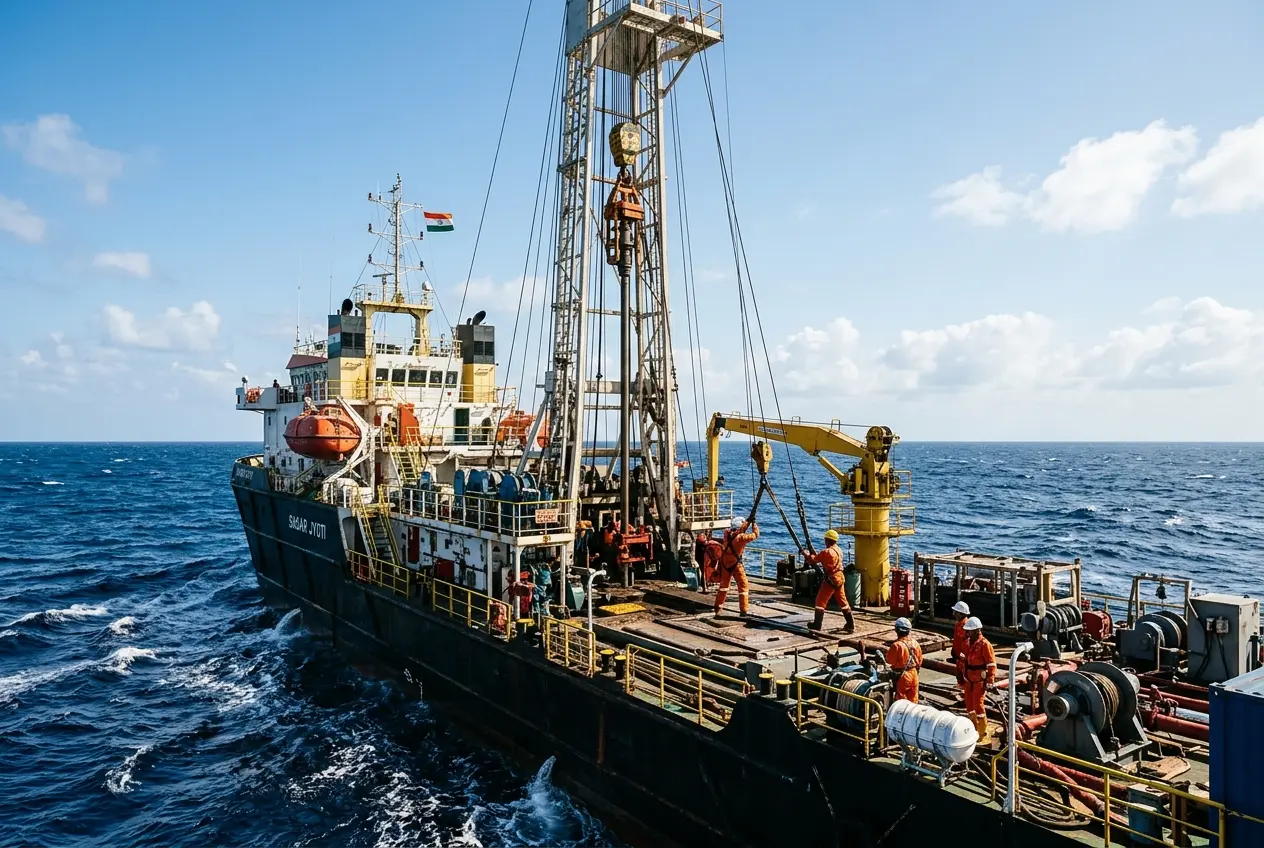
Why the Clock Is Already Running
Existing Indian oil and gas fields decline 6-7 percent every year. Hydrocarbon projects typically need 5-10 years from block award to first commercial production. India is the world’s third-largest crude consumer and carries an annual import bill near USD 144 billion, or roughly ₹13 lakh crore.
- Import dependence: Crude oil import reliance has climbed into the high 80s percent range in recent full years and first-half readings.
- Production base: Domestic oil-and-gas output sits around 62 MMTOE a year.
- Resource base: Current hydrocarbon resources are put at 1.6 billion tonnes of oil equivalent.
- Well economics: A single deepwater exploratory well costs approximately USD 125-150 million.
At a 6-7 percent annual decline, the existing 62 MMTOE base loses several million tonnes of oil equivalent each year even before demand growth is counted. The 5-10 year project lag means wells spudded late in the scheme window may not deliver commercial barrels until after 2030-31.
Without new discoveries the production gap only widens. The scheme therefore treats continuous exploration as non-negotiable rather than optional.
How the Risk-Share Mechanics Work
The heart of the bet is the drilling support. Operators still choose the wells and carry the bulk of the commercial risk. The government simply halves the most painful cash outlay on the 60 targeted deepwater holes. Seismic money comes first so companies see clearer geology before they spud. Shared infrastructure hubs later cut the cost and time needed to commercialise any find.
Key support rules include:
- Government pays up to 50 percent of eligible deepwater drilling cost or ₹675 crore per well.
- Data acquisition covers basin-wide 2D, targeted 3D and National Data Repository re-processing with AI tools.
- Common hubs provide production and evacuation facilities that no single operator would build alone for early discoveries.
- Manufacturing zones aim to localise critical equipment and services under Make in India.
The sequence is deliberate. Better maps reduce the chance that a ₹675 crore public contribution is spent on a poorly located hole. Shared hubs then ensure that a discovery does not sit idle for want of an evacuation route that a single early find cannot justify on its own books.
Frontier basins named as priorities include Krishna-Godavari, Cauvery, Mahanadi and the Andaman region. Water depths reach 3,000 metres. Eastern and western offshore basins together are estimated to hold more than 5,600 MMTOE of hydrocarbon potential.
Who Stands Closest to the Upside
State majors ONGC and Oil India already operate the bulk of India’s offshore acreage and have begun deepwater campaigns under the broader Samudra Manthan banner, including a recent Mahanadi basin spud. Private players with deepwater experience, notably Reliance Industries, sit next in line for data packages and cost support. Service contractors and equipment makers gain from the manufacturing-zone outlay and the simple volume of work the 60 wells will generate.
On X, early market chatter quickly listed ONGC, Oil India and Reliance as the clearest near-term beneficiaries. That reading matches the structure: public risk capital lowers the hurdle rate for the companies that already hold the best acreage and technical capability.
The manufacturing and services zones, though the smallest spending pot at ₹2,000 crore, extend the upside beyond the three operators. Local equipment makers and service firms gain a domestic demand signal tied directly to the 60-well programme rather than to any single discovery outcome.
The Reforms That Made the Bet Possible
Samudra Manthan sits on top of a decade of upstream changes. More than 99 percent of earlier “No-Go” offshore areas have been opened, freeing over one million square kilometres of Exclusive Economic Zone. India moved from production-sharing to revenue-sharing contracts. The Oilfields (Regulation and Development) Amendment Act 2025 and the Petroleum and Natural Gas Rules 2025 modernised the legal and regulatory frame. Performance metrics for ONGC and Oil India now emphasise exploration more heavily. An Empowered Committee of Secretaries applies consistent decision-making across contract vintages.
Those steps removed paper barriers. Open acreage, clearer revenue terms and a single empowered committee reduce the friction that once slowed every deepwater decision. The scheme therefore translates earlier paper reforms into cash and infrastructure.
It also echoes other large energy self-reliance bets, including the parallel coal gasification self-reliance scheme that likewise uses public money to de-risk private industrial capacity.
What 600 MMTOE and 80 MMTOE Would Change
Subject to exploration success, the scheme targets an increase in annual domestic oil and gas production from around 62 MMTOE to 80 MMTOE. The hydrocarbon resource base is meant to expand from 1.6 billion TOE to 2.2 billion TOE. Additional production carries the potential to cut crude oil imports by nearly ₹1 lakh crore each year.
| Metric | Today | Scheme target |
|---|---|---|
| Annual domestic output | ~62 MMTOE | 80 MMTOE |
| Hydrocarbon resource base | 1.6 billion TOE | 2.2 billion TOE |
| New reserves catalysed | – | >600 MMTOE |
| Indicative annual import saving | – | ~₹1 lakh crore |
An 18 MMTOE lift on a 62 MMTOE base is roughly a 30 percent rise in domestic supply. Against an import bill near ₹13 lakh crore, a ₹1 lakh crore annual saving would trim the bill by a meaningful but still partial share.
Investments in large-scale seismic data acquisition and drilling of exploratory well in deep and ultra deep waters will reduce geological uncertainty and derisk exploration and lay the foundation for future discoveries. Goods results can catalyse greater private investments in the sector.
Rajnish Gupta, Partner for Tax and Economic Policy at EY India, made that assessment after the Cabinet decision. The same logic underpins the Prime Minister’s Red Fort Samudra Manthan vision articulated on Independence Day 2025: unlock offshore potential through modern data, technology and shared risk.
The bet remains just that. Deepwater success rates are never guaranteed and the 5-10 year lag means visible production gains arrive only after sustained drilling. Yet the structure is clear. Public money buys better maps, cheaper wells and shared pipes. Private and state operators then decide whether the geology justifies the remaining capital. If the wells deliver, India gains both barrels and a domestic offshore services industry that outlasts any single discovery. If they do not, the country still owns denser seismic coverage and the institutional muscle built while spending the money.
Where the Basins Fit the Spending Plan
The four named frontier basins are not equal in maturity or water depth, yet they share the same cost problem. Wells in water depths that reach 3,000 metres sit at the upper end of the USD 125-150 million range. That is precisely the band where a 50 percent public contribution or a ₹675 crore ceiling changes the decision math.
Eastern and western offshore basins together hold more than 5,600 MMTOE of estimated hydrocarbon potential. The national resource base today stands at only 1.6 billion TOE. The gap between known resources and basin potential is the core argument for spending ₹28,534 crore on fresh seismic and National Data Repository work before the heavy drilling money is committed.
- Krishna-Godavari and Cauvery: established eastern offshore plays with existing operator presence and room to step into deeper water.
- Mahanadi: already seeing a recent deepwater spud under the broader Samudra Manthan banner by state majors.
- Andaman region: the least tested of the four, where basin-wide 2D and targeted 3D data matter most before any well is drilled.
Data first, then supported drilling, then shared hubs. The spending order follows the geology rather than the political calendar.
How the Scheme Bridges the Production Lag
The 5-10 year stretch from block award to first oil is the structural constraint that pure policy reform cannot shorten. Samudra Manthan attacks that lag at three points already funded inside the ₹84,084 crore envelope.
- Seismic and NDR work first: clearer geology shortens the appraisal cycle that follows any discovery.
- Cost-shared deepwater wells: 60 holes can be drilled on a faster cadence once operators face only half the cash outlay.
- Common infrastructure hubs: early finds gain production and evacuation routes without waiting for a full field development plan financed by a single company.
None of those steps guarantees a barrel before 2030-31. They do raise the odds that discoveries made inside the scheme window reach commercial production sooner than the historical average. The manufacturing zones add a longer tail: localised equipment and services remain available for later campaigns even if the first 60 wells prove mixed.
Against a 6-7 percent annual decline and import reliance in the high 80s percent range, the scheme treats time itself as a cost. Public capital buys speed on data, wells and pipes so that private capital, when it follows, spends fewer years waiting on infrastructure that no single early discovery can fund alone.
Frequently Asked Questions
What is the total outlay and duration of Samudra Manthan?
The Cabinet approved ₹84,084 crore as a Central Sector Scheme of the Ministry of Petroleum and Natural Gas for implementation through fiscal year 2030-31, ending 31 March 2031.
How much government support does each deepwater well receive?
Support is capped at 50 percent of eligible drilling cost or ₹675 crore per well, whichever is lower, across the 60 wells budgeted under the scheme.
Which production and reserve targets has the scheme set?
Subject to success it aims to lift annual domestic oil and gas output from around 62 MMTOE to 80 MMTOE and expand the national hydrocarbon resource base from 1.6 billion TOE to 2.2 billion TOE, while catalysing more than 600 MMTOE of new reserves.
What are the four main spending components?
They are offshore data acquisition (₹28,534 crore), deepwater exploration drilling (₹43,200 crore), common offshore infrastructure hubs (₹10,000 crore) and oil and gas manufacturing and services zones (₹2,000 crore), plus a small monitoring slice.
Which basins are the priority frontier areas?
Krishna-Godavari, Cauvery, Mahanadi and the Andaman region are highlighted as the deepwater and ultra-deepwater basins holding the bulk of remaining potential.

-
 TECH1 year ago
Where Garmin Watches are Made and How They are Assembled
-

 AUTO2 months ago
Tesla’s Roadster Is ‘a Few Weeks Away,’ Says Its Chief Designer
-
 NEWS10 years ago
Samsung Releases Galaxy Note7 TV Ad as Reddit AMA Leaks Specs
-
 NEWS10 years ago
Android 7.0 Nougat Rolls Out To Nexus Devices With New Emoji, Features
-
 FINANCE9 years ago
Cardano Price Surges as ADA Enters the Crypto Top Ten List
-
 NEWS10 years ago
Pre-Order the First Camera Made for Facebook Live Streaming Video
-
 FINANCE1 year ago
Binance Suspends Trading and Withdrawals for a System Upgrade
-
 FINANCE9 years ago
RChain Price Jumps Nearly 150% to a New All-Time High of $2.03