
FINANCE
FPI July Inflow Meets Thin DII Cash and a Tight Range
Foreign investors turned net buyers in July with ₹15,412 crore, but DIIs sit at two-year cash lows and markets stay range-bound as the buffer thins.

Foreign portfolio investors turned net buyers of Indian equities in July, adding ₹15,412 crore and snapping a four-month selling streak that began after the US-Iran flare-up. The NSDL monthly equity net investment series still shows a calendar-year hole of roughly ₹2.59 trillion. Domestic institutions have soaked up most of that outflow, yet their cash now sits at the lowest level in two years.
That combination, not the headline inflow alone, shapes what happens next.
The July print matters less as a single monthly number and more as a stress test of the arrangement that held markets together through the spring. Foreign selling met domestic buying for months. July showed both sides of that trade beginning to reverse at the same time. The range that follows is a product of that shift, not of the inflow in isolation.
July Flipped the Four-Month Script
March delivered the heaviest blow: ₹1.18 trillion of equity outflows. April, May and June added another ₹1.43 trillion. February had been positive at ₹22,615 crore before geopolitics and risk-off took over.
July’s +₹15,412 crore equity print (data through 30 July) ended the sequence. Total FPI flows across assets were stronger still, helped by debt. On some late-July sessions the pattern reversed day by day: foreigners bought while domestic institutions sold.
| Month 2026 | FPI Equity Net (₹ crore) |
|---|---|
| January | -35,962 |
| February | +22,615 |
| March | -117,775 |
| April | -60,847 |
| May | -32,963 |
| June | -49,340 |
| July (to 30) | +15,412 |
| YTD equity | -258,860 |
The path into the July turn reads cleanly as a sequence once the monthly prints are lined up in order.
- February: last clear positive month at +₹22,615 crore before the risk-off wave.
- March: heaviest single blow at -₹117,775 crore, opening the four-month streak.
- April to June: a further -₹1.43 trillion stacked on top of the March hit.
- July (to 30): +₹15,412 crore, the first net equity buy print since February.
Sensex still rose 1.6% in the month. It had climbed 2.3% in June even while FPIs sold. Domestic money has been the stabiliser for most of the year.
That June gain during heavy foreign selling remains the clearest single-month proof that domestic flows can carry the tape without foreign help. July simply added the other half of the picture: foreigners can return without domestics needing to keep buying in lockstep.
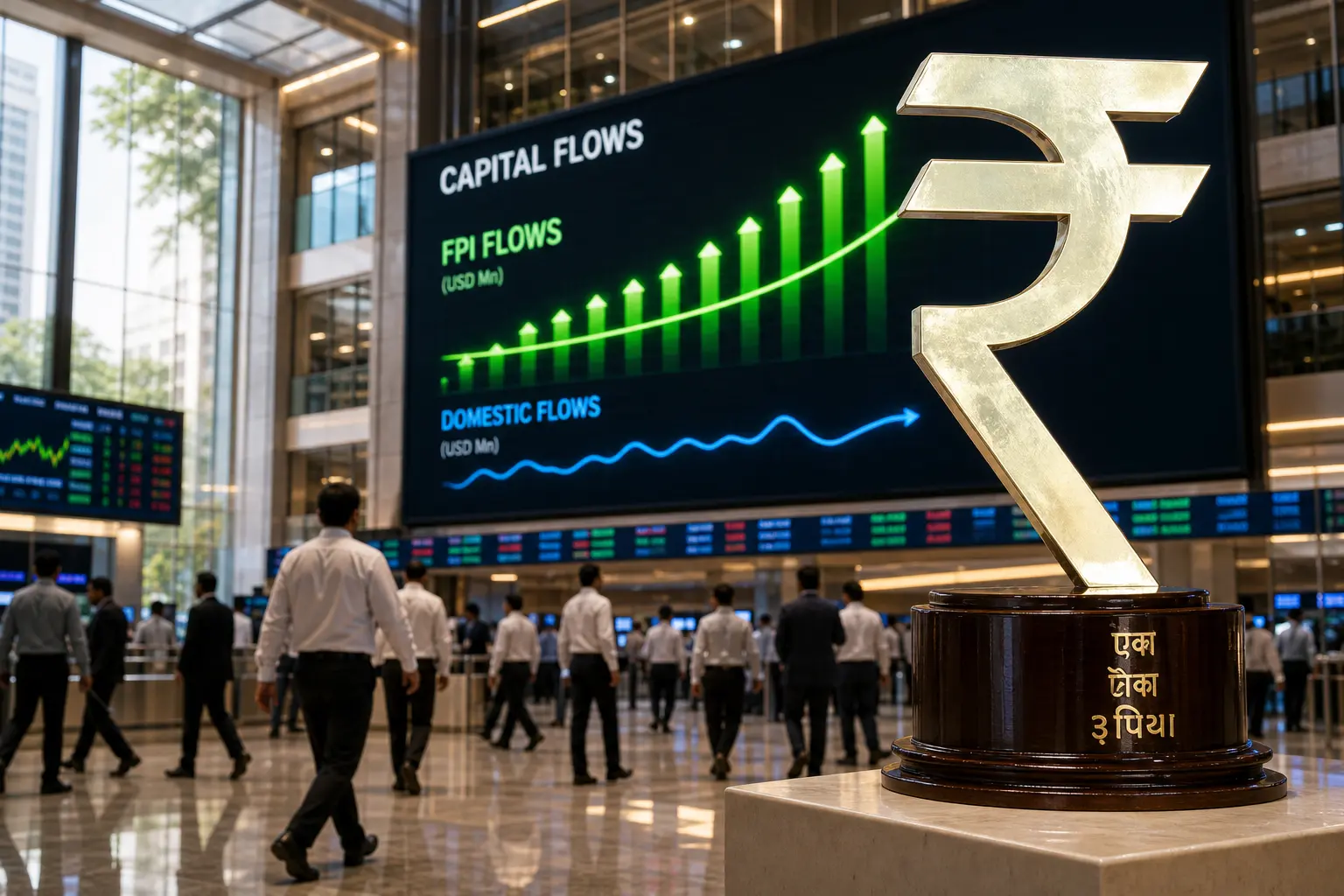
The Asia AI Unwind That Freed Capital
Karan Aggarwal, co-founder and CIO at Ametra PMS, links the pause to positioning elsewhere in Asia. FPIs spent two years long the AI trade in Korea and Taiwan while staying near 90% net short on Indian index options for almost 18 months.
As that AI trade was wound down, India large-caps were set for a short-covering bounce. In the same window FPIs pulled $12.5 billion from South Korea and sold $23.4 billion of Taiwan equities. The India selling simply paused.
The mechanism is mechanical rather than sentimental. Capital that had been concentrated in a narrow Asia AI long book became available once those positions were reduced. India, already carrying a heavy short-options overhang, was a natural place for that capital to show up first as covering rather than as fresh strategic buying. The pause in Indian selling and the short-covering bounce are two sides of the same book adjustment.
Rajesh Singla, CEO and fund manager at Alpha AMC, called July “the first meaningful positive turn since the US-Iran conflict broke out in February, driven by geopolitical de-escalation, easing crude prices, and improving global risk appetite.” He still labels it tactical repositioning, not structural reallocation. Continued buying, he said, needs crude contained, the rupee stable, and Q1 FY27 earnings to deliver.
- Geopolitical pause after US-Iran tensions
- Crude price relief and better global risk appetite
- Short covering after Asia AI longs were reduced
- Selective primary-market participation continuing
Crowd chatter on X has tracked the same late-July sessions: multi-day FII cash buying paired with DII profit-taking, and talk that a clean break above 24,600 would need more aggressive foreign interest.
Singla’s frame and the Asia positioning story point in the same direction. July restored a bid, yet the bid still depends on the same external conditions that flipped in February. Tactical flows can reverse as quickly as they arrived if crude, the rupee, or earnings slip.
Primary Market Kept the Door Open
While secondary-market selling ran hard, FPIs stayed active in primaries. Year-to-date they pulled more than ₹2 trillion from the secondary market yet net-invested nearly ₹33,000 crore in primary issues.
Saurabh Patwa, head of equity and portfolio manager at Quest Investment Managers, read the split as selectivity rather than outright negativity. Secondary selling often reflects portfolio rebalancing and global liquidity needs. Primary tickets let investors size into new businesses and structural themes at negotiated valuations.
IPO activity itself slowed earlier in the year under geopolitical pressure. Mainboard and SME issues raised only ₹26,338 crore through June. Sentiment improved in July and companies raised ₹29,235 crore that month alone. A healthy pipeline remains, so FPI primary participation is expected to stay firm.
On 30 July alone, daily FPI primary market equity purchases ran to ₹1,155 crore with zero sales on that route, according to NSDL’s latest daily trends.
Stats snapshot
- ₹33,000 crore approximate FPI primary net YTD while secondary saw multi-trillion outflows
- ₹29,235 crore raised by companies in July alone after a muted first half
- ₹1,155 crore primary equity bought by FPIs on 30 July with no corresponding sales
The primary-secondary split also explains why headline FPI equity figures can look hostile while allocation intent toward India remains intact. Secondary sales free cash and manage risk across a global book. Primary cheques place that cash into chosen themes at prices set in the deal process rather than on the screen. Both can run at once without contradiction.
July’s primary surge, with a single month outraising the entire first-half mainboard and SME total, shows how quickly that channel reopens once sentiment steadies. The pipeline keeps the option alive even if secondary flows stay choppy.
Domestic Cash Hits a Two-Year Floor
DIIs have been the shock absorber. Year-to-date they invested a little over ₹5 trillion, more than offsetting the ₹2.58-2.59 trillion FPI equity outflow. July alone saw domestic institutions add around ₹35,000 crore. Monthly SIP inflows have stayed consistently above ₹25,000 crore, and direct retail equity buying exceeded ₹36,000 crore YTD.
That cushion is now thinner. Aggarwal notes DIIs sit at their lowest cash levels in 24 months. They may no longer be able to support selling on the scale seen over the prior 18 months. “In reality, FPIs were selling because DIIs were supporting the prices. As lower liquidity available with DIIs creates a headwind, it is very difficult for markets to break the 23600-24800 range on either side.”
Recent NSE combined FII and DII cash activity already shows days of the reverse flow: FII net buys of ₹3,000-plus crore paired with DII net sales near ₹1,800 crore. The domestic side is no longer a one-way buyer.
The offset arithmetic for the year so far still favours the domestic bid, but the stock of dry powder behind that bid has changed.
- DII equity investment YTD: a little over ₹5 trillion
- FPI equity outflow YTD: roughly ₹2.58-2.59 trillion
- July DII add: around ₹35,000 crore
- Monthly SIP run-rate: consistently above ₹25,000 crore
- Direct retail equity buying: more than ₹36,000 crore YTD
- DII cash: lowest in 24 months
SIP and direct retail flows continue to feed the system every month. They do not, on their own, replace the institutional cash buffer that met large foreign sale programmes through the prior year and a half. The floor on DII cash is the constraint that turns a stabiliser into a range-bound market.
Ownership Drift to 14-Year Lows
Aggregate FPI holding across roughly 4,500 companies fell to 14.4% in the June quarter, a 14-year low. Foreign ownership declined 160 basis points over the past year. Mutual-fund stakes rose 100 bps to 11.5%.
| Holder | Recent level | Change noted |
|---|---|---|
| FPI stake | 14.4% (June qtr) | -160 bps over past year; 14-year low |
| Mutual funds | 11.5% | +100 bps over past year |
Patwa agrees India’s dependence on FPI flows has reduced. Domestic institutional and household participation has deepened and supplies a more stable capital base. That is why markets could post positive months even while foreigners sold. He cautions against calling full decoupling. FPIs still move liquidity, valuations, the currency and short-term direction. The change is that foreign selling no longer automatically sets the market’s path; domestic flows and earnings now counterbalance more strongly.
The ownership gap has narrowed but has not closed. Mutual funds at 11.5% remain below the FPI share at 14.4%, even after the 100 bps rise and the 160 bps foreign decline. The drift is real and it has already changed how monthly tape is absorbed. It has not removed foreign investors from the price-setting process on days when global risk appetite shifts.
The SEBI FPI investment calendar-year portal points users to the same NSDL and CDSL series that track these shifts in real time.
What Thin Domestic Cash Changes Next
The practical consequence of the two-year cash floor is visible in the late-July session mix. Foreigners can buy in size and domestics can sell into that bid. The old pattern, in which every foreign sale met a domestic bid, no longer runs in only one direction.
Aggarwal’s range of 23,600-24,800 follows from that balance. Upside needs a foreign bid strong enough to clear offers without relying on DII support. Downside needs selling heavy enough to overwhelm SIP and retail inflows that still arrive each month. Neither side has shown that force in a sustained way since the spring outflow wave cooled.
The reverse-flow days already logged on the NSE combined series are the early evidence. FII net buys above ₹3,000 crore alongside DII net sales near ₹1,800 crore do not break a market. They do show that the shock absorber is now also a source of supply when prices firm. That dual role is new relative to the prior eighteen months of one-way domestic support.
Retail and SIP money still drip in above ₹25,000 crore a month. Direct retail equity buying above ₹36,000 crore year-to-date adds another steady layer. Those streams set a floor under disorderly breaks. They are slower to deploy as a surge bid when foreigners press the market from the top. The asymmetry is what keeps the band intact.
Why Selective Foreign Interest Still Matters
Primary-market cheques and secondary-market covering are not the same commitment, yet both keep India on global allocation lists. The nearly ₹33,000 crore of FPI primary net investment year-to-date sits against more than ₹2 trillion of secondary outflow. The gap looks wide until it is read as a preference for entry terms rather than as an exit from the country.
Short covering after the Asia AI unwind fits the same selective pattern. Capital left Korea and Taiwan in large size, with $12.5 billion pulled from South Korea and $23.4 billion of Taiwan equities sold. India received a pause and a bounce, not a mirror-image allocation wave. That is consistent with a book that is reducing crowded longs elsewhere and trimming crowded shorts here, without yet declaring a fresh multi-year overweight.
Singla’s checklist still gates any move from tactical to structural. Contained crude, a stable rupee, and Q1 FY27 earnings that deliver are the conditions he flagged for continued buying. July met enough of the geopolitical and risk-appetite side to flip the monthly sign. It did not, on its own, rewrite the allocation case.
Patwa’s reading of the primary channel points the other way on intent. Negotiated valuations in new issues let foreigners express theme-level interest even while they rebalance secondary holdings for liquidity. As long as the IPO pipeline stays healthy, that channel can keep printing net FPI primary demand of the kind seen on 30 July, when purchases hit ₹1,155 crore with zero sales on that route.
Why 23600-24800 Still Holds
Nifty has spent recent sessions around 24,300-24,400. Late-July FII buying has helped, yet the cash-constrained DII picture and still-elevated valuations keep both breakouts and breakdowns hard. Aggarwal’s 23,600-24,800 band remains the working frame for many desks.
Further foreign buying needs the same checklist Singla listed: contained crude, a stable rupee, and earnings that clear the bar. Primary-market interest shows foreigners still want India exposure; they simply prefer negotiated entry points over chasing secondary prices. Retail SIPs continue to drip money in every month, but the institutional cash buffer that previously met every FPI sale is no longer flush.
The second-order effect is already visible in the tape. When foreigners buy, domestics sometimes sell. When the next risk-off wave arrives, the same domestics have less dry powder. The July pause therefore does more than end a selling streak. It marks the point where the domestic safety net starts to show its own limits.
Markets can stay constructive inside the range. A decisive move either way now requires clearer earnings or a clearer global backdrop than July alone supplied.
Until that clearer signal arrives, the working assumption stays the one the cash and ownership data already support. Foreign flows can turn positive without opening a new trend leg. Domestic flows can stabilise without absorbing another multi-trillion sale wave at the same pace. The band holds because both sides are now constrained in different ways, and July was the month that made those constraints visible on the same tape.

-
 TECH1 year ago
Where Garmin Watches are Made and How They are Assembled
-

 AUTO2 months ago
Tesla’s Roadster Is ‘a Few Weeks Away,’ Says Its Chief Designer
-
 NEWS10 years ago
Samsung Releases Galaxy Note7 TV Ad as Reddit AMA Leaks Specs
-
 NEWS10 years ago
Android 7.0 Nougat Rolls Out To Nexus Devices With New Emoji, Features
-
 FINANCE9 years ago
Cardano Price Surges as ADA Enters the Crypto Top Ten List
-
 NEWS10 years ago
Pre-Order the First Camera Made for Facebook Live Streaming Video
-
 FINANCE1 year ago
Binance Suspends Trading and Withdrawals for a System Upgrade
-
 FINANCE9 years ago
RChain Price Jumps Nearly 150% to a New All-Time High of $2.03