
NEWS
Trump’s Hamas Disarmament Deal Locks in the Same Old Standoff
Hamas accepted phased complete disarmament under the Board of Peace, but Israel still demands full demilitarization first, leaving verification as the real test.

U.S. President Donald Trump announced Thursday that his Board of Peace had secured agreement for the complete disarmament of Hamas and every other armed group in Gaza, to unfold in verified phases with Israeli forces pulling back as each stage clears. Hamas officials quickly confirmed a deal covering weapons and gradual withdrawal. An Israeli political source called the terms unsatisfactory.
The claim arrives nine months into a U.S.-brokered ceasefire whose second phase had stalled precisely on the weapons-versus-withdrawal sequence. That same mismatch sits inside the new text.
What the Roadmap Requires
Trump wrote on Truth Social that the Board reached a “HISTORIC agreement for the COMPLETE DISARMAMENT of Hamas and all other armed groups in Gaza.” He called it a monumental step. Disarmament proceeds in phases. As stages finish, Israeli forces leave and an International Stabilization Force works with a new Palestinian police force.
Two U.S. officials described months of delicate talks that produced Hamas acceptance of the framework. A diplomatic source briefed on the roadmap said there would be “no exceptions for certain weapons or certain people. One authority, one law, one weapon.”
Under the terms:
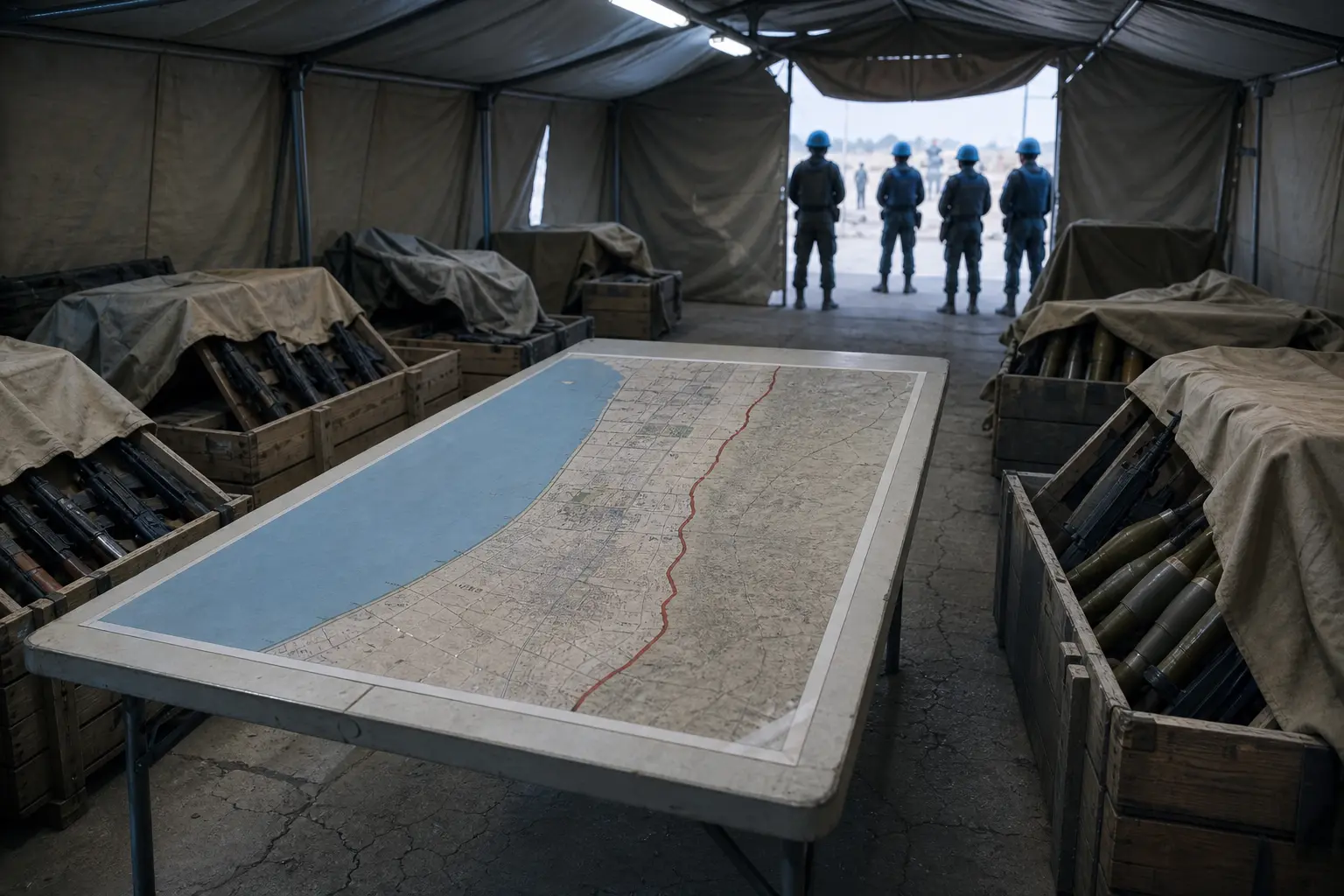
- All heavy and light weapons fall under full control of the National Committee for the Administration of Gaza with ISF support.
- Tunnels, depots and production facilities are eliminated.
- A verification mechanism checks compliance by each side before the next stage advances.
- Israeli withdrawal is timed to completed stages, sector by sector.
- Hamas ends military activity and recruitment; all other militias, including some armed by Israel during the war, also surrender arms.
Officials estimate the full process at roughly 200 to 350 days. Implementation is built on zero trust: neither side moves until monitors confirm the other has met its obligations. Police weapons transfer first, then heavy weapons into secure storage, then tunnel and factory destruction. Small arms follow Palestinian law. The NCAG assumes authority over each cleared area only after verification.
Three Parties, Three Different Sequences
The public statements already diverge on order of operations.
| Party | Core Demand on Weapons | Sequencing Preference |
|---|---|---|
| Trump / Board of Peace | Complete disarmament of Hamas and all armed groups, no exceptions | Phased process; Israeli withdrawal as stages complete |
| Hamas | Weapons catalogued and stored by NCAG; Israel stays out of the process | Tied to gradual Israeli withdrawal, NCAG deployment and reconstruction |
| Israel (political source) | Complete disarmament plus physical removal of weapons and full demilitarization | Precondition before any process advances |
Ghazi Hamad, a member of the Hamas negotiating team, said the movement was making concessions so Gazans could end killing and displacement. He was explicit: Israel will not intervene in disarmament. The National Committee undertakes the task. Weapons are linked to withdrawal, NCAG deployment and reconstruction work. A senior official added that the NCAG would manage cataloguing and storage on an agreed timetable.
An Israeli political source told reporters the proposed deal does not satisfactorily address Israeli demands. Israel wants complete disarmament including removal of weapons from Gaza and full demilitarization as the entry ticket. The same source said Gaza did not come up at all in the meeting between Prime Minister Benjamin Netanyahu and Trump in Washington this week. Israel’s UN Mission offered no immediate comment. Far-right minister Itamar Ben Gvir rejected talks with Hamas in any form short of destruction.
The Board Machinery That Must Now Deliver
The Board of Peace is the body Trump chairs to oversee the 20-point plan endorsed by UNSCR 2803 two-pillar Board and ISF framework. Its founding charter stresses pragmatic results and local ownership. Founding members include the United States, Israel, Egypt, Qatar, Turkey, Saudi Arabia, the UAE, Jordan and more than a dozen other states.
A January White House statement detailed the operating structure. NCAG led by Dr. Ali Sha’ath and ISF under Maj. Gen. Jasper Jeffers sit under Trump’s chairmanship. Nickolay Mladenov serves as High Representative for Gaza, linking the Board to the NCAG on the ground. Executive board names include Secretary Marco Rubio, Steve Witkoff, Jared Kushner, Sir Tony Blair and others covering reconstruction, investment and regional ties.
Key appointments and force pledges:
- NCAG head: Dr. Ali Sha’ath, technocratic governance and services.
- ISF commander: Maj. Gen. Jasper Jeffers, security, demilitarization support, aid delivery.
- High Representative: Nickolay Mladenov, Board-to-ground link.
- ISF contributors: ISF troop pledges from Indonesia Morocco Albania, Kosovo and Kazakhstan, with earlier planning figures near 20,000 and recent commitments above 5,000; Egypt and Jordan train a Palestinian police force expected around 12,000.
A UN report on Resolution 2803 describes the NCAG as the sole legitimate transitional authority for civilian governance and security, with the ISF operating under unified U.S. command in consultation with Egypt and Israel. That architecture now faces its first hard compliance test. Donors have hesitated on large reconstruction packages while weapons questions stayed open. Related regional pacts already show how Congress review power over related regional pacts can slow or reshape executive deals.
Earlier Attempts Left Clear Lessons
Regional militia disarmament efforts have a poor record when sequencing and verification stay vague. Lebanon’s Taif Accords called for militias to relinquish weapons; Hezbollah retained a parallel force for decades. Prior Gaza ceasefires repeatedly stalled on the same demilitarization language that now returns under a new institutional wrapper.
- October 2025: Ceasefire phase one begins after the October 7, 2023 attack that killed around 1,200 in Israel and took 251 hostages. Incomplete Israeli pullbacks and continued strikes follow.
- January 2026: Phase two formally opens with demilitarization talks and further withdrawal once the technocratic committee stands up. Little public progress for months.
- January 16, 2026: White House congratulates NCAG formation and names executive and Gaza boards.
- January 22, 2026: Trump ratifies Board of Peace charter in Davos.
- February 19, 2026: Founding donor and ISF contributor declarations signed in Washington.
- July 30-31, 2026: Board announces complete disarmament agreement; Hamas confirms; Israeli sources reject sequencing.
Phase one already faced incomplete pullbacks, continued strikes, and disputes over hostages and remains. Four months after the formal start of phase two, little had moved until this week’s claim. The current text tries to close gaps with verification, NCAG custody and explicit linkage of withdrawal to completed stages. Whether those clauses survive contact with ground realities is the open variable.
Residual Force and Public Opinion Still Matter
Under the announced terms the NCAG takes full control of heavy and light weapons with ISF support. A new Palestinian police force shares day-to-day security once Israeli units pull back. Hamas has already dissolved its own Gaza governing committee in earlier steps and signaled readiness to transfer civilian authority.
The practical question is residual coercive capacity. Analysts note Hamas’s decentralized structure survived leadership losses during the war. Public opinion data from late 2025 showed large majorities of Palestinians rejecting disarmament even as a condition to stop fighting, viewing arms as tied to occupation rather than internal legitimacy. Iran remains a background factor. One official noted Tehran counselled against a deal yet is preoccupied with its own conflict with the United States and in no position to offer substantial support. That weakens one traditional external backstop for rejectionists inside Hamas, but does not erase the domestic political cost of appearing to surrender arms without visible Israeli withdrawal and reconstruction.
Despite the ceasefire that began in October 2025, Israeli strikes continued. Health officials said at least four people, including two children, were killed on Thursday. Israel’s military still controls more than half of Gaza. Palestinians remain concentrated in damaged neighborhoods and tent camps. Gaza’s Health Ministry puts the overall death toll above 73,000, including post-ceasefire deaths. Reconstruction cannot scale while tunnels and rocket capacity remain contested.
On X the announcement drew heavy skepticism. Some treated it as distraction from other fronts. Others noted that Israel’s wait-and-see posture already signals the next friction point. Crowd commentary repeatedly returned to the same observation: previous public claims of Hamas disarmament agreement did not produce weapons on the ground, and a leopard does not change its spots. That layer of doubt is already priced into Israeli political reaction.
The First Tests Arrive Quickly
Cairo is preparing a mediators’ meeting to discuss second-phase implementation. Violence on the ground has not paused. U.S. officials say Israel was consulted at every step and is being asked only to fulfill commitments already made under the 20-point plan. One senior official said Trump would be “very, very disappointed” if Israel did not adhere. Another noted that Israel did not believe the earlier hostage releases would happen either.
What We Know
- Trump and Hamas both describe an agreement covering weapons and phased Israeli withdrawal.
- NCAG is designated to catalogue and store arms; ISF provides support and verification.
- Mediators Egypt, Qatar and Turkey remain central; a Cairo meeting of truce parties is expected soon.
- Process is sector-by-sector with independent monitors and automatic stop if either side fails a stage.
What’s Unconfirmed
- Exact timetable, inspection protocols and definition of “completed” stages.
- Israeli cabinet acceptance of the sequencing as written.
- Full composition, rules of engagement and arrival date for the ISF contingent.
- Whether residual tunnels or light weapons can be hidden past verification in a decentralized network.
The Board of Peace now owns the claim of a complete solution. Its untested enforcement tools, the mismatched sequencing still visible in Israeli and Hamas statements, and the residual capacity of armed groups will decide whether Thursday’s announcement becomes the pivot or another entry in the long list of announced breakthroughs that stalled in the details.

-
 TECH1 year ago
Where Garmin Watches are Made and How They are Assembled
-

 AUTO2 months ago
Tesla’s Roadster Is ‘a Few Weeks Away,’ Says Its Chief Designer
-
 NEWS10 years ago
Samsung Releases Galaxy Note7 TV Ad as Reddit AMA Leaks Specs
-
 NEWS10 years ago
Android 7.0 Nougat Rolls Out To Nexus Devices With New Emoji, Features
-
 FINANCE9 years ago
Cardano Price Surges as ADA Enters the Crypto Top Ten List
-
 NEWS10 years ago
Pre-Order the First Camera Made for Facebook Live Streaming Video
-
 FINANCE1 year ago
Binance Suspends Trading and Withdrawals for a System Upgrade
-
 FINANCE9 years ago
RChain Price Jumps Nearly 150% to a New All-Time High of $2.03