
NEWS
Earth Has a Hidden Symmetry That Climate Models Can’t Reproduce
NOAA scientists found Earth’s east-west albedo symmetry at the 27°E meridian using 25 years of satellite data. Every major climate model currently fails to reproduce it.

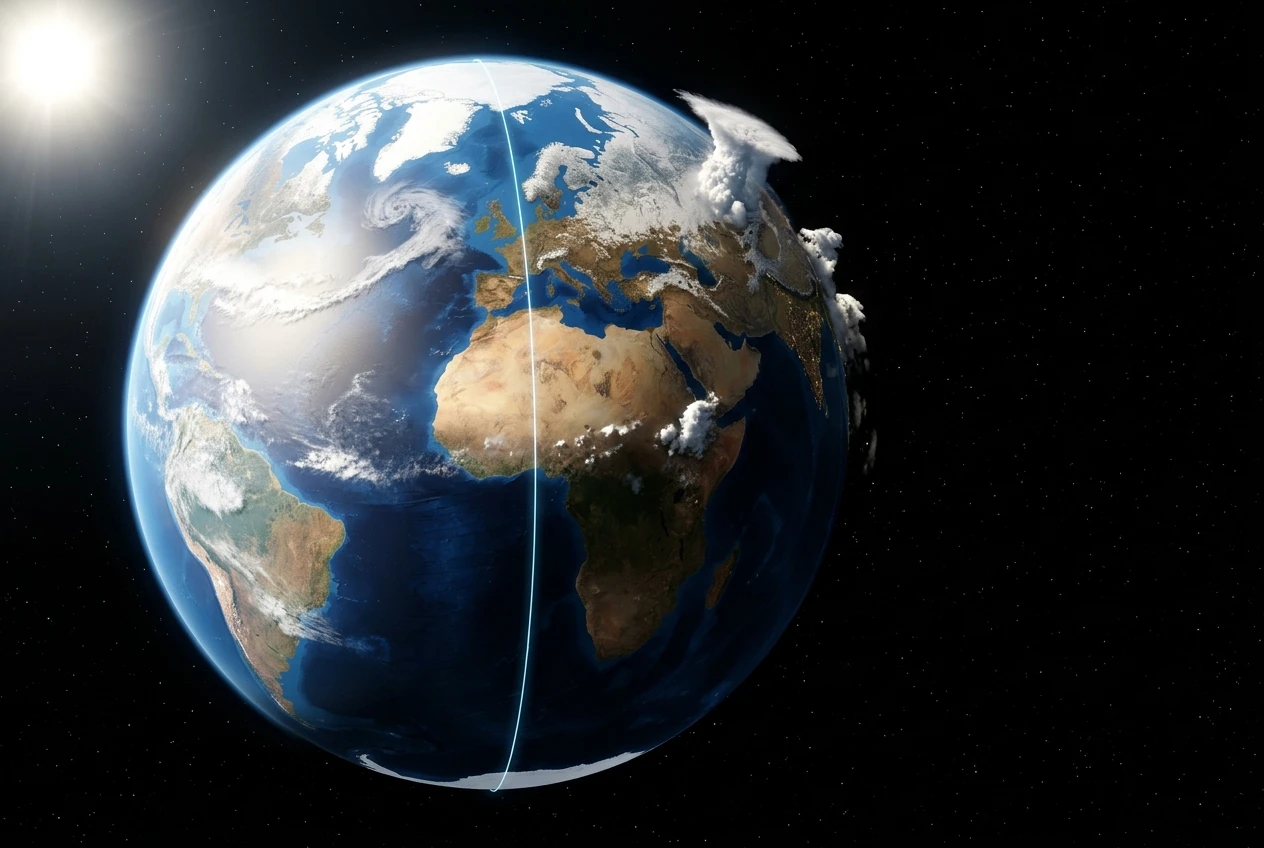
Earth’s east-west albedo symmetry went undetected for decades. The planet’s eastern and western hemispheres reflect almost exactly the same amount of sunlight back into space, split along the 27°E meridian, and 25 years of NASA satellite measurements put the mean reflective difference between the two sides at just 0.04 watts per square meter. Published in Nature on June 3 by a team at the National Oceanic and Atmospheric Administration (NOAA), the discovery comes with a second result: every major climate model currently in use fails to reproduce the balance.
The Invisible Meridian
The 27°E longitude is, on its face, unremarkable. It runs through Bergen in Norway, drops south through Poland, Romania, and Turkey, crosses Kenya, and continues to Antarctica. What Jianhao Zhang, a researcher at NOAA, found at that meridian took more than two decades of satellite data to confirm.
Working with co-authors Jake J. Gristey and Graham Feingold, Zhang ran a systematic analysis through 25 years of measurements from NASA’s Clouds and the Earth’s Radiant Energy System (CERES) program, the instruments that monitor how much solar radiation Earth reflects from the top of the atmosphere. Their approach: divide Earth into eastern and western pairs at every possible longitude and compare reflected sunlight on each side. Out of 360 possible divisions, only one produced a near-perfect balance.
In a research community summary on Springer Nature, Zhang described what the analysis revealed: “The line itself, encompassing 27°E and 153°W, is an invisible boundary that stretches through Eastern Europe, Turkey, Central Africa, Norway, Alaska, and down to both Poles. At any other meridian, the balance breaks.”
Prior research on Earth’s radiation budget established that only about 3% of randomly drawn hemisphere pairings show reflective balance within 0.1 watts per square meter. The east-west match falls well within that threshold, with a 25-year mean difference of 0.04 ± 0.24 watts per square meter, meaning the average stays essentially at zero even as individual years shift in both directions.
How Three Balances Hold at Once
The east-west symmetry runs deeper than its north-south counterpart. North and south align on total reflected sunlight, a single agreement maintained by clouds in the Southern Hemisphere compensating for the brighter landmasses and industrial aerosols of the North. At this meridian, three independent properties align at the same divide simultaneously, a configuration the study calls a triple symmetry.
The Eastern Hemisphere generates its reflective contribution primarily from high-altitude clouds: the thick cumulonimbus towers and anvil-topped cirrus systems common over tropical Africa, South Asia, and the Indo-Pacific warm pool. Over the Western Hemisphere, low-lying stratocumulus sheets blanket the subtropical oceans of the Atlantic and southeastern Pacific, working far closer to the surface. These two cloud regimes operate at opposite ends of the atmosphere and form through entirely different physical processes. Their aggregate reflective contribution to each side of the divide comes out equal.
Geographic structure reinforces the cloud balance. At this same longitude, the fraction of ice-free ocean splits almost evenly between the two hemispheres, which in turn makes the underlying clear-sky albedo contributions match. Take away that ocean-fraction balance and the three-way agreement falls apart. The three properties matched here, each independently measured:
- Total all-sky reflection: the sum of every solar photon bounced back from both halves, clouds and surface included, is essentially equal
- Clear-sky albedo: with clouds removed from the calculation, the surface and atmospheric column still reflect matching amounts from each side
- Cloud radiative effect (CRE): the net warming or cooling contribution of clouds alone, isolated from the clear-sky signal, also balances across the divide
ENSO Keeps the Books
The symmetry holds over decades, but it moves year to year. Those shifts track closely with ENSO, the El Niño-Southern Oscillation, the coupled ocean-atmosphere cycle that alternates between warm El Niño and cooler La Niña conditions across the tropical Pacific.
Zhang’s team found a strong correlation between interannual variability in the east-west hemispheric balance and ENSO’s phase. The Walker circulation (the large-scale atmospheric loop rising over the warm western Pacific and subsiding over the cooler eastern Pacific) is the most likely regulating mechanism. When El Niño shifts the Walker circulation eastward, deep convection migrates toward the central Pacific, altering the cloud distribution on which the east-west balance depends. The low-level stratocumulus decks over the Eastern Pacific thin as the warmer surface suppresses them, while convective systems over Africa and the Maritime Continent strengthen. The long-run oscillation between phases, repeated on decadal timescales, is what the paper suggests sustains the symmetry, rather than any fixed geographic feature of the planet.
The team points to a predicted super El Niño in 2026 as a near-term test. “As we brace for future climate shifts, such as the predicted 2026 super El Niño, it is clear that we must maintain continuous, high-quality satellite observations of Earth’s radiation budget,” Zhang wrote in his Springer Nature summary. “Our discovery was only possible because we had an uninterrupted 25-year record to lean on.”
CERES has been gathering that record since 2000. The east-west symmetry is only visible once the dataset spans multiple full ENSO cycles, which required a minimum of about two decades of unbroken observation before the signal could be reliably separated from year-to-year noise.
Where Climate Models Fall Short
CMIP6 (the Coupled Model Intercomparison Project Phase 6), the current ensemble of Earth system models used to underpin IPCC-level climate projections, fails across nearly every member to reproduce the east-west triple symmetry. In the paper’s examination of CMIP6 model performance against the satellite record, the researchers state that “all models fail to capture…the triple-symmetry feature,” a shortcoming that may be “contributing to the persistent uncertainty in climate projections.”
The failure traces back to low-level stratocumulus clouds. These thin, horizontally extensive cloud sheets over subtropical ocean regions are sensitive to sea-surface temperature and lower-atmosphere stability in ways that global model grids at coarse resolution handle poorly. Recent analyses have found that the stratocumulus radiative feedback is widely under-represented in CMIP6 models, a problem that compounds across successive model generations. The Western Hemisphere’s contribution to the east-west balance depends on representing these clouds accurately; a model that misrepresents their coverage or brightness will produce a lopsided hemispheric division even when its global radiation averages look reasonable.
We cannot yet rule out the possibility that these hemispheric symmetries are simply coincidental features of the present climate state.
Zhang and his co-authors wrote this caveat in the paper. A coincidence requires no structural fix. If the documented mechanisms (ENSO correlation, Walker circulation, ice-free ocean fraction balance) are real, then every CMIP6 model shares the same systematic gap in boundary-layer cloud physics, a problem that has persisted across multiple model generations.
The North-South Balance Under Strain
The east-west discovery arrived while the original hemispheric symmetry story was growing more complicated. Since T.H. Vonder Haar and V.E. Suomi first published satellite measurements of Earth’s radiation balance in 1971, researchers had documented the near-perfect reflective match between Northern and Southern hemispheres as a persistent feature of the planet. Prior studies found it had not changed significantly through 19 years of CERES satellite observations, even as global warming reshaped other aspects of the radiation budget.
A study published in October 2025 in the Proceedings of the National Academy of Sciences by Norman Loeb, a climate scientist at NASA’s Langley Research Center, found that picture is shifting. Loeb’s team analyzed 24 years of CERES observations tracking hemispheric radiation trends and found that while both hemispheres are darkening as the planet warms, the Northern Hemisphere is doing so faster. The NH-SH difference in absorbed solar radiation has grown at a rate of 0.34 watts per square meter per decade (5-to-95% confidence interval). Clouds, which historically compensated for the Northern Hemisphere’s brighter landmasses and aerosol burden, are no longer keeping pace.
The drivers are compound: accelerating Arctic sea ice loss and shrinking seasonal snow cover, declining industrial aerosol pollution over China, the United States, and Europe since 2000, and shifting cloud patterns that no longer offset surface darkening at the same rate. “The break in hemispheric symmetry in absorbed solar radiation challenges the notion that clouds naturally compensate for forced hemispheric asymmetries in noncloud properties,” Loeb’s team wrote. Whether atmospheric circulation adjusts to restore the balance is, per the PNAS paper, “an open question that has important implications for future climate.”
| North-South Symmetry | East-West Symmetry | |
|---|---|---|
| Dividing line | Equator | 27°E longitude |
| First documented | 1971, Vonder Haar and Suomi | 2026, Zhang et al., Nature |
| Properties balanced | Total reflected sunlight only | Total sunlight, clear-sky albedo, and cloud radiative effect (triple) |
| Maintenance mechanism | Southern Ocean clouds offset brighter Northern landmasses | Eastern high-altitude clouds offset Western stratocumulus decks |
| CMIP6 performance | Partially reproduced | Fails across all models |
| Current status | Breaking down; Northern Hemisphere darkening faster | Stable across the full CERES record |
A Constraint Climate Science Needs
Zhang’s team describes the east-west finding as “a powerful…constraint on state-of-the-art Earth system models and, more broadly, on our fundamental understanding of the Earth climate system.” In climate modeling, a planetary feature that models consistently miss is diagnostic in a way that agreement is not: it shows where a model’s physics diverges from reality, which is harder to detect when models arrive at correct totals through canceling errors.
Both symmetry discoveries share the same precondition. The north-south match went undetected as anything but steady until the satellite record grew long enough to resolve its weakening. The east-west match went undiscovered until continuous CERES observations spanning multiple ENSO cycles made it statistically separable from year-to-year noise. In both cases, the length of the record determined what was visible.
The triple symmetry now sits alongside the north-south balance as a benchmark the next CMIP generation will have to meet. Reproducing it requires getting boundary-layer stratocumulus physics right across the subtropical ocean regions that supply the Western Hemisphere’s reflective contribution, a problem that has survived two rounds of CMIP improvement. The 2026 El Niño will be the first real-time test of whether ENSO does the maintenance work the paper’s Walker circulation hypothesis describes.

-
 TECH1 year ago
Where Garmin Watches are Made and How They are Assembled
-

 AUTO2 months ago
Tesla’s Roadster Is ‘a Few Weeks Away,’ Says Its Chief Designer
-
 NEWS10 years ago
Samsung Releases Galaxy Note7 TV Ad as Reddit AMA Leaks Specs
-
 NEWS10 years ago
Android 7.0 Nougat Rolls Out To Nexus Devices With New Emoji, Features
-
 FINANCE9 years ago
Cardano Price Surges as ADA Enters the Crypto Top Ten List
-
 NEWS10 years ago
Pre-Order the First Camera Made for Facebook Live Streaming Video
-
 FINANCE1 year ago
Binance Suspends Trading and Withdrawals for a System Upgrade
-
 FINANCE9 years ago
RChain Price Jumps Nearly 150% to a New All-Time High of $2.03