
NEWS
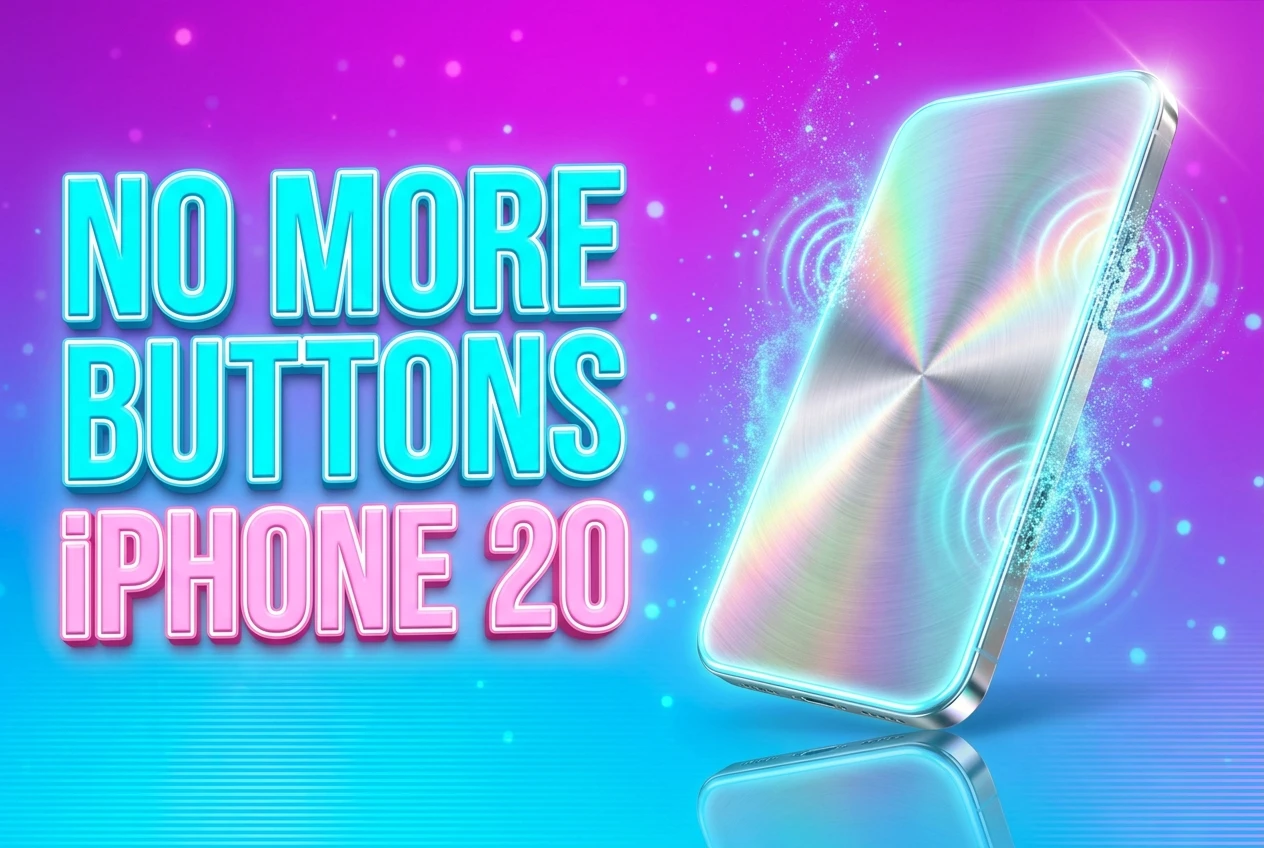
iPhone 20 Could Hide Its Buttons Inside Curved Glass Edges

Apple is back to chasing the iPhone with no buttons. A Weibo leaker known as Instant Digital, who has correctly called past Apple color and finish reveals, says the company’s 20th anniversary iPhone in 2027 will replace every mechanical button with a solid-state haptic system, and the buttons have already cleared lab tests for gloved fingers, wet hands, freezing or scorching temperatures, and use through a phone case. The same post claims an ultra-low-power microprocessor will let the buttons keep working even after the battery dies.
That last detail is the new wrinkle. Apple has tried solid-state buttons twice before, on the iPhone 15 Pro and again on the iPhone 16 Pro, and walked away both times. The third attempt is bolted to a much bigger gamble: an all-glass, four-edge curved iPhone meant to mark 20 years since Steve Jobs unveiled the first one in January 2007.
The leak landed in the same week Bloomberg’s Mark Gurman renewed his reporting that Apple’s 2027 anniversary device will be a mostly glass, cutout-free slab. The two stories slot together. If the screen wraps every edge, the old click-down side rails have to go.
Buttons That Keep Working After the Battery Dies
The headline claim from Instant Digital is not the haptic feedback itself. It is the dedicated low-power chip that keeps the Side, Volume, Action, and Camera Control regions alive when the rest of the phone is off. If accurate, that turns the four button zones into something closer to the NFC reader on a powered-down iPhone, which already keeps responding to transit cards on a reserve charge.
That matters for emergency use. A dead iPhone today still cannot trigger a power-on press without battery. A side rail with its own microcontroller could, in theory, let a long-press wake the phone the moment a charger touches the back, or let Find My ping the buttons during a recovery scenario. Instant Digital has not spelled out what the chip does beyond keeping the buttons responsive, but the architecture echoes the always-on coprocessor work Apple has shipped for motion sensing since the M7 in 2013.
Instant Digital first floated the solid-state plan for this device in an October 2025 Weibo post, the same month Apple shipped iOS 26 with its glass-themed Liquid Glass interface. Six months later, the leaker is back with the lab-test details and the always-on chip. The story has gained specifics, not retreated.
How Apple Killed Haptic Buttons Twice Before This Try
The history matters because every prior promise broke at the prototype line. Apple ran a program internally codenamed Project Bongo, aimed at replacing the iPhone 15 Pro side rails with a single pill-shaped haptic volume control and a non-clicking power button. The unit fired a tiny solenoid against an attraction plate, faking the bump of a press without any travel.
Project Bongo got far enough that suppliers had tooling. Then it died. Apple cut the feature late in the Engineering Validation Test stage, the EVT phase where a design either survives heat, drop, and reliability testing or it does not. AppleInsider published an exclusive 2024 hands-on with a surviving Bongo prototype, showing a chunky module crammed into a Pro-class chassis. The device shipped in September 2023 with the same metal buttons every iPhone has carried since the iPhone 5.
The reason given inside the supply chain at the time was failure rate. Apple has since revived the patent. In April 2025, the United States Patent and Trademark Office published Apple’s Bongo filing, the first official acknowledgment that the canceled mechanism existed at all.
- 2022: Reports first peg solid-state buttons for the iPhone 15 Pro under Project Bongo.
- April 2023: Supplier sources say the feature has been pulled at EVT for high failure rates.
- September 2023: iPhone 15 Pro launches with conventional metal buttons.
- 2024: Rumors briefly resurface for the iPhone 16 Pro before being shelved a second time.
- April 2025: USPTO publishes Apple’s Bongo patent application, filed in September 2023.
- October 2025 to May 2026: Instant Digital ties the technology to the 2027 anniversary iPhone.
Two cancellations is not nothing. Suppliers have absorbed the cost twice, and Apple’s own engineers know what broke last time. The 2027 timeline buys roughly three years of additional reliability work over the 2023 attempt.
What the Lab Tests Now Say They Solved
The four conditions Instant Digital lists are exactly the ones that killed the 2023 design. Capacitive touch is famously fragile against water, cold, and anything between skin and sensor. AppleInsider reported in 2023 that the original Bongo iPhone 15 Pro buttons had a sensitivity slider planned in Settings to compensate for cases and gloves. That slider never shipped because the buttons did not.
The current claim is that the new module passes without a software workaround. Read literally, that means the rail itself can detect a press in conditions like these:
- Gloved fingers: The capacitive layer reportedly registers presses through standard winter gloves, which earlier touchscreen-only solutions struggle with below freezing.
- Wet hands: A long-standing problem for capacitive sensors, since water shorts the field. Solving this likely requires force-sensing combined with capacitive input, not capacitive alone.
- Phone in a case: The button area must transmit pressure through the case wall. Apple already does this with iPhone 16’s Camera Control, but only at one fixed location.
- Extreme heat and cold: Lithium-coil haptic actuators can drift in viscosity at temperature extremes, which is what soured the EVT round in 2023.
Why the Buttons Matter for the Glass Slab Vision
Apple’s 2027 device is being built around an industrial-design thesis: a phone that looks like a single piece of glass. Gurman’s August 2025 Power On post on X framed it as one of three big iPhone moves in a row, alongside the iPhone Air and the first foldable iPhone.
A four-edge curved screen leaves nowhere clean to mount mechanical buttons. The metal cutouts on a current iPhone interrupt the chassis precisely because the keys need a stamped chamber for the spring contact underneath. Solid-state rails dissolve that constraint. The glass simply registers a touch where the side curves down.
Apple’s new Liquid Glass interface in iOS 26 sets the stage for the 20th anniversary glass-focused iPhone overhaul.
Mark Gurman wrote that line on X in June 2025, after Apple’s WWDC keynote. The reading inside Cupertino, by his account, is that the software was a deliberate dress rehearsal. The hardware Apple wants to ship in 2027 already has a matching design language on shelves now.
That is also why the leaker’s button claim is more credible this round than in 2022. The buttons are no longer a Pro-tier flourish. They are a structural requirement of the anniversary chassis. Killing them again would force a partial redesign of the phone’s defining feature.
Sorting Hard Leaks From Wishful Bullet Points
Instant Digital’s same Weibo post packed in a wider feature list, including a 6,000mAh battery, under-display Face ID, an under-display front camera, under-display audio with no earpiece slit, reverse wireless charging, and a next-generation Ceramic Shield. Some of these are corroborated by separate supply-chain reporting. Others read like the leaker’s own wish list.
Display analyst Ross Young, the former Counterpoint Research vice president who tracks panel orders, has publicly pushed back on the cleanest version. In a January 2026 clarification, Young said he expects a smaller Dynamic Island to remain through 2027, not a fully invisible Face ID array. His view is that a true under-display front sits closer to 2030.
| Rumored Feature | Corroboration Level | Most Recent Source |
|---|---|---|
| Solid-state haptic buttons | Strong (multiple iterations from same leaker plus active patent) | Instant Digital, May 2026 |
| Quad-curved all-glass display | Strong (Gurman, supply chain) | Bloomberg Power On, 2025 to 2026 |
| Under-display Face ID | Disputed (Young expects hole punch through 2027) | Ross Young, January 2026 |
| 6,000mAh silicon-anode battery | Speculative (no supply-chain confirmation) | Instant Digital wish list |
| Under-display audio (no earpiece slit) | Speculative | Instant Digital wish list |
| Mass production in China only | Reported (design too complex for Indian assembly lines) | Bloomberg, March 2026 |
Treating every bullet as equally solid is the trap. The buttons and the curved glass have engineering momentum behind them. The earpiece-free audio and the 6,000mAh figure should be filed under aspiration until a second source surfaces.
What 2027 Has to Prove
The leaker’s reputation rides on accuracy patterns, not single calls. Instant Digital correctly flagged the yellow iPhone 14 ahead of its March 2023 launch and called the frosted back glass on the iPhone 15 and iPhone 15 Plus before announcement. The track record on color and finish is strong. The track record on radically new mechanisms is shorter, simply because Apple has shipped fewer of those.
Twenty years after the original iPhone, Apple is being asked to deliver the device the company has chased internally for at least four product cycles. The 2027 launch window is roughly 16 months out from May 2026. Suppliers will start to commit to tooling by late 2026. If the buttons survive that gate this time, they will have outlasted Project Bongo’s failure point by a full development cycle.
Frequently Asked Questions
When does the 20th anniversary iPhone come out?
The release is targeted for fall 2027, in line with Apple’s standard September iPhone window. Bloomberg has reported it as one of three flagship devices Apple plans to launch across 2026 and 2027, alongside the iPhone Air and the first foldable iPhone. Treat the date as soft until Apple confirms during a 2027 earnings call or developer conference.
Will my iPhone case still work with the new haptic buttons?
Yes, according to Instant Digital’s lab-test summary, the buttons are designed to register presses through a standard case. Buyers will not need a special cutout case the way some early Touch Bar MacBook accessories required. Plan to replace your current case anyway, since the 2027 chassis is expected to be quad-curved and substantially thinner than the iPhone 17 series.
Can the haptic buttons really work when the iPhone is dead?
That is the claim, and it relies on a dedicated ultra-low-power microprocessor in the side rail. The mechanism would resemble how a powered-down iPhone still answers Express Transit cards via NFC on a small reserve. Apple has not confirmed the design publicly. Until it does, treat the always-on button feature as the most ambitious and least proven part of the leak.
How accurate are Instant Digital’s iPhone leaks?
Mixed but useful. The Weibo account correctly called the yellow iPhone 14 in March 2023, the frosted glass back on the iPhone 15 lineup, and several Apple Watch finishes. The account is weaker on multi-year roadmap items where supply-chain signals are still forming. Cross-check anything Instant Digital says against Mark Gurman, Ming-Chi Kuo, and Ross Young before treating it as locked.
Will the iPhone 18 or iPhone 19 also get haptic buttons?
No leaker has placed solid-state buttons on the iPhone 18 in 2026 or the iPhone 19 in 2027 base lineup. The current rumor reserves the design for the anniversary device only. If Apple ships it successfully in 2027, expect the technology to migrate down to the broader Pro lineup in 2028 or 2029, the same diffusion path Dynamic Island took after debuting on the iPhone 14 Pro.
The story sitting under all the bullet points is patience. Apple has wanted the buttonless iPhone since at least 2018, when reports first tied solid-state controls to a future Apple Watch, and has spent two product cycles failing to ship it on a phone. The 20th anniversary device is the company’s deadline to itself.
If the leak holds, the 2027 iPhone will arrive looking less like a phone and more like a glowing rectangle of glass, with four invisible touch zones that survive a frozen ski lift, a wet kitchen counter, and a dead battery. If it slips again, Apple loses the symbolism of a 20-year reset. Either way, the next 16 months of supply-chain reporting will tell us whether the third attempt is the one that finally clears EVT.

-
 TECH1 year ago
Where Garmin Watches are Made and How They are Assembled
-

 AUTO2 months ago
Tesla’s Roadster Is ‘a Few Weeks Away,’ Says Its Chief Designer
-
 NEWS10 years ago
Samsung Releases Galaxy Note7 TV Ad as Reddit AMA Leaks Specs
-
 NEWS10 years ago
Android 7.0 Nougat Rolls Out To Nexus Devices With New Emoji, Features
-
 FINANCE9 years ago
Cardano Price Surges as ADA Enters the Crypto Top Ten List
-
 NEWS10 years ago
Pre-Order the First Camera Made for Facebook Live Streaming Video
-
 FINANCE1 year ago
Binance Suspends Trading and Withdrawals for a System Upgrade
-
 FINANCE9 years ago
RChain Price Jumps Nearly 150% to a New All-Time High of $2.03