
NEWS
Samsung’s $2,799 AI Fridge Hits Stores as Vision AI Update Lands

Samsung is no longer just selling a refrigerator. It’s selling a camera-equipped, Gemini-trained, voice-aware roommate that lives in your kitchen and reports back to your phone. The company’s 2026 Bespoke AI lineup, now shipping in the United States, pushes artificial intelligence into nearly every door, dial, and door handle of the modern kitchen, with the headline Vision AI fridge starting at $2,799 and a new wave of advanced food-recognition features rolling out this month.
The pitch from Samsung Electronics America is simple: your fridge will see what’s inside, your oven will watch what’s cooking, and Bixby will know which family member just walked into the room. Michael McDermott, executive vice president of consumer electronics at Samsung, told Business Insider the goal is technology that “fades into the background while making your day easier.” The price tag, the camera count, and the privacy footprint suggest something less invisible.
This is what is actually shipping, what it costs, and what the marketing video skips.
The $2,799 Fridge That Watches Your Lettuce
Samsung’s flagship is the 2026 Bespoke AI Family Hub refrigerator, available now on Samsung.com and at major retailers. The freestanding 29 cu. ft. four-door model carries a 32-inch vertical touchscreen on the door. A slimmer Kitchen Fit variant uses a 9-inch screen. The advanced Vision AI food-recognition features McDermott described to Business Insider are scheduled to land via over-the-network firmware update in May 2026, according to Samsung’s CES 2026 announcement.
- $2,799. Starting price for the 2026 Bespoke AI Family Hub refrigerator.
- 37 fresh + 50 processed. Food types Vision AI can identify on-device.
- 32 inches. Touchscreen size on the freestanding model, a 33% jump over the prior 21-inch panel.
- $1,349. Entry price for Samsung’s new Bespoke Smart Slide-in Range with oven camera.
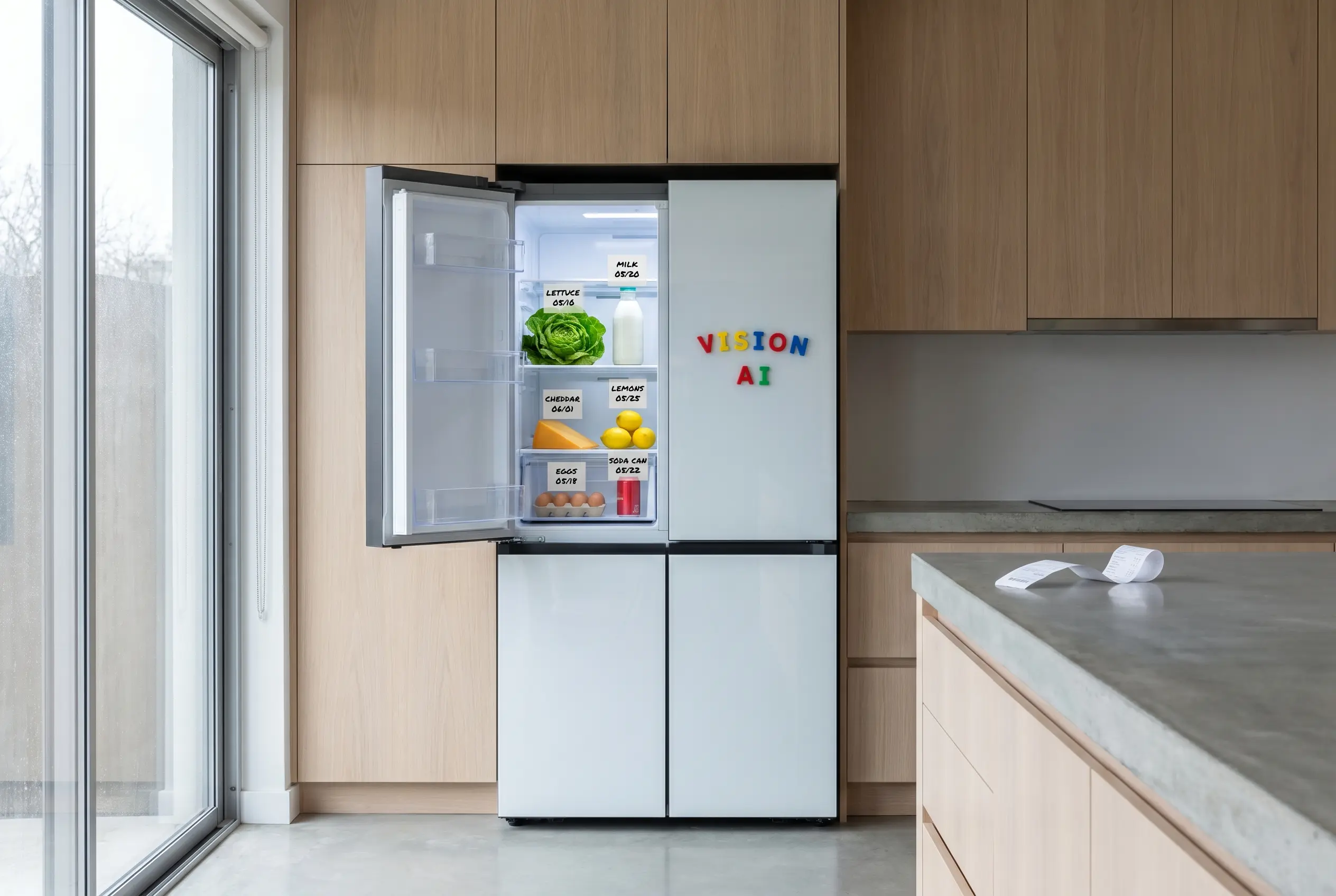
What Vision AI Actually Sees Inside The Box
The internal cameras snap photos every time the door closes, then a large language model identifies items and pushes the inventory to the SmartThings app on your phone. Samsung says it can spot a can of Coke, a bag of spinach, or a tub of yogurt and tag it without manual input. The recognition list grew from 33 to 37 fresh items between 2024 and 2026, with another 50 pre-registered processed items recognizable on-device through the Google Gemini integration Samsung detailed at KBIS 2026.
The cleverer trick is what happens after recognition. If the milk runs low, the fridge can ping Instacart, match the item against a local grocer’s catalog through the Instacart product-match API, and prep a same-day delivery. The multi-year Instacart partnership turns the fridge from a passive box into an active spender, with the user only confirming checkout on the app.
The Oven Is Now A Camera, Too
The kitchen camera count keeps climbing. Samsung’s 2026 Bespoke Smart Slide-in Ranges include an internal oven camera that detects the dish you slide in, recommends a cooking program, and can record video of the bake. The induction model with AI Home retails for $2,599 in white glass, with the gas slide-in starting at $1,499, per Samsung’s product listings.
Samsung is openly pitching the video feature at food influencers who want close-up bake footage without a tripod. It’s a small detail, but a telling one: the company is building features for the people who post their kitchens online, not just the people who eat in them.
Bixby Picks Up A Voice ID
Bixby, Samsung’s long-suffering virtual assistant, is the connective tissue across the lineup. The 2026 update introduces Voice ID, which fingerprints individual household members by how they speak so calendar entries, reminders, and even music recommendations can be tailored per voice.
“Our latest Bespoke AI appliances demonstrate Samsung’s commitment to craftsmanship with premium design choices that blend seamlessly into modern living spaces,” McDermott said in Samsung’s KBIS 2026 release.
Why Samsung Is Pushing AI Into Hardware Right Now
The math behind the marketing is straightforward. The smart refrigerator category is growing. Mordor Intelligence’s 2026 market report values the global smart refrigerator market at $7.66 billion in 2025 and forecasts $8.39 billion in 2026, a 9.5% CAGR with North America holding a 34.2% share.
Samsung is the volume leader in U.S. refrigerators and one of the four companies, alongside LG, Whirlpool, and Haier, that effectively define the category. AI is how Samsung defends a premium price point in a market where mid-tier brands have closed the design and reliability gap.
It’s also a SmartThings play. Every AI Family Hub fridge sold is a SmartThings hub permanently bolted to a wall, hard to swap out and cheap to update. That gives Samsung a beachhead in millions of kitchens at a moment when Google, Amazon, and Apple are all chasing the same room.
The LG Counterattack And A Crowded Kitchen
LG isn’t sitting still. Its 2026 InstaView line uses internal cameras with what LG describes as improved freshness algorithms, and Whirlpool has rolled adaptive cooling into its connected lineup. The differentiation is narrowing fast.
| Appliance | Starting Price | Key AI Feature | Powered By |
|---|---|---|---|
| Samsung Bespoke AI Family Hub fridge | $2,799 | Vision AI food ID, Instacart auto-list | Google Gemini |
| Samsung Bespoke Slide-in Range | $1,349 | Oven camera with cook-time suggestions | Bixby + on-device CV |
| LG InstaView with AI | $3,499 | Internal camera, freshness scoring | LG ThinQ |
| Whirlpool Connected French Door | $2,199 | Adaptive cooling, predictive diagnostics | Whirlpool app |
The split mirrors what’s happening in phones: Samsung is leaning on a Big Tech foundation model (Gemini) for the heavy lift, while pitching its own assistant on top. LG is keeping its stack in-house. Buyers may not care which model recognizes their broccoli, but regulators eventually will.
The Reliability Question Buyers Keep Raising
Samsung’s AI ambition collides with a less flattering data point. In 2023, Samsung sold roughly 23% of all U.S. refrigerators yet accounted for around 70% of refrigerator complaints filed, according to a USA Today analysis cited in a viral Daily Dot piece on Bespoke buyer’s remorse. The brand has been working to repair that perception, but every new feature adds another thing that can break.
Samsung’s own community forums are full of threads from owners whose Family Hub touchscreens froze, blanked, or ghosted within two years, sometimes after a routine software update. Replacement panels have been quoted at hundreds of dollars by independent technicians.
Reviewers are split. Engadget’s hands-on review called the AI features useful but acknowledged camera capture wasn’t always reliable, and noted the food-tracking still demands more user effort than the marketing implies. Consumer Reports’ Bespoke writeup made a similar point: smart features are real, but the cooling fundamentals matter more.
The buyer’s question is whether a $2,799 fridge with a 32-inch screen will still be useful in 2032, when the chip is two generations stale and the LLM has moved on.
Cameras, Mics, And A Wi-Fi Network You Forgot About
The privacy footprint deserves more attention than the press releases give it. A Vision AI fridge has internal cameras that photograph your food. A Bixby-enabled fridge has microphones that listen for voice commands and identify who is speaking. A Family Hub fridge has a 32-inch always-on display that knows your calendar.
None of that is inherently sinister, and Samsung’s privacy documentation says voice and image data is encrypted and largely processed on-device. Galaxy AI’s recent privacy update added a one-tap toggle to keep AI processing local. The fridge inherits some of that posture. The catch is that household members rarely read the privacy policy attached to a kitchen appliance the way they might for a phone.
- Default credentials. Roughly 20% of IoT devices still ship with default passwords, security firm StationX found in 2026.
- Patch cadence. Many connected appliances receive firmware updates only sporadically, leaving known vulnerabilities open for months.
- Lateral movement. A compromised smart fridge can act as a foothold for attackers to reach laptops and phones on the same Wi-Fi network, IoT For All has documented.
- Botnet recruitment. Microsoft Azure blocked a record 15.72 Tbps DDoS attack in early 2026 traced to IoT-driven botnets.
Samsung is not the worst offender in this market, and being a name brand likely means faster patches than off-brand smart appliances. But the calculus shifts when the average kitchen has a fridge, oven, dishwasher, and washing machine all connected to the same router.
Frequently Asked Questions
How much does the Samsung Bespoke AI Family Hub refrigerator cost in 2026?
The 2026 Bespoke AI Family Hub refrigerator starts at $2,799 for the freestanding 29 cu. ft. four-door configuration with a 32-inch touchscreen. A counter-depth Kitchen Fit version with a 9-inch AI Home screen sits below it in the lineup. Both are available now on Samsung.com and at major U.S. retailers.
What can Samsung’s Vision AI actually recognize inside the fridge?
Vision AI can identify up to 37 fresh food items, such as fruits and vegetables, plus 50 pre-registered processed items, including branded products like a can of Coke. It runs the recognition through a Google Gemini-backed large language model and pushes the inventory to the SmartThings app, so users can check supplies from the grocery aisle.
When does Samsung’s advanced food-recognition update roll out?
The advanced Vision AI features McDermott described to Business Insider are scheduled to land via over-the-network firmware update in May 2026 for compatible 2025 and 2026 Bespoke AI Family Hub units. Older Family Hub models without internal cameras will not receive the food-recognition feature.
Can the Samsung AI fridge order groceries by itself?
It does not auto-purchase without user approval. The fridge detects low or missing items, suggests them through Instacart’s product-matching API, and adds them to a shopping list on the touchscreen or SmartThings app. The household member confirms checkout, and same-day delivery comes from a participating local grocer.
How does Bixby Voice ID work on the new appliances?
Voice ID fingerprints each household member by their unique speech patterns. When someone speaks to the fridge or oven, Bixby identifies the person and serves up their personal calendar, reminders, music, or recipe preferences. Samsung says voice data is processed on-device by default, with a privacy toggle to disable cloud processing entirely.
Are Samsung AI appliances a privacy risk?
The cameras and microphones inside Samsung’s AI appliances collect images and voice data, mostly processed locally. The bigger risk is generic IoT exposure. Smart appliances on a poorly secured home Wi-Fi network can be recruited into botnets or used as lateral entry points to phones and laptops, security researchers have warned. Updating router firmware and changing default device passwords mitigates most of that.
Samsung’s bet is that buyers will trade a higher sticker, a denser sensor footprint, and a longer privacy policy for a fridge that takes one chore off the to-do list. Whether the May firmware drop turns Vision AI into a quiet utility or another reason to call a technician will define how the rest of the kitchen industry responds. The cameras are already inside the door.

-
 TECH1 year ago
Where Garmin Watches are Made and How They are Assembled
-

 AUTO2 months ago
Tesla’s Roadster Is ‘a Few Weeks Away,’ Says Its Chief Designer
-
 NEWS10 years ago
Samsung Releases Galaxy Note7 TV Ad as Reddit AMA Leaks Specs
-
 NEWS10 years ago
Android 7.0 Nougat Rolls Out To Nexus Devices With New Emoji, Features
-
 FINANCE9 years ago
Cardano Price Surges as ADA Enters the Crypto Top Ten List
-
 NEWS10 years ago
Pre-Order the First Camera Made for Facebook Live Streaming Video
-
 FINANCE1 year ago
Binance Suspends Trading and Withdrawals for a System Upgrade
-
 FINANCE9 years ago
RChain Price Jumps Nearly 150% to a New All-Time High of $2.03