
BUSINESS
Cities Must Learn to Spend the Urban Challenge Fund
Experts told Nirmala Sitharaman that cities still cannot absorb the Urban Challenge Fund and Finance Commission grants already pledged.

Experts told Nirmala Sitharaman on November 20, 2026 that Indian cities still lack the accounts and staff to draw urban funds already pledged. The ninth pre-Budget meeting for Union Budget 2027-28 put rental housing, transit-led growth and heritage repair on the table, then returned to a drier point: urban local bodies need the ability to absorb money, not only a new line in the Budget.
The finance ministry posted the meeting from New Delhi, with the secretaries of the Department of Economic Affairs and the Ministry of Housing and Urban Affairs in the room.
Union Minister for Finance & Corporate Affairs Smt. @nsitharaman chairs the ninth Pre-Budget Consultation with the experts and stakeholders from the housing, urbanisation, and culture sectors in connection with the Union Budget 2027-28, in New Delhi, today.
The meeting was also… pic.twitter.com/zuUKpm8AOz
— Ministry of Finance (@FinMinIndia) November 20, 2026
Sitharaman’s Ninth Consultation Puts Capacity Before Cash
On November 20, 2026, Sitharaman chaired the housing, urbanisation and culture sitting in the national capital as part of work on Union Budget 2027-28. People at the table included Shekhar Patel, national president of the Confederation of Real Estate Developers’ Associations of India; Srikanth Viswanathan, chief executive of Janaagraha; Vipul Roongta, managing director and chief executive of HDFC Capital Advisors; and Samir Jasuja, founder of PropEquity.
\p>Talk on housing ran toward transit-oriented development, rental supply and affordable homes. Transit-oriented development packs denser mixed-use neighbourhoods around metro and bus hubs, and several states are rewriting city master plans with that idea as they look toward 2047. The sharper worry in the room was that states will soon receive money from both the Urban Challenge Fund and Finance Commission devolution, and that many cities still cannot take it in.
Larger municipal corporations can organise accounts, seek credit ratings and write bankable projects. Smaller cities may not. Stakeholders also asked for a way to reward cities that actually start those reforms, because a competitive fund will otherwise recycle money through the same few corporations that already know how to file.
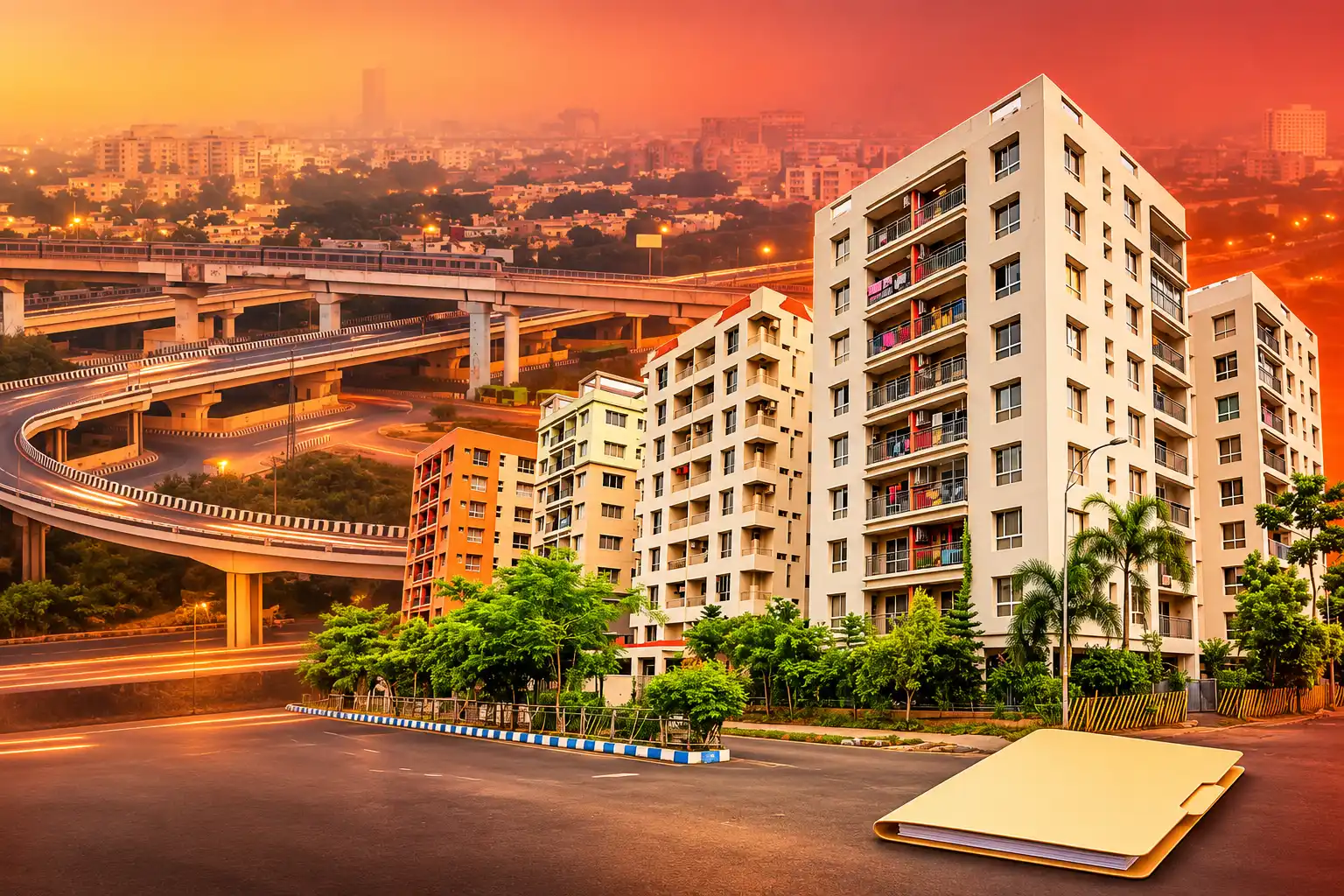
The ₹1 Lakh Crore Fund Cities Must Earn
Sitharaman first announced an Urban Challenge Fund of Rs 1 lakh crore in the Budget 2025-26 speech, to carry three ideas from the July 2024 Budget: cities as growth hubs, creative redevelopment, and water and sanitation. The Union Cabinet cleared the scheme on February 13, 2026. Central aid is meant to cover 25 percent of project cost if at least 50 percent comes from municipal bonds, bank loans or public-private partnerships, with the rest from states, union territories or the cities themselves, for a targeted ₹4 lakh crore of urban investment over five years.
That is a shift from grant-heavy city schemes. A city that cannot raise the market half does not get the central quarter. Housing minister Manohar Lal Khattar released the guidelines on April 15, 2026, splitting the corpus into ₹90,000 crore for projects, ₹5,000 crore for project preparation and capacity building, and ₹5,000 crore for a credit repayment guarantee. Revised estimates for 2025-26 cut the Budget line to ₹1,000 crore from ₹10,000 crore after the late Cabinet nod and April rules; the 2026-27 Budget restored ₹10,000 crore. The fund runs from 2025-26 to 2030-31 and can be stretched to 2033-34.
THE URBAN CHALLENGE FUND SO FAR
- February 1, 2025: Sitharaman announces the ₹1 lakh crore fund in Budget 2025-26 and proposes ₹10,000 crore for that year.
- February 13, 2026: The Union Cabinet clears the scheme, with 25 percent central aid tied to at least 50 percent market finance.
- April 15, 2026: The housing ministry issues guidelines and says money can start moving to projects that are ready.
- May 11, 2026: The first Apex Committee, chaired by the housing secretary, clears Pune projects costing ₹1,290 crore.
- November 20, 2026: Pre-Budget advisers tell Sitharaman that many urban local bodies still cannot absorb the fund and Finance Commission grants together.
Pune Municipal Corporation, through commissioner Naval Kishore Ram, took two works through that first Apex Committee: ₹890 crore to supply treated water to 12 merged villages, including a 200 MLD plant, 71 km of transmission mains and 390 km of distribution for about 7.78 lakh people, and ₹400 crore for storm drains at 335 flood-prone spots. Those are project costs, not a full central cheque, and they show which kind of city is already fluent in the new rules.
THREE URBAN MONEY PIPES
| Window | Amount | What unlocks it |
|---|---|---|
| Urban Challenge Fund (centre) | ₹1 lakh crore through 2030-31 | At least 50% from bonds, loans or partnerships |
| 16th Finance Commission urban grants | ₹3.56 lakh crore, 2026-31 | Elections, audited accounts and own-revenue growth |
| Pune’s first UCF projects | ₹1,290 crore project cost, May 2026 | A large corporation already through the Apex Committee |
Brickwork Ratings, in an April 2026 note, put the wider bill at ₹80 trillion of urban infrastructure needed by 2037, with cities expected to produce about 70 percent of national output by 2036, while commercial debt is still about 5 percent of municipal receipts. Since FY18, 17 cities have issued 31 municipal bonds worth ₹4,540 crore. The fund’s design is a bet that ratings, asset registers and user charges can lift that share. For most towns, the first job is still to produce books a lender will read.
The 25 Percent Rule and the Market Half
Projects must sit in one of three verticals: growth hubs (economic nodes, transit corridors, greenfield and semi-greenfield cities), creative redevelopment (central business districts, historic cores, brownfield rebuilds, transit-oriented development), and water and sanitation, including legacy waste. Works already paid for under AMRUT 2.0, Swachh Bharat Mission 2.0 or other central schemes are out. Reforms in governance, municipal finance and planning are part of the design, and further releases stop if those reforms stall. About 9,500 urban local bodies can enter; the core list is cities of 10 lakh or more on 2025 estimates, leftover state and union territory capitals, and industrial cities of 1 lakh or more.
Guarantees Built for Towns Under One Lakh
A ₹5,000 crore credit repayment guarantee is meant to get smaller towns into the market for the first time. All urban bodies in hilly and northeastern states, and towns under 1 lakh people elsewhere, can seek a central guarantee of up to Rs 7 crore or 70 percent of the loan, whichever is lower, on a first loan, then ₹7 crore or 50 percent after a clean repayment. The ministry says that structure can back projects of ₹20 crore the first time and ₹28 crore the next. A dedicated ₹5,000 crore corpus is also meant to improve the credit standing of 4,223 cities, including many tier-two and tier-three towns. That is real help, and it is still a different league from Pune’s ₹1,290 crore shelf.
Why Smaller Municipalities May Never Reach the Market
The November meeting’s warning about absorptive capacity is easiest to see in own-source revenue. A parliamentary note on the 16th Finance Commission’s urban work shows how much of a city’s money it raises itself, and how sharply that share falls with size.
OWN-SOURCE REVENUE BY CITY SIZE
- Above 40 lakh people: Own-source revenue is 61 percent of total revenue.
- Five lakh to 40 lakh: The share is 55 percent.
- Below 5 lakh: The share drops to 32 percent, against a national average of 51 percent.
A town that lives on grants cannot show lenders a repayment stream, and it cannot show the centre a 50 percent market slice. Performance grants under the 16th Finance Commission will also ask urban bodies to lift own-source revenue by at least 5 percent a year, or to 1.05 times the previous year, and to publish two years of audited accounts. From the second year, a state’s extra slice depends on it having passed on at least 20 percent of the basic grant from its own resources. Uttar Pradesh has told its 763 civic bodies to prepare for that test; combined revenue there rose to ₹5,568 crore in 2024-25 from ₹3,853 crore in 2023-24, nearly 45 percent, according to Anuj Jha, the state’s urban development secretary.
The bond route has a further gate. A bank loan can, in principle, meet the 50 percent rule without a public rating, but it keeps a city tied to state guarantees and one funding channel. A municipal bond needs an investment-grade rating. Cities that have not finished a property census, still run cash accounts, or have no elected council will not get there on the timetable the fund assumes. Large state missions are already sizing 25 percent central slices for water, sewerage and roads. Challenge mode will send the first money to whoever arrives with a complete file, which is why the advisers asked Sitharaman for a reward for reform and for help that smaller cities can actually use.
A Second Pipe of Money Comes With Tests
Beside the challenge fund sits a larger, quieter pipe. Janaagraha, the Bengaluru civic group that runs CityFinance.in and has worked with successive Finance Commissions, counts Rs 3.56 lakh crore for urban local governments over 2026-31, 2.3 times the ₹1.56 lakh crore under the 15th Commission, with the urban share of local grants up to 45 percent from 36 percent. Untied money is 52 percent, or ₹1.84 lakh crore, against ₹33,143 crore last cycle. Basic grants alone are ₹2,32,125 crore. Janaagraha says the five-year urban total matches thirteen years of centrally sponsored city schemes put together.
Viswanathan, who sat in Sitharaman’s November meeting, has argued that states now have to build, at speed, the ability at state and city level to identify, tender and oversee good projects. That is the same absorptive-capacity point the Friday sitting put to the finance minister. Untied grants cannot be used for salaries, and no more than 20 percent can go to roads. Eligibility still turns on local elections, published audits, and state finance commissions whose action-taken reports reach the legislature within six months. Money that is both larger and more flexible still stalls in a commissioner-run office with no project cell.
Delhi’s Master Plan Bets on Transit Around Metro Lines
The housing half of Friday’s agenda already has a working model in the capital. The Union government notified the Master Plan for Delhi 2047 on August 20, 2026, estimating about 40 lakh extra homes as the city’s population moves toward 32 million from 23 million. Union housing minister Manohar Lal unveiled the plan with chief minister Rekha Gupta and lieutenant-governor Taranjit Singh Sandhu. Delhi Development Authority vice-chairperson N. Saravana Kumar said the largest block should come from transit-oriented development, then land pooling, slum rebuilds and high-density belts along Urban Extension Road-II.
About 200 sq km along Metro, Regional Rapid Transit System and railway corridors is marked for denser mixed use, generally within 500 metres of those lines and stations. Affordable homes along metro corridors are expected to yield around 18 lakh units. Land pooling is meant to open nearly 200 sq km, about 12 lakh homes and a 600 km road network, with planning schemes from a 20-hectare minimum. Under the revised transit rules, the minimum plot for such projects falls from 10,000 sq m to 2,000 sq m and the maximum floor-area ratio rises from 300 to 500. The Metro network is planned at 695 km by 2047. Height caps come off across most of the city, with listed historic and ecological pockets kept out.
That package is what other states told Sitharaman they want written into city plans: homes next to trains, pooled land instead of scatter, and a lower bar for assembling plots. It still assumes trunk water, sewerage and power arrive with the extra floor space. A master plan does not, by itself, give a nagar palika a credit rating.
Rental Supply Still Lags Behind Ownership Sanctions
Several people at the November sitting pushed rental housing as a Budget item, because ownership schemes miss migrants, students and industrial workers who need a bed near work. Affordable rental housing is now a vertical under PMAY-Urban 2.0, which took effect on September 1, 2024. As of August 9, 2026, 18.38 lakh houses had been sanctioned under that mission.
PMAY-U 2.0 SANCTIONS
- Beneficiary-led construction: 14.40 lakh houses, the dominant line, for eligible families building on their own land.
- Affordable housing in partnership: 2.48 lakh houses with public or private agencies.
- Interest subsidy: 1.36 lakh houses.
- Affordable rental housing: 13,046 dwelling units, a thin slice of the 18.38 lakh total.
\p>The earlier Affordable Rental Housing Complexes scheme, launched in July 2020 after the pandemic reverse migration, converted vacant public stock and built new rental blocks near jobs. PMAY-U 2.0 kept that idea and still treats it as a junior line. Knight Frank India, in a pre-Budget note, asked for a full tax exemption on rental income up to ₹3 lakh from homes costing up to ₹50 lakh, a five-year tax holiday for purpose-built rental projects, and surplus railway and defence land for dense rental blocks. Those are Budget asks. They sit beside a sanction list that still runs on self-construction.
Inner-City Heritage Falls Between Two Ministries
One source at the sitting said work in historic city areas does not belong to a single ministry. It sits between urban development and culture, and the gap shows up as stalled cores, inner-city villages and heritage streets that no budget head quite owns. The Urban Challenge Fund’s redevelopment vertical does name historic cores, placemaking and traditional architecture, and it wants land-value capture to make those rebuilds pay. That only helps a city that can write the project, share risk with a private operator and keep the books.
Union Budget 2027-28 will be the first full Budget in which both the challenge fund and the new Finance Commission urban grants are live at once. Pune has already shown what a prepared corporation can pull through an Apex Committee. The November advice to Sitharaman was that the next test is whether hundreds of smaller urban bodies can do anything like it before the money lapses back into underspend.

India’s First-Timers and Pant Build a Record 720

Kutch Crash Kills Seven From Army Families After October Toll

Ukrainian Drones Leave Finland Fighting a Russian Ship Fire

ICJ Genocide Order Runs Through Arakan Army Land

CII Asks Patel Panel to Shift Who Funds Indian Credit

Clancy Juror Says the Holdout Never Cited Evidence

The iPhone 18 Pro Max Splits Apple’s Fall in Two

OpenAI Calls GPT-6 Astra AGI Then Locks Its Exploits

Trump Claims Hormuz Control as Oil Holds Near $96

Russia Closes the Goethe-Institut Berlin Tried to Save

 NEWS2 months ago
Clancy Juror Says the Holdout Never Cited Evidence
- NEWS3 months ago
The iPhone 18 Pro Max Splits Apple’s Fall in Two
- NEWS3 months ago
OpenAI Calls GPT-6 Astra AGI Then Locks Its Exploits
- BUSINESS3 months ago
Trump Claims Hormuz Control as Oil Holds Near $96
- LIFESTYLE3 months ago
Russia Closes the Goethe-Institut Berlin Tried to Save
- AUTO3 months ago
Volkswagen’s Job Cuts Leave Four Plants Without Cars
- NEWS3 months ago
Dyson Puts Nurovi Robots on Sale Without the UV Flagship
- BUSINESS3 months ago
US Destroys Five Iranian Tankers as the Shock Hits Jordan