
NEWS
IN-SPACe Clears Jio’s 1,600-Satellite Plan, but Bigger Gates Stay Shut
India’s IN-SPACe rated Reliance Jio’s 1,600-satellite network technically sound, though spectrum and security clearances still stand in the way.

India’s space regulator has judged Reliance Jio’s 1,600-satellite broadband plan “technically sound,” clearing the way for the country’s largest private space bet. The Indian National Space Promotion and Authorisation Centre, known as IN-SPACe, completed the review with the Indian Space Research Organisation and the Department of Telecommunications, The Economic Times reported.
The clearance lets Reliance chase international orbital slots for a network it says could out-capacity Starlink and Amazon’s satellite arm combined over India. It does nothing to resolve the spectrum allocation and security clearances that have already left three fully licensed satellite operators, Jio’s own joint venture among them, unable to switch on a single paying customer.
Jio’s Blueprint Clears Its First Technical Gate
The review examined the constellation’s design, frequency plan and orbital configuration. IN-SPACe judged it on par with leading global satellite systems already flying or under construction abroad, a finding that opens the door to government-backed filings with the International Telecommunication Union, the body that assigns orbital slots and settles interference disputes between operators worldwide.
Reliance had asked for exactly that kind of help, seeking assistance both with ITU paperwork and with coordinating rights against operators already circling the planet. An unnamed official quoted in the Economic Times report said the government is prepared to back Jio’s filings “as an Indian entity is entering the strategic sector,” adding that the same support would extend to other domestic companies entering the segment.
What a 1,600-Satellite Network Is Meant to Do
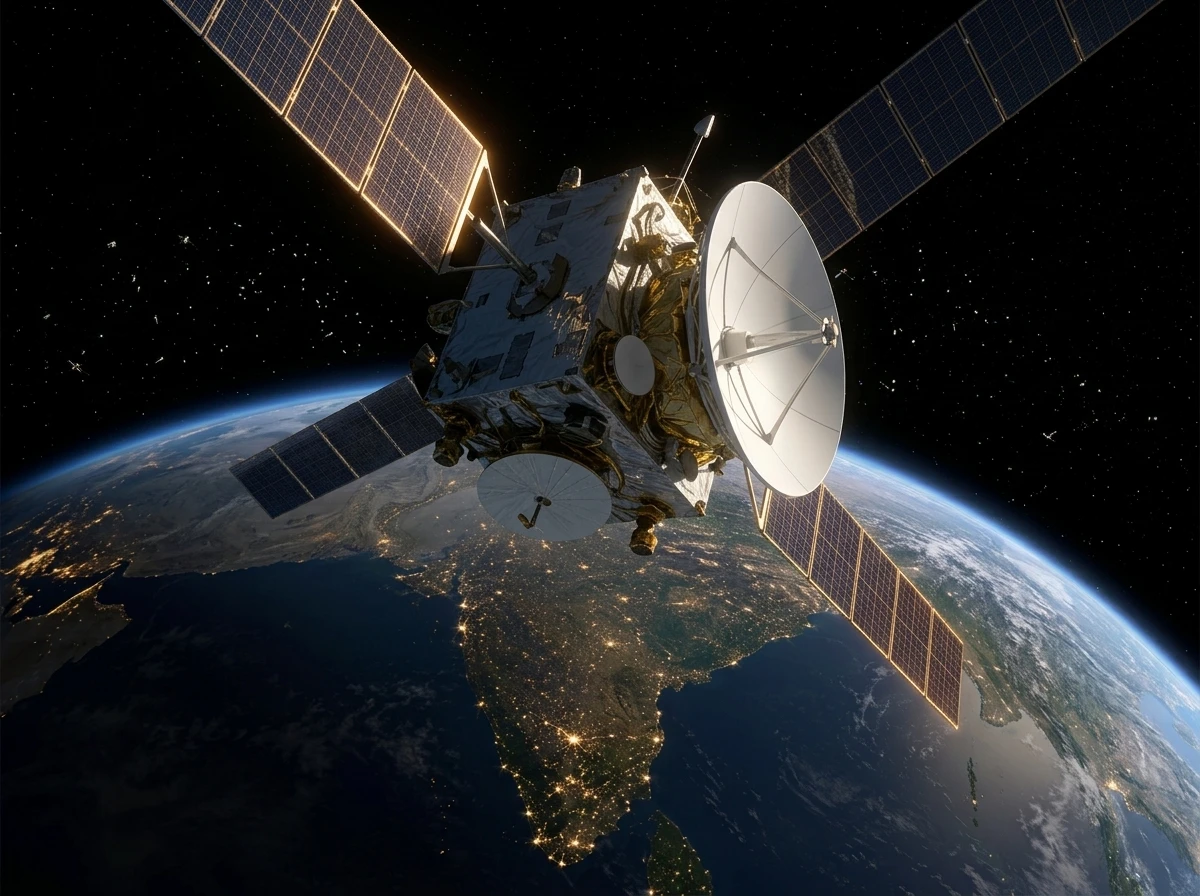
Jio’s constellation would fly low enough to cut latency to a fraction of what geostationary satellites deliver. The company plans 20 to 22 ground stations across India, alongside fixed satellite services such as broadband and cellular backhaul and mobile satellite services including direct-to-device links, letting an ordinary phone reach a satellite without a dish in between.
Akash Ambani, managing director of Jio Platforms, pitched the project around geography Jio’s fibre and towers still cannot reach.
Jio connected India on the ground. Now, we must connect India from the skies.
Ambani made the remark at Reliance Industries’ 49th annual general meeting in June, the same day Jio Platforms filed draft papers for its initial public offering, tying the satellite bet to the biggest listing in the company’s history.
The Capacity Math Against Starlink and Kuiper
The numbers are where Jio’s pitch turns aggressive. Its proposed network targets a total capacity of 4.5 to 5 terabits per second, as much as eight times the 600 gigabits per second currently approved for Starlink’s operations over India. Amazon’s satellite arm has planned 3 terabits per second but has not yet secured any IN-SPACe authorisation at all.
| Operator | Satellite Fleet | Capacity or Status Over India |
|---|---|---|
| Reliance Jio | About 1,600 satellites proposed, roughly 650km altitude | 4.5 to 5 Tbps proposed; IN-SPACe rated design technically sound |
| Starlink (SpaceX) | Nearly 10,000 satellites in orbit globally | 600 Gbps approved capacity over India |
| Amazon Leo (Project Kuiper) | About 3,200 planned, over 300 already launched | 3 Tbps planned; not yet IN-SPACe authorised |
| Eutelsat OneWeb | About 654 satellites in orbit | IN-SPACe approval already secured |
The appeal of flying this close to Earth is speed. Testing by Canadian operator Telesat on its own Lightspeed constellation found round trip latency of 18 to 40 milliseconds for low-orbit backhaul, against the 600-plus milliseconds typical of the geostationary satellites still carrying much of the world’s rural broadband.
Why Delhi Is Racing to Own Its Orbital Shell
The timing follows a broader security push. Through the first half of 2026, India’s Ministry of Home Affairs has sharpened scrutiny of foreign-controlled satellite networks, weighing concerns about signal spillage near the border, cybersecurity and who controls orbital infrastructure during a conflict.
The Department of Telecommunications added 29 new rules for satellite broadband operators in May, citing national security, trade outlet Communications Today reported. A separate draft on administrative spectrum allocation, published June 17, left non-geostationary players such as Starlink and Jio’s own ventures out entirely, pending a different framework, Business Standard reported.
Reports that Starlink’s remaining approvals had effectively frozen circulated through June. SpaceX pushed back hard on that characterisation.
- Security officials, via Bloomberg’s reporting – Starlink’s outstanding India clearances have stalled amid concerns flagged by security agencies.
- SpaceX – Lauren Dreyer, vice president of Starlink business operations, wrote on X that talks with the Indian government remain “active and productive,” calling the frozen narrative misleading.
- Analysts on Jio’s price tag – one industry commentator called the outlay roughly half of what Jio spent building its entire terrestrial network a decade ago; other coverage counts it among the largest capital commitments in Indian corporate history.
Reliance’s push into orbit runs alongside its other capital-heavy wager, artificial intelligence, where the conglomerate recently installed a new chief executive for its Meta-backed AI venture, a sign Mukesh Ambani is spreading big bets across several frontier businesses at once.
Where Defence Planners Fit In
Beyond broadband economics, the project carries a security dimension. The Economic Times reported that discussions are underway on folding defence-related payloads into the constellation, which, if approved, would let the network double as national security infrastructure while deepening India’s home-grown space communications capability. That detail has not been independently confirmed elsewhere, and Reliance has not commented on it publicly.
The rationale tracks a wider pattern. Countries that once leaned on foreign constellations are increasingly wary of doing so as conflicts elsewhere expose how much control a foreign operator can exert over sensitive communications links. An Indian-owned, Indian-filed network sidesteps the exact objection that has slowed Starlink, OneWeb and SES.
Jio has argued the other side of this coin before. Domestic telecom operators, Jio and Airtel among them, objected that administratively assigning satellite spectrum tilts the playing field against terrestrial networks that pay for spectrum at auction. Building its own sovereign constellation puts Jio on both sides of that argument at once, a spectrum-paying telco and a spectrum-seeking satellite operator in the same breath.
Not everyone reads the bet as an immediate business case. Siddhant Cally, a senior analyst at Counterpoint Research, said Jio’s satellite investment should be seen as “a long-term strategic bet rather than a near-term revenue opportunity.”
Does This Approval Get Jio Any Closer to Launch?
Not by itself. IN-SPACe’s technical sign-off lets Jio start pursuing orbital slots at the ITU, but three operators, Starlink, Eutelsat OneWeb and Jio’s own SES venture, already hold full licences and still have not switched on a single Indian customer, because spectrum allocation and security clearance remain unresolved.
As of June 2026, Starlink, Eutelsat OneWeb and the Jio-SES venture called Orbit Connect India all held the licences required to operate, yet none had launched commercial service, Business Standard reported. The Department of Telecommunications had not allocated spectrum to non-geostationary operators, and security clearances remained pending for all three.
Jio’s new constellation will face the same queue once design review is behind it, plus a longer list of firsts.
- ITU coordination – Reliance must file for orbital slots with the International Telecommunication Union and negotiate frequencies with operators already in the same orbital shell.
- Spectrum allocation – India has yet to finalise a framework for non-geostationary satellite operators, leaving Jio, Starlink and OneWeb all waiting on the same rulebook.
- Security clearance – consumer-facing service cannot go live until clearances tied to the government’s new security conditions are complete.
- Ground infrastructure – Jio still has to build the 20 to 22 ground stations its proposal calls for before the network can carry live traffic.
“The biggest bottleneck remains regulatory and operational readiness rather than technology,” said Vinish Bawa, a telecom sector partner at PwC India. Pricing adds another unknown: Starlink’s India website briefly listed a monthly subscription near Rs 8,600 before withdrawing the figures, leaving retail economics an open question for every operator in the category, Jio’s future network included.
Sebastian Barros, an industry commentator who has tracked the plan’s finances, put the outlay in perspective: Jio is preparing to spend on space infrastructure “roughly half of what it originally spent to build its entire terrestrial footprint a decade ago.”
Reliance has set itself a two-to-three-year deployment window, an aggressive target given how long ITU processing and ground infrastructure builds typically run for constellations this size. That clock starts once the remaining approvals land, not from this month’s design sign-off.
Frequently Asked Questions
What Is Direct-to-Device Satellite Connectivity?
Direct-to-device, or D2D, lets an ordinary smartphone connect straight to a satellite without a dish, router or ground terminal in between. Jio’s proposal lists D2D alongside fixed broadband and cellular backhaul among the services its constellation would support, aimed at coverage gaps that mobile towers cannot reach.
Has Amazon’s Kuiper Constellation Received Indian Approval Yet?
No. Amazon’s satellite constellation, rebranded Amazon Leo but still widely called Project Kuiper, has not secured IN-SPACe authorisation, even though the company has already placed more than 300 of its roughly 3,200 planned satellites in orbit elsewhere. Kuiper has instead applied through a separate GMPCS licence route with the Department of Telecommunications rather than going through IN-SPACe first.
Could Jio’s Satellites Reach Orbit Before Starlink Goes Live in India?
Possibly. Industry analysis suggests that if Eutelsat OneWeb and the Jio-SES venture are cleared for commercial launch ahead of Starlink, as the current regulatory trajectory suggests, they could gain a 12 to 18 month head start to lock in ground infrastructure and customers before Starlink enters the market.
Is This Different From Jio’s Existing Satellite Service?
Yes. Jio already sells satellite broadband through JioSpaceFiber, built on its joint venture with Luxembourg’s SES using medium-Earth-orbit and geostationary satellites leased from that partner. The new 1,600-satellite plan is a separate, wholly owned low-Earth-orbit network that Jio would build itself rather than lease.
How Big Is India’s Satellite Communications Market?
India’s satellite communications market is valued at roughly $3.77 billion and is projected to grow at a compound annual rate of 16.04%, reaching about $7.93 billion by 2031, according to estimates from research firm Mordor Intelligence.

-
 TECH1 year ago
Where Garmin Watches are Made and How They are Assembled
-

 AUTO3 months ago
Tesla’s Roadster Is ‘a Few Weeks Away,’ Says Its Chief Designer
-
 NEWS10 years ago
Samsung Releases Galaxy Note7 TV Ad as Reddit AMA Leaks Specs
-
 NEWS10 years ago
Android 7.0 Nougat Rolls Out To Nexus Devices With New Emoji, Features
-
 FINANCE9 years ago
Cardano Price Surges as ADA Enters the Crypto Top Ten List
-
 NEWS10 years ago
Pre-Order the First Camera Made for Facebook Live Streaming Video
-
 FINANCE1 year ago
Binance Suspends Trading and Withdrawals for a System Upgrade
-
 FINANCE9 years ago
RChain Price Jumps Nearly 150% to a New All-Time High of $2.03