
GAMING
Sony’s PS6 Cloud Plan Targets Xbox With PCIe Gen5 Server Upgrade

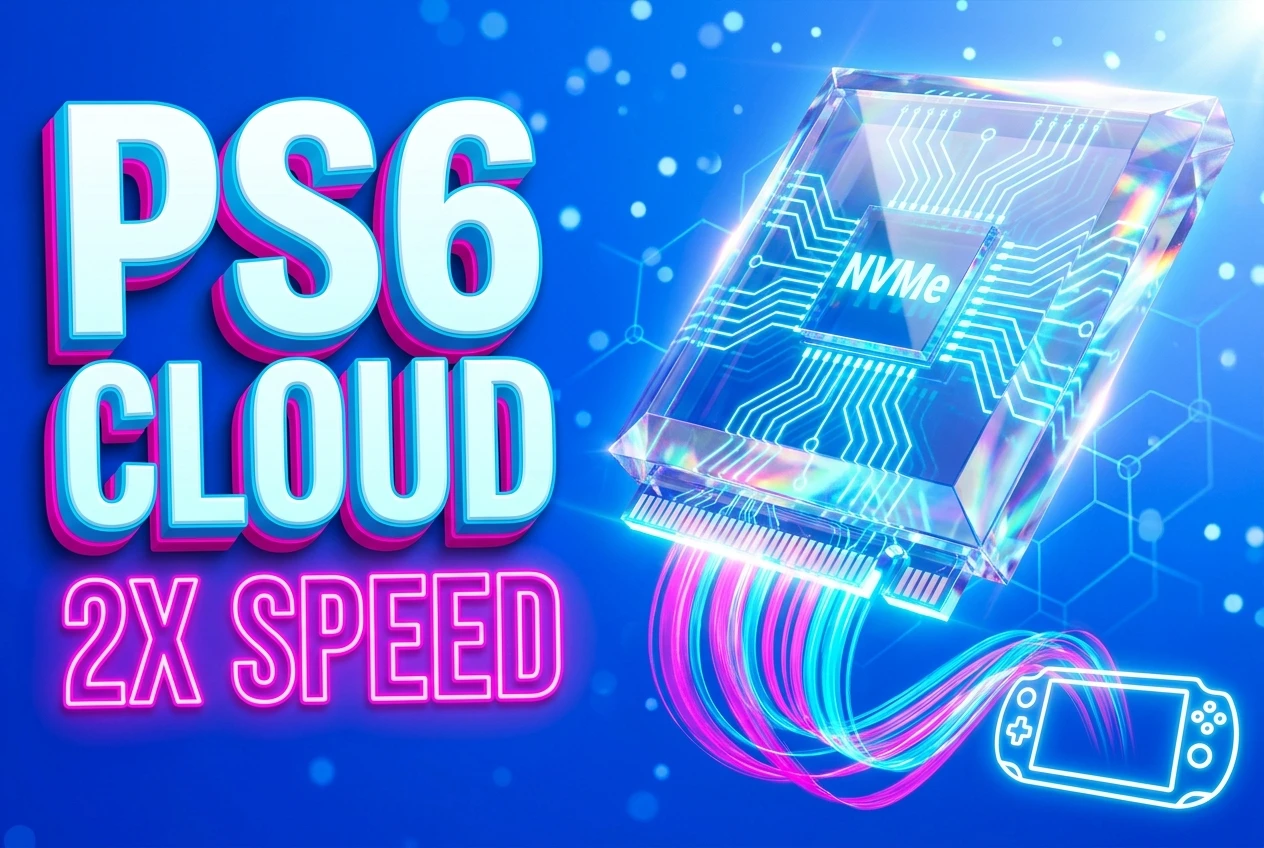
Sony plans to overhaul its cloud gaming servers with PCIe Gen5 NVMe storage, almost doubling sequential read speeds to 14,900 MB/s, according to a fresh MP1st briefing. The same upgrade is tipped for the PS6 console SSD, with the work timed to a Holiday 2027 launch alongside a long-rumored PS6 handheld.
The plan reads less like Sony copying Xbox’s xCloud playbook and more like Sony quietly building the rails it needs to make a portable PlayStation actually viable. The cloud is no longer a “Premium” perk. It is the load-bearing tech for the next platform.
What Sony’s Cloud Server Upgrade Actually Changes
The leak, first surfaced in MP1st’s PS6 cloud streaming briefing, points to a server-side hardware swap that has been in development for three to four years. PS Plus Premium currently runs on PCIe Gen4 NVMe drives that top out near 7,500 MB/s. The next-gen cloud platform is moving to PCIe Gen5 NVMe storage rated up to 14,900 MB/s.
That doubling matters for one obvious reason. Every cloud streaming session begins with a server pulling a game’s assets off disk before pixels reach your screen. Faster server SSDs cut queue times, shrink the gap between “tap play” and “see frame one,” and let developers stream higher-fidelity assets on demand.
For the consumer, the change shows up as fewer loading screens, faster matchmaking spin-up, and more headroom for higher bitrate streams. For Sony, it is the foundation under almost everything else the PS6 needs to do.
The Storage Numbers, Side By Side
The shift from Gen4 to Gen5 NVMe is not subtle. Each generation roughly doubles per-lane bandwidth, and Sony’s reported targets sit near the top of what the standard supports today.
| Component | Storage Standard | Sequential Read (Max) |
|---|---|---|
| PS5 consumer SSD | PCIe Gen4 NVMe | 5,500 MB/s |
| Current PS Plus cloud server | PCIe Gen4 NVMe | up to 7,500 MB/s |
| Reported PS6 console SSD | PCIe Gen5 NVMe | up to 14,900 MB/s |
| Reported PS6 cloud server | PCIe Gen5 NVMe | up to 14,900 MB/s |
Industry leaker Kepler_L2 has separately corroborated a 1TB Gen5 SSD target for the home console in a long-running ResetEra spec thread tracking PS6 component leaks. The same thread pegs system memory at roughly 30GB on the home console and 24GB on the handheld sibling.
Where Xbox Cloud Still Has The Lead
Server hardware alone will not close the gap. Xbox Cloud Gaming exited beta this year and now streams 1440p to Game Pass Ultimate subscribers on supported titles, with Series X-quality rendering pushed through a higher bitrate pipeline rolled out in February 2026.
The bigger problem for Sony is measurable latency. Digital Foundry’s lag face-off pinned PS Plus cloud at roughly 137ms against Xbox’s xCloud at 99ms on the same content, a 38ms gap that is the difference between “fine for Stardew Valley” and “do not even try Tekken.”
- 137ms measured PS Plus cloud streaming latency in Digital Foundry’s test, against 99ms on Xbox Cloud Gaming.
- 1440p resolution ceiling on Xbox Cloud Gaming Ultimate after the February 2026 backend update, while PS Plus Premium streaming sits at 1080p high quality.
- 2,845 games available on the PlayStation Portal cloud streaming catalog page, including Ghost of Yotei and Astro Bot.
- 91.04 million vs 34.43 million PS5 against Xbox Series X/S lifetime hardware sales per VGChartz’s February 2026 console comparison data.
Sony has crushed the box-shifting fight. But on streaming quality and codec performance, Xbox spent four years iterating while PlayStation treated cloud as a bonus feature glued onto PS Plus Premium.
Why The Handheld Needs This More Than The Console Does
A PS6 handheld is the device that benefits most from a fast cloud. Battery, thermals, and a sub-$500 price ceiling all argue against shoving full RDNA 5 silicon into a portable. Cloud streaming is the cheat code that makes the BOM math work.
Mat Piscatella, video games industry advisor at Circana, told an industry interviewer in February 2026 that uptake stays soft today but pivots fast if hardware prices climb. His framing maps directly onto Sony’s bet on a cheaper, cloud-leaning second SKU.
“We’re not seeing a lot of people subscribing to play on cloud right now. That could change if consoles become $1,500 because of the component shortage.”
The Cerny And AMD Plan, Beyond Frame Rates
The cloud upgrade is one half of the story. The other half is Project Amethyst, the multi-year Sony-AMD machine learning collaboration that PS5 lead architect Mark Cerny and AMD computing chief Jack Huynh detailed in a joint video this year.
Cerny said on camera he was “really excited about bringing [these advances] to a future console in a few years’ time,” language industry watchers have read as a soft PS6 confirmation. Huynh was blunter about why the project exists at all.
“We knew we had to go with machine learning because Moore’s Law is diminishing, the old school way of adding more performances, more transistors, more flops, more memory bandwidth,” Huynh said in the same conversation. The pitch: PSSR 2.0, ML frame generation (not before 2027 per Cerny), and ray regeneration baked into the silicon.
For developers, the implication is that compute and AI throughput, not raw rasterization, becomes the headline spec on the PS6 datasheet. The console SSD pumping at 14,900 MB/s feeds that pipeline. The cloud servers carry the same DNA so the streaming experience does not get out-classed by the local one.
https://x.com/JackMHuynh/status/1976272374543630842
How Quickly PS Portal Users Are Voting With Their Wallets
Sony’s own usage data already tilts toward this future. Cloud streaming monthly active users grew 162% year-over-year in January 2026, and over 50% of PlayStation Portal owners are now PS Plus Premium subscribers, the company has disclosed.
The handheld got a 1080p high-quality streaming mode in a PlayStation.Blog update post dated March 17, 2026, alongside refinements to game invites and trophy notifications during streaming. Each release pushes the device a little further from “remote play accessory” toward “first cloud-native PlayStation.”
By the time a PS6 handheld arrives, Sony will have spent two more years tuning the experience on a device with 50% Premium attach. That is a captive audience handing Sony real-world telemetry that Xbox Cloud Gaming, with no first-party handheld of its own, simply cannot collect.
Frequently Asked Questions
Will my PS5 games carry over to the PS6 cloud library?
Yes, every leak so far points to broad PS5 compatibility on PS6, both locally and through the cloud, and the MP1st report explicitly cites cross-gen support as a Sony priority. Your existing PS Plus Premium catalog should remain streamable on day one. Saved games, trophies, and the digital library tied to your PSN account will follow as they did from PS4 to PS5.
When does the PS6 actually launch?
Holiday 2027 is the most consistent target across leaks, with Kepler_L2 and Moore’s Law Is Dead both pointing to that window. Some recent reports suggest Sony could push to 2028 or 2029 because of the global memory shortage tied to AI data center demand. No official date has been announced. Expect a formal Sony reveal in the back half of 2027 ahead of any pre-order rush.
Do I need PS Plus Premium for the new cloud features?
Yes, cloud streaming on PlayStation hardware sits behind the Premium tier today, and there is no signal that changes for PS6. Premium currently runs $159.99 per year in the United States. If you only own a PlayStation Portal and stream from the cloud rather than a paired PS5, Premium is effectively a requirement, not an upsell. PS Plus Essential and Extra do not include cloud streaming.
Will the PS6 handheld work without a home console?
Yes, the rumored PS6 handheld is being designed to run games standalone, both natively on its own silicon and through cloud streaming, unlike the PlayStation Portal, which originally required a paired PS5. That positions it closer to a Steam Deck or Switch 2 than a remote play accessory. Pricing leaks suggest a $400 to $500 range, well under the main PS6 console.
Does the storage upgrade improve PS5 cloud streaming today?
No, the PCIe Gen5 NVMe rollout is for next-generation server hardware that boots alongside PS6, not a retrofit to the current PS Plus Premium cluster. PS5 cloud users today still stream from PCIe Gen4 NVMe servers capped near 7,500 MB/s. The benefit lands when you log in on a PS6, a PS6 handheld, or a future Portal that targets the upgraded backend.
None of this lands until Sony actually announces it. The leaked roadmap, the Cerny and Huynh on-camera chemistry, and the 162% cloud user growth all point in the same direction, but Sony has not committed publicly to any of it.
The next State of Play is the test. If a PS6 reveal arrives with a handheld sharing the stage and a live cloud demo running 1080p at sub-100ms latency, the strategy MP1st outlined is real and on schedule. If it does not, the gap with Xbox Cloud Gaming widens for another year.

-
 TECH1 year ago
Where Garmin Watches are Made and How They are Assembled
-

 AUTO3 months ago
Tesla’s Roadster Is ‘a Few Weeks Away,’ Says Its Chief Designer
-
 NEWS10 years ago
Samsung Releases Galaxy Note7 TV Ad as Reddit AMA Leaks Specs
-
 NEWS10 years ago
Android 7.0 Nougat Rolls Out To Nexus Devices With New Emoji, Features
-
 FINANCE9 years ago
Cardano Price Surges as ADA Enters the Crypto Top Ten List
-
 NEWS10 years ago
Pre-Order the First Camera Made for Facebook Live Streaming Video
-
 FINANCE1 year ago
Binance Suspends Trading and Withdrawals for a System Upgrade
-
 FINANCE9 years ago
RChain Price Jumps Nearly 150% to a New All-Time High of $2.03