
NEWS
Kled Pulls App From Nigeria After 95% Fraud Rate Hits Data Marketplace

US data startup Kled has pulled its app from the Nigerian app store and IP-banned the entire country, citing a 95 percent fraud rate driven by AI-generated images, duplicate uploads, and thousands of forged Japanese passports run through its KYC system. Founder Avi Patel called the move temporary in a statement posted Monday on X.
Kled is a four-month-old San Francisco data marketplace that pays everyday users to upload photos, videos, and documents through its official data marketplace product page, then sells those datasets to AI companies for model training. The startup is fresh off a $100 million valuation milestone announced in December 2025 and a $5.5 million seed round in March 2026.
How An AI Data Marketplace Got Eaten By AI Fraud
An AI data platform was forced offline in one of its biggest markets by AI-generated fraud. The pattern that broke Kled in Nigeria is the same one hammering identity systems across fintech, crypto, and onboarding flows worldwide.
Patel said internal review of Nigerian uploads showed three dominant fraud patterns: pictures of black screens captured to game volume-based payouts, duplicate photos uploaded across linked accounts, and image files pulled from open web search or generated by tools such as Midjourney and ChatGPT image models. Each pattern broke a different validation layer.
Kled pays per asset. Real, in-app capture work earns small but cumulative rewards. AI-generated images, by contrast, can be churned out by the thousand for cents. That economic gap is what attracted the fraud at scale, and what made absorbing the cost impossible for a four-month-old company.
The Fake Japanese Passport Operation That Broke The Camel
The breaking point came over the weekend.
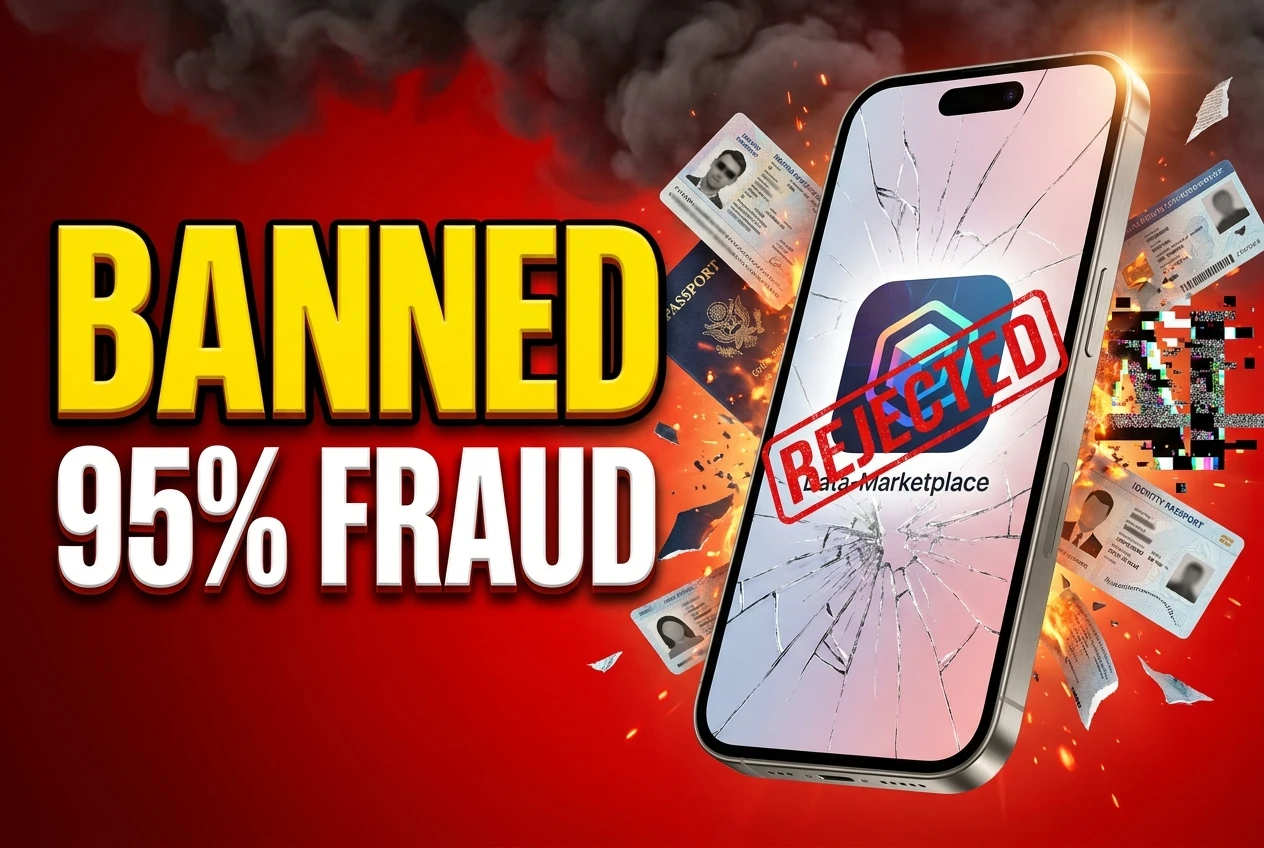
Patel said Kled’s KYC verification system was hit with thousands of fake Japanese identity documents, all featuring Nigerian faces photoshopped onto Japan-issued passport templates and ID cards. By his count, more than 500 of those forgeries hit the queue in the final 48 hours alone.
This weekend we were flooded with thousands of fake Japanese passports and identity cards with Nigerians photoshopped onto them in our KYC system. That was the final straw.
Those forgeries were part of a longer thread Patel posted on his X profile statement on Monday, May 4, 2026.
The choice of Japan as the impersonation target tracks with how Kled prices its data. Submissions tagged to higher-income countries fetch larger payouts because enterprises training AI models pay a premium for geographic and demographic diversity. A successful Japan-coded account would, in theory, earn a multiple of what a Nigeria-coded account earns for the same upload.
The fraud toolset is no longer expensive. According to Sumsub’s 2025 identity fraud research note on AI-generated documents, AI-built fakes now account for roughly 2 percent of all detected forgeries globally. Services such as OnlyFake have advertised passport-quality images for as little as $15 each, and several cryptocurrency exchanges have already lost KYC fights to that exact toolset.
Why Kled’s Other Markets Are Still Safe
Kled’s other top regions have not produced anything close to the Nigerian fraud signature. Patel said Malaysia, Indonesia, and the Philippines combined run a fraud rate below 10 percent, despite a userbase roughly ten times larger than Nigeria’s combined upload volume. All three markets have, at points in 2026, ranked Kled as the number one free app on their local stores.
That comparison matters because it puts the issue squarely on local actor concentration rather than platform design. The same upload flow, the same KYC stack, the same payout system, and three other emerging markets behave completely differently.
| Market | Fraud Rate | Status (May 2026) |
|---|---|---|
| Nigeria | ~95% | App removed, IP ban active |
| Malaysia | Under 10% (combined) | Active, ranked #1 on local store |
| Indonesia | Under 10% (combined) | Active, ranked #1 on local store |
| Philippines | Under 10% (combined) | Active, ranked #1 on local store |
Inside The Four Month Old Startup Now Burning Cash
Kled is small. The company exited beta in early 2026 and scaled in roughly four months to over one billion uploaded assets, hundreds of thousands of paid users, and a top-100 ranking on the Nigerian App Store.
- 1 billion+ assets uploaded since beta exit.
- $100 million valuation announced in December 2025.
- $9 million in total funding to date.
- $5.5 million seed round closed in March 2026.
- 4 months operational since exiting beta.
That makes a 95 percent fraud rate from a top-100 market lethal. Every fraudulent upload that gets paid, even at a fraction of a cent, is a direct cash drain on a balance sheet that has not yet hit a Series A.
Patel was explicit on the cost framing. “As a startup we can’t afford to eat the costs of that data overhead,” he wrote, framing the IP ban as a defensive cash move while engineering rebuilds detection.
Kled’s bigger picture is a company sprinting. The team has signed data-licensing partnerships across film, healthcare, robotics, consulting, and finance, according to Kled’s December 2025 valuation press release. Stanford, MIT, Duke, and Caltech research hires were announced just weeks before the Nigeria call.
- May 2025: Kled founded by Avi Patel in San Francisco.
- December 2025: $100 million valuation announced.
- January 2026: Consumer app exits beta into V1.
- March 2026: $5.5 million seed round closed.
- May 4, 2026: Nigerian app removal and IP ban announced.
Why Nigeria’s KYC Problem Keeps Eating Foreign Apps
Kled is not the first US tech company to flag concentrated identity fraud out of Nigeria, and the local fintech sector has been raising the same red flags for months.
The Economic and Financial Crimes Commission summoned fintech chief executives to its Abuja headquarters on April 30, 2026. Executive chairman Ola Olukoyede warned that “one mishandled transaction can destroy what you have built over ten years,” citing KYC failures and the laundering of ransom payments through fintech and POS channels as primary concerns.
Industry voices are saying the same in different language. Olatoye Agboola, a Nigerian technology and data analytics specialist, has urged digital banks and fintechs to switch from document-based KYC to biometric KYC built on the country’s Bank Verification Number and National Identification Number databases. Legacy document checks are exactly the kind of system the fake-Japanese-passport flood would defeat, aligning with the Central Bank of Nigeria’s December 2023 guidance that mandated BVN and NIN attachment to Tier-1 accounts. The VoveID 2026 compliance guide to CBN KYC requirements spells out the framework now expected of any platform onboarding Nigerian users.
What Comes Next For Nigerian Users
Patel was careful in his statement to separate the country from its user base. “I have nothing against Nigeria. I have a ton of friends from this region and these were some of our earliest app adopters. Genuinely, thank you all for the support,” he wrote.
The company says the suspension is temporary. Kled’s plan, by Patel’s own description, is to ship an upgraded fraud detection and banning system that can filter out manipulated submissions in real time, then bring the country back online once false-positive risk is acceptable.
For Nigerian users today, the practical effect is simple. The app will not load, upload screens will not push, and any payouts that had cleared verification before the cut should still process. Anything sitting in the KYC queue at the time of the IP ban is unlikely to be approved without manual review.
Patel also noted that Kled will continue serving the rest of the African continent. That carve-out matters: it signals the company is not retreating from Africa as a market thesis, just from one country whose abuse load broke its pricing model.
The company’s public channels were, by Patel’s own description, drowning. “Every time we make a post there is someone asking us to bring the region back within seconds,” he wrote. “We hear you, but it’s gotten out of hand.”
Frequently Asked Questions
Why did Kled remove its app from Nigeria?
Kled removed the app and IP-banned the country after founder Avi Patel found a 95 percent fraud rate on Nigerian submissions, including AI-generated images, duplicate uploads, black-screen captures, and over 500 forged Japanese passports submitted through its KYC system in 48 hours. The company said the cost of paying out fraudulent uploads was unsustainable for a four-month-old startup with $9 million in total funding.
Can I still use Kled in Nigeria?
No. The app has been removed from the Nigerian app store and Kled has put an IP-level block on traffic from Nigerian addresses. A VPN may load the app surface, but the company’s KYC and fraud systems are flagging the same patterns that triggered the ban, so accounts created via VPN are likely to be banned at verification rather than paid out.
Will Kled return to Nigeria?
Yes, eventually. Patel said in his May 4 X statement that the suspension is temporary and Kled will return “when the time is right.” The company is rebuilding its fraud detection and banning system to filter out manipulated submissions in real time. There is no published timeline. The rest of Africa remains supported in the meantime, with no other country affected.
How much has Kled paid out to users so far?
Kled has paid out “hundreds of thousands of people” globally in the four months since exiting beta, with over one billion assets uploaded. The company has not disclosed dollar totals or a Nigeria-specific payout figure. Kled raised $5.5 million in March 2026 and reached a $100 million valuation in December 2025, and Patel framed the Nigerian fraud overhead as a direct threat to that runway.
What is the Kled app and how does it pay users?
Kled is a San Francisco data marketplace that pays users to upload photos, videos, and documents that are then anonymised and licensed to AI companies for model training. Payouts have been routed through Cash App and Venmo in the V2 release, with cryptocurrency options on the roadmap. The app shows an estimated reward value before each upload is confirmed, and users earn additional rewards through enterprise-requested special tasks.
Are other African countries affected by this ban?
No. Patel said Kled will keep “supporting every other area in Africa” and the IP block is specific to Nigerian addresses. The company has flagged Nigeria as a one-country anomaly, contrasting it with Malaysia, Indonesia, and the Philippines, which run combined fraud rates under 10 percent on roughly ten times the upload volume. Users in other African markets can continue uploading and getting paid as normal.
The wider lesson goes beyond one app. As more consumer platforms push payout-for-data models into emerging markets, the cost gap between what local fraudsters can produce with a $15 AI-built passport and what small startups can absorb keeps widening. Kled’s return now depends on whether its detection stack can outrun the cheapest fraud toolset on the open web.

-
 TECH1 year ago
Where Garmin Watches are Made and How They are Assembled
-

 AUTO3 months ago
Tesla’s Roadster Is ‘a Few Weeks Away,’ Says Its Chief Designer
-
 NEWS10 years ago
Samsung Releases Galaxy Note7 TV Ad as Reddit AMA Leaks Specs
-
 NEWS10 years ago
Android 7.0 Nougat Rolls Out To Nexus Devices With New Emoji, Features
-
 FINANCE9 years ago
Cardano Price Surges as ADA Enters the Crypto Top Ten List
-
 NEWS10 years ago
Pre-Order the First Camera Made for Facebook Live Streaming Video
-
 FINANCE1 year ago
Binance Suspends Trading and Withdrawals for a System Upgrade
-
 FINANCE9 years ago
RChain Price Jumps Nearly 150% to a New All-Time High of $2.03