
NEWS
MacBook Ultra Rumor: Touchscreen, OLED And M6 Pro By Early 2027

Apple is preparing the first touchscreen MacBook in its history, and supply chain leaks now point to a January 2027 launch under a brand new tier called MacBook Ultra. The redesign would sit above the MacBook Pro, ship in 14 and 16-inch sizes, run unannounced M6 Pro and M6 Max chips on TSMC’s 2-nanometer process, and cost roughly 20 percent more than today’s flagship laptops.
Bloomberg’s Mark Gurman first put the Ultra label on Apple’s roadmap in March, and a steady drip of analyst notes since has lined up the same six headline upgrades: a tandem OLED touchscreen, a Dynamic Island in place of the notch, a thinner shell, M6 Pro and M6 Max silicon on TSMC’s new 2-nanometer node, optional 5G cellular through Apple’s own modem, and a price hike to match. Reporting through April from MacRumors, 9to5Mac and AppleInsider has not contradicted any of those points.
Nothing is official. WWDC 2026 is expected on June 8, and Cupertino is unlikely to confirm laptop hardware on a software stage. But the rumor signal is loud enough that Apple’s silence is starting to look like confirmation.
What The Tandem OLED Touchscreen Actually Changes
The display is the headline, and not just for marketing reasons. Apple already shipped tandem OLED in the M4 iPad Pro in 2024, where two stacked OLED panels combine to hit 1,000 nits of full-screen brightness and a 2,000,000:1 contrast ratio, per Apple’s May 2024 iPad Pro launch announcement. That same architecture, scaled to 14 and 16 inches and laminated with on-cell touch, is what every analyst now expects on the Ultra.
Ming-Chi Kuo, the TF International analyst whose supply-chain calls on Apple are widely tracked, said in September that Samsung Display will manufacture the panel and that the touch sensor will sit inside the display “cell” rather than on top. That detail matters more than it sounds. Putting the sensor in the cell shaves microns off the lid, improves touch latency, and avoids the optical haze that older add-on touch layers introduced.
Kuo posted his analysis publicly on X, and the line that landed hardest with developers was simple.
https://x.com/mingchikuo/status/1968249865940709538
The change ripples through software too. Bloomberg has reported that Apple is rewriting parts of macOS so on-screen targets, sliders, scroll bars and modal sheets respond to taps, pinches and long presses the way iPadOS does, with controls dynamically resizing depending on whether you reach for the screen or the trackpad. Hardware-wise, removing the mini-LED backlight stack lets the lid get noticeably thinner.
- Tandem OLED panel from Samsung Display, 1,000 nits sustained, roughly 2,000,000:1 contrast
- On-cell touch sensor laminated inside the display cell for lower latency and a thinner lid
- Dynamic Island camera cutout replacing the 2021-era notch
- Thinner chassis with the keyboard, MagSafe, HDMI and SD slot retained
- macOS gestures aligned with iPadOS conventions: pinch to zoom, drag to rearrange, tap to dismiss
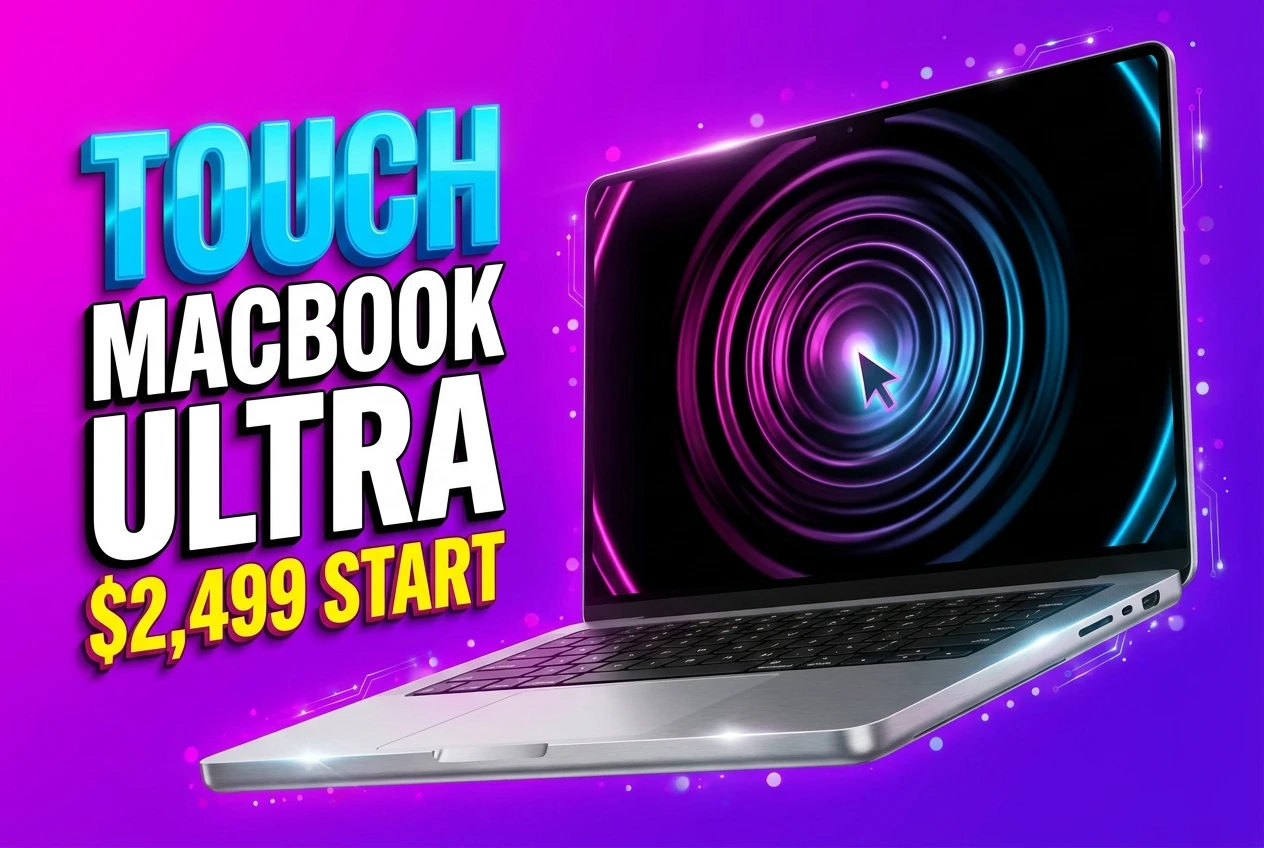
The Price Tag, And Why It Climbs By Roughly 20 Percent
Apple has done this dance before. When the iPhone X launched with OLED in 2017, the lineup’s starting price jumped from $769 to $999. When the iPad Pro went tandem OLED in 2024, the 11-inch model jumped from $799 to $999 and the 13-inch from $1,099 to $1,299. Macworld’s pricing forecast for the MacBook Ultra applies the same 20 percent multiplier and lands here.
| Model | Today (M5 Pro) | Rumored Ultra Start | Increase |
|---|---|---|---|
| 14-inch base | $2,199 | $2,499 | $300 |
| 16-inch base | $2,699 | $2,999 | $300 |
| Loaded build (64GB / 4TB) | $4,499 | $5,200 plus | $700 plus |
Those are starting configurations. Loaded with more RAM and storage, both models have historically climbed past $4,500, and the DRAM crisis described later in this piece is not going to push that ceiling down.
M6 Pro And M6 Max On TSMC’s 2-Nanometer N2 Node
The Ultra would be Apple’s first laptop built on TSMC’s N2 nanosheet logic technology specification, which entered volume production in the fourth quarter of 2025 at fabs in Baoshan and Kaohsiung. N2 is TSMC’s first node using gate-all-around nanosheet transistors, a structural shift from the FinFET design that has carried mobile silicon since 2014.
Per TSMC’s own published specs, N2 delivers a 10 to 15 percent speed gain at the same power as 3nm, or a 25 to 30 percent power reduction at the same speed, plus roughly 15 percent higher transistor density. More than half of N2’s 2026 capacity is already reserved for Apple, according to public TSMC capacity disclosures.
Reports through February indicated Apple chose the base N2 variant rather than the enhanced N2P expected in 2027, prioritizing architectural redesign over a half-step manufacturing bump. The likely outcome is summarized below.
- Up to 18 percent CPU performance lift over M5 Pro at the same wattage
- Up to 30 percent lower power draw at the same clock
- About 15 percent higher transistor density for logic-heavy designs
- More than 50 percent of TSMC’s 2026 N2 capacity booked by Apple alone
For the Ultra specifically, that translates into longer sustained burst performance under heavy loads (Final Cut renders, Xcode compiles, on-device LLM inference) and meaningfully more battery life from a chassis that is itself losing the mini-LED backlight stack.
The Cellular Mac, Apple’s Quietest Big Bet
The cellular rumor has gotten less attention than the touchscreen, but it may matter more in the long run. Apple debuted its in-house C1X cellular silicon in the iPhone Air in September 2025, with Apple’s iPhone Air launch announcement claiming the chip runs up to 2x faster than the original C1 while using 30 percent less energy.
In independent testing, the chip has held up. Ookla data published through March 2026 showed the C1X matching Qualcomm’s X80 modem on raw download speed and beating it on latency in 19 of 22 markets. That is the modem now expected inside the MacBook Ultra, either C1X or its in-development successor C2. A built-in 5G modem would make the Ultra Apple’s first laptop that connects to a cellular network on its own, no iPhone hotspot needed.
Kuo, summarizing why Apple is finally crossing the line on Mac touch and cellular at the same time, wrote on X:
MacBook models will feature a touch panel for the first time, further blurring the line with the iPad. This shift appears to reflect Apple’s long-term observation of iPad user behavior, indicating that in certain scenarios, touch controls can enhance both productivity and the overall user experience.
Why The Launch Slipped From Late 2026 Into Early 2027
The original target was late 2026, in time for the holiday quarter. Mark Gurman’s Bloomberg reporting catalog shifted that window in April to roughly late January 2027, and the reason is not engineering. It is memory.
Global DRAM and NAND prices have roughly doubled since mid-2025, driven by AI server demand from Microsoft, Google, Meta and Amazon. AppleInsider, citing supply-chain sources, reported that Apple is paying Samsung close to twice its 2024 contract rate for the same DRAM, and that even with that premium, allocation is constrained.
That hits the Ultra hardest. Tandem OLED panels, M6 Pro and M6 Max chips with high-bandwidth memory packaging, and high-capacity NVMe SSDs are exactly the components in shortest supply. Apple has elected to delay rather than ship a feature-stripped version. Gurman, in a November X post laying out Apple’s full 2026 Mac roadmap, listed the redesigned model as “M6 Pro/Max OLED MacBook Pro (into 2027 potentially),” the earliest public hint that the launch window had slipped past the holiday quarter.
The path here, in date order:
- March 2026: Bloomberg’s Gurman first reports Apple’s MacBook Ultra branding and 2027 timing
- April 19, 2026: Gurman confirms the launch has shifted from late 2026 to early 2027 because of memory shortages
- April 24, 2026: MacRumors compiles the six rumored features into a single recap
- May 1, 2026: A second MacRumors piece advises holders of M5 Pro models to hold off upgrading until the Ultra ships
- Late January 2027 (rumored): Mass production target window for the redesigned MacBook Ultra
Apple has options. It could split the launch, releasing M6 Pro and M6 Max in the new Ultra body first and following months later with a base M6 in the existing MacBook Pro and Air shells. That is essentially how the M1 transition played out across 2020 and 2021.
Or Cupertino could do what it did with the original Apple Silicon transition and hold everything until the supply situation breaks. Neither call is being made publicly yet.
The Skeptics Have A Point
Not everyone on the Mac side of the internet is celebrating. The macOS faithful have spent a decade arguing that touch on a vertical laptop screen is ergonomically broken, that gorilla-arm fatigue is real, and that the trackpad is already the best pointing device on any laptop sold. Three concerns surface repeatedly in MacRumors and Hacker News threads.
- Reach distance: a 16-inch laptop screen sits 50 to 70 cm from the user. Touching it hundreds of times per session causes documented forearm fatigue
- Smudging: glossy OLED with constant fingerprint contact is the failure mode every touchscreen Windows reviewer has flagged since 2014
- Software fragmentation: Mac developers have not built apps with touch targets in mind, and macOS retrofitting may take years to feel native
Apple’s counter, implicit in the Kuo and Gurman reporting, is that touch is meant to be occasional rather than primary. Tap a notification, drag a slider, pinch a Photos image, then go back to the trackpad. That framing is closer to how Microsoft Surface Pro owners actually use touch than to the iPad-first model the skeptics imagine.
The market context backs Apple up. Counterpoint Research’s note on tablet specs favoring productivity over portability tracked tablets with 11-inch and larger screens taking on roles traditionally filled by laptops. The Ultra is Apple’s response in the other direction: pull the most useful tablet behavior into the laptop, without giving up the trackpad-and-keyboard ergonomic the Pro line has refined for 15 years.
Frequently Asked Questions
When does the MacBook Ultra come out?
Late January 2027 is the current rumored target, per Bloomberg’s Mark Gurman. The launch was originally scheduled for late 2026 but slipped because of DRAM and NAND flash shortages. Apple has not confirmed a date. Expect a teaser through Apple’s newsroom four to six weeks ahead of release, with pre-orders typically opening the Friday after announcement and shipments the following Friday.
How much will the MacBook Ultra cost?
Around $2,499 for the 14-inch and $2,999 for the 16-inch base configurations, roughly 20 percent above today’s M5 Pro pricing. Loaded specs (64GB RAM, 4TB SSD, M6 Max) historically push past $5,000. Apple’s education store typically discounts about $200 to $300, and trade-in credit through Apple’s online trade-in tool can knock another $400 to $900 off depending on your current Mac.
Will my current MacBook Pro still get macOS updates?
Yes. Apple typically supports Mac models with full macOS feature releases for six to seven years from launch. An M3 or M4 MacBook Pro bought in 2024 should keep getting major macOS updates through 2030 or 2031, with security patches a year or two beyond that. The touch-aware macOS shell will run on existing Macs without touch hardware, with controls falling back to trackpad input.
Should I wait for the MacBook Ultra or buy an M5 Pro now?
If you can wait, wait. The Ultra brings a tandem OLED display, faster M6 Pro and M6 Max chips on a smaller process, optional cellular and a thinner design. If you need a machine before mid-2026 for work, the certified refurbished M4 Pro on Apple’s online refurbished store offers the best price-to-performance ratio right now, with a one-year warranty and AppleCare+ eligibility.
Is a touchscreen Mac actually useful?
For some workflows, yes. Tap-to-dismiss notifications, pinch-zoom in Photos and Preview, drag-to-rearrange in Finder, and direct annotation in PDF apps all become faster. For traditional keyboard-and-trackpad work like coding, writing or spreadsheet editing, the trackpad will still win. The Ultra is designed to make touch optional, not central, so daily ergonomics should not change.
WWDC opens on June 8 in Cupertino, and while Apple will not unveil hardware on a developer stage, the macOS demos that day will tell us almost everything. If the SDK shows native touch targets, gesture handlers, and a rebuilt Control Center, the Ultra is real and on schedule.
Either way, the MacBook hierarchy looks set to grow. After a decade of Pro at the top, an Ultra tier above it would put the most expensive Mac ever made on Apple’s online store, and put a touchscreen in front of millions of developers who have been told for 15 years they would never need one.

-
 TECH1 year ago
Where Garmin Watches are Made and How They are Assembled
-

 AUTO3 months ago
Tesla’s Roadster Is ‘a Few Weeks Away,’ Says Its Chief Designer
-
 NEWS10 years ago
Samsung Releases Galaxy Note7 TV Ad as Reddit AMA Leaks Specs
-
 NEWS10 years ago
Android 7.0 Nougat Rolls Out To Nexus Devices With New Emoji, Features
-
 FINANCE9 years ago
Cardano Price Surges as ADA Enters the Crypto Top Ten List
-
 NEWS10 years ago
Pre-Order the First Camera Made for Facebook Live Streaming Video
-
 FINANCE1 year ago
Binance Suspends Trading and Withdrawals for a System Upgrade
-
 FINANCE9 years ago
RChain Price Jumps Nearly 150% to a New All-Time High of $2.03