
BUSINESS
The Rs10 Cumin Soda That Invited Coke Back In
Lahori Zeera’s Rs10 cumin soda punched an 8-point hole in India’s cola duopoly, then locked the new category into a price Reliance and Coca-Cola can flood.

Lahori Zeera is on course for $115-120 million in 2026 sales on a Rs10 ($0.11) cumin soda that has already cut Coca-Cola and PepsiCo to 85 percent of India’s fizzy-drink market. Three cousins in Punjab bottled a street flavour the cola companies had treated as a stall drink, not a brand.
That cheap pack pulled volume the duopoly rarely surrenders. It also froze the new category at a price Reliance’s Campa and Coca-Cola’s old RimZim brand can now flood, with plastic, plants and coolers the cousins do not own.
Cumin Soda Took Eight Points off the Cola Duopoly
NielsenIQ figures shared by industry executives put the combined share of smaller brands, led by Campa and Verlinvest-backed Lahori Zeera, at about 15% in January-September 2025, up from about 7 percent a year earlier. Coca-Cola and PepsiCo slipped from about 93 percent to about 85 percent over the same nine months, an 8% swing Kotak Mutual Fund called structural because global cola duopolies rarely lose more than 1-2 percent in a year.
The leak showed up in a Rs60,000 crore carbonated-soft-drink market whose overall volume went nowhere, after rain cut the summer. The fight was not a premium taste war. It was a kirana war at the mass Rs10 slot, where a new bottle is an impulse and a missing crate is a lost day.
INDIA’S CARBONATED SHARE, JANUARY TO SEPTEMBER
| Group | First nine months of 2024 | First nine months of 2025 |
|---|---|---|
| Campa, Lahori Zeera and other smaller brands | About 7% | About 15% |
| Coca-Cola and PepsiCo combined | About 93% | About 85% |
| Overall category growth | Not given | Flat, rain-hit summer |
Kotak labelled the shift a “Jio moment” for drinks: incumbents bleed volume once a cheaper, good-enough product lands in every small shop. India’s wider non-alcoholic drinks market was put at $32 billion in 2024 and is forecast to double by 2033, so the 8 points came out of a still-growing thirst, not a shrinking one.
WHERE EXPERTS DISAGREE
- Kotak Mutual Fund: An 8 percent swing in under a year is a structural break, not a seasonal wobble, because established cola pairs almost never give up that much share so fast.
- Rajiv Agarwal, SP Jain Institute of Management: Jeera soda can keep growing and still fail to match cola in size, because the flavour is a large niche rather than a replacement for the whole fizzy aisle.
Agarwal, who advises family firms that go up against multinationals, also said the global players remain better organised in bottling, systems and routes. The share table does not settle that argument. It only shows the first year in decades when the organised “ethnic” shelf was large enough to show up in the same audit as Coke and Pepsi.
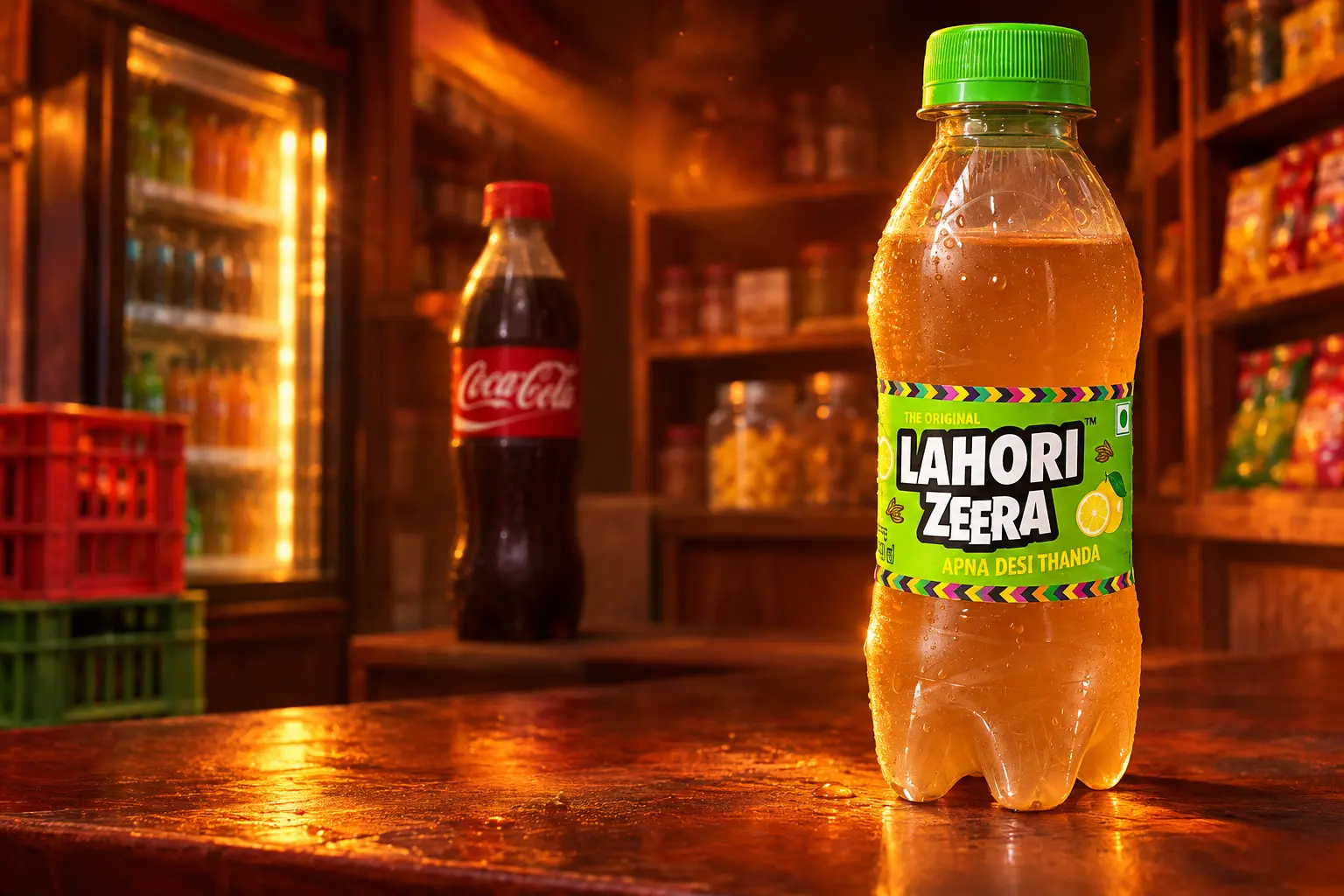
The Rs10 Bottle That Coke and Pepsi Had to Copy
Lahori Zeera, from Archian Foods, has sold at Rs10 since 2017. After a 2021 GST change, the firm kept the price and cut the pack from 200 ml to 160 ml, a fifth less drink in the same rupee. Co-founder and chief operating officer Nikhil Doda later said the whole industry now meets that entry price, and that the older brands matched it to hold share as costs climbed.
Coca-Cola and PepsiCo answered with new Rs10 packs on Coke, Thums Up, Sprite, Gatorade and Pepsi, down from Rs12 and above. Coca-Cola CEO Henrique Braun called rivals’ pricing an “irrational play.” A Coca-Cola bottler’s November 2026 filing said it would push Rs10 and Rs20 packs harder and had added 458 third-party sales reps just for cheap-pack outlets in the three months to June.
The arithmetic is ugly on purpose. Archian spent nothing on ads for its first seven years and still takes more than 95 percent of sales from general trade, the kirana network rather than mall coolers. At a Drinktec India panel in November 2026, co-founder and chief executive Saurabh Munjal said the firm reverse-engineered every cost around Rs10 instead of raising the sticker. Packaging is nearly 60 percent of making cost, so a jump in PET resin hits the bottle before it hits the shopper.
Doda said gross margins had already fallen 4-5 percent when West Asia disrupted raw materials, and that Archian would not pass the hit on.
We are taking a hit on margins but holding on to consumer prices.
Nikhil Doda, co-founder and COO, Archian Foods
One delivery platform recorded a 900 percent jump in online orders for these fizzy drinks in the 2026 summer, a spike off a small base that still tells you the flavour moved beyond Punjab. The same shopper who will pay Rs10 for cumin fizz will also mix it with vodka, or drink it while a friend smokes, which is a long way from the “healthier than cola” pitch on the label.
Campa Died in 2001 and Came Back Cheap
India has run this film before. Coca-Cola left in 1977 under an Indianisation drive. Pure Drinks, which had bottled Coke, launched Campa Cola the same year with the line “The Great Indian Taste.” Parle launched Thums Up. For a generation, cola in many towns meant those two names.
Coca-Cola came back on 24 October 1993 and bought Thums Up, Limca and Gold Spot, a deal its annual report called “instant ownership” of leading Indian soft-drink brands plus about 60 bottling plants. Thums Up then held around 85 percent of the cola market. Campa faded as Pepsi (from 1989) and Coke retook the cooler. Pure Drinks shut Delhi bottling around 2000-01. A 2019 comeback died for lack of money.
THE ROAD FROM STREET GLASS TO RS10 PET
- 1977: Coca-Cola exits; Pure Drinks launches Campa; Parle launches Thums Up, and Parle’s RimZim jeera soda is already a 1980s stall favourite.
- 24 October 1993: Coca-Cola returns and buys Parle’s big brands, including Thums Up, then adds RimZim in 1994.
- 2000-01: Campa’s Delhi plant and offices close; the name survives mainly as a trademark.
- 2017: Saurabh Munjal, Nikhil Doda and Saurabh Bhutna launch Lahori Zeera from a kitchen experiment in Punjab.
- 2022: Reliance buys the Campa trademark from Pure Drinks for about Rs22 crore, then takes a 50 percent stake in Gujarat’s Sosyo Hajoori in January 2023.
- 9 March 2023: Reliance Consumer Products relaunches Campa Cola, Campa Lemon and Campa Orange, later adding Campa Jeera and a Jeera Up line in Andhra Pradesh.
- January-September 2025: Smaller brands double share to about 15 percent; Coke and Pepsi fall to about 85 percent.
- 16 November 2026: Work begins on an about Rs1,600 crore Campa plant on 109 acres at Mulawad in Vijayapura, Karnataka.
Mukesh Ambani now calls Campa “India ka Thanda.” Reliance’s 49th annual-general-meeting transcript puts Campa at more than Rs4,700 crore in gross sales for FY26 and calls it India’s fourth-largest carbonated brand, with double-digit share in key markets. RCPL’s own FY26 gross revenue was Rs22,000 crore. On 30 October 2026 the wider drinks business did Rs5,250 crore in the first half of FY27, with Campa in front.
That is what a dead trademark looks like when it is plugged into Reliance Retail’s shops, IPL airtime, a Ram Charan face and vending rights on the Hyderabad Metro. Lahori Zeera still sells the cleaner origin story. Campa sells the crate.
Coca-Cola Already Owned a Jeera Drink
RimZim did not have to be invented for this boom. Parle built the jeera soda in the 1980s, Coca-Cola bought it in 1994 with Thums Up, and Atlanta relaunched it in 2018 with a spicier recipe that then went quiet. Northern bottlers are now running it hard at Rs10.
One leading bottler said monthly RimZim output at his plants had risen to nearly 4 million units, up 100 percent in two years, across more than 30,000 retail points in Delhi-NCR, Uttar Pradesh, Gujarat and Karnataka. “We are scaling our RimZim masala jeera soda offering to meet the rising consumer demand for traditional Indian homemade beverages,” he said. BBC-era reporting that Coca-Cola had doubled RimZim production fits that bottler math.
The rest of the aisle filled in behind them. House of Bindu has sold cumin soda for nearly 25 years; director Megha Shankar said it was flat until recently and is now the firm’s fastest-growing fizzy line, with its share of Bindu’s revenue up from 20 percent to 40 percent in five years, which is why a southern brand is finally leaving the south. Parle Agro took Dhishoom, a rural cumin soda since 2012, national in 2025. Dabur put Hajmola Zeera on the shelf, Bisleri put out Spyci Jeera, PepsiCo put jeera into Nimbooz, and Mumbai’s Xotik Frujus sells Jeeru.
THE JEERA SHELF NOW
- Lahori Zeera: Archian Foods, Punjab, 2017, still the volume proof that a branded 160 ml pack at Rs10 can sell out.
- Campa Jeera: Reliance, on a relaunched 1977 cola name, with Sosyo jeera and Jeera Up as extra SKUs in the same group.
- RimZim: Coca-Cola’s Parle-era jeera, relaunched in 2018, now doubled at the same Rs10 ticket.
- Bindu, Dhishoom, Jeeru: Older regional recipes that only started compounding once the category had a national price and a national argument.
- Hajmola, Spyci, Nimbooz Jeera: Legacy food and water brands using cumin to hold cooler space they once left to cola.
Munjal has said Indian consumer brands spent years either westernising Indian products or Indianising western ones. Lahori’s line is “apna desi thanda,” India’s own cold drink. Campa’s revival line is a cousin of the same thought. The irony is that the two loudest desi pitches now belong to a Punjab startup and to the conglomerate that already ran the last great price war in Indian telecom.
Why a Health Halo Does Not Cut the Sin Tax?
Analysts keep repeating that shoppers want drinks that feel more Indian and more healthy. Cumin is a kitchen spice. Jaljeera is a digestif. A sugar-free Bindu SKU and Archian’s own sugar-free line chase that halo. The tax system does not.
The GST Council’s 56th meeting on 3 September 2025 put aerated drinks with added sugar or flavour in the 40 percent demerit slab from 22 September 2025. Official FAQs said carbonated fruit drinks had carried GST plus compensation cess, and that the new rate exists to keep the tax burden unchanged after the cess ended. A jeera soda with sugar is still a sin good in the same bucket as cola. The halo is marketing. The invoice is 40 percent.
WHAT A RS10 BOTTLE HAS TO FUND
- The tax: Flavoured fizzy drinks sit at 40 percent GST, the demerit rate, so a large slice of the rupee never reaches the brand.
- The plastic: Packaging is nearly 60 percent of Archian’s making cost, which is why a PET spike shows up as a 4-5 percent gross-margin cut rather than a Rs12 sticker.
- The shop: General trade still needs a reason to open fridge space; Lahori’s early answer was a fat retailer cut and a pack that sold through, not a cricket ad.
- The size cut: Holding Rs10 after the 2021 tax change meant shrinking 200 ml to 160 ml, so “cheap” already bought less drink.
Reliance can blunt part of that stack. A related-party filing shows Reliance Industries will sell RCPL the resin-based materials used in packaging, which is another way of saying the Campa bottle’s main cost sits inside the same group that cracks the crude. Coca-Cola’s bottler is chasing a lighter PET that uses about a third less plastic than a standard 250 ml Indian bottle and a network of 572,973 branded coolers. Archian’s answer is to absorb the hit and wait for resin to crack, because Doda thinks current prices cannot last.
Even the desi claim has a bill. A brand that prints India’s-own-cold-drink on a name taken from Lahore has had to defend its Indian-ness in a way Coca-Cola never did. That row does not move a crate in Fatehgarh Sahib. It does show how much identity the Rs10 bottle is now being asked to carry.
Sold Out in 20 States and Still Outgunned
Archian is not a hobby. It closed FY26 at about Rs775 crore in net revenue, after FY25 revenue from operations of Rs540 crore, up 73 percent from Rs312 crore in FY24. Munjal told the Drinktec panel the company now makes more than 1.2 crore bottles a day and sells through more than 3,000 distributors in about 20 states. A year before June 2026, combined output was about 50 lakh bottles a day.
Belgian investor Verlinvest put in $15 million in 2021. Motilal Oswal later led a round of about $23.6 million for a 7.14 percent stake that valued the firm around Rs2,800 crore; Verlinvest held 19.64 percent and the founders 70.76 percent after that deal. Total money raised is about Rs375 crore. Doda says the model is now asset-light, with no fresh raise planned, growth coming from co-bottlers in Bengaluru, Patna, Agra, Muzaffarnagar and Bhopal beside owned plants in Lucknow, Mohali and Vapi. Lahori Zeera is still about 89 percent of sales; Nimboo is 4-5 percent. They want a second hero drink, and a UAE co-bottler to chase the diaspora, with some global presence targeted by 2028.
They are still not a national cola. Doda said in late 2025 the brand was missing only in the south and wanted 80-90 percent of pin codes the following year. India’s ready-to-drink habit is 15 to 20 litres a person a year against 100 to 120 litres in the United States, so the headroom is real. So is the gap on the balance sheet.
TWO INDIAN CHALLENGERS, VERY DIFFERENT WEIGHT
| Brand | FY26 sales | What the network looks like |
|---|---|---|
| Lahori Zeera (Archian Foods) | About Rs775 crore net | More than 1.2 crore bottles a day, 3,000-plus distributors, about 20 states, still thin in the south |
| Campa (Reliance Consumer Products) | More than Rs4,700 crore gross | Fourth-largest carbonated brand, group PET resin, IPL and metro rights, new Rs1,600 crore Karnataka plant |
| RimZim (Coca-Cola) | Not disclosed | One northern bottler at nearly 4 million units a month and 30,000 shops, plus the Coke cooler network |
Munjal still talks like a man whose problem is demand. He has said the plants sell out, that Indian flavours need a global spotlight, and that he wants the next generation on zeera rather than cola. India’s per-capita gap says he might get the volume. The share table says he already got the argument. The Campa plant in Vijayapura says someone else is pouring concrete around that argument.
For generations, we’ve grown up drinking colas of the world, but I hope the next generations will drink the zeeras of India.
Saurabh Munjal, co-founder and CEO, Archian Foods
On 16 November 2026, Karnataka industry minister M. B. Patil laid the foundation stone for that about Rs1,600 crore Campa unit on 109 acres at Mulawad, with 2,000 direct jobs promised. The cousins in Punjab proved a Rs10 cumin soda could move a crate. The plant is how a Rs22 crore trademark turns that proof into capacity the kirana cannot run out of.

India’s First-Timers and Pant Build a Record 720

Kutch Crash Kills Seven From Army Families After October Toll

Ukrainian Drones Leave Finland Fighting a Russian Ship Fire

ICJ Genocide Order Runs Through Arakan Army Land

CII Asks Patel Panel to Shift Who Funds Indian Credit

Clancy Juror Says the Holdout Never Cited Evidence

The iPhone 18 Pro Max Splits Apple’s Fall in Two

OpenAI Calls GPT-6 Astra AGI Then Locks Its Exploits

Trump Claims Hormuz Control as Oil Holds Near $96

Russia Closes the Goethe-Institut Berlin Tried to Save

 NEWS2 months ago
Clancy Juror Says the Holdout Never Cited Evidence
- NEWS3 months ago
The iPhone 18 Pro Max Splits Apple’s Fall in Two
- NEWS3 months ago
OpenAI Calls GPT-6 Astra AGI Then Locks Its Exploits
- BUSINESS3 months ago
Trump Claims Hormuz Control as Oil Holds Near $96
- LIFESTYLE3 months ago
Russia Closes the Goethe-Institut Berlin Tried to Save
- AUTO3 months ago
Volkswagen’s Job Cuts Leave Four Plants Without Cars
- NEWS3 months ago
Dyson Puts Nurovi Robots on Sale Without the UV Flagship
- BUSINESS3 months ago
US Destroys Five Iranian Tankers as the Shock Hits Jordan










