BUSINESS
Anthropic’s Record Debut Left Asia’s Chip Trade Reeling
Anthropic’s record IPO rose 17% as Asia’s chip stocks fell, with cash rotating out of TSMC, Samsung and SoftBank.

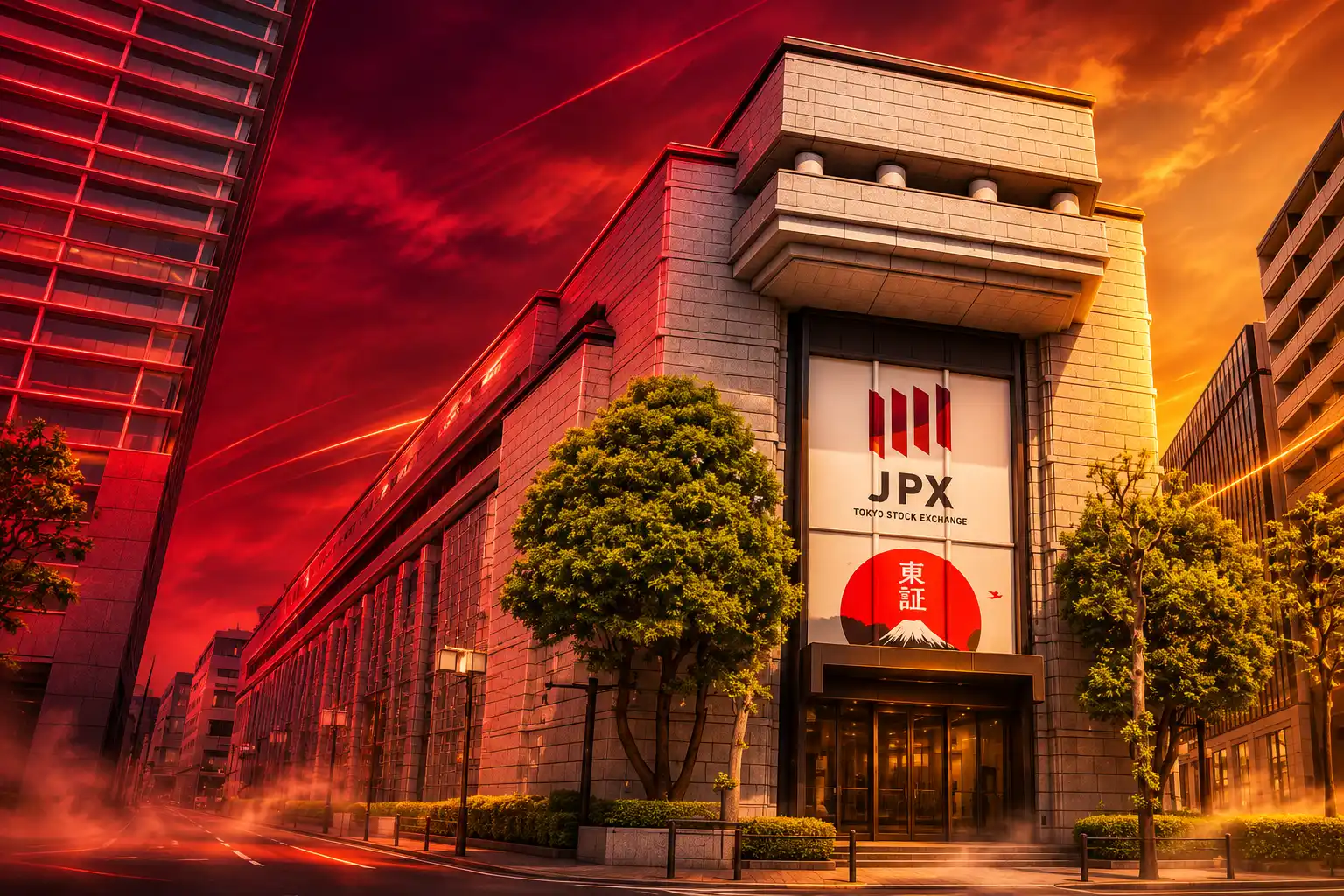
Taiwan’s Taiex sank more than 6.8% on Friday after Anthropic’s IPO closed 17% higher, and Asia’s chip-heavy bourses followed Wall Street lower.
South Korea’s Kospi dropped 5.7% and Tokyo’s Nikkei 225 lost as much as 4.9%. The five-year-old Claude maker had just raised $81.3 billion, the largest listing on record. The new stock took the cash. The chip plants took the hit.
The Tape in Taipei, Seoul and Tokyo
Friday’s selling sat on top of a brutal week in the indexes that actually make the chips. Taiwan had already cracked on Thursday, when the Taiex fell 4.4% to 38,426.89, a drop of 1,768.02 points and the seventh-largest closing point loss on record. Contract chipmaker Taiwan Semiconductor Manufacturing Co., more than 40% of local market value, lost 3.45% to NT$2,100. Turnover was NT$895.28 billion (US$27.15 billion).
Friday stretched that into a weekly loss of more than 17%, the worst week for the Taiex since 1990. TSMC fell another 5.2%. Foxconn dropped 5.4% and MediaTek slumped 9.95%.
FRIDAY’S ASIA TAPE
| Market | Friday move | What broke |
|---|---|---|
| Taiex | more than 6.8% | Weekly loss more than 17%, worst week since 1990 |
| Kospi | 5.7% | Samsung -7.1%, SK Hynix -6.6%; brief trading halt |
| Nikkei 225 | as much as 4.9% | SoftBank -14.6%, Kioxia -11.3%, Advantest -10.6% |
| Hang Seng | more than 2% | About 20% below the January 29 peak |
The MSCI Asia-Pacific index excluding Japan lost 3.2% on Friday and 8.3% for the week, its worst week since March 2020. Hong Kong’s Hang Seng slipped more than 2% and now sits about 20% below its January 29 peak. Australia’s S&P/ASX 200 was down about 1.5% to 1.6% in the same session.
Anthropic’s Record Listing Took the Cash
This was not a weak debut. Anthropic priced 980 million Class A shares at $83 on November 18, above a marketed range of $70 to $78, and raised $81.3 billion. That passed SpaceX, which raised $75 billion when it listed in June. Shares opened at $111.50, a 34% jump, briefly valued the firm near $2.01 trillion, and closed at $97.17. First-day volume was 846 million shares, above the 522 million SpaceX traded on its open.
THE ANTHROPIC OFFERING
- The raise: $81.3 billion at $83 a share, the largest IPO on record, after the book was lifted from 825 million shares.
- The close: $97.17, up 17% from the offer, for a fully diluted value of about $1.8 trillion after a $1.5 trillion IPO valuation.
- The side check: a concurrent $26 billion sale of non-voting Class N shares to Google, Nvidia, AMD, Broadcom, Micron, Microsoft and TSMC.
- The books: $33.24 billion of revenue in the nine months through September 30, against a prospectus stack of about $900.9 billion in committed compute and infrastructure spend.
Carlos Casanova, senior economist for Asia at Union Bancaire Privee in Hong Kong, said the listing did the opposite of what the hardware complex needed.
Rather than lifting the broader AI complex, the listing appears to have diverted liquidity from established AI plays as investors rotated into the new issue.
Carlos Casanova, senior economist for Asia, Union Bancaire Privee
Japanese research house Fisco told clients that some investors sold existing holdings to raise cash for Anthropic stock. That is a plumbing problem, not a confidence problem. A new name that opens 34% above offer soaks up orders that would otherwise sit in TSMC, SK Hynix, Samsung and SoftBank, and those four names are the indexes.
Why the Chip Factories Took the Hit
Asia’s main bourses are built around the plants that train other people’s models, so a rotation into Anthropic hits Seoul, Taipei and Tokyo directly, and the new U.S. compute rule lands on the data-center buyers those plants supply. TSMC fabricates the leading AI processors. SK Hynix and Samsung sell the high-bandwidth memory those processors eat. SoftBank is the listed proxy for a web of AI bets, and it fell 14.6%.
Thursday had looked like a rehearsal for the opposite trade. The Kospi closed up 1.4% at 5,137.89, with SK Hynix up 3.4% and Samsung up 1.1%. The Nikkei 225 gained 0.71% to 59,444.21, and SoftBank added 4.6%. Taipei never joined that bounce. By Friday morning the Kospi had broken the 5,000 line, and the Korea Exchange briefly halted trading as Samsung sank 7.1% and SK Hynix 6.6%.
Rajat Agarwal, an Asia equity strategist at Societe Generale, said AI-led growth is slowing and that the peak growth phase may have passed. He also pointed at a demand vacuum. Foreigners are not buying, he said, and it is an open question how long domestic money in Korea can stay put when the drawdown has been more severe there than elsewhere.
Early in the Seoul session, foreigners were net sellers of 413 billion won and institutions of 325.2 billion won. Individuals bought 674.1 billion won on their own. That is the split Agarwal is watching: the local buyer as the last bid in a market that foreigners have already left.
Washington Shut the Third-Country Compute Door
The other bid those factories needed was in Southeast Asian data centers that rent American chips to Chinese model builders over the wire. The Commerce Department’s Bureau of Industry and Security published an interim final rule on remote access that took effect on November 19, the same day Anthropic listed.
BIS said the rule is meant to stop existing chip limits from being circumvented through remote computing arrangements involving data centers in third countries. Treasury and the National Security Council directed the text. The practical target is a Malaysian or Thai hall full of legal Nvidia iron that sells training time to a Beijing-headquartered lab without a crate ever entering China.
WHAT THE RULE CHANGES
- End-use license: A license is required for advanced computing items headed to a data center, anywhere, that will supply more than 12,000,000 aggregate TPP to firms headquartered in Macau or Country Group D:5, which includes China.
- Five extra countries: Destination licensing now covers Indonesia, Malaysia, Singapore, Thailand and Brazil, which BIS calls higher-risk diversion routes.
- Linked halls: Digitally linked sites count as one, so splitting a training run across borders does not dodge the threshold.
- Savings clause: Shipments already on a carrier on November 19 may finish under the old rules if they complete within 30 days.
That is a direct hit to the order book TSMC, SK Hynix and Samsung have been selling into. House lawmakers also said the administration had approved shipments of nearly 900,000 advanced Nvidia and AMD AI chips to Chinese companies between December 2025 and May 2026. The new rule tries to close the remote door after that physical wave.
Huang Is Out and the Subpoena Landed
The hardware complex was already carrying Nvidia’s own crisis into Anthropic’s open. Nvidia’s board accepted Jensen Huang’s resignation on November 11 and announced the next day that he had resigned as president and chief executive and left the board, ending a 33-year run. Colette Kress, the finance chief since 2013, is interim CEO. Harvey C. Jones became the first chair of the board.
THE WEEK AROUND THE BELL
- November 12: Nvidia announces Huang’s resignation and names Kress interim chief executive.
- November 16: BIS releases the remote-access rule, later published and effective November 19.
- November 17: Nvidia reports third-quarter results under Kress; Jones says the board does not intend to bring Huang back and will not take questions on the resignation.
- November 19: Anthropic lists as ANT; California’s attorney general serves Nvidia; the remote-access rule takes effect.
- November 20: Asia’s chip indexes sell off. Huang is due before congressional committees on December 1, with general counsel Tim Teter on December 2.
On Thursday, California Attorney General Rob Bonta served an investigative subpoena on Nvidia over Huang’s affair with an alleged Chinese spy and over whether advanced chips or confidential information reached China. Nvidia shares lost 3.3% after an early gain of 4.7%. The Nasdaq Composite closed down 2.3% and the S&P 500 down 2%.
The conduct of Nvidia and its former CEO raises bright red flags, including about the ways in which the company may have misled investors. My office is investigating whether Nvidia or Jensen Huang’s actions resulted in China obtaining advanced chips or confidential information, and if Nvidia misled investors and the public about this risk, in violation of the law.
Rob Bonta, Attorney General of California, November 19 statement
U.S. officials have tied the alleged relationship to Alice Huang, a former executive at Singapore-based Megaspeed, which is under investigation over possible diversion of restricted chips. She is not related to Jensen Huang. China has rejected the espionage claim, and the Justice Department has said it has not reached a conclusion on whether she was a spy. Nvidia did not immediately comment on the subpoena.
Gartner Still Counts $2.7 Trillion of AI Spend
The spend forecasts that built these valuations have not been withdrawn. In its September 16 outlook, Gartner put worldwide AI spending of $2.7 trillion in 2026, up 49.5% from 2025, and $3.6 trillion in 2027. AI infrastructure, the slice that pays TSMC, Hynix and Samsung, is $1.48 trillion of the 2026 total.
GARTNER’S AI SPEND TABLE
| Slice | 2025 | 2026 | 2027 |
|---|---|---|---|
| Total AI spending | $1.79 trillion | $2.7 trillion | $3.6 trillion |
| AI infrastructure | $0.98 trillion | $1.48 trillion | $1.98 trillion |
John-David Lovelock, a distinguished vice president analyst at Gartner, said demand for that infrastructure remains strong and inelastic even as memory prices rise, and called the data-center buildout “the largest infrastructure project humanity has even undertaken.” Friday’s tape was not a forecast revision. It was a price on who collects the spend, and on whether a lab with $33.24 billion of nine-month sales and about $900.9 billion of compute bills can keep a $1.8 trillion multiple while the foundry that will ship the silicon is sold.
Kevin J. Koharki, an associate professor of accounting at Purdue University, said the AI book still carries a lot of uncertainty and a business model that looks shaky on pricing power. If that power is weaker than buyers think, he said, the valuation will rerate lower.
SoftBank’s 14.6% drop is the blunt version of that rerating. The same session that gave Anthropic a ticker took a double-digit bite out of the listed vehicle most exposed to the last round of AI private deals. TSMC sat on both sides at once: a buyer in the $26 billion Class N placement, and a stock that fell 5.2% in Taipei while the lab it helps supply became a public mega-cap in New York.
The Anthropic offering was scheduled to close on November 20, the same day Asia’s chip indexes printed those losses. Huang appears before Congress on December 1.
Disclaimer: This article is news reporting and analysis of market moves, company filings and official statements. It is for information only and is not investment advice, a recommendation to buy or sell any security, or a forecast of future prices. Readers should consult a licensed financial adviser or broker who can review their own holdings and risk limits before acting on any figure or event described here. Index levels, stock prices, offering terms and legal statuses reflect the cited statements and market prints and can change as sessions close and investigations proceed.

India’s First-Timers and Pant Build a Record 720

Kutch Crash Kills Seven From Army Families After October Toll

Ukrainian Drones Leave Finland Fighting a Russian Ship Fire

ICJ Genocide Order Runs Through Arakan Army Land

CII Asks Patel Panel to Shift Who Funds Indian Credit

Clancy Juror Says the Holdout Never Cited Evidence

The iPhone 18 Pro Max Splits Apple’s Fall in Two

OpenAI Calls GPT-6 Astra AGI Then Locks Its Exploits

Trump Claims Hormuz Control as Oil Holds Near $96

Russia Closes the Goethe-Institut Berlin Tried to Save

 NEWS2 months ago
Clancy Juror Says the Holdout Never Cited Evidence
- NEWS3 months ago
The iPhone 18 Pro Max Splits Apple’s Fall in Two
- NEWS3 months ago
OpenAI Calls GPT-6 Astra AGI Then Locks Its Exploits
- BUSINESS3 months ago
Trump Claims Hormuz Control as Oil Holds Near $96
- LIFESTYLE3 months ago
Russia Closes the Goethe-Institut Berlin Tried to Save
- AUTO3 months ago
Volkswagen’s Job Cuts Leave Four Plants Without Cars
- NEWS3 months ago
Dyson Puts Nurovi Robots on Sale Without the UV Flagship
- BUSINESS3 months ago
US Destroys Five Iranian Tankers as the Shock Hits Jordan