NEWS
Fujifilm Bets Wildlife Shooters on a 1,245-Gram 400mm
Fujifilm’s new XF 400mm F4.5 weighs 1,245 grams, lists at $3,199.95, and undercuts the 500mm as the handheld 609mm-equivalent prime.

Fujifilm priced the XF 400mm F4.5 R LM OIS WR at $3,199.95 on September 4, 2026, a 400mm prime that the company rates at 609mm in 35mm terms and 1,245 grams without cap or hood. U.S. shipments are due in mid-September 2026, with a Canadian list of $3,899.99.
The bet is specific. Fujifilm skipped an f/2.8 halo and built a carryable f/4.5 that sits $200 above the XF 500mm F5.6’s original $2,999.95 launch price and well under that lens’s current $3,599 retail after tariffs.
A 609mm Equivalent That Weighs 1,245 Grams
Fujifilm Corporation, led by President and CEO Teiichi Goto, called the XF400mmF4.5 a 1,245g super-telephoto prime lens with the highest optical performance in the XF lineup. The 35mm equivalent is 609mm, and the aperture runs from f/4.5 to f/22.
The optical formula uses 21 elements in 14 groups, including 2 Super ED and 4 ED pieces, plus a rounded 9-blade diaphragm. Fujifilm says that mix is there to hold chromatic aberration, the usual tax on long glass, while the 1.5x APS-C crop is what turns 400mm into the 609mm field of view.
THE HANDHELD NUMBERS
- Weight: 1,245 grams, or 2.74 pounds, excluding the cap and hood.
- Stabilization: Up to 5.5 stops of optical correction, CIPA rated for pitch and yaw.
- Size: 104.5 mm across and 239.5 mm long, with a 95mm front filter.
- Close focus: 2.75 meters, with a maximum magnification of 0.16x and a 4.1° angle of view.
Victor Ha, vice president and general manager of Fujifilm North America’s Electronic Imaging Division, put the design in those terms on the launch call for the United States.
When you’re making images outdoors, reach matters. You need a lens that gets you close to the action without disturbing the scene or wearing you down over a long day. XF400mm lets photographers stay mobile and react to what’s in front of them, and they don’t have to trade image quality to do it. With super telephoto lenses, the balance of size and performance is the creative advantage, and XF400mm is exactly that. Lightweight, compact, powerful.
Victor Ha, vice president and general manager, Electronic Imaging Division, FUJIFILM North America
The North America statement also says the optical layout pulls the center of gravity toward the camera body, a direct answer to the front-heavy feel that makes a long prime miserable after an hour in a hide.
199.95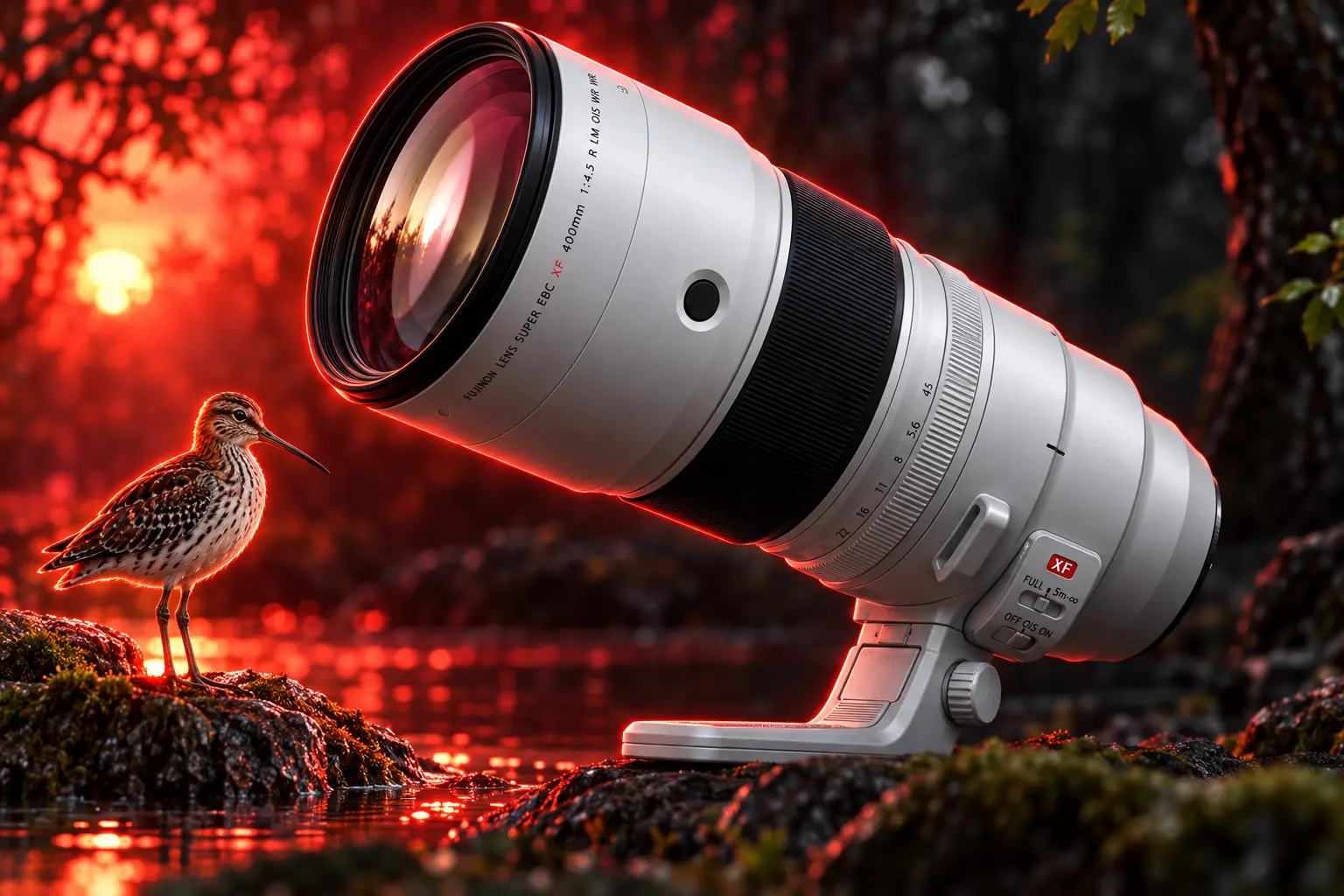
The 400mm Undercuts Fujifilm’s Own 500mm
The 400mm is not a lonely flagship. It shares the same 104.5 mm barrel diameter and 95mm filter as the XF 500mm F5.6 R LM OIS WR, the 1,335g 500mm super-telephoto prime Fujifilm announced on October 14, 2024 at $2,999.95. The 400mm is 90 grams lighter and 16 mm shorter than that 255.5 mm lens.
Briefings from Fujifilm’s Japan engineering team described the 400mm as a near copy of the 500mm’s 21-element, 14-group layout, with a changed rear group, and they called the new lens the sharper of the two. The 500mm uses 5 ED elements plus 2 Super ED; the 400mm uses 4 ED plus 2 Super ED. Current U.S. retail on the 500mm is $3,599, a tariff-era jump that now makes the newer, faster 400mm the cheaper prime on the shelf.
THE X-MOUNT SUPER-TELEPHOTO SHEET
| Lens | 35mm equivalent | Max aperture | Weight | List price |
|---|---|---|---|---|
| XF 400mm F4.5 | 609mm | f/4.5 | 1,245g | $3,199.95 |
| XF 500mm F5.6 | 762mm | f/5.6 | 1,335g | $2,999.95 launch |
| XF 150-600mm | 229-914mm | f/5.6-8 | 1,605g | $1,999.95 |
| XF 200mm F2 | 305mm | f/2 | 2,265g | $5,999 |
The zoom still wins on flexibility and on the sticker. At $1,999.95 and 1,605 grams, the XF 150-600mm F5.6-8 remains the cheaper way to cover birds and sidelines, and it reaches a 914mm equivalent at the long end. What it cannot match is the 400mm’s f/4.5 and the 360 grams it sheds against that zoom. The older XF 100-400mm F4.5-5.6, at 1,375 grams, is already heavier than the new prime while ending at the same 609mm equivalent and a slower f/5.6.
So the 400mm is the lens that makes the 150-600mm look like a compromise on speed, and it makes the 500mm look expensive after tariffs unless a shooter truly needs 762mm in one piece of glass. The 200mm F2, at 2,265 grams and $5,999, stays the low-light specialist in a different weight class.
What the Teleconverters Do to 400mm
Fujifilm is selling the 400mm as a complete 609mm-equivalent tool, then offering two official extenders for days when that is not enough. Both converters are sold separately, and both keep weather sealing in the system.
TELECONVERTER REACH
- XF1.4X TC WR: 560mm on the barrel, 853mm in 35mm terms, with one stop of light lost to f/6.3.
- XF2X TC WR: 800mm on the barrel, 1,219mm in 35mm terms, with two stops lost to f/9.
- The field math: That 1.4x pairing is the birding length most X-mount shooters have been cobbling together with zooms.
A hands-on tester working golden hour with the 1.4x converter on an X-H2S kept ISO around 400 and still held 1/2000 second, which is the shutter speed wildlife work actually uses. The 2x path exists for aircraft and distant field sports, but f/9 is a dimmer, slower lens, and autofocus has less light to chew on.
Birds of Prey Were the First Test
Fujifilm’s own sample set was shot on the X-H2S and X-H2, the two bodies that already do the system’s fastest work. Yun Zhong in China logged 400mm, f/4.5, 1/2000 second, ISO 640 on an X-H2S. Madeline Penfold in the United Kingdom logged 400mm, f/4.5, 1/2500 second, ISO 640 on an X-H2. Those are daylight action settings, not studio charts.
Giacomo de Franchis, an Italian wildlife photographer Fujifilm put on the product page, treated the lens as a kit staple after those sessions.
Compact, lightweight, and remarkably sharp, the XF400mmF4.5 has quickly become an essential part of my wildlife kit. It offers the ideal balance of reach, portability, and performance, giving me the flexibility to capture everything from environmental wildlife portraits to distant subjects with confidence.
Giacomo de Franchis, wildlife photographer, Italy
Independent hands-on time with birds of prey on an X-H2S told a more mixed story about the body behind the glass. One tester, after hunting for the right autofocus settings, got plenty of sharp frames and said the lens had no trouble holding the X-H2S at 15 frames per second. Another left the same pairing still wanting better tracking from the camera. That split is the leftover risk in Fujifilm’s bet: the 400mm is light enough to handhold, and the remaining argument is whether current X bodies can stay glued to a falcon that jinks.
B&H posted a first-look video with the listing, a walk around the barrel rather than a lab test.
Sarah Dotson, a U.S. motorsport shooter on Fujifilm’s page, said the same compact size let her move from cars in motion to tight mechanical detail without changing lenses. Japanese users looking at the motorsport claim were blunter: the glass can be built for that work, and the camera still has to prove it.
Three Primes Now Cover 305mm to 762mm
Fujifilm’s North America statement is explicit. With the 400mm in the catalog, FUJINON X-mount super-telephoto primes now cover 35mm equivalents from 305mm to about 762mm. That is the XF 200mm F2 at 305mm, this 609mm full-frame equivalent lens, and the XF 500mm F5.6 at 762mm. The global product page stretches the language to “approximately 300mm through 800mm,” which is the same trio counted with more round numbers.
THE PRIME TIMELINE
- July 20, 2018: Fujifilm announces the XF 200mm F2 R LM OIS WR, a 2,265g f/2 prime at 305mm equivalent, later sold in a $5,999 kit with its own 1.4x converter.
- October 14, 2024: The XF 500mm F5.6 arrives as the longest current XF prime, 1,335g, 762mm equivalent, $2,999.95 at launch.
- September 4, 2026: The XF 400mm F4.5 fills the gap at 609mm equivalent, 1,245g, $3,199.95.
The set is the argument for staying on APS-C. A full-frame 600mm f/4 still gathers more light, and it still weighs more than twice this 400mm. Fujifilm is selling the idea that 609mm at f/4.5 in a 2.74-pound tube is the version a person will actually walk with. The 150-600mm zoom remains the cheaper, slower alternative for people who will not spend $3,199.95 on a prime that does not zoom.
July chatter around a rumored 400mm had already split along those lines. Some wanted the f/2.8 halo that holds value on the used market. Others wanted a slower lens that ordinary buyers could pay for. Fujifilm built the f/4.5 in the middle and left the f/2.8 on the table.
The Barrel Packs 20 Weather Seals
The handling kit is borrowed from the 500mm playbook and aimed at people who already know how a long prime should work in the field. A linear motor drives an internal focus group, which Fujifilm calls fast and near silent. A limiter switch restricts focus to subjects farther than 5 meters, or 15 feet, so the lens spends less time hunting through grass in the foreground.
BARREL CONTROLS
- Focus preset: A SET button stores a distance, then a Focus Control button on the front of the barrel recalls it.
- Focus Select switch: The same button can be set to AF-L, PRESET, or AF, so a thumb can lock, jump, or start focus without leaving the barrel.
- Weather kit: 20 sealed points, operation down to 14°F (-10°C), and a fluorine coat on the front element.
- Support: A tripod collar with an Arca-type foot, plus compatibility with the 1.4x and 2x converters at the rear.
Those 20 seals and the fluorine coat are the difference between a showroom prime and a lens that stays on in rain. Early testers who took birds of prey up in wet weather kept shooting; the birds were less willing than the barrel. B&H’s listing also flags the collar as Arca-type, which means it drops on a standard plate without a spare adapter in the bag.
B&H Lists a September 14 Ship Date
Fujifilm North America set U.S. availability for mid-September 2026 at $3,199.95. B&H opened preorders on the announcement at that price, with an estimated ship date of Monday, September 14, and no store display copy. Fujifilm Japan listed Friday, September 18, 2026 as the domestic sale date, and Japanese shops began taking reservations the same morning as the global reveal.
The retailer that packaged the U.S. first look posted the lens as a stills and video prime the hour it went live.
https://x.com/bhphoto/status/2095738636209721423
No new X-T body arrived with the glass. The 400mm is shipping into the cameras Fujifilm already sells, which is why the X-H2S kept showing up in every first test. If the bet pays, it will be because bird and sideline shooters decide 1,245 grams at 609mm equivalent is enough reach to stop shopping for a full-frame 600mm. If it stalls, it will be because $3,199.95 still buys a lot of zoom, and because the camera behind the lens still has to track the thing that just left the frame.

Police Tighten the Ring Around Gyanesh Kumar’s House

Ravi Shankar Calls Hanuman Ansh a Slap to Big Spenders

Microsoft Puts Nvidia in the Surface Laptop Ultra Flagship

Adult Fires on an Armed Juvenile at Longmont Dollar Tree

Jordan Absorbs Iranian Missiles Aimed at Parked US Jets

The iPhone 18 Pro Max Splits Apple’s Fall in Two

OpenAI Calls GPT-6 Astra AGI Then Locks Its Exploits

Clancy Juror Says the Holdout Never Cited Evidence

Russia Closes the Goethe-Institut Berlin Tried to Save

Trump Claims Hormuz Control as Oil Holds Near $96

 NEWS2 months ago
The iPhone 18 Pro Max Splits Apple’s Fall in Two
- NEWS2 months ago
OpenAI Calls GPT-6 Astra AGI Then Locks Its Exploits
- NEWS1 month ago
Clancy Juror Says the Holdout Never Cited Evidence
- LIFESTYLE2 months ago
Russia Closes the Goethe-Institut Berlin Tried to Save
- BUSINESS2 months ago
Trump Claims Hormuz Control as Oil Holds Near $96
- AUTO2 months ago
Volkswagen’s Job Cuts Leave Four Plants Without Cars
- NEWS2 months ago
Dyson Puts Nurovi Robots on Sale Without the UV Flagship
- NEWS2 months ago
The Lincoln’s 286-Day War Cruise Ends at a Thai Pier