LIFESTYLE
Russia Closes the Goethe-Institut Berlin Tried to Save
Lavrov ordered Goethe-Institut centres shut, ending a language network Berlin had cut to 15 staff and had warned was the price of closing the Russian House.

Foreign Minister Sergey Lavrov said on 3 September that Russia will close Germany’s Goethe-Institut centres, ending a presence that opened in Moscow in 1992. He spoke in Vladivostok after Germany blamed Moscow for an explosive drone at Leipzig/Halle Airport and moved to shut the Russian House in Berlin.
The order finishes a language network Berlin had already cut to 15 staff. German diplomats had flagged that price in August if they closed the Russian House.
Lavrov Turns Classrooms Into Hostages
Lavrov spoke at the Eastern Economic Forum, on a session billed as diplomacy of truth. He said Germany had Goethe-Institut branches in Moscow, St Petersburg and Yekaterinburg, and that they would go once Berlin expelled Russia’s cultural centre.
Of course they will be closed after our cultural centre was expelled from there. Otherwise we would not respect ourselves.
Sergey Lavrov, foreign minister of Russia, Eastern Economic Forum, Vladivostok
He added that Germany had taken the step on purpose, and that it meant the end of a German cultural presence that had remained, in his words, despite all the Ukrainian complications in relations with the West. He said Berlin would then have no remaining direct way to work with the Russian public.
The city list was already wrong. The institute’s own Russia pages still name Moscow, St Petersburg and Novosibirsk, not Yekaterinburg. That slip is of a piece with the rest of the file: Moscow is closing a German network it has barely bothered to describe with care, while the people inside it were still running exams and teacher courses in August.
German voices that have spent four years calling the institutes a leftover of peacetime policy now have their wish, at least on paper. The bill does not land on the foreign ministry podium. It lands on the exam halls and the Deutsch teachers who were still using the husk.
The 2011 Treaties Made the Swap Automatic
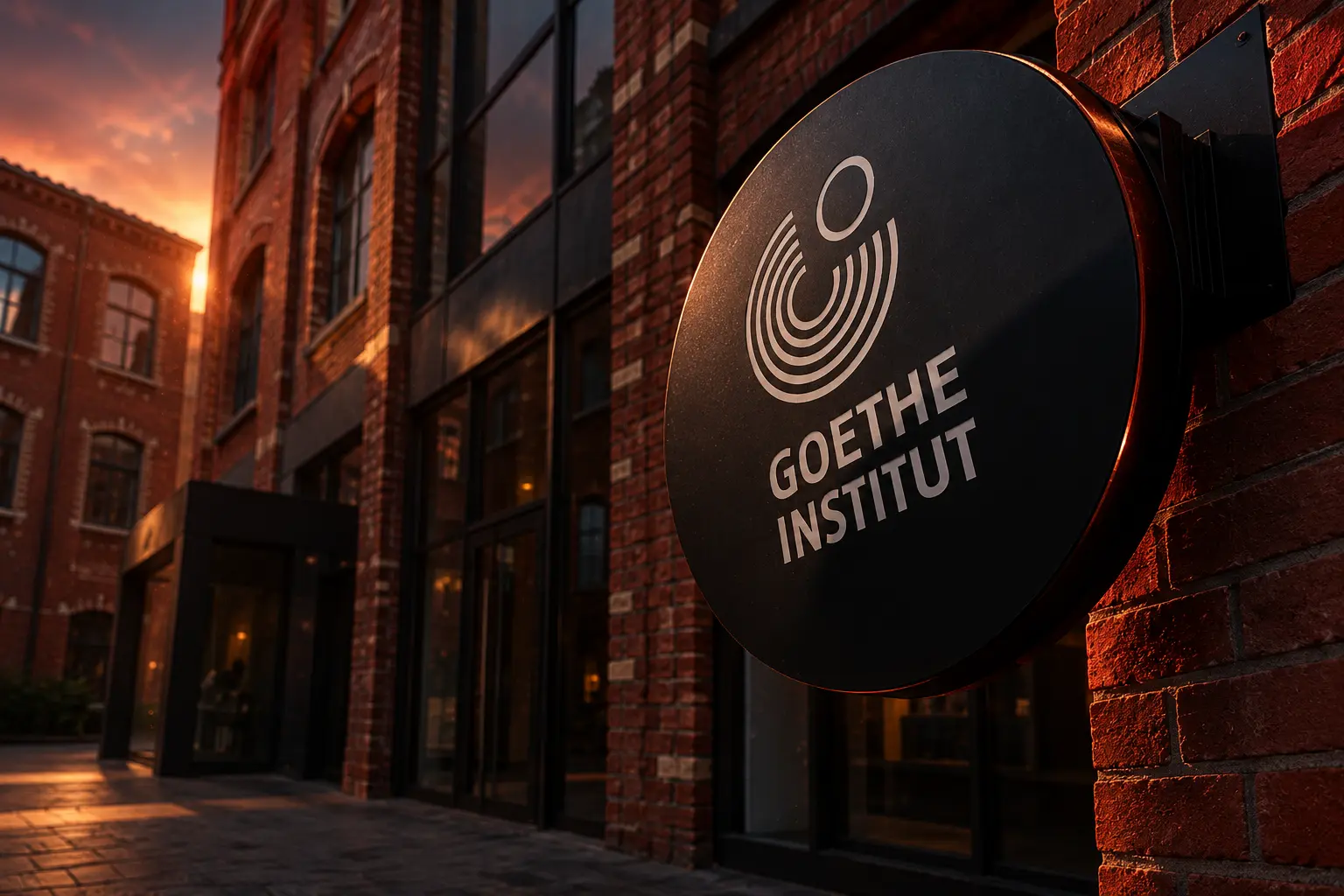
Two weeks before the Leipzig accusation became a public package, the German foreign office was still explaining why it did not want to kill the Russian House. The House on Friedrichstrasse and the Goethe-Institut in Moscow are tied by two state agreements, from 2011 and 2013. Germany hosts the House; Russia hosts the German cultural institute. Close one, and the other is designed to go.
Rossotrudnichestvo, the Russian government agency that runs the House, has been under European Union sanctions for four years. Assets are frozen, and Berlin says full operations are not taking place. Even so, the foreign office told interviewers in mid-August that ending the contract would take at least a year, and that the building would stay in Russian hands for the rest of the century. It also said the Goethe sites in Moscow and St Petersburg still offered, in reduced form, direct contact with Russian civil society, and were among the few rooms left for people still attached to Germany and to the rule of law.
On 1 September that caution died. Foreign Minister Johann Wadephul, standing with Interior Minister Alexander Dobrindt, said Russia’s leadership had chosen to damage an already strained relationship with the Leipzig attempt, and he listed the answers. The lease for the Russian House would be terminated. The consulate general in Bonn would go. Lavrov’s reply on 3 September did what those 2011 and 2013 papers implied, and what Berlin had spent August saying it wanted to avoid.
How Many Students Lose Their Exam Centres?
The Goethe-Institut opened its first Moscow centre on 8 October 1992. St Petersburg followed, then Novosibirsk in 2009. By June 2026 the public pages still described three institutes plus four cultural societies, eight contact offices, sixteen reading rooms, eighteen language and exam centres, and sixty teaching-material points. That map is the part of the story the retaliation talk skips.
The staff map is smaller. Until 2023 the institute employed about 200 people in Russia. After Moscow capped all official German personnel at 350, from about 700, covering the embassy, consulates, two German schools and the institutes, Goethe’s own count fell to 15, including two posted from Germany. Novosibirsk stopped being a full institute. Since June 2023 it has run the Novosibirsk site as a contact office, with one staffer on the ground and online courses for Siberia and the Far East.
Moscow left the old East German embassy block at the end of 2022, after the building could no longer be used, and moved into the Bolshevik cultural and business complex on the site of a former confectionery plant. Libraries in Moscow and St Petersburg stayed open in reduced form. Public festivals, live music and exhibitions in public rooms did not. The institute said it worked with individuals, not Russian state bodies.
THE NETWORK STILL RUNNING IN AUGUST
| Function | Figure given by the Goethe-Institut |
|---|---|
| Staff in Russia | 15, including 2 posted from Germany |
| Annual exams at partner centres | 22,000 (almost 10,000 in Moscow, 3,000 in St Petersburg) |
| People in the course network each year | about 10,000 adults, youths and children |
| People using teacher-support offerings | 14,000 |
| Scholarship groups sent to Germany, summer 2026 | 2 |
Those exam numbers are why a closure of 15 posts is not an empty gesture. Goethe said its remaining job was to keep partner test centres at standard and to train Deutsch teachers under hard conditions. For some of those teachers, the institute’s help was the reason they still taught German at all.
An Explosive Drone on the Leipzig Apron
The trigger sat on the cargo apron at Leipzig/Halle on the evening of 4 August. A drone carrying explosives and a detonator that failed was found in the security zone between Ukrainian cargo aircraft, including an Antonov An-124. Flights stopped. A second unidentified object then hit a DHL cargo jet that had to abandon its landing; that aircraft reached Hanover with light damage. The federal prosecutor took the case.
On 1 September, 28 days later, Dobrindt said police work, the pattern of the offence and intelligence findings together established Russian responsibility. He described the build as professional, and the people who carried it out as low-level agents. He said Germany is not at war, and is still a daily target of hybrid attacks. President Vladimir Putin, the same day, accused Germany of planting evidence to pin the incident on Moscow.
Wadephul, in consultation with the chancellor, then ordered the Bonn consulate closed as of 18 September and terminated the Russian House lease. He also proposed new European Union listings of Russians tied to hybrid attacks, tighter checks on Russians entering Germany, more pressure on Russia’s shadow fleet, and further intelligence steps. The Russian ambassador was summoned while he spoke.
WHAT BERLIN ORDERED ON 1 SEPTEMBER
- Bonn post: The consulate general closes as of 18 September, cutting a mission whose district covers Bavaria, Baden-Württemberg, Hessen, North Rhine-Westphalia, Rhineland-Palatinate and Saarland.
- Russian House: The Berlin lease is terminated, the step the 2011 and 2013 papers had treated as a partner to Goethe’s stay in Moscow.
- Lists and borders: Germany will seek new EU listings over hybrid attacks and will tighten immigration controls for Russian nationals.
- Fleet and spies: Pressure on the shadow fleet rises, and the government said it will take further measures in the intelligence sector.
EU foreign policy chief Kaja Kallas, meeting colleagues in Ireland, called the Leipzig case an act with the hallmarks of state-sponsored terrorism and said ministers were still working on listings covering 1,600 people and entities tied to Russia’s military industry. French Foreign Minister Jean-Noël Barrot said such an act would not go unpunished, and that Paris had called in Russia’s envoy.
Germany remains secure, and Germany is defending itself against opponents who seek to spread insecurity.
Johann Wadephul, federal foreign minister, joint press conference with Alexander Dobrindt, 1 September 2026
Russia Used This Script on Britain in 2018
The British Council, which had worked in Moscow since 1959, was told to stop after the Salisbury poisoning dispute. It suspended operations in March 2018 on a 17 March instruction from the Russian foreign ministry, 59 years after that Moscow presence began. The council said that when political ties sour, cultural work and study chances are what keep a dialogue going between people and institutions.
FROM THE FIRST MOSCOW OFFICE TO LAVROV’S ORDER
- 8 October 1992: The first Goethe-Institut in Russia opens in Moscow.
- 2009: A full institute opens in Novosibirsk.
- 2011 and 2013: Berlin and Moscow sign the paired agreements that bind the Russian House to German cultural work in Russia.
- 17 March 2018: Russia instructs the British Council to cease, after Salisbury.
- April 2023: Germany declares 40 Russian sham diplomats unwelcome; 34 more are asked to leave, 74 in all.
- 1 June 2023: Russia’s cap of 350 official German staff takes effect; Novosibirsk becomes a contact office the same month.
- 4 August 2026: The explosive drone is found at Leipzig/Halle.
- 1 September 2026: Berlin names Russia, ends the Russian House lease and sets 18 September for Bonn.
- 3 September 2026: Lavrov says the Goethe centres will close.
Deputy Foreign Minister Alexander Grushko had already said on 2 September that Russia would answer the Bonn closure very soon. The Goethe order is the cultural half of that answer. The consular half is still unstated.
For Some Teachers, Goethe Was the Reason to Stay
Interest in German, the institute said in August, was still very high. About 10,000 people a year were in the course network. Partner centres delivered 22,000 exams, almost 10,000 of them in Moscow and 3,000 in St Petersburg, leaving about 9,000 in the rest of the country. Fourteen thousand people used the teacher-support side. Two groups of scholarship holders still made it to Germany in the summer.
That is the layer a 2022 walk-out would have dropped on the floor, and it is the layer a 2026 shutdown now puts at risk. Partner schools may keep testing if Moscow allows it. They will do so without the quality watch Goethe described as its last real task, and without the training that some teachers called the difference between staying with German and giving it up.
Lavrov’s Yekaterinburg line makes the same point from the other side. The third German site that still had a door, even as a contact office, was Novosibirsk. If the foreign minister closing the network cannot name it, the classrooms had already become invisible in the dispute that will now erase them.
Bonn’s Consulate Goes Dark on 18 September
The Bonn post is a date, not a metaphor. Wadephul set 18 September. Grushko promised a further reply for that closure. The Goethe order has no public date for padlocks on the Moscow or St Petersburg doors, and no word on whether the 18 exam partners keep their licences once the German quality watchers are gone.
WHAT WE KNOW
- The order: Lavrov said the Goethe centres will close after the Russian House was expelled, and named Moscow, St Petersburg and Yekaterinburg.
- The German package: Bonn closes as of 18 September, the Russian House lease is terminated, and the ambassador has been summoned.
- The remaining work: In August the institute still reported 15 staff, 22,000 annual exams and about 10,000 course learners.
WHAT IS UNCONFIRMED
- The doors: No public date has been given for when Moscow and St Petersburg actually shut, or what happens to the Novosibirsk contact office.
- The exams: It is not confirmed whether partner test centres can keep running 22,000 sittings without Goethe supervision.
- The next hit: Grushko’s reply for Bonn has not been spelled out, and Putin’s planted-evidence claim has not been matched to a published German forensic file.
On 18 September the Bonn consulate is due to go dark. The language network Lavrov said he would close is the piece that outlasted the war, the staff cap and the frozen accounts, and it is the piece Berlin spent August saying it still needed.

Police Tighten the Ring Around Gyanesh Kumar’s House

Ravi Shankar Calls Hanuman Ansh a Slap to Big Spenders

Microsoft Puts Nvidia in the Surface Laptop Ultra Flagship

Adult Fires on an Armed Juvenile at Longmont Dollar Tree

Jordan Absorbs Iranian Missiles Aimed at Parked US Jets

The iPhone 18 Pro Max Splits Apple’s Fall in Two

OpenAI Calls GPT-6 Astra AGI Then Locks Its Exploits

Clancy Juror Says the Holdout Never Cited Evidence

Russia Closes the Goethe-Institut Berlin Tried to Save

Trump Claims Hormuz Control as Oil Holds Near $96

 NEWS2 months ago
The iPhone 18 Pro Max Splits Apple’s Fall in Two
- NEWS2 months ago
OpenAI Calls GPT-6 Astra AGI Then Locks Its Exploits
- NEWS1 month ago
Clancy Juror Says the Holdout Never Cited Evidence
- BUSINESS2 months ago
Trump Claims Hormuz Control as Oil Holds Near $96
- AUTO2 months ago
Volkswagen’s Job Cuts Leave Four Plants Without Cars
- NEWS2 months ago
Dyson Puts Nurovi Robots on Sale Without the UV Flagship
- NEWS2 months ago
The Lincoln’s 286-Day War Cruise Ends at a Thai Pier
- BUSINESS2 months ago
Cable Stocks Fall as UltraTech Copies the Paints Playbook