
NEWS
Last Mammoths Were Not Doomed by Inbreeding After All
A 2024 Cell study of 21 genomes shows Wrangel Island woolly mammoths recovered from a bottleneck of eight and stayed stable until a sudden event, not genetics.

A 2024 analysis of ancient DNA shows the last woolly mammoths on Wrangel Island carried clear scars of inbreeding yet stayed demographically stable for roughly 6,000 years after the Ice Age. The finding overturns the long-held view that genetic decline alone sealed their fate around 4,000 years ago.
Scientists now point to a sudden external shock acting on an already small herd. The same data also warn that living species recovering from crashes may need genetic monitoring for millennia, not just bigger headcounts.
Isolated on a Cold Arctic Island
Woolly mammoths vanished from most of their northern range near the end of the Pleistocene. A remnant population survived on Wrangel Island, north of mainland Siberia, after rising seas cut it off around 10,000 years ago.
That isolated group lasted until about 4,000 years ago, or roughly 2000 BC. By then the Great Pyramids already stood and many early civilisations had risen and fallen. The island herd outlived mainland relatives by six millennia.
Earlier work had framed the Wrangel animals as a textbook case of extinction by genetic attrition. A tiny founding group, long isolation and rising inbreeding seemed enough to explain the end. The new genomes rewrite that chapter.
- Isolation timing: roughly 10,000 years ago when sea levels rose
- Founding effective size: about eight individuals
- Recovery: rebound to an effective population of 200-300 within roughly 20 generations
- Final disappearance: around 4,000 years ago after more than 200 generations of stability
The numbers come from forward simulations matched to observed diversity loss and from radiocarbon dates on the sequenced specimens.
Those same dates place the island herd in a long quiet interval after the seas closed the door. The founders were few, the rebound was quick, and the centuries that followed held neither collapse nor boom. Stability itself became the signal that earlier single-specimen work could not see.
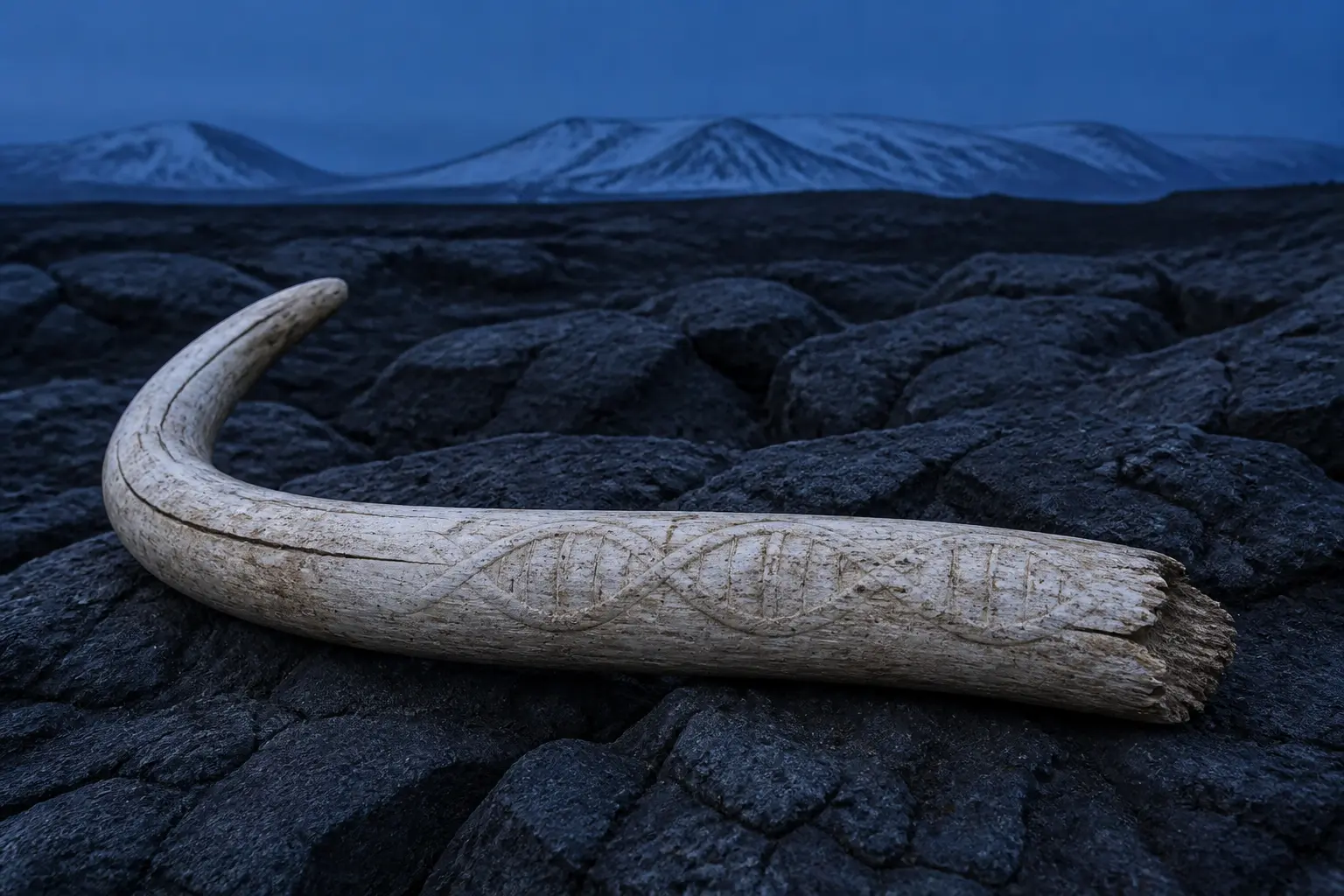
What 50,000 Years of DNA Showed
Lead author Marianne Dehasque and colleagues at the Centre for Palaeogenetics sequenced or re-analysed 21 high-coverage woolly mammoth genomes. Fourteen came from Wrangel Island (dated 9.2 to 4.3 thousand years before present). Seven were older mainland Siberian animals that predated the bottleneck. The full set spans the final 50,000 years of the species.
Genome-wide heterozygosity fell more than 40 percent after isolation, from 0.75 ± 0.013 to 0.43 ± 0.012 heterozygous sites per 1,000 base pairs. The fraction of the genome in runs of homozygosity (FROH) rose fourfold, from about 10 percent to 41.6 percent. Medium and long runs of homozygosity pointed to mating among close relatives right after the split.
| Metric | Mainland (pre-bottleneck) | Wrangel Island |
|---|---|---|
| Genome-wide heterozygosity (per kb) | 0.75 ± 0.013 | 0.43 ± 0.012 |
| FROH (genome fraction) | ~10% | 41.6% ± 2.1% |
| Effective population size (Ne) | larger continuous | bottleneck ~8, then 200-300 |
| Highly deleterious mutations | baseline | gradually purged |
| Mildly deleterious mutations | baseline | slowly accumulated |
After the initial crash the population recovered fast and then held steady. Heterozygosity outside runs of homozygosity stopped falling. Long runs shortened while medium ones rose, consistent with more distant inbreeding in a stable small herd. MHC immune-gene diversity also dropped, by about 49 percent, yet remained higher than the genome average.
High-impact loss-of-function mutations declined over time on the island. Moderate-impact (missense) mutations slowly increased. GERP-based load in conserved regions was lower post-bottleneck than in the older mainland samples. Selection removed the worst alleles when they became homozygous; milder ones drifted upward.
The pattern across the 14 island genomes is consistent rather than chaotic. Diversity fell hard at the split, then levelled. The contrast with the seven pre-bottleneck mainland animals makes the island trajectory legible: a sharp cut, a rebound, and a long plateau.
The Population Was Never Spiralling Toward Collapse
Senior author Love Dalén put the central result bluntly. The team could confidently reject the idea they were doomed simply because the population was small. “This means it was probably just some random event that killed them off, and if that random event hadn’t happened, then we would still have mammoths today.”
We can now confidently reject the idea that the population was simply too small and that they were doomed to go extinct for genetic reasons.
Dalén, an evolutionary geneticist at the Centre for Palaeogenetics (Swedish Museum of Natural History and Stockholm University), spoke after the Cell paper appeared. Dehasque added that the youngest genomes in the set did not look dramatically worse than animals centuries older. No accelerating genomic collapse appears in the final centuries covered by the data.
The Centre for Palaeogenetics research thread that accompanied publication drew hundreds of thousands of views. It stressed the same point: the herd bounced back demographically and genetic diversity stayed fairly level for the remaining 6,000 years. Inbreeding depression and purging both persisted, yet numbers held.
Earlier single-specimen studies had fed the “doomed by inbreeding” story. The new time series, plus simulations, reverse the inference. Demographic recovery happened in decades to a few centuries. Genetic recovery lagged for thousands of years, but the lag did not produce a death spiral.
- Around 10,000 years ago: rising seas isolate Wrangel; effective size crashes to about eight
- Within roughly 20 generations: herd rebounds to an effective size of 200-300
- Next 6,000 years: inbreeding and purging continue, yet demographic stability holds
- Around 4,000 years ago: the population disappears after more than 200 generations on the plateau
A Sudden Event Still Looks Most Likely
If genetics did not push the last mammoths over the edge, what did? The genomes stop short of the final few centuries. Fossils from that closing window have since been collected and await sequencing. Until those data arrive the exact trigger stays open.
What we know
- Population size and inbreeding levels stayed relatively stable for millennia after recovery
- No genomic signature of accelerating decline appears in the youngest samples analysed
- Humans left no clear archaeological trace (hearths, tools, worked bone) on Wrangel at the right time
What remains unconfirmed
- Whether disease, wildfire, extreme weather or another short-term shock delivered the final blow
- Whether genetic load rose sharply in the last 300 years not yet sequenced
- Any contribution from subtle climate shifts on the island itself
Researchers float disease outbreak, a bad run of winters that cut forage, or a large fire as plausible candidates. Any of those could finish a herd already limited in adaptive potential. Genetics may have lowered resilience without being the direct cause. The paper leaves every option on the table.
One side story illustrates how hard the work was. The specimen long nicknamed Lonely Boy, once thought among the very last, proved older after re-dating and full of lab artefacts. The authors detail the Lonely Boy re-dating and contamination fights in a companion piece. Ten years of effort produced the clean time series that finally settled the inbreeding question.
Clean dating mattered because a single mis-aged specimen can tilt an entire narrative. Lonely Boy’s artefacts and revised age removed a false endpoint. The remaining series then showed a plateau where earlier work had assumed a slide.
How Purging and Drift Pulled in Opposite Directions
The island genomes record two processes running at once. Selection stripped out high-impact loss-of-function mutations once those alleles sat in homozygotes. At the same time, milder missense changes drifted upward because their fitness costs were too weak for efficient removal in a herd of a few hundred.
GERP-based load in conserved regions ended lower after the bottleneck than in the older mainland samples. That drop tracks the purge of the worst alleles. The slow rise in moderate-impact mutations tracks the other side of the ledger. Net load did not spiral; it rebalanced.
MHC diversity fell by about 49 percent, harder than the genome-wide average, yet stayed above that average. Immune genes retained more variation than neutral sequence even after the cut. The herd carried scars without sliding into mutational meltdown across the sampled interval.
Long runs of homozygosity shortened after the first generations while medium runs rose. Close inbreeding gave way to more distant relatedness inside a stable small population. The shift matches a herd that had already recovered its numbers and then simply persisted.
Lessons Still Landing for Living Species
The Wrangel mammoths supply a rare multi-millennial natural experiment. Many modern species have crashed, then climbed back in census numbers while still carrying bottleneck scars. Looking only at headcount misses the lag between demographic and genetic recovery.
Dehasque noted that mammoths mirror the fate of many present-day populations. Rebuilding numbers alone is not enough. Long-term genetic monitoring must continue because bottleneck effects can persist for thousands of years. Mildly harmful mutations keep accumulating even after the immediate crisis ends. Highly damaging ones get purged, but the process is slow and fitness costs linger.
- Census recovery can mask ongoing mutation load for hundreds of generations
- Purging of the worst alleles continues long after numbers stabilise
- Immune-gene diversity (MHC) can fall harder than genome-wide averages
- Conservation plans that stop at “enough animals” risk missing delayed genetic costs
The same pattern has been seen in some living bottlenecked taxa such as Channel Island foxes. The mammoth series simply stretches the timeline far enough to make the lag unmistakable.
For managers of rare large mammals, island endemics or any species reduced to dozens of founders, the message is practical. Track genomes across decades, not just population size. Watch for slow rises in mild load and for the persistence of inbreeding depression even when the herd looks demographically healthy.
| Timescale | What recovered | What lagged |
|---|---|---|
| Decades to a few centuries | Effective population size (to 200-300) | Genome-wide heterozygosity |
| Thousands of years | Demographic stability held | Full genetic recovery; mild load still rose |
| More than 200 generations | Numbers stayed level | Inbreeding depression and purging both persisted |
Why a Single Shock Fits the Closing Chapter
Once the time series rules out a genetic death spiral, the remaining explanations cluster around short-term external blows. Disease, a run of hard winters that cut forage, or a large fire each fit a herd that had already lived for millennia at low but steady numbers. Any of those events could finish animals whose adaptive potential was already trimmed.
Humans left no clear archaeological trace on Wrangel at the right time. Hearths, tools and worked bone are absent from the critical window. That absence does not prove people never arrived; it does mean the current record supplies no positive evidence for hunting as the final cause.
The genomes themselves stop at about 4.3 thousand years ago. Remains from the last few centuries have been recovered and await sequencing. Those samples will test whether mild load rose sharply at the close or whether the plateau simply ended when an outside shock arrived. Until then every option stays open, and a sudden event remains the most economical reading of the data in hand.
Frequently Asked Questions
How long did the last woolly mammoths survive after the Ice Age?
The Wrangel Island population became isolated about 10,000 years ago and persisted until roughly 4,000 years ago, a span of about 6,000 years or more than 200 generations after mainland herds had already disappeared.
How small was the founding population on Wrangel Island?
Forward simulations matched to the sharp drop in heterozygosity indicate an effective population size of about eight individuals at isolation, followed by recovery to 200-300 within roughly 20 generations.
Did the mammoths keep accumulating harmful mutations until the end?
Highly deleterious mutations were gradually purged by selection once exposed in homozygotes, while mildly deleterious mutations slowly accumulated; the net load did not spiral into mutational meltdown in the sampled interval.
Does the 2024 study include DNA from the very last centuries?
No. The youngest genome analysed dates to about 4.3 thousand years ago; remains from the final few centuries have been recovered and are slated for future sequencing that may reveal whether load rose sharply at the close.
What does the mammoth case change for modern conservation?
It shows that genetic consequences of a bottleneck can last thousands of years after census numbers recover, so programmes must combine population growth with long-term genomic monitoring rather than treating headcount alone as success.
The last mammoths were scarred but not finished by their own DNA. Something abrupt finished them. That distinction now sits at the centre of both their story and the genetic ledgers we keep for the species still hanging on.

-
 TECH1 year ago
Where Garmin Watches are Made and How They are Assembled
-

 AUTO2 months ago
Tesla’s Roadster Is ‘a Few Weeks Away,’ Says Its Chief Designer
-
 NEWS10 years ago
Samsung Releases Galaxy Note7 TV Ad as Reddit AMA Leaks Specs
-
 NEWS10 years ago
Android 7.0 Nougat Rolls Out To Nexus Devices With New Emoji, Features
-
 FINANCE9 years ago
Cardano Price Surges as ADA Enters the Crypto Top Ten List
-
 NEWS10 years ago
Pre-Order the First Camera Made for Facebook Live Streaming Video
-
 FINANCE1 year ago
Binance Suspends Trading and Withdrawals for a System Upgrade
-
 FINANCE9 years ago
RChain Price Jumps Nearly 150% to a New All-Time High of $2.03