
NEWS
Samsung’s Record Profit Hides a Galaxy Operating Loss
Samsung posted record KRW 171.5T revenue and KRW 89.5T operating profit in Q2 2026, yet its Galaxy unit slipped into the red on soaring memory costs.

Samsung Electronics posted KRW 171.5 trillion in consolidated revenue and KRW 89.5 trillion in operating profit for the second quarter ended June 30, 2026, both all-time quarterly highs. Revenue rose 28% from the prior quarter and roughly doubled year on year. Operating profit jumped more than 1,800% from a year earlier and 56% quarter on quarter.
Earnings per share climbed 52% to KRW 10,849. The numbers matched the company’s early-July guidance and beat most consensus estimates. Almost every won of that profit came from one place.
The scale of the print is hard to overstate. A single quarter delivered profit growth measured in thousands of percent year on year while the top line doubled. That combination is rare even in memory upcycles, and it frames every division result that follows.
Samsung Posts Another All-Time Profit Peak
The Device Solutions division, home to memory, system LSI and foundry, delivered KRW 127.5 trillion in revenue and KRW 89.2 trillion in operating profit. That left the rest of the company near zero on the bottom line.
- Consolidated revenue: KRW 171.5 trillion (+28% QoQ)
- Operating profit: KRW 89.5 trillion (+56% QoQ, ~1,814% YoY)
- Operating margin: 52%, up from 43% in Q1
- Net profit: about KRW 71.6 trillion
- Earnings per share: KRW 10,849 (+52%)
Memory set fresh records for both revenue and operating profit. Server products took a record share of the sales mix. Prices kept rising industry-wide as AI infrastructure spending stayed strong.
The margin step from 43% to 52% in a single quarter shows how fast the mix shift paid off. Server DRAM, enterprise SSDs and HBM carried a heavier weight than in prior periods, and that weight showed up directly in the consolidated operating line.
Shares had already sold off hard after the July 7 preliminary print, dropping as much as 7-10% that day on fears the AI boom was priced in. On the full-results day the stock was little changed to slightly higher after earlier gains.
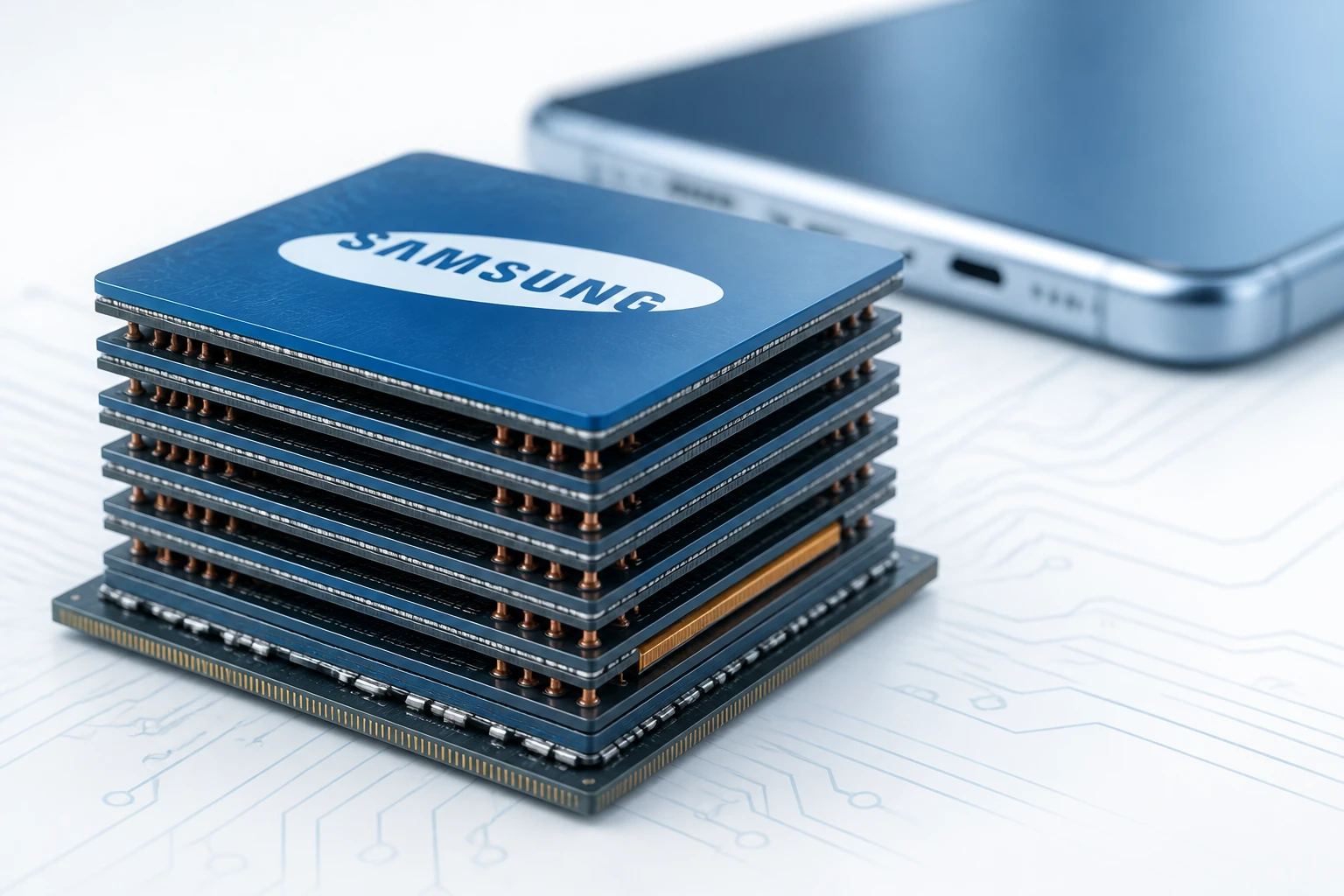
Nearly All the Money Came From One Division
DS revenue rose 56% quarter on quarter. Its operating profit of KRW 89.2 trillion essentially equaled the entire company’s KRW 89.5 trillion. The arithmetic is blunt.
| Division | Revenue (KRW T) | Operating Profit (KRW T) |
|---|---|---|
| Device Solutions (DS) | 127.5 | 89.2 |
| MX + Networks | 33.2 | -0.7 |
| Samsung Display (SDC) | 7.5 | 0.7 |
| VD + DA (CE) | 14.5 | slight loss |
| Total | 171.5 | 89.5 |
DS operating margin sat near 70%. That level matches or approaches the peaks SK hynix has shown in its HBM-heavy mix. Nothing else in Samsung’s portfolio operates in the same range.
The concentration is the quarter’s defining feature. One business line printed the profit; the others absorbed cost or stood still.
Put another way, DS produced more than 70% of group revenue and essentially 100% of group operating profit. MX and Networks, Display, and the consumer electronics pair together contributed the remaining revenue and almost none of the earnings. That imbalance is visible in every row of the division table.
| Metric | Q1 | Q2 | Change |
|---|---|---|---|
| Operating margin | 43% | 52% | +9 pts |
| DS revenue growth | – | +56% QoQ | led group |
| Group revenue growth | – | +28% QoQ | roughly 2x YoY |
Galaxy Phones Turned a Loss on Their Own Chips
The MX and Networks businesses reported KRW 33.2 trillion in revenue and an operating loss of KRW 0.7 trillion. Revenue still grew year on year on solid Galaxy S26 series sales and strong Galaxy A momentum. Elevated component costs erased the gain.
Those components are largely memory. Samsung’s own capacity decisions helped keep DRAM and NAND prices high. Every wafer steered toward high-bandwidth memory removes the equivalent of several conventional DRAM units from the market. Commodity prices stay elevated. Galaxy phones buy that memory as an input.
The mechanism is straightforward. Scarce fab capacity is allocated first to the highest-value products. HBM and server DRAM win that allocation. Mobile DRAM and NAND supply stays tight as a result. Handset bill-of-materials costs rise even when unit sales are healthy. The same company that collects the memory upside pays the handset downside.
The company said it will pursue efficiency initiatives in the second half to blunt the cost pressure. It also plans flagship-first expansion around the new Galaxy Z8 and continued S26 series push, plus AI features and a new Intelligent Eyewear product. An upcoming Galaxy Z foldable pricing push is already part of the mix conversation on the site.
Visual Display and Digital Appliances posted KRW 14.5 trillion in revenue and a slight operating loss. Sporting-event demand helped TVs year on year, but costs rose. Air-conditioner volume lifted DA revenue, yet margins stayed under pressure.
Capacity Went to HBM and Commodity Prices Followed
Memory management focused on server products and high-value items despite limited capacity. Server DRAM, enterprise SSDs and HBM all saw accelerating demand. The market stayed undersupplied even with softer mobile and PC trends.
Samsung scaled HBM4 sales and shipped the industry-first HBM4E samples to major customers. HBM4 targets platforms including Nvidia’s Vera Rubin. The company also highlighted SOCAMM2, DDR5 and PCIe Gen6 / UFS 5.0 traction from the first half.
- HBM4 volume scaled in the commercial mix
- HBM4E samples reached major customers first in the industry
- SOCAMM2, DDR5 and PCIe Gen6 / UFS 5.0 gained first-half traction
- Server DRAM and enterprise SSDs saw accelerating demand
Independent global DRAM and HBM market share data still show SK hynix holding the HBM lead, often above 50%. Samsung has been climbing from a lower base and used its early HBM4 position to regain ground. Conventional DRAM share remains a Samsung strength near the high 30s percent range in recent quarters.
The internal irony is hard to miss. The division that sells the scarcest, highest-margin chips is also the supplier whose product mix decisions raise the bill for the division that builds phones.
That share picture matters for the second-half plan. Samsung wants an HBM position closer to its conventional DRAM standing. Closing that gap while still feeding server and mobile customers is the capacity puzzle management keeps describing.
First HBM4E Samples and Multi-Year Data-Center Deals
Management said it has finalized supply agreements with the top five global data-center customers and is in final talks with five more. Multi-year deals with volume commitments and deposits are becoming the norm as customers lock in AI capacity.
Those structures change the demand signal. Volume commitments and deposits give the supplier clearer visibility than spot orders ever did. They also raise the cost of being short of wafers, which is why the Pyeongtaek build-out and related infrastructure spending matter now rather than later.
Capex rose quarter on quarter for the new Pyeongtaek fab and related infrastructure. R&D hit a quarterly high near KRW 16 trillion. The company expects supply constraints to persist and even tighten into 2027 as AI token generation drives longer-term demand.
The AI infrastructure buildout is still paying its suppliers handsomely, and Samsung expects more to come, pointing to strong memory demand in the second half as agentic AI adds another layer of appetite for its chips.
Josh Gilbert, lead analyst for APAC at eToro, made that assessment after the results. Crowd reaction on X zeroed in on the same tension: record numbers already baked in, mobile losses from the very chip prices driving the boom, and questions about how long the undersupply lasts.
Samsung also said it is not currently reviewing an ADR listing, though it remains one of several longer-term options for shareholder value.
Foundry and Display Held Steady While CE Stalled
Foundry earnings improved before incentive provisions, lifted by HBM base-die demand and strong U.S. customer orders. Design wins expanded, including 2nm HPC work. The unit targets double-digit revenue growth in the second half by ramping second-generation 2nm mobile products and 4nm LPU and base-die volume. Demand is rising across nodes from both U.S. and China customers.
System LSI held revenue steady despite flagship seasonality and soft China mobile demand, helped by high-volume SoCs and image sensors. First-half revenue hit a record. Next-generation flagship SoC orders are in hand.
Samsung Display posted KRW 7.5 trillion revenue and KRW 0.7 trillion operating profit. High-end mobile OLED and gaming-monitor volume helped. The 8.6G IT OLED line is due for mass production to chase tablet, gaming and automotive demand.
Harman improved on automotive and portable audio strength and will lean further into central compute and brand expansion.
Taken together, foundry, System LSI and Display provided stability rather than the explosion seen in memory. They neither dragged the group into deeper red ink nor matched DS margins. That middle path is why the concentration story remains a memory story first.
Undersupply Looks Set to Stretch Into 2027
For the second half, Memory expects robust server demand from continued AI infrastructure spending and broader agentic AI adoption. Server DRAM, eSSDs and HBM growth should accelerate. The market is projected to stay undersupplied even if mobile and PC demand softens further.
Samsung will keep prioritizing high-value products: HBM4, DDR5, SOCAMM2 and next-generation AI platforms. Production increases are under way, yet constraints are expected to continue. The company aims for an HBM share closer to its conventional DRAM position over time by balancing the mix.
- Second half 2026: prioritize HBM4, DDR5, SOCAMM2 and next-generation AI platforms while production ramps
- Into 2027: supply constraints expected to persist and even tighten as AI token generation extends demand
- Over time: lift HBM share toward the conventional DRAM position near the high 30s percent range
MX will push AI experiences and premium mix while chasing efficiency. Networks will chase new orders and cost discipline against telco spending caution. VD will lean on Vision AI TVs, Samsung TV Plus content and advertising. DA will expand AI appliances and channel mix.
The Samsung SK hynix turnover dynamics remain a live thread for anyone watching Korean memory leadership. Both companies just printed historic profits. Both face the same investor question: how much of this is structural AI demand and how much is a classic memory cycle peaking at elevated prices.
Record Numbers Met a Cautious Market Response
The July 7 preliminary figures already told the market most of what the full release confirmed. The stock’s 7-10% drop that day captured a simple fear: that the AI-driven memory boom was fully priced in before the formal results landed.
Full-results day brought a calmer tape, with the shares little changed to slightly higher after earlier gains. That pattern fits a market that had already digested the scale of the beat and moved on to duration questions.
Gilbert’s note and the reaction on X pointed at the same cluster of issues. Record profit is clear. So is the mobile loss tied to the chip prices that created that profit. The open debate is how long undersupply can last once every major supplier is racing to add capacity.
An ADR listing is not under active review. Management still lists it among longer-term options for shareholder value, which keeps the topic alive without promising near-term action.
Both Memory Leaders Face One Cycle Question
Samsung’s near-70% DS operating margin now matches or approaches the peaks SK hynix has shown in its HBM-heavy mix. Historic profits on both sides of the Korean memory pair make the comparison unavoidable.
Share positions still differ. SK hynix often holds above 50% of HBM. Samsung remains stronger in conventional DRAM, near the high 30s percent range in recent quarters, and is using early HBM4 traction to climb from a lower HBM base. The strategic aim is to bring those two share profiles closer together.
Investors watching either name are asking the same thing. Multi-year data-center deals, deposits and volume commitments argue for a structural layer of AI demand that stretches into 2027. Classic memory-cycle history argues that elevated prices eventually pull in enough supply to close the gap. The quarter’s numbers do not settle that argument. They only show which side is winning right now.
For now the numbers are unambiguous. One division carried the entire company to a record. The divisions that sell finished devices paid part of the price in higher input costs and red ink. That split is the real shape of Samsung’s second quarter.

-
 TECH1 year ago
Where Garmin Watches are Made and How They are Assembled
-
 AUTO3 months ago
Tesla’s Roadster Is ‘a Few Weeks Away,’ Says Its Chief Designer
-
 NEWS10 years ago
Samsung Releases Galaxy Note7 TV Ad as Reddit AMA Leaks Specs
-
 NEWS10 years ago
Android 7.0 Nougat Rolls Out To Nexus Devices With New Emoji, Features
-
 FINANCE9 years ago
Cardano Price Surges as ADA Enters the Crypto Top Ten List
-
 NEWS10 years ago
Pre-Order the First Camera Made for Facebook Live Streaming Video
-
 FINANCE1 year ago
Binance Suspends Trading and Withdrawals for a System Upgrade
-
 FINANCE9 years ago
RChain Price Jumps Nearly 150% to a New All-Time High of $2.03