
NEWS
FIFA Charges Argentina Again in Familiar World Cup Pattern
FIFA opens assault cases on Paredes and Molina plus Malvinas banner charges, echoing the same 2014 fine and code minimums that never fully deterred Argentina.

FIFA has opened assault proceedings against Argentina midfielder Leandro Paredes on three counts and defender Nahuel Molina on two after the post-final brawl with Spain, while charging the Argentinian Football Association over the Malvinas banner and wider fan and protocol breaches at the 2026 World Cup.
The cases, announced Wednesday, also name assistant coach Roberto Ayala on one assault count and add unsporting behaviour charges for Molina, Thiago Almada and Spain’s Gavi. Decisions will follow once the respondents present their positions.
The Full List of Opened Cases
FIFA’s Disciplinary Committee opened proceedings against the Argentinian Football Association for potential breaches across four articles of the Disciplinary Code. The individual player and coach cases rest on the prosecutor’s report from the final.
| Party | Charges | Code Articles |
|---|---|---|
| AFA (federation) | Non-sporting demonstrations, team misconduct, discrimination and racist abuse, order and security failures | 13.2c, 14.5, 15, 17 |
| Leandro Paredes | Three counts of assault | 14.1i |
| Nahuel Molina | Two counts of assault (one completed, one attempted) plus one unsporting behaviour | 14.1i, 14.1b |
| Roberto Ayala (assistant coach) | One count of assault | 14.1i |
| Thiago Almada | One unsporting behaviour | 14.1b |
| Gavi (Spain) | One unsporting behaviour | 14.1b |
The federation charges cover discriminatory chants and gestures by fans, late kick-offs, failures to follow match and security protocols, inappropriate messages by the team and spectators, and objects thrown in several Argentina matches. The banner falls under using a sports event for non-sporting demonstrations.
How the Final Whistle Turned Ugly
Spain beat Argentina 1-0 after extra time on July 19 at MetLife Stadium, Ferran Torres scoring the winner. Enzo Fernández had been sent off earlier. As Spanish players and staff flooded the pitch, the scuffles began.
Footage and reports show Molina appearing to strike Spain captain Rodri in the stomach. Paredes grabbed Eric García by the throat, shoved him, then threw Gavi to the ground when the younger midfielder intervened. Ayala was seen in an altercation with Dani Olmo. Almada was also involved in the wider melee.
Referee Slavko Vinčić did not issue a red card on the field for the post-whistle actions. FIFA later confirmed no such card stood. Gavi later said any bad blood should stay in the past and that he did not want punishment for the Argentina players. The prosecutor’s report still recommended the assault and unsporting cases.
The Malvinas Banner That Never Went Away
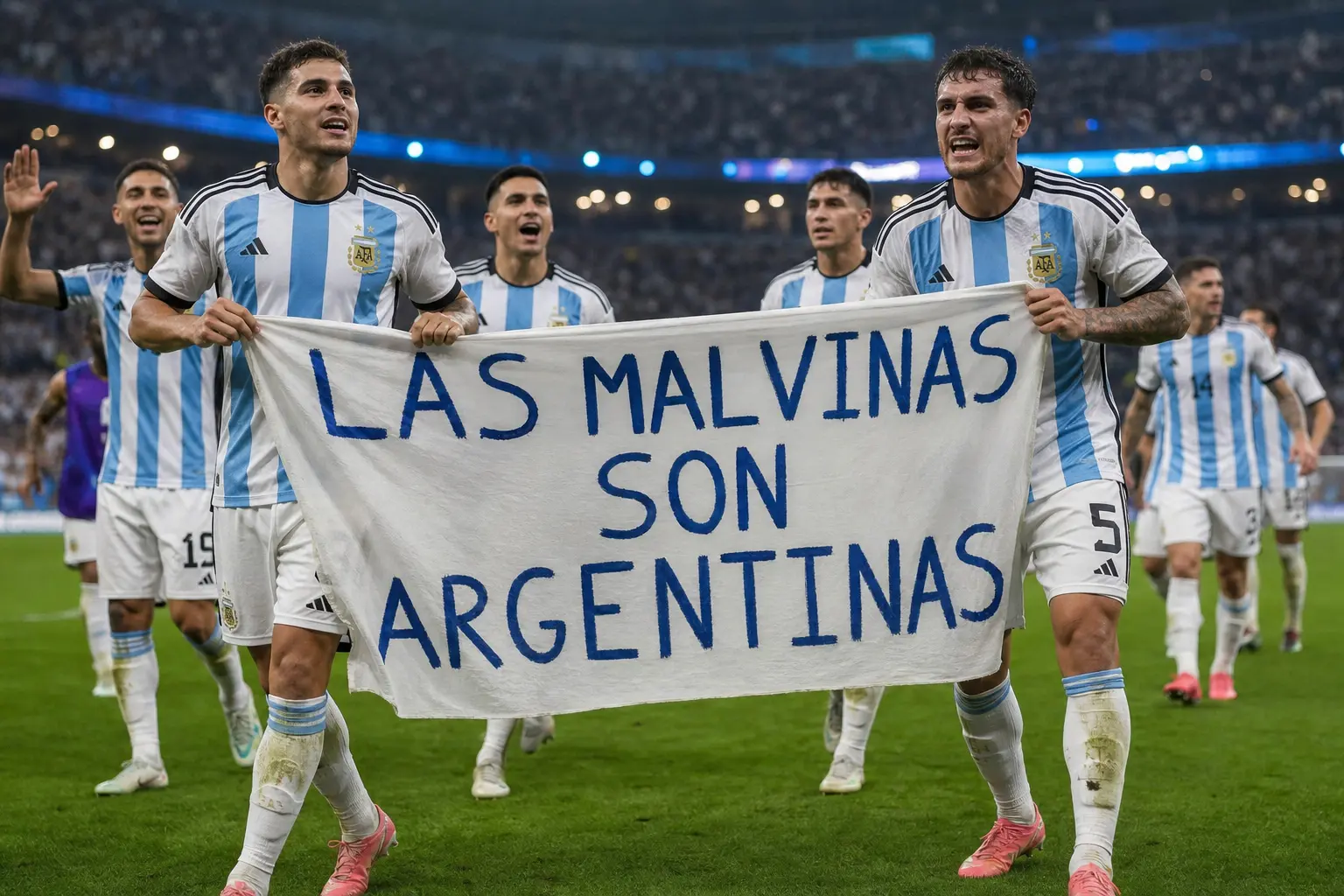
After Argentina’s 2-1 semi-final win over England in Atlanta, players including Giovani Lo Celso and Nicolás Otamendi unfurled a banner reading “Las Malvinas son Argentinas.” Fans had displayed similar messages in the stands. The slogan asserts Argentina’s claim to the Falkland Islands, known as Islas Malvinas in Spanish.
Britain won the 1982 war that followed Argentina’s invasion under its military dictatorship. British officials urged FIFA to act. The White House World Cup task force, via Andrew Giuliani, defended the players’ free-speech right under the First Amendment while the tournament was hosted partly in the United States.
FIFA’s charge is precise: using a sports event for demonstrations of a non-sporting nature. The same banner appeared after a 2014 warm-up win over Slovenia ahead of the Brazil World Cup. FIFA fined the AFA 30,000 Swiss francs then, roughly $37,000 at the time. The pattern is identical twelve years later.
What the Disciplinary Code Sets as Minimums
The September 2025 edition of the FIFA Disciplinary Code leaves little ambiguity on the individual cases. Article 14 covers misconduct of players and officials.
- Assault (elbowing, punching, kicking, biting, spitting at or hitting an opponent or other person): at least three matches for assault or an appropriate period of time.
- Unsporting behaviour toward an opponent or other person: at least one match or an appropriate period.
- Violent conduct: at least three matches.
- Off-field timing does not erase liability; the code applies the same sanctions even when the offence occurs after the whistle or via other means.
Fines sit alongside suspensions. For a FIFA World Cup, annex tables list direct-red-card level fines around CHF 20,000 and team-misconduct add-ons of CHF 15,000 when multiple players are sanctioned from the same match. Political or inappropriate messaging by teams or fans historically draws CHF 5,000 to 20,000 ranges, with increases for repeats. Associations remain jointly liable for player and official fines.
Stats snapshot from the code and priors:
- Minimum assault ban: 3 matches
- 2014 Malvinas fine: CHF 30,000
- Serbia 2022 Kosovo banner: CHF 20,000
- World Cup direct red fine band: CHF 20,000
A football lawyer’s widely shared breakdown on X noted that AFA cases from the 2022 Qatar celebrations and a later Brazil qualifier sit inside the recidivism window, which can aggravate sanctions. Fines alone have not changed the behaviour.
The Same Script, Different Stadium
This is not Argentina’s first turn under the disciplinary light. The 2014 banner fine was published after that tournament. A South Korean player received a two-match ban for a Dokdo territorial banner after the 2012 Olympics bronze-medal match; FIFA called the conduct intolerable. Serbia’s 2022 locker-room Kosovo banner produced a CHF 20,000 fine.
Post-match flashpoints at major finals are rarer but not new. The code’s minimums have stayed consistent: short bans for assault, modest federation fines for messages. Crowd reaction on X after the charges mixed calls for lengthy suspensions with shrugs that “this is just Argentina being Argentina.” One detailed legal thread argued the pattern of escalation from dressing-room excess to a final-pitch brawl at MetLife may finally test whether the committee uses tools beyond the fine schedule.
Argentina’s path to the final itself carried earlier heat, including England’s own exit to Argentina that produced the banner moment. The defending champions left the tournament with the runners-up medal and a fresh case file.
Clubs, Careers and the Federation Bill
Paredes, Molina and Ayala now wait on the committee. Multi-match bans would hit the start of the next club season and any early international windows. Almada’s lighter charge and Gavi’s single unsporting count are lower stakes. The AFA faces the cumulative bill: fines for the banner, chants, objects and protocol failures across multiple matches, plus joint liability for individual penalties.
Strict liability under the code means the federation cannot simply claim it told fans to behave. Object throwing and political messaging by spectators still land on the association. Repeat offences in the same cycle raise the multiplier.
Spain escapes with only Gavi’s case. The winners celebrated cleanly enough that no federation-level charges followed them. That split is the zero-sum edge of the decision: one side absorbs the reckoning, the other does not.
Why the Deterrence Keeps Falling Short
FIFA’s process is methodical. A prosecutor investigates, the committee opens formal proceedings, the parties respond, then a decision issues “in due course.” No timeline was given. The same sequence produced the 2014 fine after the tournament ended and similar outcomes after Qatar’s earlier World Cup controversy cycles.
The code supplies clear floors: three matches for assault, one for unsporting, five-figure francs for messages. It also supplies the ceiling language of “appropriate period” and combined measures that could go further. History shows the floor is the usual landing spot. Argentina’s players and federation have paid those amounts before and returned with the same banner and the same physical response to defeat.
The latest charges therefore close one chapter of the 2026 tournament while reopening an older one. The numbers and articles are new only in their stacking. The pattern is the story that keeps getting charged.

-
 TECH1 year ago
Where Garmin Watches are Made and How They are Assembled
-
 AUTO2 months ago
Tesla’s Roadster Is ‘a Few Weeks Away,’ Says Its Chief Designer
-
 NEWS10 years ago
Samsung Releases Galaxy Note7 TV Ad as Reddit AMA Leaks Specs
-
 NEWS10 years ago
Android 7.0 Nougat Rolls Out To Nexus Devices With New Emoji, Features
-
 FINANCE9 years ago
Cardano Price Surges as ADA Enters the Crypto Top Ten List
-
 NEWS10 years ago
Pre-Order the First Camera Made for Facebook Live Streaming Video
-
 FINANCE1 year ago
Binance Suspends Trading and Withdrawals for a System Upgrade
-
 FINANCE9 years ago
RChain Price Jumps Nearly 150% to a New All-Time High of $2.03