
NEWS
CRPF Chief Owns Troop Decisions as Pellet Probe Tightens
Gyanendra Pratap Singh assures CRPF personnel he will own bona fide actions after RAF pellet use at Delhi NEET protest draws probe and Supreme Court scrutiny.

CRPF Director General Gyanendra Pratap Singh told his force on July 29 that he will take full responsibility for every bona fide decision and action by operational or law-and-order units. The assurance came at the Grand Investiture Ceremony, nine days after Rapid Action Force personnel fired plastic pellets at student protesters marching on Parliament over the NEET paper leak.
The speech lands as an internal assessment, a weapons withdrawal order, and a Supreme Court petition all converge on the same July 20 deployment.
What the Diary and Probe Record from July 20
The Cockroach Janta Party (CJP) called a Sansad Chalo march on July 20, the first day of the monsoon session, demanding the resignation of then Education Minister Dharmendra Pradhan. RAF companies, under Delhi Police operational control, were deployed around Jantar Mantar and Connaught Place.
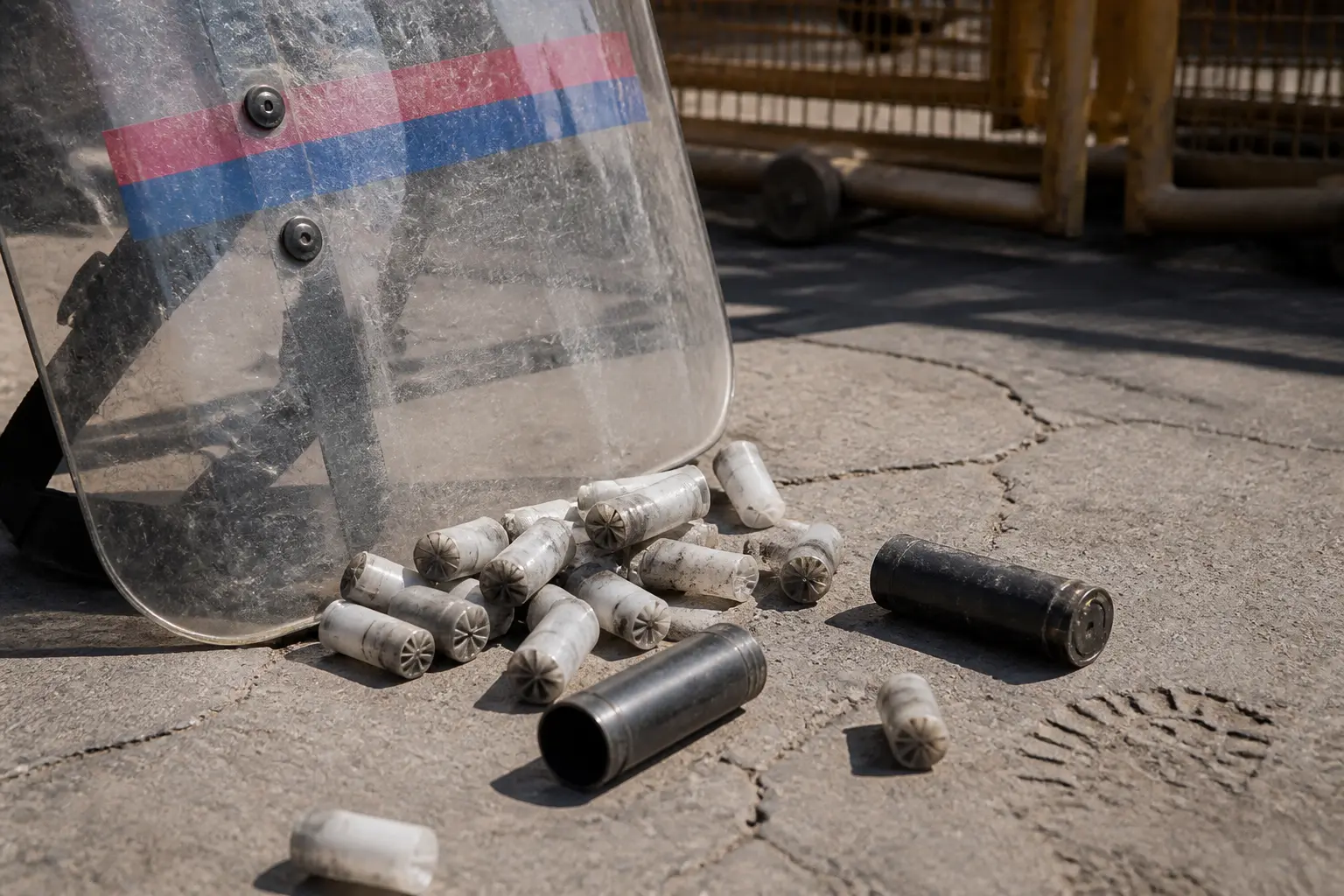
A general diary entry registered by the RAF at Parliament Street police station at 1:24 a.m. on July 22 lists the munitions expended “on the orders of Zone-1, DCP, Jantar Mantar.” Separate reporting from the CRPF inquiry has identified one RAF personnel who fired seven pellet rounds in Connaught Place, five of which struck protesters.
| Source | Pellet detail | Other munitions noted |
|---|---|---|
| RAF general diary | Two rounds ballistic cartridges with plastic pellets from anti-riot gun | 55 non-electrical shells, 15 electrical shells, five tear smoke grenades |
| CRPF inquiry sources | Seven rounds by one personnel; five hits, two ground | Shock batons also used |
| Hospital confirmations | At least three treated for pellet wounds | One case sheet listed 30 pellet sites on a journalist |
Named injured include Sahil Lochab, 19, a Delhi University student whose family says a pellet pierced his pupil and risks vision loss in the right eye; Irshad Sheikh, 25; and a 28-year-old Outlook journalist. Delhi Police initially denied pellet use. The diary and medical records contradict that denial. This was the first recorded use of pellet guns against unarmed protesters in the national capital.
The Investiture Assurance Itself
CRPF Director General G P Singh spoke directly to the ranks. He framed the backing in clear terms.
As the Director General of the CRPF, I want to assure each one of you that whether it is an operational battalion or a law-and-order unit, whatever decisions you take and whatever actions you carry out in the bonafide discharge of your duties, I take responsibility for all those decisions and actions. Continue to perform your duties fearlessly. Wherever responsibility or accountability needs to be taken, I will take it as the Director General.
The video of the full remarks at the investiture ceremony circulated the same day. Days earlier Singh had told ANI that a professional post-event assessment, standard after every major operation, would examine the sequence of events and whether pellet use followed established protocols.
RAF’s Own Inspector General Already Flagged Problems
RAF Inspector General Seema Dhundhia held a video conference with company commanders on July 22. Minutes of that review, accessed by The Hindu, record “serious deficiencies” in the operation and behaviour “contrary to the established work culture and image of RAF.”
- Pump-action guns, anti-riot guns, electric shock weapons and electric shields were ordered withdrawn from personnel deployed at Jantar Mantar until further notice.
- Force was to be used only to the necessary extent, in a judicious, fair, restrained and sensitive manner, after warnings and graded measures.
- Videos of personnel assaulting people already separated from the crowd or without full protective gear were called unjustified.
- All force data, medical records and FIRs must match state police records with 100 percent accuracy.
Dhundhia reiterated that the core principle remains “sensitive policing.” The temporary bar on the heaviest less-lethal kit remains in force for the Delhi deployment.
Supreme Court Enters the Frame
On July 27 former Intelligence Bureau Special Director Yashovardhan Azad, joined by two pellet-injured petitioners, moved the Supreme Court seeking a ban on wholly or partly metallic kinetic projectiles fired from pump-action or projectile-action guns for civilian crowd dispersal. They also sought exemplary compensation and full medical care for July 20 victims.
The petition calls the trajectory of pellets “sporadic and unpredictable” and therefore an unreasonable tool against assemblies. On July 30 the Supreme Court asked the Centre to preserve the ammunition log of the RAF units deployed at Jantar Mantar. The court indicated it is ready to examine the use of pellet guns in exceptional situations and sought the government’s SOPs.
- July 20: CJP march; tear gas, lathi charge and pellet rounds fired.
- July 21-22: Hospital reports and RAF diary surface; IG review and weapon withdrawal.
- July 27: Azad-led petition filed for ban and compensation.
- July 29: DG investiture speech owning all bona fide actions.
- July 30: Supreme Court orders preservation of ammo logs and signals examination of SOPs.
Under the new criminal codes, any prosecution of RAF personnel for voluntarily causing hurt would still require sanction from the CRPF Director General. Singh’s public pledge therefore carries procedural weight beyond morale.
How Large and How Varied the Force Is
The CRPF is India’s largest central armed police force. Official figures list 201 general duty battalions and 16 RAF battalions, plus 10 CoBRA units specialised in jungle and guerrilla warfare, six women battalions and supporting signal and VIP security units.
- Mission focus: crowd management, riot control, anti-Naxal and anti-insurgency operations, election security, VIP protection and disaster relief.
- RAF role: dedicated anti-riot wing trained for rapid deployment under state police control when requisitioned.
- Operating reality: units routinely shift from Left-Wing Extremism theatres and the Northeast to urban law-and-order duties with little margin for error.
The force’s pan-India footprint and frequent collaboration with state police make every high-visibility deployment a test of both tactics and political cover. The Manipur encounter of November 2024, in which CRPF personnel shot dead ten suspected Kuki insurgents after an attack on a village, remains a recent example of contested force that still shapes internal caution.
What Upward Ownership Changes on the Ground
Frontline personnel now hear two simultaneous messages. Their own IG has withdrawn the heaviest kit and demanded stricter graded force. Their DG has declared he will absorb the accountability for any action taken in good faith. On X the speech split opinion immediately. Some users called it cover for firing on students. Others praised it as the first duty of a commander facing political heat.
The practical effect is a shift in the individual risk calculus. A jawan who previously calculated personal prosecution or departmental inquiry now calculates whether headquarters will stand behind the decision. At the same time the Supreme Court has the ammunition logs and the SOPs under review. Any future deployment that escalates to pellets will be measured against both the July 20 diary and the fresh judicial attention.
Singh’s formulation is careful: responsibility attaches only to bona fide discharge of duty. That leaves the post-event assessment free to decide whether the Connaught Place rounds met protocol. The assessment itself is standard CRPF procedure; its findings will determine whether the DG’s shield extends or stops short of the identified personnel.
The Force Still Has to Police Tomorrow’s Crowd
Delhi’s student agitation has been called off. The temporary bar on pump-action and anti-riot guns for the current RAF deployment remains. The professional assessment continues. The Supreme Court has fixed the next steps around logs and SOPs. And the Director General has placed his own name between the ranks and the political and legal fallout.
That is the second-order change the speech produces. Individual hesitation may ease. Institutional exposure has risen. The next time a RAF company faces a stone-throwing crowd or a surging march, both the withheld kit list and the DG’s July 29 words will be present in the decision loop.

-
 TECH1 year ago
Where Garmin Watches are Made and How They are Assembled
-

 AUTO2 months ago
Tesla’s Roadster Is ‘a Few Weeks Away,’ Says Its Chief Designer
-
 NEWS10 years ago
Samsung Releases Galaxy Note7 TV Ad as Reddit AMA Leaks Specs
-
 NEWS10 years ago
Android 7.0 Nougat Rolls Out To Nexus Devices With New Emoji, Features
-
 FINANCE9 years ago
Cardano Price Surges as ADA Enters the Crypto Top Ten List
-
 NEWS10 years ago
Pre-Order the First Camera Made for Facebook Live Streaming Video
-
 FINANCE1 year ago
Binance Suspends Trading and Withdrawals for a System Upgrade
-
 FINANCE9 years ago
RChain Price Jumps Nearly 150% to a New All-Time High of $2.03