
GAMING
Switch 2 June 2026 Games Test Nintendo’s Second-Year Run

Switch 2 June 2026 games start fast and stay busy: Final Fantasy VII Rebirth arrives June 3, to a T follows June 11, Denshattack! hits June 17, The Adventures of Elliot lands June 18, Wanderstop comes June 23, and Star Fox closes the U.S. run on June 25. That gives owners a release every few days, with a Square Enix epic at the front and a Nintendo revival at the end.
The timing matters because Nintendo, the Kyoto-based platform holder, enters the console’s second full year with proof that hardware demand is already there. The harder job now is keeping new owners playing after the launch rush, and June is built to do that through ports, oddball indies, a fresh action role-playing game and one franchise resurrection.
June Becomes Nintendo’s Second-Year Software Test
Nintendo has already cleared the first bar for Switch 2. In Nintendo’s May investor Q&A, Shuntaro Furukawa, Nintendo’s president and representative director, said Switch 2 sales reached 19.86 million units by the end of the fiscal year in March, ahead of both the original 15 million forecast and a later 19 million target.
That number changes how June should be read. A weak month on a small install base can be shrugged off as early-cycle softness. A busy month on nearly 20 million systems starts to look like a stress test for the software habit Nintendo needs in year two.
- 19.86 million Switch 2 systems had sold by the end of Nintendo’s last fiscal year.
- 16.5 million more Switch 2 hardware units are forecast for the current fiscal year.
- 60 million Switch 2 software units are forecast in Nintendo’s financial results presentation.
The six-game run has a useful spread. One title is a giant third-party role-playing port. One is a first-party exclusive. Two are Square Enix releases. Three come from the indie or boutique publishing side. That is the mix a platform holder wants after the launch window: recognizable names for cautious buyers, smaller games for people already using the machine every week, and enough genre variety to avoid one crowded lane.
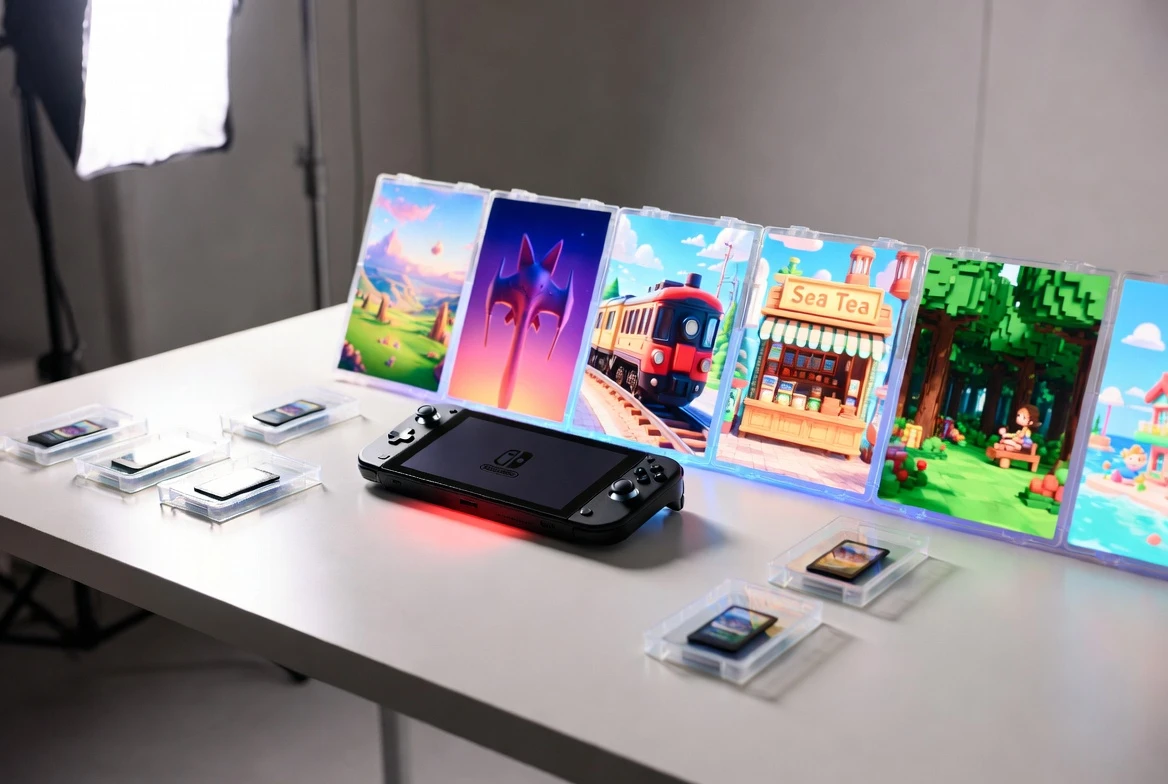
The Six-Game Calendar Gives Every Week a Job
The month works because the releases are spaced like a schedule, not dumped like a sale page. Every week has a different pitch, which matters for players choosing what to buy and for Nintendo’s store, where visibility often gets swallowed when similar games arrive together.
| Game | U.S. Date | Main Backer | The Job in the Month |
|---|---|---|---|
| Final Fantasy VII Rebirth Switch 2 listing | June 3 | Square Enix | Big-budget role-playing anchor and storage test |
| to a T Switch 2 listing | June 11 | Annapurna Interactive, Uvula LLC | Small, strange narrative adventure between bigger releases |
| Denshattack! Switch 2 listing | June 17 | Fireshine Games, Undercoders | Arcade energy and demo-friendly spectacle |
| The Adventures of Elliot official site | June 18 | Square Enix, Claytechworks | New action role-playing property with HD-2D appeal |
| Wanderstop official game page | June 23 | Annapurna Interactive, Ivy Road | Quiet counterprogramming about burnout and tea |
| Star Fox Direct details | June 25 | Nintendo | First-party closer with multiplayer and nostalgia |
U.S. players should note the Star Fox date. Nintendo’s American materials list June 25, while some overseas calendars can show a different local date because regional release timing does not always line up cleanly. For this guide, the U.S. calendar is the useful one.
The Biggest Port Carries the Storage Bill
The practical detail is storage. Nintendo lists Square Enix’s June 3 role-playing port at 102.5 GB, using gigabytes (GB, the download space a game needs before updates). For a digital buyer with several big games already installed, that is the title that forces housekeeping before the month even starts.
There is a clear upside for players who waited out the PlayStation cycle. The Switch 2 version includes the second chapter of the remake trilogy, a free demo, and save-data bonuses tied to Remake Intergrade. That makes the port feel less like a belated catch-up release and more like a planned handoff for people who started Cloud’s story on Nintendo hardware in January.
It also gives June its weight. Without that opener, the month would lean heavily on smaller games until Star Fox. With it, Nintendo gets a heavyweight on the first Wednesday, then lets the calendar breathe before the next three-game cluster. That spacing matters for a 100 GB download. Players need time to install it, sample the demo, clear storage and decide whether the full price belongs in the same month as Nintendo’s own fox flight.
Indies Give the Month Its Weirdness
The middle of the month is where the list becomes more than familiar names. Annapurna Interactive, the publisher behind several narrative-led indies, puts to a T on Switch 2 on June 11. Keita Takahashi, the designer best known for Katamari Damacy, gives the game its immediate hook: a teenager stuck in a T-pose, trying to live in a seaside town with a dog, a mother, bullies and a pile of deliberately odd daily problems.
Denshattack! is the opposite kind of strange. Undercoders, the Barcelona studio behind it, built an arcade trick game around a train that can flip, grind and kickflip through a stylized Japan. The concept reads like a dare, but the Nintendo store listing helps explain why it fits Switch 2: the file size is modest, the demo is available, and the pitch is visible in five seconds.
- to a T gives June a narrative game that can sit beside the bigger role-playing releases without competing on scale.
- Denshattack! gives the eShop a fast demo game, useful for players browsing between longer campaigns.
- Wanderstop gives the month its quietest sell, a cozy game about change from Ivy Road.
Wanderstop carries the heaviest backstory. Ivy Road, the developer behind the game, said in its studio closure update that it would close on March 31 after funding for its next project did not come through. That turns the June 23 Switch release into more than another port. It is a second chance for a game whose subject, burnout, now sits uncomfortably close to the studio’s own ending.
Square Enix Turns Switch 2 Into a Role-Playing Machine
Square Enix, the Japanese publisher that has spent decades defining console role-playing games, owns the most serious third-party lane in June. It opens the month with one known quantity and follows 15 days later with a new property. That is a tight pairing, but the two games solve different problems for Nintendo.
The June 3 release tells lapsed Final Fantasy fans that Switch 2 can handle a modern showcase game. The June 18 release of The Adventures of Elliot tells them the machine also gets new Square Enix work near day one, not only catch-up ports. The latter uses high-definition 2D, or HD-2D, a layered style that mixes pixel characters with 3D staging and lighting. It is the look Square Enix has used to make nostalgia feel premium rather than cheap.
The calendar math is good for Nintendo even if it is tough on wallets. Players who want one giant campaign can start with Cloud. Players who prefer a new setting, a fairy companion and action-based combat can wait two weeks. The shared publisher gives the month a role-playing spine, while the different scale of each game keeps them from feeling interchangeable.
Star Fox Carries the First-Party Handoff
Star Fox is the closer because it gives Nintendo something none of the other five games can provide: a first-party answer to the question of why Switch 2 needed its own June moment. Nintendo describes the game as a cinematic take on Star Fox 64, with a complete visual overhaul, fully voiced dialogue and an orchestral soundtrack. It is also listed as a Switch 2 exclusive.
The online feature set is where the remake gets more interesting. Nintendo’s materials describe 4-vs-4 Battle Mode, online play for up to eight players and GameShare support for select play. GameShare is Nintendo’s system for letting one Switch 2 owner share a compatible game session with other players, while GameChat handles the online social layer for Switch 2 users.
That makes Star Fox a different kind of test from Final Fantasy. The Square Enix opener asks whether Switch 2 can absorb a massive third-party role-playing game. Star Fox asks whether an old Nintendo name can return with enough modern multiplayer structure to feel new. Nostalgia gets attention. Online play decides whether the game is still being talked about after launch weekend.
The first-party handoff lands at the right point. By June 25, players will have seen one blockbuster port, two unusual indies, one action role-playing debut and a bittersweet cozy release. If Star Fox holds attention beyond launch week, June gives Nintendo a clean bridge into July; if it fades quickly, Square Enix and the indie slate will have done most of the work.

-
 TECH1 year ago
Where Garmin Watches are Made and How They are Assembled
-

 AUTO2 months ago
Tesla’s Roadster Is ‘a Few Weeks Away,’ Says Its Chief Designer
-
 NEWS10 years ago
Samsung Releases Galaxy Note7 TV Ad as Reddit AMA Leaks Specs
-
 NEWS10 years ago
Android 7.0 Nougat Rolls Out To Nexus Devices With New Emoji, Features
-
 FINANCE9 years ago
Cardano Price Surges as ADA Enters the Crypto Top Ten List
-
 NEWS10 years ago
Pre-Order the First Camera Made for Facebook Live Streaming Video
-
 FINANCE1 year ago
Binance Suspends Trading and Withdrawals for a System Upgrade
-
 FINANCE9 years ago
RChain Price Jumps Nearly 150% to a New All-Time High of $2.03