
NEWS
Pope Leo AI Encyclical Targets Power Behind the Code

Pope Leo’s AI encyclical the Vatican’s full text of Magnifica Humanitas turns artificial intelligence from a product-policy question into a power question: who controls data, who carries the labor cost, who can appeal an algorithmic decision, and who remains accountable when machines enter war. Signed May 15 and presented May 25, the document reaches beyond chatbots to work, education, democratic truth and lethal force.
The sharper move is historical. Leo places data centers, model training, patents and platforms in the same moral line that earlier popes used for factories, wages and land, then asks whether the people affected by those systems have any say over them.
A Power Document in AI Language
Magnifica Humanitas arrives as Pope Leo XIV’s first encyclical, one of the most authoritative teaching forms in the Catholic Church. Its title means Magnificent Humanity, and the subtitle places the text in the age of artificial intelligence. Yet the document spends much of its force on older questions: dignity, labor, ownership, war, truth and the duties of institutions.
That makes the encyclical more ambitious than a papal warning about a new tool. Leo treats AI as a stress test for Catholic social teaching, the body of doctrine that asks how economies, governments and communities should protect the human person. In the official text, the discussion runs through 245 numbered sections before closing at St. Peter’s.
- 245 numbered sections move from Catholic anthropology to digital power, schools, work, slavery and war.
- 135 years after Rerum Novarum, Leo uses another technological upheaval to restate labor and dignity claims.
- One governing word, disarm, links model development to the moral vocabulary of arms control.
The result gives bishops, Catholic universities, labor groups and policymakers a common reference point. It also gives technology companies a less comfortable audience than investors or users, a church speaking in the language of moral responsibility rather than market adoption.
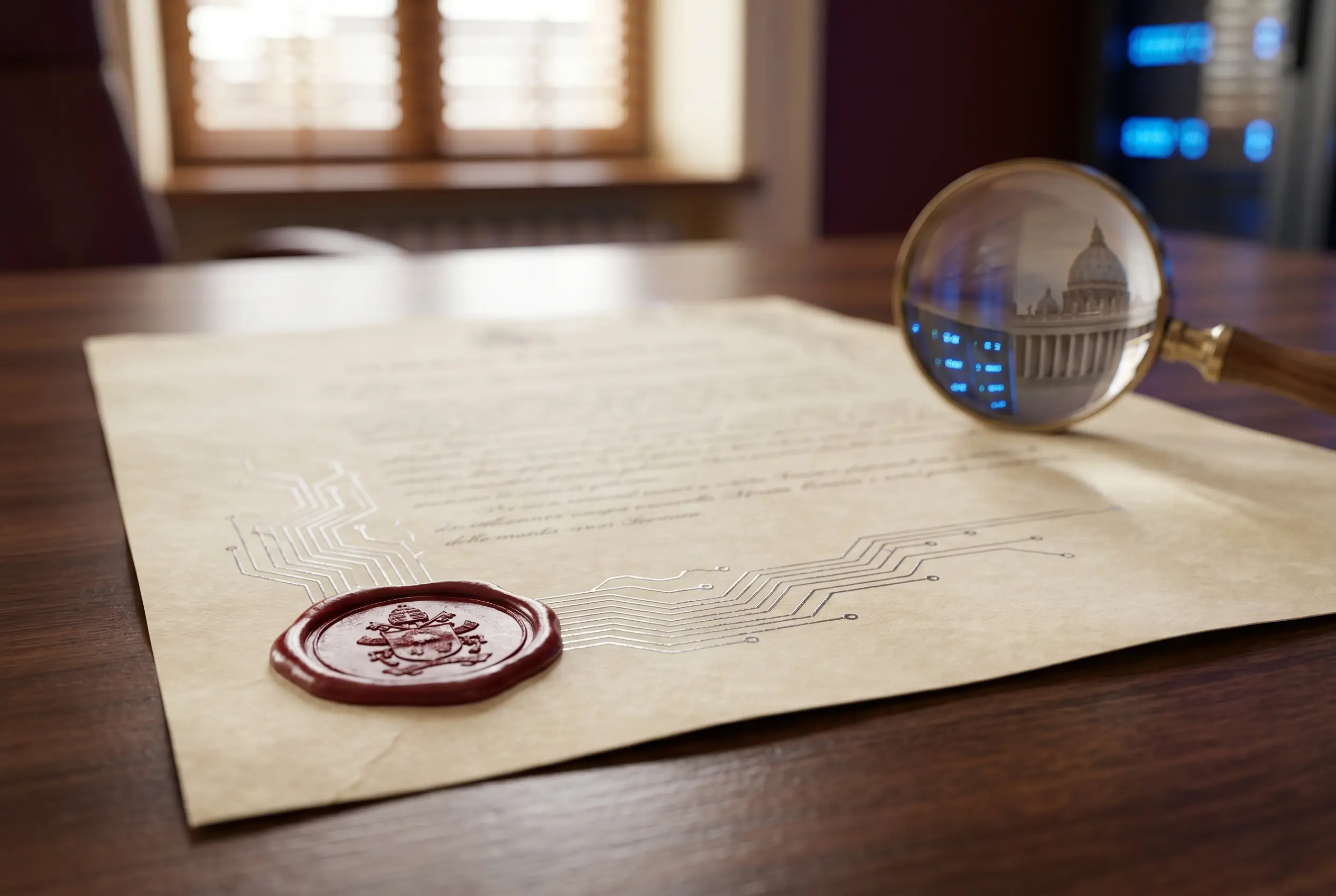
The Line From Factories to Models
The document’s power comes from its lineage. Leo XIII, the industrial-era pope whose name the current pontiff deliberately echoes, wrote Rerum Novarum amid the social crisis of factories, wages and labor organization. Pope Francis, Leo’s immediate predecessor, used Laudato Si to connect ecology with the technocratic mindset. Leo now extends that chain into compute, data and automated judgment.
| Church Document | Year | Technological Pressure | Moral Question |
|---|---|---|---|
| Rerum Novarum | 1891 | Industrial capitalism and factory labor | How capital, workers and the state owe duties to one another |
| Laudato Si | 2015 | Energy, extraction and the technocratic mindset | How development can damage the poor and the common home |
| Magnifica Humanitas | 2026 | AI systems, data, platforms and automated decisions | How digital power can serve people rather than sort, profile or replace them |
That comparison matters because Leo avoids treating AI as a sealed technical field. He writes about systems that imitate functions of human intelligence, then quickly turns to the humans who design, finance, train, regulate and depend on those systems. The owner of a model, in this account, resembles the owner of a factory more than the owner of a clever gadget.
One phrase carries the argument: technology is never neutral. The encyclical says design choices reflect a vision of humanity. That line lands hardest when the technology is used to rank job applicants, assign credit, distribute services, filter public speech or decide who becomes visible.
Disarmament as a Governance Word
Leo made the document’s central verb plain in his Synod Hall address on the encyclical, where he thanked Christopher Olah, Anthropic co-founder and interpretability researcher, for joining the Vatican presentation. The presence of an Anthropic figure was no small stage detail. The church wanted the people building frontier systems in the room.
Artificial intelligence needs to be disarmed.
Pope Leo XIV used that phrase at the Vatican presentation, comparing AI power with other forms of technical power that have required moral discernment and public control. He also said disarmament does not mean rejecting technology. It means freeing AI from a logic of domination, exclusion and death.
That is stronger than the usual public language around AI safety. Much of the policy debate asks whether systems are accurate, explainable or compliant. Leo asks a prior question: what kind of race are governments and companies choosing to run? If competition for commercial and geopolitical advantage drives the whole field, then guardrails become add-ons to a machine pointed in the wrong direction.
His target is not consciousness hype. The text draws a firm distinction between human beings and artificial systems, stressing that machines do not have bodies, relationships, moral conscience or lived experience. The problem, in Leo’s account, comes from people granting those systems authority over other people.
Data, Labor and the Hidden Supply Chain
The most concrete section of the encyclical may be its treatment of the AI economy’s hidden workers. Leo links the polished answer from a model to data labeling, model training, content moderation, energy use, mineral extraction and hardware production. The point will irritate the parts of the industry that prefer to describe AI as clean software.
People converted into inputs are the hidden stakeholder in this document. The encyclical says digital systems can depend on low-paid labor that remains unseen, including workers exposed to disturbing material and communities tied to extraction for devices and microprocessors.
- Data ownership: Leo argues that ownership of data cannot be left only in private hands and should be regulated in light of the common good.
- Appeal and recourse: Automated decisions affecting credit, employment and services require transparency and a path to challenge harm.
- Invisible labor: The document names data labeling, model training and content moderation as forms of work that carry human cost.
- Material infrastructure: It connects AI to energy demand, water use, natural resources, data centers and mining.
This is where the encyclical pushes beyond soft ethics. A company can publish principles and still outsource the damage. A government can praise innovation and still leave workers with no bargaining power. Leo’s answer is old Catholic social doctrine in new clothes: subsidiarity, solidarity, social justice and the universal destination of goods.
The universal destination of goods is especially awkward for a digital economy built around closed models, proprietary data and infrastructure advantages. Leo includes patents, algorithms, digital platforms, technological infrastructure and data among the goods that must be assessed through that older principle.
War Gives the Document Its Hard Edge
The encyclical becomes bluntest when AI enters war. Leo acknowledges self-defense in the strict sense, but he says technological change has altered the moral conditions that once shaped just-war reasoning. Autonomous weapons, cyberattacks, influence operations and automated strategic decisions make violence faster, more remote and easier to justify.
His clearest rule is that lethal or otherwise irreversible decisions must not be entrusted to artificial systems. He insists that a chain of responsibility must remain identifiable, so that blame cannot disappear into the machine. That is a direct answer to the defense industry’s recurring temptation: if targeting becomes more automated, accountability becomes easier to blur.
The teaching also hits political culture. Leo writes about a friend-or-foe mentality, algorithmic amplification and polarizing narratives that condition societies for conflict before weapons are fired. That makes the war section broader than battlefield AI. It includes social platforms, synthetic media, cyber operations and the systems that reward rage because rage holds attention.
For a pope, the position fits a long campaign for peace. For governments investing in autonomous and AI-enabled military tools, it is a rebuke. The document does not provide procurement rules, technical standards or a treaty draft. It does something harder to dismiss: it says speed and efficiency cannot become supreme motives where human life is at stake.
Where the Encyclical Meets the Rulebook
Leo’s text now sits beside a growing stack of official AI frameworks. The European Commission, the EU executive body, has a binding law. The National Institute of Standards and Technology, the U.S. standards agency, has a voluntary risk framework. The OECD, a Paris-based policy forum, has intergovernmental principles. The Vatican brings no fines, but it brings a moral vocabulary that travels through schools, parishes, universities and diplomacy.
| Framework | Legal Force | Core Pressure Point |
|---|---|---|
| the EU Artificial Intelligence Act | Binding EU regulation | Risk categories, general-purpose model duties and fines up to 7% of global annual turnover for banned uses |
| the NIST AI Risk Management Framework | Voluntary U.S. guidance | Trustworthy AI practices for design, development, use and evaluation |
| the OECD AI Principles | Intergovernmental standard | Human rights, democratic values and policy cooperation across jurisdictions |
| the Rome Call for AI Ethics | Voluntary pledge | Transparency, inclusion, social benefit and accountability, first signed by Vatican partners, FAO, Microsoft and IBM |
| Magnifica Humanitas | Authoritative Catholic teaching | Human dignity, labor, peace, data ownership and limits on technical power |
The table shows the unusual place Leo has chosen. He is not writing code for compliance officers. He is setting terms for conscience, and conscience can affect how institutions choose rules before the regulator arrives.
That matters because AI governance is still split between hard law and voluntary norms. The EU law can punish some conduct. NIST can help organizations manage risk. OECD language can guide national policy. Leo’s contribution presses on the moral purpose beneath all three.
The Weakness in Leo’s Intervention
The encyclical names power clearly, but it cannot govern power by itself. The companies building the most capable systems answer to boards, investors, customers and national-security pressure. Governments that fear falling behind in AI will not slow down because Rome asks for restraint. Many non-Catholics will read the text as a moral essay rather than an authority.
That is the built-in limit of papal social teaching. It rarely changes markets at once. Its effect is slower, through institutions that repeat its language until it becomes part of ordinary argument. Rerum Novarum did not settle the labor question in 1891. It gave Catholic workers, unions, schools and political movements a vocabulary for entering the fight.
Leo seems to understand that timetable. The closing image of the document is construction, not conquest. He asks people to build habits, rules and communities that keep human dignity visible when machines make decisions feel inevitable.
If Magnifica Humanitas becomes reference language for bishops, universities, unions, diplomats and lawmakers, it will make AI power harder to discuss as a purely technical race; if it stays a Vatican text praised for a week, the companies and states building the systems will keep setting the clock.

-
 TECH1 year ago
Where Garmin Watches are Made and How They are Assembled
-

 AUTO2 months ago
Tesla’s Roadster Is ‘a Few Weeks Away,’ Says Its Chief Designer
-
 NEWS10 years ago
Samsung Releases Galaxy Note7 TV Ad as Reddit AMA Leaks Specs
-
 NEWS10 years ago
Android 7.0 Nougat Rolls Out To Nexus Devices With New Emoji, Features
-
 FINANCE9 years ago
Cardano Price Surges as ADA Enters the Crypto Top Ten List
-
 NEWS10 years ago
Pre-Order the First Camera Made for Facebook Live Streaming Video
-
 FINANCE1 year ago
Binance Suspends Trading and Withdrawals for a System Upgrade
-
 FINANCE9 years ago
RChain Price Jumps Nearly 150% to a New All-Time High of $2.03