
NEWS
3D Printer Vibration Theft Pushes Patent Law Into the Room

3D printer vibration theft is the practice of using acoustic, vibration, magnetic, or power signals from a printer to infer the toolpath behind a part. It will not become common theft for hobby prints soon, but it is a serious intellectual property risk for labs, defense suppliers, medical device teams, and service bureaus printing high-value designs.
The legal problem is awkward: the design can leak after the file is encrypted, while patent law usually bites only when someone makes, uses, sells, offers to sell, or imports the patented invention. That gap shifts the fight toward trade secret controls, shop-floor security, and contracts that treat the printer’s sounds as protected data.
A Lab Attack With a Factory Lesson
The idea has been around long enough to leave the novelty stage. University of California, Irvine researchers showed in 2016 that printer sound could be processed to recover motion clues from a machine making a key-shaped object. University at Buffalo researchers then pushed the threat model closer to everyday life by using sensors found in a smartphone.
- 89.72% perimeter accuracy for a key in a UCI acoustic side-channel test, according to the UCI acoustic side-channel poster.
- 94% replication accuracy for a simple object at 20 centimeters in a University at Buffalo smartphone study; complex objects stayed above 90%.
- 99% reconstruction accuracy in a power side-channel experiment published through the National Institute of Standards and Technology (NIST, the U.S. standards agency) in NIST’s power leakage paper.
Those figures need a warning label. They came from controlled research, not a crime wave. Still, they prove a narrower point that manufacturers used to ignore: after the print head starts moving, the protected file is no longer the only asset.
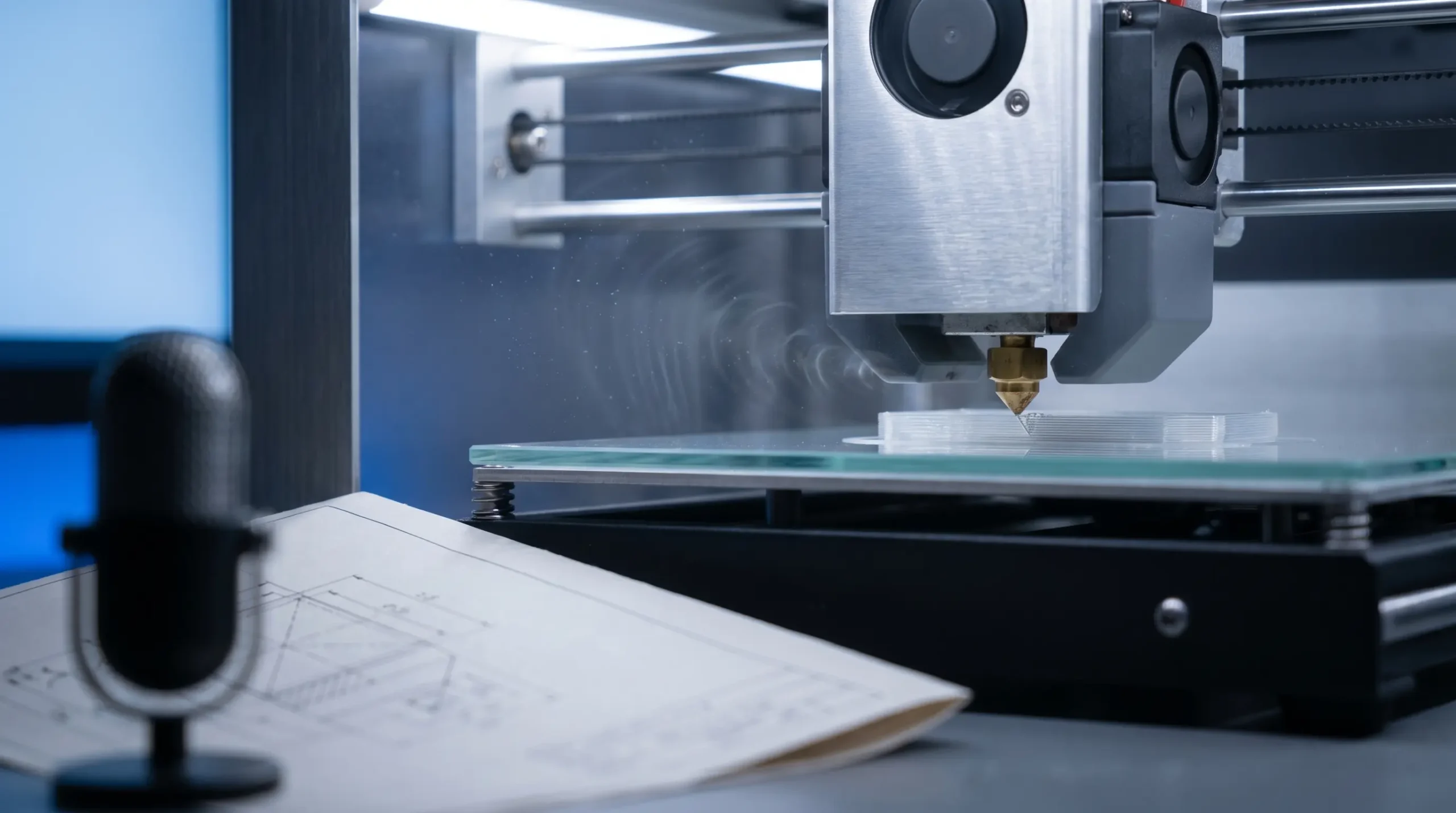
The Leak Starts After the File Is Protected
Fused deposition modeling (FDM, filament-based 3D printing) turns computer-aided design (CAD, the digital model) and stereolithography file format (STL, the common mesh format) into G-code, the machine instructions that drive the nozzle. Encryption can protect the file in transit. It cannot stop a motor from making sound, drawing power, or vibrating the frame.
The side-channel problem is simple in principle. Each change in speed, axis, or direction changes the physical signal around the printer. A trained model can map those changes back to motion, then rebuild enough of the path to approximate the part.
| Signal | Typical Sensor | What It Can Reveal | Main Limitation |
|---|---|---|---|
| Acoustic emissions | Phone microphone or field recorder | Motor movement, direction changes, rhythm | Background noise and room distance |
| Vibration | Accelerometer | Frame motion tied to nozzle travel | Usually needs contact or close placement |
| Magnetic emissions | Phone magnetometer | Stepper motor activity and axis cues | Signal falls quickly with distance |
| Power draw | Inline or nearby power sensor | Toolpath and workload changes | Access to power feed is harder to get |
Recent data makes the issue easier to study. Zenodo, an open research repository, hosts an open 3D printer audio and vibration dataset collected from Bambu Lab P1P and A1 mini printers with an iPhone and a Teensy 4.0 sensor system across 12 designs.
Why Common Practice Still Looks Far Away
For ordinary hobby models, a microphone attack is a clumsy way to steal a file. Public STL libraries, careless cloud sharing, and plain old screenshots are easier. The acoustic route becomes attractive only when the design is valuable, the attacker can get close, and the file itself is unavailable.
The Buffalo paper behind the smartphone study showed how distance hurts the attack. Average Mean Tendency Error (MTE, a geometry similarity measure) rose from 5.87% at 20 centimeters to 34.45% at 40 centimeters in one rectangle test in the CCS smartphone side-channel paper.
- Proximity – the attacker needs a useful position near the machine, not a vague recording from down the hall.
- Training data – printer model, slicer settings, material, speed, and firmware behavior all change the signal.
- Geometry loss – an approximate contour may expose a concept, but it may not be enough to make a production-grade copy.
- Payoff – the effort makes sense for aerospace tooling, implants, keys, jigs, and prototypes, not for a plastic trinket.
That is why common practice is the wrong benchmark. The better question is whether a determined insider or service provider could use the method when the target is worth the trouble.
Outsourcing Makes the Microphone More Dangerous
The risk climbs when the printer sits outside the design owner’s office. Additive manufacturing (AM, industrial 3D printing) often runs through service bureaus, university labs, defense subcontractors, and shared prototyping rooms. Those settings already move sensitive geometry through more hands than a company likes.
NIST warned in additive manufacturing guidance on insufficient encryption that side-channel attacks can bypass file-centered defenses and that AM security needs a risk-based process beyond technical protection measures. That sentence matters because many companies still treat the CAD file as the crown jewel and the print room as ordinary workspace.
The International Organization for Standardization (ISO, the global standards body) is also pushing data protection into AM service platforms. Its product data protection standard for AM service platforms covers data collection, display, transfer, deletion, and responsibilities among parties. Physical emissions belong in that same control map.
Patent Law Catches the Print, Not the Listening
A patent owner does not own every clue that points toward an invention. The U.S. Patent and Trademark Office (USPTO, the federal agency that grants U.S. patents) says patent infringement involves unauthorized making, using, offering for sale, selling, or importing the patented invention, as summarized in its patent infringement basics. So patent law still waits for an infringing act in many cases.
| Protection Tool | What It Protects | Acoustic Theft Problem | Practical Response |
|---|---|---|---|
| Patent | Claimed invention after publication | Listening alone may not be the infringing act | Track copied prints, sales, imports, and use |
| Trade secret | Valuable information kept secret | Leaks can happen without file access | Show secrecy measures reached the print area |
| Contract | Duties between named parties | Generic nondisclosure language may miss signals | Ban recording, sensor placement, and extra prints |
That split creates a proof problem. A company may know its prototype was reconstructed from a print job, yet still need evidence tying the recording to a copied part or to misuse of confidential information.
Trade Secrets Put the Fight at the Door
Trade secret law is a better fit for the listening stage when the design has not been disclosed in a patent. The USPTO’s trade secret policy says a trade secret needs independent economic value from not being generally known, value to others who cannot properly find it, and reasonable efforts to keep it secret.
Federal law also matters. 18 U.S.C. 1839 treats acquisition through "espionage through electronic or other means" as improper means, while excluding reverse engineering and independent derivation in the U.S. Code trade secret definitions. For sensitive printing, reasonable efforts have to include the room, not just the file server.
- Classify CAD, STL, sliced G-code, and side-channel recordings as confidential information in written policies.
- Restrict phones, microphones, and unknown sensor devices during sensitive print jobs.
- Require service bureaus to ban recording, extra prints, and reuse of process data.
- Log printer access, job start times, operator identity, and file hashes for later proof.
- Use shielding, enclosures, distance rules, and randomized non-extrusion moves where print quality allows.
None of this guarantees a lawsuit win. It gives counsel and investigators a record showing that the company treated physical leakage as part of the secret.
Courts Need a New Evidence Habit
Lawmakers do not need to outlaw ordinary printer noise. That would punish owners, repair shops, schools, and makers for a threat that remains technical and target-specific. The better update is narrower: define unauthorized capture of manufacturing side-channel data as a form of improper acquisition when the surrounding facts show secrecy, intent, and commercial value.
Contracts can move faster than statutes. A service bureau agreement can say that audio, video, vibration data, power telemetry, and machine logs generated during a confidential print job belong to the customer or must be deleted after inspection. A clean clause beats a courtroom argument about whether a phone recording was just ambient sound.
If the first public case arrives with a clean recording, a logged print job, and a copied part, courts can fit much of it into existing trade secret doctrine. Lawmakers still owe manufacturers clearer words for the signal.
Frequently Asked Questions
Can a 3D Printer Be Hacked by Sound Alone?
Yes, in controlled research settings, sound can help infer printer motion, but the strongest attacks often combine acoustic data with magnetic, vibration, or power data. Accuracy depends on distance, printer model, background noise, material, print speed, and whether the attacker has training data for that machine.
Is Acoustic Reconstruction the Same as Patent Infringement?
No, acoustic reconstruction by itself is not the usual patent infringement act. U.S. patent infringement normally turns on making, using, selling, offering to sell, or importing the claimed invention, so the copied print or process matters more than the recording alone.
Do Soundproof Enclosures Stop 3D Printer Vibration Theft?
Soundproof enclosures can reduce acoustic leakage, but they do not address magnetic, power, or vibration channels by themselves. Sensitive print rooms need layered controls such as distance, access limits, shielding, background noise management, and contract rules for service bureaus.
Should Designers Patent a 3D Model or Keep It Secret?
Both may be useful, but they protect different things. A patent can protect claimed inventions after publication, while trade secret protection depends on secrecy, economic value, and reasonable efforts to keep the information confidential.
Are STL and G-code Files Trade Secrets?
They can be trade secrets if they are not generally known, have economic value from secrecy, and are protected through reasonable measures. The same file can lose trade secret status if it is posted publicly, shared without controls, or left accessible in an unmanaged print queue.
Will 3D Printer Vibration Theft Become Common?
Common for ordinary home prints is unlikely in the near term because attacks still require proximity, training data, and a valuable target. The higher risk sits in outsourced additive manufacturing, prototype labs, defense suppliers, and medical device shops where one design can justify the effort.
Disclaimer: This article is for informational purposes only and does not provide legal advice. Intellectual property, cybersecurity, and trade secret disputes depend on specific facts and jurisdictions. Consult a qualified attorney or security professional before acting on these issues. Figures and legal references are accurate as of publication.

-
 TECH1 year ago
Where Garmin Watches are Made and How They are Assembled
-

 AUTO2 months ago
Tesla’s Roadster Is ‘a Few Weeks Away,’ Says Its Chief Designer
-
 NEWS10 years ago
Samsung Releases Galaxy Note7 TV Ad as Reddit AMA Leaks Specs
-
 NEWS10 years ago
Android 7.0 Nougat Rolls Out To Nexus Devices With New Emoji, Features
-
 FINANCE9 years ago
Cardano Price Surges as ADA Enters the Crypto Top Ten List
-
 NEWS10 years ago
Pre-Order the First Camera Made for Facebook Live Streaming Video
-
 FINANCE1 year ago
Binance Suspends Trading and Withdrawals for a System Upgrade
-
 FINANCE9 years ago
RChain Price Jumps Nearly 150% to a New All-Time High of $2.03