
GAMING
8BitDo Ultimate 3 Puts Xbox Elite on TMR Notice

The 8BitDo Ultimate 3 Xbox controller pushes Tunneling Magnetoresistance (TMR, a magnetic joystick sensor that avoids contact wear) below Microsoft’s Elite price floor: $99.99 buys TMR sticks, 2.4GHz Xbox wireless, a charging dock, two back buttons, extra shoulder inputs and hall-effect triggers.
The $149.99 3E pushes further with modular ABXY buttons and D-pad swaps. For Xbox players who have waited years for a first-party Elite refresh with magnetic sticks, the sharper question now sits on price: how much can Microsoft still charge for the old feature set?
The $99.99 Controller Puts TMR Under Microsoft’s Price Floor
8BitDo’s Ultimate 3 eShop listing showed a $99.99 price and an Aug. 31, 2026 ship date when checked on June 1, 2026. The official Ultimate 3 specifications list Xbox Series X|S, Xbox One, Windows 10 and 11, Android 13 and Apple compatibility, with Xbox connection through 2.4G wireless or wired USB.
- $99.99 for the standard model, including a charging dock, 2.4G adapter, USB cable and instruction manual.
- $149.99 for the modular 3E, which keeps the same Xbox console compatibility and adds swappable parts.
- 20 hours of claimed play time for the standard model, with 18 hours listed for the 3E.
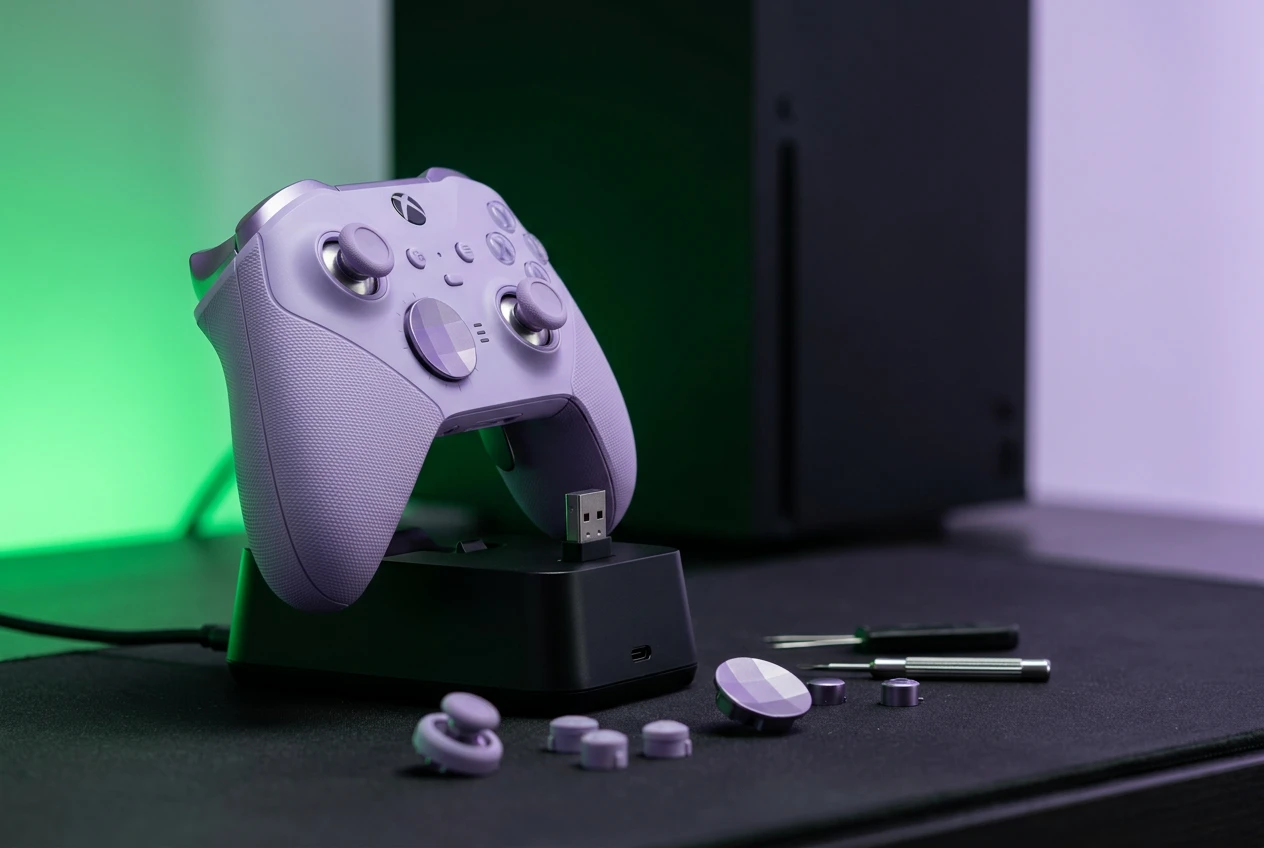
The standard pad’s most important feature is the Force Ring system around the sticks. Players can change thumbstick resistance without opening the controller, while 8BitDo says the TMR sticks are paired with a 12-bit analog-to-digital converter (ADC, the chip that turns stick movement into digital values) and a 216MHz processor. For a controller under $100, that is an aggressive spec sheet.
Ultimate 3E Adds Modular Hardware for the Elite Buyer
The 3E is the version aimed at players who buy premium pads for feel, not only for extra buttons. 8BitDo’s Ultimate 3E product page lists a magnetic faceplate, swappable ABXY modules, two D-pad options, replaceable stick caps, RGB Fire Rings, a custom profile switch and a 1400mAh battery.
That modular layer matters because face buttons split competitive players. Some prefer a soft membrane because it feels familiar and quiet. Others want micro-switch buttons because the actuation feels sharper and the reset is easier to sense during fast inputs. Shipping both modules in one box lets 8BitDo sell feel as a hardware choice rather than a permanent purchase decision.
There is a trade. The standard model gets Force Ring stick-tension control, while the 3E focuses on swappable sticks, D-pads and button modules. Buyers choosing between them are not simply moving from cheap to expensive. They are choosing between tension tuning on the $99.99 pad and physical input swaps on the $149.99 pad.
TMR Sticks Matter, but Firmware Still Decides the Feel
TMR is the attention grabber because stick drift has trained players to distrust expensive controllers. Traditional potentiometer sticks rely on contact between a wiper and a resistive surface. Magnetic sensing removes that rubbing point, which can help with long-term stability. It does not make the rest of the controller immortal.
The resolution mainly depends on the sampling precision of the backend MCU, and is not closely related to the joystick itself.
That caution comes from GuliKit’s TMR joystick technical FAQ, where GuliKit, a controller-parts maker that sells replacement TMR modules, pushes back on the idea that the sensor alone determines resolution. The useful buyer takeaway is simple: **firmware and sampling** decide how good a magnetic stick feels in game.
That makes 8BitDo’s 12-bit ADC claim worth watching in reviews. A great sensor can still feel twitchy if dead zones, response curves or calibration are sloppy. A well-tuned stick can feel stable even when the raw sensor story is less glamorous. The first test should be slow aim and circularity, not a spec-sheet victory lap.
The Elite Series 2 Comparison Turns on What’s in the Box
Microsoft still has strengths that 8BitDo cannot copy cleanly: first-party Xbox Wireless pairing, deep Xbox Accessories app integration and a familiar shape. But Microsoft’s Elite Series 2 Core store page and Elite Series 2 controller page pitch adjustable-tension thumbsticks, component packs and up to 40 hours of battery life. They do not advertise TMR or Hall-effect sticks.
| Controller | Advertised Price | Stick Tech Advertised | Included Pro Inputs | Battery Claim |
|---|---|---|---|---|
| 8BitDo Ultimate 3 | $99.99 | TMR sticks with Force Ring tension tuning | Two back buttons plus L4 and R4 shoulder buttons | 20 hours |
| 8BitDo Ultimate 3E | $149.99 | TMR sticks with swappable caps | Two back buttons, L4 and R4, swappable ABXY and D-pads | 18 hours |
| Xbox Elite Series 2 Core | $149.99 original Microsoft Store price | Adjustable-tension thumbsticks, no magnetic-stick claim in listing | No paddles in the base box; component pack sold separately | Up to 40 hours |
| Xbox Elite Series 2 | $199.99 ERP | Adjustable-tension thumbsticks, no magnetic-stick claim in listing | Paddles, case, dock and interchangeable parts included | Up to 40 hours |
Comfort, latency and quality control still need testing. The feature inversion is visible before a review unit lands. The Core model asks buyers to add parts later. 8BitDo puts the dock, back buttons and magnetic sticks in the cheaper box.
Wireless Licensing Changes the Buying Math
Official Xbox licensing is doing quiet work here. Older third-party Xbox pads often forced a cable on console, while reserving wireless play for Windows or mobile. The Ultimate 3 and 3E listings say Xbox Series and Xbox One users can play through the bundled 2.4G adapter or wired USB, with Bluetooth left for Android and Apple devices.
That distinction matters. These are not first-party pads pairing directly through Microsoft’s own Xbox Wireless button flow. They are **dongle-first wireless** controllers for console play. For most players, that is a minor living-room inconvenience. For anyone short on USB ports, it is part of the purchase decision.
PC players get the wider spec sheet. 8BitDo rates both models for up to 1000Hz polling on PC and lists six-axis motion control outside Xbox console use. Console buyers should not pay for those two lines expecting the Xbox to expose them in the same way.
Software, Privacy and Jurisdiction Set the Ceiling
The companion software is the part buyers should treat with the same seriousness as the hardware. 8BitDo Ultimate Software X handles mapping, sticks, triggers, vibration and firmware. Profiles can be switched on the controller, but deeper setup still runs through software.
Apple’s 8BitDo Ultimate Software App Store listing identifies the developer as SHENZHEN 8BITDO TECH CO., LTD. and says the developer indicates no data is collected from that app. Apple also says that privacy information has not been verified by Apple, which is standard wording on App Store privacy labels.
For a wireless controller, the practical exposure is narrower than a router, phone or cloud camera. Basic play does not require a persistent account, and the device talks to a console, PC or phone through a local controller link. The main risk surface is the software you install for customization and firmware updates.
So the buying call is less dramatic than the usual China-tech argument. Use the app if you want profiles, calibration and firmware support. Skip it if the default layout works for you. Corporate or school devices with strict peripheral rules should treat any companion utility as software first and a game accessory second.
Frequently Asked Questions
Is the 8BitDo Ultimate 3 Better Than the Xbox Elite Core?
It depends on what you value. The 8BitDo model offers TMR sticks, a dock, two back buttons and two extra shoulder buttons for $99.99, while the Elite Core offers first-party Xbox Wireless pairing, up to 40 hours of battery life and Microsoft’s accessory app support at a higher list price.
Does the Ultimate 3E Work Wirelessly on Xbox?
Yes. 8BitDo lists Xbox Series and Xbox One connection through the included 2.4G adapter or wired USB; Bluetooth is for Android and Apple devices, not Xbox consoles.
What Does TMR Mean for Stick Drift?
TMR uses magnetic sensing rather than the rubbing contact point used in traditional potentiometer sticks, so it removes one common cause of drift. It does not guarantee that springs, caps, bumpers or firmware will never need service.
Why Is the Ultimate 3E More Expensive?
The extra $50 buys the modular layer: swappable ABXY modules, a magnetic faceplate, swappable D-pads, extra stick cap shapes, Fire Ring lighting and a larger 1400mAh battery rated for 18 hours.
Should PC Players Buy These for the 1000Hz Polling Rate?
PC players may benefit more than console players because 8BitDo rates 1000Hz polling and six-axis motion control for PC only. Xbox consoles do not support those two features on these controllers, according to 8BitDo’s spec pages.
If the listing-day specs survive real reviews, Microsoft will face the hard version of the Elite question at last: not whether a third-party Xbox controller can look premium, but why the first-party one still ships without magnetic sticks.

-
 TECH1 year ago
Where Garmin Watches are Made and How They are Assembled
-

 AUTO3 months ago
Tesla’s Roadster Is ‘a Few Weeks Away,’ Says Its Chief Designer
-
 NEWS10 years ago
Samsung Releases Galaxy Note7 TV Ad as Reddit AMA Leaks Specs
-
 NEWS10 years ago
Android 7.0 Nougat Rolls Out To Nexus Devices With New Emoji, Features
-
 FINANCE9 years ago
Cardano Price Surges as ADA Enters the Crypto Top Ten List
-
 NEWS10 years ago
Pre-Order the First Camera Made for Facebook Live Streaming Video
-
 FINANCE1 year ago
Binance Suspends Trading and Withdrawals for a System Upgrade
-
 FINANCE9 years ago
RChain Price Jumps Nearly 150% to a New All-Time High of $2.03