
BUSINESS
Tiny DoT Fine Spotlights Vodafone Idea’s Lingering 5G Lag
Vodafone Idea’s ₹26.83 crore liquidated damages notice for 2022 rollout shortfalls is small against its debt mountain yet marks unfinished 5G catch-up with Jio.

Vodafone Idea received a ₹26.83 crore notice from the Department of Telecommunications for alleged shortfalls in minimum network rollout on spectrum won in the 2022 auction. The company told exchanges the demand will not affect its finances or day-to-day operations and that it is reviewing the paper.
The sum is tiny beside the operator’s remaining spectrum and AGR liabilities. Yet the notice arrives years after the country’s first big 5G sale and underlines how far Vi still sits behind Reliance Jio and Bharti Airtel on coverage.
The Notice That Landed on Friday
Vodafone Idea said in a BSE filing that it got the notice on 31 July 2026. DoT seeks payment of liquidated damages amounting to ₹26.83 crore for alleged default in compliance of minimum rollout obligations linked to spectrum allocated under the 2022 auction.
The company is reviewing the notice and evaluating the next steps in this matter.
The filing added that the notice carries no material effect on the financial position and that operations continue unaffected. Shares closed at ₹13 the day before the disclosure, up 1.09 percent, after a month that had already cut more than 10 percent from the price.
The alleged breach sits in the network rollout rules set out in the Notice Inviting Applications that governed the 2022 sale. Those rules kick in once spectrum is assigned.
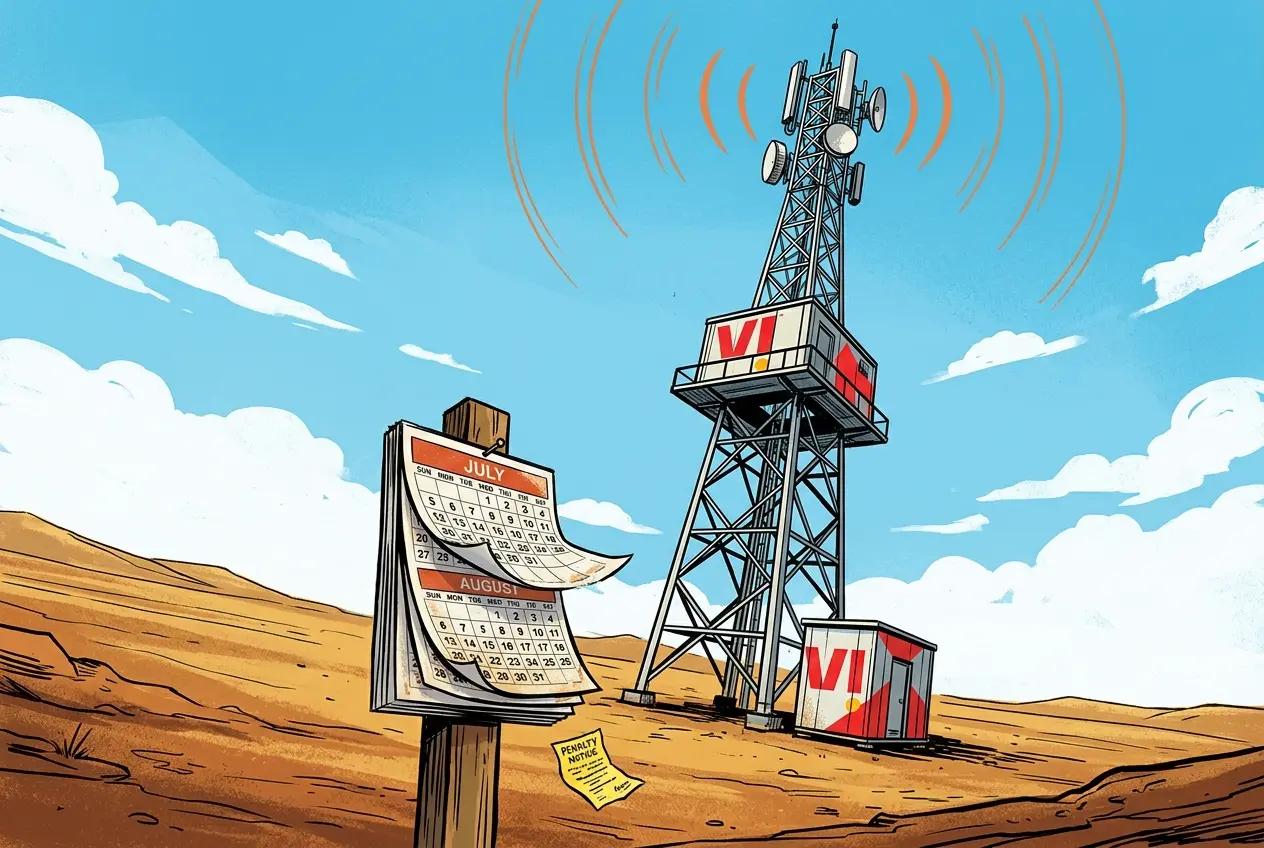
How the Rollout Rules Work
Successful bidders must meet phased coverage targets that differ by band and by circle type. Metro areas face steeper early targets than non-metros. Miss a phase deadline by more than 15 days and liquidated damages begin.
- First 13 weeks of delay: ₹1 lakh per week
- Next 13 weeks: ₹2 lakh per week
- Following 26 weeks: ₹4 lakh per week
- Maximum per phase: ₹1.40 crore
- Delay beyond 52 weeks in a phase can trigger spectrum withdrawal
Those phased coverage targets and liquidated damages were spelled out clearly in the original NIA documents. Later auction papers kept similar structures. A demand of ₹26.83 crore therefore implies shortfalls across multiple phases or circles rather than a single miss.
The same framework appears in subsequent DoT rollout obligations and LD clauses that operators still work under.
What Vodafone Idea Bought in 2022
The 2022 auction was India’s first major 5G sale and the largest spectrum event the country had run. It moved 51.2 GHz across bands from 600 MHz to 26 GHz and raised roughly ₹1.5 lakh crore. Jio spent the most. Airtel followed. Vodafone Idea took a more limited package.
Stats snapshot
- ₹18,799 crore, amount Vi paid for its 2022 holdings
- 17 circles, 3300 MHz mid-band acquired
- 16 circles, 26 GHz mmWave acquired
- ~6,288 MHz, total quantum roughly reported for Vi
Vi also picked up some additional 4G spectrum in three circles. The package was enough on paper for priority markets but far smaller than the pan-India footprints Jio and Airtel secured. The overall 2022 auction total of roughly $19 billion showed the scale of capital the leaders committed.
Earlier Warnings Already Pointed the Same Way
In January 2024 DoT issued show-cause notices to Vodafone Idea and Adani Data Networks over year-one 5G rollout shortfalls. Reports at the time put Vi’s potential exposure near ₹14 crore. Then-CEO Akshaya Moondra had already told investors the company would miss minimum obligations in 15 of the 17 circles where it held the new spectrum.
“Of the 17 circles we have acquired spectrum, for 2 circles we have already filed for compliance. In the remaining circles, as per the NIA there are liquidated damages that are applicable which over a period of 26 weeks is of the order of Rs 12-13 crore,” Moondra said then.
The fresh ₹26.83 crore demand looks like the later bill for continued shortfalls or additional phases. Vi eventually began 5G services, yet the gap with the two larger operators never fully closed.
A Tiny Number Beside a Mountain of Dues
Context turns the notice ironic. Vodafone Idea still carries spectrum payment obligations near ₹1.2 lakh crore. AGR dues were recently frozen around ₹87,695 crore as of end-2025, with a long deferred schedule that keeps near-term cash outflows low. The government converted debt into equity on two occasions and now holds roughly 49 percent, making it the largest shareholder.
| Item | Approximate Scale |
|---|---|
| DoT liquidated-damages notice | ₹26.83 crore |
| Remaining spectrum dues | ~₹1.2 lakh crore |
| Frozen AGR principal and related | ~₹87,695 crore |
| Government equity stake | ~49 percent |
| 2022 spectrum outlay by Vi | ₹18,799 crore |
Bank debt has shrunk, but the statutory mountain remains. Upcoming spectrum instalments rise sharply later this decade. Against that backdrop a ₹26.83 crore demand barely registers on the balance sheet. That is exactly why the company could state with confidence that operations stay unaffected.
Public reaction on X treated the figure more as a punchline about chronic delay than as a fresh crisis. One post dryly called the penalty the result of Vi’s own “IDEA campaign.” The sum itself is small enough that markets largely shrugged.
Jio and Airtel Finished the Race Years Ago
Jio and Airtel launched commercial 5G in October 2022 and pushed rapid national coverage. By early 2024 both had far outpaced Vi. Jio claimed complete rollout; Airtel targeted full coverage soon after. Vi’s funding constraints and selective circle strategy left it playing catch-up in most markets.
The 2024 auction saw Vi spend another ₹3,510 crore mainly to renew expiring 900 MHz and 1800 MHz holdings. Airtel and Jio again took larger or more strategic packages. The pattern holds: Vi buys what it must to stay alive, while the leaders buy to widen the gap.
What the Review Leaves Open
Vi can contest the calculation, seek a hearing, or simply pay. Nothing in the filing suggests an immediate cash crunch. The notice does, however, keep the spotlight on execution risk just as the company works through its deferred-dues schedule and looks for fresh capital.
Government ownership adds a quiet layer. The same DoT that issued the demand is part of the largest shareholder. That dual role has already produced relief packages; it may also produce tighter compliance pressure going forward. For now the operator’s line remains simple: the paper is under review and the network keeps running.
A ₹26.83 crore fine will not break Vodafone Idea. The fact that such a fine is still arriving nearly four years after the spectrum was won says more about unfinished business than about any single invoice.

-
 TECH1 year ago
Where Garmin Watches are Made and How They are Assembled
-

 AUTO2 months ago
Tesla’s Roadster Is ‘a Few Weeks Away,’ Says Its Chief Designer
-
 NEWS10 years ago
Samsung Releases Galaxy Note7 TV Ad as Reddit AMA Leaks Specs
-
 NEWS10 years ago
Android 7.0 Nougat Rolls Out To Nexus Devices With New Emoji, Features
-
 FINANCE9 years ago
Cardano Price Surges as ADA Enters the Crypto Top Ten List
-
 NEWS10 years ago
Pre-Order the First Camera Made for Facebook Live Streaming Video
-
 FINANCE1 year ago
Binance Suspends Trading and Withdrawals for a System Upgrade
-
 FINANCE9 years ago
RChain Price Jumps Nearly 150% to a New All-Time High of $2.03