
NEWS
Creality KliTek Turns Anniversary Into a Market Test

Creality KliTek gives the Shenzhen consumer 3D printing company a sharper anniversary story than a birthday reel. Creality says the nozzle-changing system can switch nozzles in 5 seconds, cut filament use by up to 80% in lab tests, and support multi-color thermoplastic polyurethane, while its new Hong Kong listing makes those claims matter beyond hobby forums.
The timing is the point. The company is moving from affordable printer hardware toward a connected product stack, just as public investors and rivals push consumer 3D printing into a costlier fight over waste, speed, materials, software, and repeat purchases.
The Anniversary Product With a Competitive Edge
For most brands, a 12th birthday would mean discounts, contests, and a retrospective video. Creality used its 12th anniversary to put a hardware answer in front of a problem that owners of multi-color desktop printers know well: purged plastic, waiting time, and fussy filament paths.
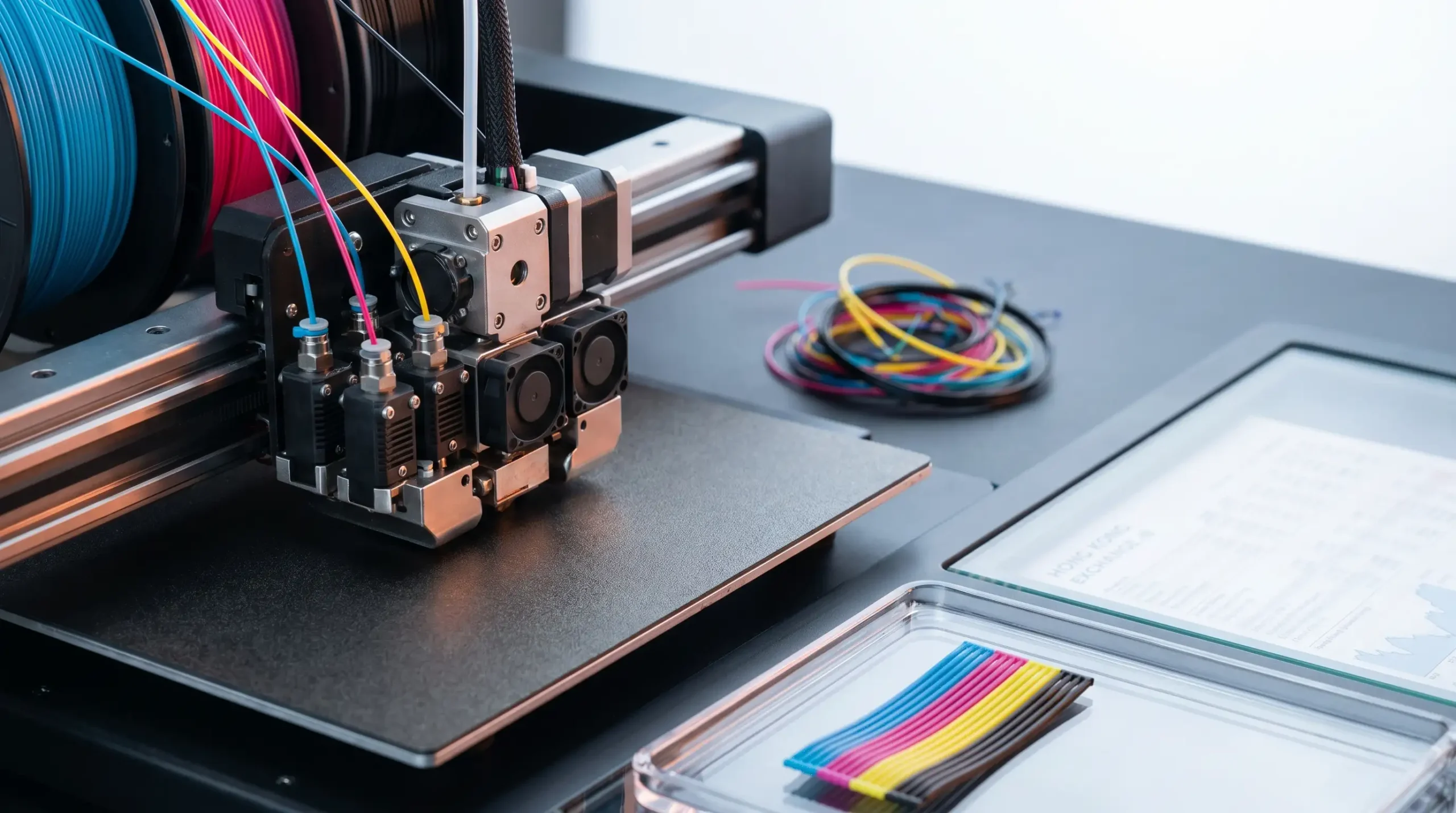
On Creality’s KliTek nozzle-changing page, the company describes a system with multiple filament channels, fast nozzle changes, and a future K3 printer due in the third quarter of 2026. The claim is simple enough for buyers to understand, even if the engineering is not: stop pushing every color through one hot nozzle when a print can move to another prepared path.
That makes the anniversary more than a brand exercise. The company is trying to sell an upgraded version of fused filament fabrication (FFF, a plastic extrusion method used by many desktop printers) at a moment when the easy gains in beds, rails, and speed are harder to market. Multi-material printing gives the next upgrade cycle a clearer reason to exist.
The Nozzle System Targets the Purge Problem
KliTek’s first promise is waste reduction. Creality’s lab example compares 39 grams of filament used by the nozzle system with 278 grams on a single-nozzle printer for the same demonstration print. The company also says color or material switches take less than 15 seconds and nozzle changes take 5 seconds.
- 5 seconds – claimed nozzle-change time on Creality’s official page.
- Up to 80% – claimed reduction in total filament use per print, based on Creality Lab data.
- 15 cubic millimeters per second – claimed flow rate with TPU 95A in Creality’s lab testing.
The thermoplastic polyurethane (TPU, flexible filament used for elastic parts) part of the pitch matters because flexible filament is where many hobby systems leave the comfort zone. Creality says its S-Drive feeding system, radio-frequency identification (RFID, short-range tag reading used to identify filament) and print-optimization algorithms are meant to handle soft TPU down to 80A Shore hardness.
Lab claims still need independent testing. A nozzle changer can move the mess away from the purge chute, but it also adds alignment, heating, wear, and calibration questions. The better comparison will be long prints with supports, many swaps, and filaments that do not share the same temperature window.
The Prospectus Gives the Launch a Harder Yardstick
The listing changes the audience. Shenzhen Creality 3D Technology Co., Ltd. began trading H shares on the Hong Kong Stock Exchange (HKEX, the exchange where Hong Kong-listed shares trade) under stock code 3388 on May 29, 2026, according to the HKEX allotment results.
The offering sold 73,427,550 H shares at HK$18.80 each, raising gross proceeds of HK$1.38 billion before listing expenses. The same announcement said the Hong Kong public tranche drew 251,375 valid applications and was subscribed 3,829.42 times, with 44,336 successful applications.
Those are attention-grabbing numbers, but the prospectus sets up a harder target. In Creality’s Hong Kong prospectus, CIC, the market research firm cited by the company, put global consumer 3D printing gross merchandise value (GMV, retail sales value of goods and services) at US$6.0 billion in 2025 and projected US$27.2 billion by 2030. The same document ranked the company second globally in consumer 3D printer GMV in 2025 with an 11.2% share.
Investors will not judge a product stack by demo parts alone. The prospectus shows revenue rising from RMB1.88 billion in 2023 to RMB3.13 billion in 2025, but it also shows a reported 2025 loss of RMB182.4 million and adjusted net profit of RMB92.4 million. The task is to turn hardware users into repeat buyers of materials, services, scanners, lasers, and digital goods.
The Multi-Material Race Has Split Into Camps
Consumer multi-material printing now has several competing designs, and each one chooses a different compromise. A filament box is simple to understand and easy to sell as an accessory. A toolhead or nozzle changer can reduce purging, but it asks the printer to hold alignment after repeated physical swaps.
| System | Core Method | Capacity Claim | Tradeoff to Watch |
|---|---|---|---|
| Creality nozzle changer | Multiple filament paths with nozzle swaps | 5-second nozzle changes and less than 15-second color or material changes | Independent reviews must test alignment, heating, and wear |
| Bambu Lab’s AMS design note | Automatic Material System feeds multiple spools to one printer path | Up to 16 colors or materials with an AMS hub in the original design note | Bambu’s own note lists purge waste, switching time, TPU limits, and spool limits as cons |
| Prusa’s MMU3 product page | Add-on selects loaded filaments for a single-extruder printer | Up to five filaments at the same time | Single-nozzle systems still need a wipe tower and careful filament handling |
| Snapmaker’s U1 product page | Four separate toolheads swap into the print path | 5-second tool change, four toolheads, 270 mm cube build volume | A toolhead system adds hardware cost and calibration load |
Creality’s narrower claim is also its strategic opening. Multi-color prints are already fun; the next sale depends on making them economical and dull in the best sense. Fewer wasted grams and better flexible-material performance could move the use case toward schools, small studios, and marketplace-scale product makers.
AI Moves From Model Discovery to Print Control
Artificial intelligence (AI, software that automates decisions usually handled by a person) is the softest part of the announcement, but it also connects the hardware pieces. Creality’s May 29 company release describes AI-assisted modeling, intelligent slicing optimization, automated parameter recommendations, and print-risk detection across Creality Cloud, the company’s creator platform.
The company says its reach now covers about 140 countries and regions. At that scale, reducing support friction can be as valuable as adding another printer size. If software can suggest print settings, catch obvious risks, and guide novices through scanning, slicing, and production, the platform becomes a customer-retention tool rather than a download page.
The anniversary bundle also widened the hardware map:
- Creality Cloud received AI-assisted modeling, slicing, parameter, and risk-detection features.
- Falcon T1 was positioned as a multi-function laser platform for engraving, cutting, and precision fabrication.
- Pika AI Scanner and Sermoon P1 Scanner were pitched for portable, high-precision digital capture.
- M1 and R1 Filament Recycling System was presented as a way to recycle waste material and create customized filament.
That spread can look unfocused on paper. It also answers a blunt question from the prospectus: where does growth come from after the first printer sale? The answer has to include consumables, creative tools, software traffic, maybe recycled filament, and new boxes with faster motion systems.
Maintenance Costs Move to the Front
The most useful number on the product page may be neither swap speed nor color range. Creality says a nozzle assembly can be replaced by removing two screws and unplugging a USB-C cable, and compares roughly $14 for that assembly with roughly $67 for a bulkier toolhead replacement. It also says the design can cut replacement cost by up to 4.5 times.
That is where the public-company story and maker story meet. A product that reduces filament waste but raises maintenance anxiety will stall at enthusiasts. A product that users can service cheaply has a better shot at classrooms, print farms, labs, and small businesses that care less about launch-day spectacle than downtime.
A launch page still leaves a gap between promise and durable platform. The company has to ship the K3, get third-party reviewers to push the nozzle system with awkward materials, prove that AI settings reduce failed prints, and show that recycling hardware does more than decorate a sustainability slide. If the third-quarter K3 lands with the reliability Creality is advertising, the company gets a clean public-market story: less waste, broader materials, more repeat revenue. If it lands as another clever mechanism that needs constant tuning, the anniversary will be remembered as the easy part.
Disclaimer: This article is for informational purposes only and does not provide investment advice. Securities and newly listed shares carry market, liquidity, and volatility risk. Consult a qualified financial professional before making investment decisions. Figures cited are accurate as of publication.

-
 TECH1 year ago
Where Garmin Watches are Made and How They are Assembled
-

 AUTO2 months ago
Tesla’s Roadster Is ‘a Few Weeks Away,’ Says Its Chief Designer
-
 NEWS10 years ago
Samsung Releases Galaxy Note7 TV Ad as Reddit AMA Leaks Specs
-
 NEWS10 years ago
Android 7.0 Nougat Rolls Out To Nexus Devices With New Emoji, Features
-
 FINANCE9 years ago
Cardano Price Surges as ADA Enters the Crypto Top Ten List
-
 NEWS10 years ago
Pre-Order the First Camera Made for Facebook Live Streaming Video
-
 FINANCE1 year ago
Binance Suspends Trading and Withdrawals for a System Upgrade
-
 FINANCE9 years ago
RChain Price Jumps Nearly 150% to a New All-Time High of $2.03