
HEALTH
Turkey Hair Transplants Face a Hair Mill Reckoning

Turkey hair transplants became a global medical tourism machine by combining price, case volume, surgeon craft and improvised medical tools. The next test is quality control: official health tourism data show 1,398,580 health visitors in 2025, while surgeons now fight over who performs the operation, how donor hair is measured and whether black market clinics are damaging the brand.
The bargain package drew the world to Istanbul. The defensible business now sits in certification, donor-area math and the few clinics that can prove a physician-led process before a patient wires a deposit.
The Export Business Under the Bandage
The global market explains why the fight has become so fierce. Grand View Research, a market-research firm, estimated the global hair restoration market at USD 7.44 billion in 2024 and forecast USD 18.67 billion by 2030. That includes procedures and therapies beyond Turkish clinics, but it gives the scale of the prize.
- 1,398,580 people visited Turkey for health services in 2025, according to International Health Services Inc. (USHAŞ, the Ministry of Health affiliate that publishes the data).
- USD 3.02 billion in health-tourism revenue was reported for those visits.
- 302,487 people visited for care in the first quarter of 2026, with USD 761.5 million in revenue.
Those are health-tourism totals, not a hair-transplant count. That caveat matters because Turkey does not publish a clean official split for hair restoration. The industry lives inside a larger export story that includes dental care, cosmetic surgery, oncology and thermal treatments, which lets clinics borrow the credibility of the national health brand even when the patient is shopping for a hairline on Instagram.
Three Versions of the Turkish Clinic Model
The phrase Turkey hair transplant hides three very different businesses. A careful patient is not choosing between Turkey and home. He or she is choosing between a medical institution, a surgeon-centered practice and a volume seller that may have more skill in advertising than in donor planning.
| Clinic Model | Main Promise | Clinical Upside | Risk to Check |
|---|---|---|---|
| Hospital-led export clinic | One package for surgery, hotel, transfers and follow-up | Clearer compliance structure and broader medical backup | Whether the named physician handles the critical steps |
| Boutique surgeon practice | Limited cases built around one doctor’s reputation | Better chance of conservative donor planning | Whether assistants are certified and roles are disclosed |
| Volume hair mill | Low price, high graft count and fast booking | Convenience for shoppers who want a fixed package | Technician-led surgery, overharvesting and weak aftercare |
This split explains the argument inside the industry. Turkey’s best operators want to be judged by case experience, surgical design and patient outcomes. The weakest sellers want the customer to compare flight-inclusive prices and before-after galleries. Both benefit from the same international reputation until a bad case goes viral.
Follicular Unit Extraction Turned the Chair Into a Production Line
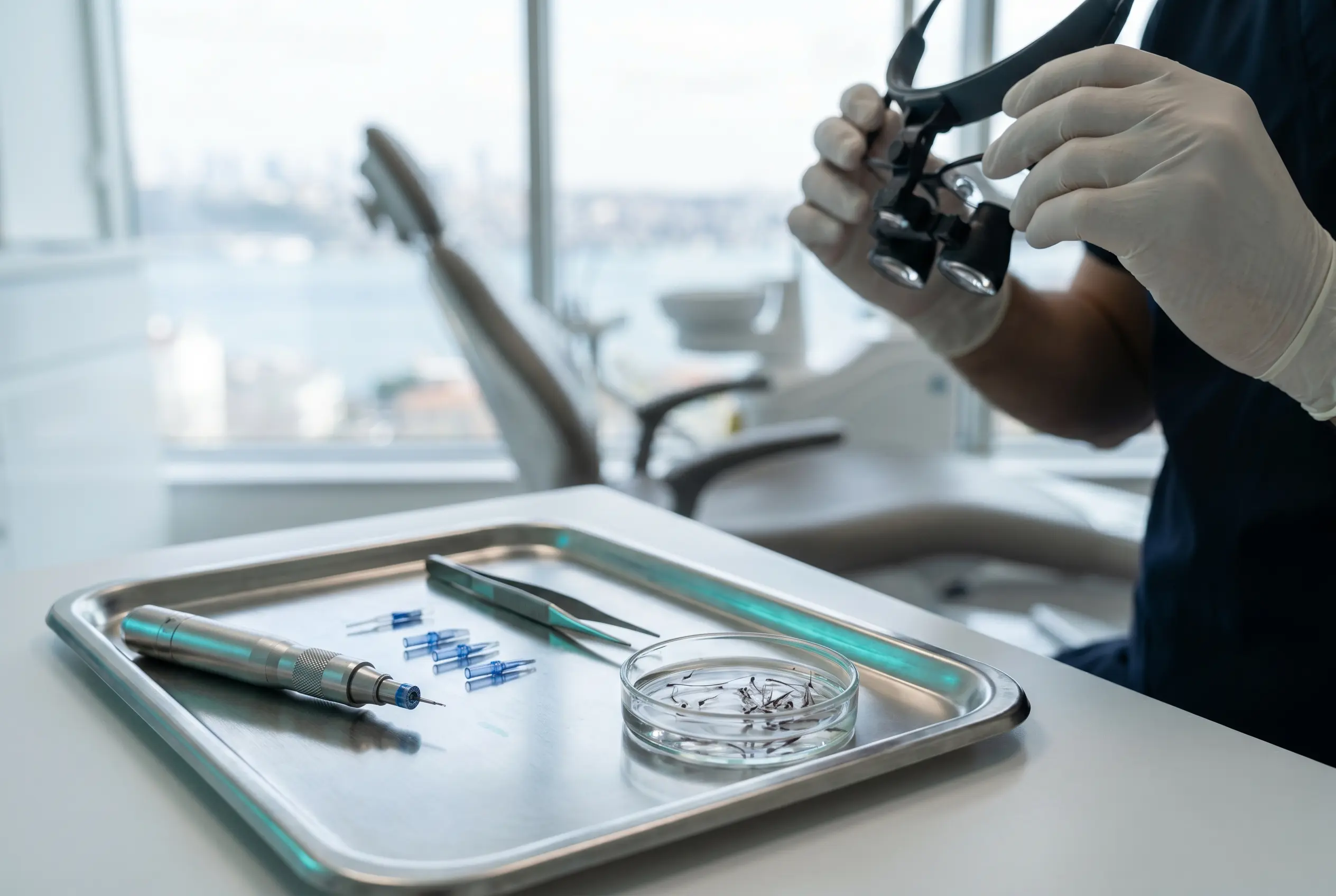
Follicular Unit Extraction (FUE, the one-by-one removal of follicular units from the donor area) changed the economics of the trade. It avoided the linear scar associated with Follicular Unit Transplantation (FUT, the strip-removal method) and made the procedure easier to sell to men who wanted a discreet recovery.
Grand View Research says the FUE segment accounted for 70.29 percent of revenue share in 2023. In Turkey, that shift met a local habit of shop-floor improvisation. Mustafa Er, chief executive of Ertıp Medikal, helped popularize adapted micro-motors for follicle extraction after surgeons found manual punches too slow for demand. Sapphire-tipped blades, borrowed from eye-surgery materials, then entered the channel-making stage because they could cut cleaner openings than steel in many cases.
That equipment story matters because it made volume possible. A procedure that once stretched over days could be compressed into one long sitting. The same compression raised the danger. When speed becomes the sales hook, the transplant chair starts to look less like an operating room and more like a queue-management problem.
The Donor Area Became the Scarce Asset
Every hair transplant has a hard biological budget. The safe supply comes mainly from the back and sides of the scalp, and once those follicles are damaged or removed badly, a later surgeon has little to work with. The donor area is the hard limit. A glossy front hairline can hide the damage for a few months, then the empty patches at the back begin to show.
The International Society of Hair Restoration Surgery (ISHRS, a global physician association for the field) reported in its 2025 practice census on black market clinics that members had a mean of 10 percent repair cases due to previous black market hair transplants, with a median of 5 percent. It also found 59.4 percent of responding members reported black market clinics in their cities.
- A graft count promised from photos alone.
- No named physician in the consultation or consent documents.
- Several surgeries running at the same time under one doctor.
- No clear answer on who extracts follicles and opens channels.
- A clinic that sells density first and discusses medical history later.
The safest clinics tend to sound less exciting in the sales call. They talk about hair caliber, miniaturization, age, medication history, future loss and the possibility that surgery is a poor choice. That caution is not bad service. It is the difference between selling hair today and preserving options for the next decade.
Robots Bring Math to the Donor Area
Artificial intelligence (AI, software trained to find patterns in images and data) now gives Turkey a way to defend its premium clinics against the factory label. The KE-BOT product page from Evstek describes a robotic 360-degree scanning system for 3D scalp modeling, donor-capacity analysis, follicle counting, hair-per-follicle counting and hair-thickness measurement.
Istanbul hair-transplant surgeon Dr. Koray Erdoğan and Dr. Oğuzhan Urhan, a Kocaeli University engineering professor, helped push that style of planning into the Turkish conversation. The aim is simple: replace rough visual estimates with a map of what the scalp can safely give. AI narrows the measurement error, especially in cases where fine hairs, reflection and skin tone make human counting harder.
The machine still cannot decide whether a nervous 24-year-old should wait, use medication first or avoid surgery. It also cannot restore follicles lost to an aggressive first procedure. The useful robot in this market is less a replacement surgeon than a brake pedal on bad arithmetic.
Regulation Is Chasing the Marketing Machine
The Turkish state has noticed the gap between medical export and online salesmanship. The Health Ministry’s hair-transplant unit rule published in the Official Gazette set standards for hair-transplant units in May 2023, with later amendments following that year. The rule sits in the background of every glossy package ad: facilities are supposed to meet physical, staffing, training and inspection requirements.
At the same time, Ankara is still promoting the sector. The Trade Ministry said in a June 2025 health-tourism export announcement that health tourists increased sixfold from 2012 to 2024 and health-service exports rose fourfold to USD 3 billion. It also said the Heal in Türkiye portal listed 221 institutions and that members would receive extra support for some marketing activities.
HealthTürkiye calls itself the official international health gateway for Turkey’s healthcare system and says patients should seek advice from a qualified healthcare professional before medical travel. That creates a useful test for the next phase. If patients use official channels as a filter, the better clinics gain distance from the hair mills. If they use them only as booking engines, the cheapest ad keeps setting the tone.
Frequently Asked Questions
Are Turkey Hair Transplants Safe?
Yes, they can be safe when a licensed physician evaluates the patient, the facility is authorized, and critical surgical steps are not handed to unqualified staff. The risk rises when a clinic sells a fixed graft number before examining donor density, hair caliber and medical history.
How Can I Check a Hair Transplant Clinic in Turkey?
Start with official Turkish health-tourism or Ministry-linked channels, then ask for the named physician, facility license, case volume for the day and written aftercare plan. If the sales agent will not identify who extracts follicles and opens channels, treat that as a red flag.
What Is a Hair Mill?
A hair mill is a volume-driven hair transplant operation that sells low-cost packages and moves many patients through similar surgery plans. The term usually points to weak physician involvement, technician-led work, rushed donor planning and heavy online marketing.
What Is FUE Hair Transplant Surgery?
Follicular Unit Extraction is a method that removes individual follicular units from the donor area and implants them into thinning areas. It avoids the linear strip scar associated with FUT, but it still requires medical planning to protect donor hair.
Does AI Make a Hair Transplant Safer?
AI can help when it measures donor density, hair thickness and extraction patterns more consistently than the naked eye. It does not replace the physician’s decision on whether surgery is appropriate, how conservative the plan should be or how complications are handled.
How Many Grafts Should a Clinic Promise?
No safe graft number can be promised from a single photo. A responsible clinic measures donor density, miniaturization, hair caliber, scalp health, age, medication history and future hair-loss risk before recommending a target.
Disclaimer: This article is for informational purposes only and is not medical advice. Hair transplantation carries surgical, anesthesia, infection, scarring and financial risks. Consult a qualified physician in your jurisdiction before booking treatment, and confirm figures and regulations because they are accurate only as of publication.

-
 TECH1 year ago
Where Garmin Watches are Made and How They are Assembled
-

 AUTO2 months ago
Tesla’s Roadster Is ‘a Few Weeks Away,’ Says Its Chief Designer
-
 NEWS10 years ago
Samsung Releases Galaxy Note7 TV Ad as Reddit AMA Leaks Specs
-
 NEWS10 years ago
Android 7.0 Nougat Rolls Out To Nexus Devices With New Emoji, Features
-
 FINANCE9 years ago
Cardano Price Surges as ADA Enters the Crypto Top Ten List
-
 NEWS10 years ago
Pre-Order the First Camera Made for Facebook Live Streaming Video
-
 FINANCE1 year ago
Binance Suspends Trading and Withdrawals for a System Upgrade
-
 FINANCE9 years ago
RChain Price Jumps Nearly 150% to a New All-Time High of $2.03